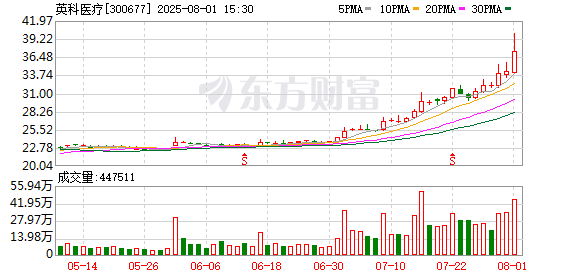
INTCO MEDICAL(300677)

Search documents
英科医疗股价回调2.84% 成交额突破12亿元
Sou Hu Cai Jing· 2025-08-05 19:48
Company Overview - Yingke Medical's main business includes medical protection, rehabilitation care, and health therapy, with key products such as disposable gloves, wheelchairs, and hot/cold packs [1] - The company's products are widely used in medical institutions, elderly care, and food processing industries [1] Stock Performance - On August 5, Yingke Medical's stock price showed a downward trend, closing at 37.70 yuan, down 1.10 yuan from the previous trading day [1] - The stock reached a high of 39.35 yuan and a low of 37.20 yuan during the day, with an overall fluctuation of 5.54% [1] - The trading volume was 313,184 hands, with a total transaction amount of 1.2 billion yuan, resulting in a turnover rate of 6.74% [1] Market Activity - On the morning of August 5, Yingke Medical experienced a rapid decline, with a drop of over 2% within five minutes [1] - By 9:44 AM, the stock price was reported at 38.26 yuan, with a transaction volume of 247 million yuan during that period [1] Capital Flow - On August 5, the net inflow of main funds into Yingke Medical was 9.4672 million yuan, with a cumulative net inflow of 25.6825 million yuan over the past five trading days [2]
医疗器械行业及重点个股更新
2025-08-05 03:16
Summary of Key Points from Medical Device Industry and Companies Industry Overview - The medical device sector has faced challenges due to centralized procurement and anti-corruption measures, leading to concerns about earnings certainty. However, with policy optimization and growth in international business, opportunities are increasing within the sector [1][2] - The medical device index has rebounded by 12% since the beginning of the year, following a period of decline due to significant events and policy factors [2] Company Performance and Outlook - **Mindray Medical**: Experienced revenue and profit pressure due to delayed domestic equipment tenders, but is expected to see a performance turnaround in Q3. The company has significant international growth potential [3][11] - **MicroPort Medical**: Currently has a low valuation, with a projected valuation of only 11 times earnings next year. The company is expected to benefit from the approval of its coronary stent application in the U.S. and potential domestic approval [5] - **Sino Medical**: Recent approval of its intracranial self-expanding drug stent is expected to drive growth, with strong clinical results anticipated to facilitate commercialization [19] - **HuiTai Medical**: In the electrophysiology sector, the company is expected to see rapid growth due to innovative products like PFA ablation catheters, which are anticipated to gain market traction [14][13] Sector-Specific Insights - **High-Value Consumables**: The sector is seeing valuation recovery and improved earnings certainty due to policy optimization. Surgical volumes are expected to grow steadily, with specific segments like electrophysiology and peripheral nerve intervention showing high growth potential [7][8] - **IVD Sector**: The IVD industry is facing challenges from price adjustments in testing services, but companies with strong innovation capabilities and international expansion potential are still expected to grow [9][28] Investment Opportunities - Companies like **Xinmai Medical** and **Nanwei Medical** have shown significant stock price increases, with some companies in the medical device sector experiencing substantial gains [4] - Low-valuation growth potential stocks such as **Chunli Medical** and **Yingke Medical** have seen price increases of up to 60% since Q2 [4][5] - The orthopedic sector is stabilizing, with companies like **Chunli** and **Aikang** showing potential for international market expansion [12] Future Trends - The medical device sector is expected to see a performance turnaround starting in Q3, driven by improved tender data and reduced channel inventory pressure [6][10] - The overall medical industry is projected to face volume and price pressures in the first half of 2025, but improvements are expected in the second half, potentially leading to a growth inflection point by year-end [10] Conclusion - The medical device industry is on the cusp of recovery, with several companies poised for growth due to policy changes and international expansion. Investors are encouraged to focus on undervalued companies with strong growth potential, particularly in high-value consumables and innovative medical technologies [29]



英科医疗获融资买入1.68亿元,近三日累计买入4.64亿元
Sou Hu Cai Jing· 2025-08-05 01:14
8月4日,沪深两融数据显示,英科医疗获融资买入额1.68亿元,居两市第152位,当日融资偿还额1.70亿 元,净卖出147.07万元。 最近三个交易日,31日-4日,英科医疗分别获融资买入1.28亿元、1.68亿元、1.68亿元。 融券方面,当日融券卖出1.59万股,净卖出0.95万股。 来源:金融界 ...
英科医疗: 关于英科转债即将到期暨赎回的第六次提示性公告
Zheng Quan Zhi Xing· 2025-08-04 16:25
Core Points - The company, Yingke Medical Technology Co., Ltd., has issued a convertible bond known as "Yingke Convertible Bond" with a total issuance amount of 470 million yuan [1][2] - The current conversion price for the bond into company stock is set at 3.42 yuan per share [2] - The bond is scheduled to mature on August 15, 2025, and will be redeemed at 128% of the face value, which amounts to 128 yuan per bond, including the last interest payment [2][3] Group 1: Convertible Bond Details - The "Yingke Convertible Bond" was approved by the China Securities Regulatory Commission and began trading on September 10, 2019 [1] - The bond has a face value of 100 yuan per bond, with a total of 4.7 million bonds issued [1] - Trading of the bond was suspended on June 29, 2021, but holders can still convert the bonds into shares until the end of the conversion period [2] Group 2: Redemption and Trading Suspension - The company will announce the bond's maturity and redemption details on the designated information disclosure website [3] - Investors are reminded that the bond will stop trading three days before the end of the conversion period [2]
中证申万新兴健康产业主题投资指数上涨0.36%,前十大权重包含英科医疗等
Sou Hu Cai Jing· 2025-08-04 11:23
金融界8月4日消息,上证指数低开高走,中证申万新兴健康产业主题投资指数 (CSSW健康,930629)上 涨0.36%,报6152.61点,成交额623.86亿元。 从中证申万新兴健康产业主题投资指数持仓样本的行业来看,医药卫生占比91.10%、金融占比4.83%、 信息技术占比3.68%、主要消费占比0.39%。 资料显示,指数样本每季度调整一次,样本调整实施时间分别为每年3月、6月、9月和12月的第二个星 期五的下一交易日。权重因子随样本定期调整而调整,调整时间与指数样本定期调整实施时间相同。在 下一个定期调整日前,权重因子一般固定不变。特殊情况下将对指数进行临时调整。当样本退市时,将 其从指数样本中剔除。样本公司发生收购、合并、分拆等情形的处理,参照计算与维护细则处理。 数据统计显示,中证申万新兴健康产业主题投资指数近一个月上涨8.80%,近三个月上涨15.78%,年至 今上涨16.04%。 来源:金融界 据了解,中证申万新兴健康产业主题投资指数分别从涉及医药健康、医疗健康以及健康服务业务的上市 公司中选取20、30以及50只证券作为样本,以反映新兴健康产业相关上市公司的整体表现。该指数以 2008年1 ...
英科医疗收盘上涨4.08%,滚动市盈率16.08倍,总市值254.01亿元
Sou Hu Cai Jing· 2025-08-04 10:37
Company Overview - Inke Medical's closing price on August 4 was 38.8 yuan, up 4.08%, with a rolling PE ratio of 16.08, marking a new low in 797 days, and a total market capitalization of 25.401 billion yuan [1] - The company specializes in the research, production, and sales of high-performance personal protective products, including disposable nitrile gloves, PVC gloves, PE gloves, isolation gowns, masks, and various medical equipment [1] Financial Performance - For Q1 2025, Inke Medical reported revenue of 2.494 billion yuan, a year-on-year increase of 13.20%, and a net profit of 353 million yuan, up 48.08%, with a gross profit margin of 24.16% [1] Shareholder Information - As of March 31, 2025, Inke Medical had 61,786 shareholders, an increase of 1,641 from the previous count, with an average holding value of 352,800 yuan and an average holding of 27,600 shares per shareholder [1] Industry Comparison - Inke Medical's PE ratio of 16.08 ranks it 34th in the medical device industry, where the average PE ratio is 54.32 and the median is 38.11 [2]
英科医疗股价上涨4.08% 盘中振幅超10%
Sou Hu Cai Jing· 2025-08-04 10:31
风险提示:股市有风险,投资需谨慎。 来源:金融界 从资金流向来看,英科医疗8月4日主力资金净流出1215.11万元,近五个交易日累计净流出3050.90万 元。盘中该股曾出现快速波动,分别在13点35分和13点54分出现超过2%的快速反弹和回调。 英科医疗8月4日收盘报38.80元,较前一交易日上涨1.52元。该股当日开盘价为36.60元,最高触及39.18 元,最低下探35.35元,全天振幅达10.27%。成交量为390511手,成交金额14.41亿元。 英科医疗主营业务涵盖医疗防护、康复护理、保健理疗等领域,主要产品包括一次性手套、轮椅等医疗 耗材。公司产品广泛应用于医疗机构、养老护理等场景。 ...
英科医疗(300677) - 关于英科转债即将到期暨赎回的第六次提示性公告
2025-08-04 08:42
特别提示: 1、"英科转债"到期日:2025 年 8 月 15 日; 本公司及董事会全体成员保证信息披露的内容真实、准确、完整, 没有虚假记载、误导性陈述或重大遗漏。 | 证券代码:300677 | 证券简称:英科医疗 | 公告编号:2025-112 | | --- | --- | --- | | 债券代码:123029 | 债券简称:英科转债 | | 英科医疗科技股份有限公司 关于英科转债即将到期暨赎回的第六次提示性公告 2、"英科转债"到期兑付价格:128 元人民币/张(含最后一期 利息); 3、"英科转债"最后转股日:2025 年 8 月 15 日; 4、"英科转债"最后交易日为 2021 年 6 月 28 日,已于 2021 年 6 月 29 日停止交易。在停止交易后、转股期结束前(即 2021 年 6 月 29 日至 2025 年 8 月 15 日),"英科转债"持有人仍可以依据约定 的条件,将"英科转债"转换为公司股票,目前转股价格为人民币 3.42 元/股; 5、截至 2025 年 8 月 15 日收市后仍未转股的"英科转债"将被 强制赎回;本次赎回完成后,"英科转债"将在深圳证券交易所摘牌。 ...
英科医疗(300677)8月1日主力资金净买入1473.01万元
Sou Hu Cai Jing· 2025-08-04 01:15
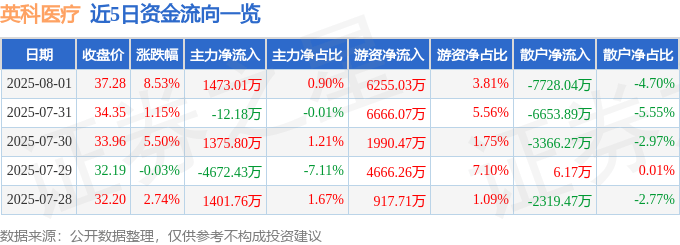
Core Viewpoint - The stock of Yingke Medical (300677) has shown a significant increase, closing at 37.28 yuan on August 1, 2025, with an 8.53% rise, indicating positive market sentiment and potential investment interest [1]. Financial Performance - For Q1 2025, Yingke Medical reported a main business revenue of 2.494 billion yuan, a year-on-year increase of 13.2% - The net profit attributable to shareholders was 353 million yuan, up 48.08% year-on-year - The net profit after deducting non-recurring gains and losses was 247 million yuan, reflecting a 53.22% increase year-on-year - The company's debt ratio stands at 51.61%, with investment income of 24.27 million yuan and financial expenses of -12.18 million yuan - The gross profit margin is reported at 24.16% [5][6]. Market Activity - On August 1, 2025, the net inflow of main funds was 14.73 million yuan, accounting for 0.9% of the total transaction volume - Retail investors experienced a net outflow of 77.28 million yuan, representing 4.7% of the total transaction volume - The stock's trading volume was 447,500 hands, with a total transaction amount of 1.643 billion yuan [1][2]. Financing and Margin Trading - On August 1, 2025, the financing buy-in was 168 million yuan, while financing repayment was 164 million yuan, resulting in a net financing buy-in of 4.58 million yuan - The margin trading balance stood at 712 million yuan, with a short selling of 20,700 shares and a remaining short position of 238,300 shares [2][3]. Industry Comparison - Yingke Medical's total market capitalization is 24.406 billion yuan, significantly higher than the industry average of 11.474 billion yuan, ranking 8th out of 122 in the medical device industry - The company's net assets are 18.042 billion yuan, ranking 4th in the industry - The price-to-earnings ratio (P/E) is 17.3, which is lower than the industry average of 61.54, ranking 9th in the industry - The gross profit margin of 24.16% is below the industry average of 51.09%, ranking 112th [5][6].

英科医疗:累计回购公司股份2703400股
Zheng Quan Ri Bao· 2025-08-01 13:39
(文章来源:证券日报) 证券日报网讯 8月1日晚间,英科医疗发布公告称,截至2025年7月31日,公司通过股份回购专用证券账 户以集中竞价交易方式已累计回购公司股份2,703,400股,占公司总股本的0.4129%。 ...