YKA(300999)
Search documents
亲历金龙鱼子公司案“庭审马拉松” 见证超18亿元退赔责任背后的复杂攻防
Mei Ri Jing Ji Xin Wen· 2025-11-25 14:29
Core Viewpoint - The case involving the subsidiary of Golden Dragon Fish (300999) has drawn significant market attention due to its implications of fraud, with the subsidiary being ordered to compensate for substantial losses totaling 18.81 billion yuan [1][2][12]. Group 1: Case Background - The lawsuit involves three parties: Golden Dragon Fish's subsidiary Guangzhou Yihai, Yunnan Huijia Import and Export Co., and Anhui Huawen International Trade Co. The case stems from a financing trade arrangement where Guangzhou Yihai acted as a storage intermediary [2][3]. - The fraud allegations date back to 2008-2014, involving bribery and manipulation of trade agreements, leading to significant economic losses for the involved parties [3][12]. Group 2: Court Proceedings - The first trial took place from February 27 to March 1, 2024, focusing on the prosecution's evidence and the defense's counterarguments [3][4]. - The second trial on July 3 and 4, 2024, was marked by intense debates over the validity of the audit report, which was crucial in determining the subsidiary's involvement in the alleged fraud [5][6]. Group 3: Key Legal Arguments - The defense argued that the audit report contained inaccuracies and inconsistencies, questioning the qualifications of the auditors involved [6][7]. - The prosecution maintained that the audit report was valid and reflected market trends, asserting that the subsidiary's actions constituted complicity in the fraud [7][10]. Group 4: Verdict and Reactions - The first-instance verdict found Guangzhou Yihai guilty as an accomplice in contract fraud, ordering it to share the compensation responsibility of 18.81 billion yuan with Yunnan Huijia [12][13]. - Following the verdict, Guangzhou Yihai announced its intention to appeal, claiming it was unaware of any fraudulent activities and asserting that it was misled by other parties [12][13]. Group 5: Future Considerations - The upcoming appeal is expected to focus on four main issues: subjective intent, the nature of the actions taken by employees, causation of losses, and the classification of the case as a civil dispute or criminal fraud [14].
金龙鱼子公司一审被判合同诈骗罪|ESG热搜榜
2 1 Shi Ji Jing Ji Bao Dao· 2025-11-25 11:15
Group 1: ESG Ratings and Trends - In 2024, 26% of Chinese companies saw their MSCI ESG ratings upgraded, marking a historical high, with the upgrade ratio significantly exceeding the downgrade ratio [1] - Over the past five years, the MSCI ESG ratings of A-share listed companies in China have shown a steady improvement and a notable increase in the proportion of leading companies [1] - The proportion of companies in the MSCI China A-share index with upgraded ESG ratings reached 36.8%, with the number of companies rated as globally leading (AA and above) doubling from 7.2% to 14% [1] Group 2: ESG Committees and Guidelines - Ten A-share listed companies, including Zejing Pharmaceutical and Lianang Micro, have released ESG committee guidelines [2] - Some companies, such as Shanghai Jiubai and Zhidema, have revised parts of their guidelines [2] Group 3: ESG Indices - China Securities Index Co., Ltd. launched the CSI 2000 ESG Benchmark Index and the CSI 2000 ESG Leading Index [3] - The CSI 2000 ESG Benchmark Index excludes the bottom 20% of companies by ESG score from the CSI 2000 sample, while the Leading Index selects the top 30% of companies by ESG score within each industry [3] Group 4: Legal Issues and Penalties - Golden Dragon Fish's subsidiary, Guangzhou Yihai, was convicted of contract fraud and fined 1 million yuan, with a joint compensation responsibility for economic losses amounting to 1.881 billion yuan [4] - Anhui Sanhe Sihzi Tongle Liquor Co. was fined 10,000 yuan for falsely labeling production dates on its products [5] - Keg Precision Machinery's general manager was sentenced to one month of detention with a three-month probation for dangerous driving [6]
金龙鱼子公司一审被判合同诈骗罪
2 1 Shi Ji Jing Ji Bao Dao· 2025-11-25 11:15
Group 1: ESG Ratings and Trends - In 2024, 26% of Chinese companies had their MSCI ESG ratings upgraded, marking a historical high, with the upgrade ratio significantly exceeding the downgrade ratio [1] - Over the past five years, the MSCI ESG ratings of A-share listed companies in China have shown two notable trends: a steady overall rating improvement and a significant increase in the proportion of leading companies [1] - The proportion of companies in the MSCI China A-share index with upgraded ESG ratings reached 36.8%, with the number of companies rated as globally leading (AA and above) doubling from 7.2% to 14% [1] Group 2: ESG Committees and Indices - Ten A-share listed companies, including Zhejing Pharmaceutical and Li'an Micro, have released ESG committee guidelines [2] - The China Securities Index Company launched the "CSI 2000 ESG Benchmark Index" and "CSI 2000 ESG Leading Index," which exclude the lowest 20% of ESG scoring companies from the CSI 2000 sample [2][3] - The CSI 2000 ESG Leading Index selects the top 30% of securities based on ESG scores within each industry, ensuring a minimum sample size of 600 securities [3] Group 3: Legal and Regulatory Issues - Golden Dragon Fish's subsidiary, Guangzhou Yihai, was convicted of contract fraud, fined 1 million yuan, and ordered to compensate for economic losses amounting to 1.881 billion yuan [4] - Anhui Huawen International Trade Co. and Yunnan Huijia Import and Export Co. are involved in the compensation case alongside Guangzhou Yihai [4] - The company has filed an appeal against the ruling [4] Group 4: Administrative Penalties - Anhui Sanhe Sizi Tongle Liquor Company was fined 10,000 yuan for marking false production dates on its products, specifically for 24 bottles of osmanthus wine [5] - The company was also ordered to forfeit the illegally marked products and related labels [5] Group 5: Climate Financing - The Asian Development Bank's role has evolved from being a fund provider to a knowledge and innovation partner, focusing on climate financing and cooperation [6] - Despite geopolitical challenges in global climate negotiations, there is cautious optimism for pragmatic cooperation [6] - The ADB aims to drive climate goals through a dual approach of "funding + intelligence," providing project financing while emphasizing standard building and experience sharing [6]
养鸡概念下跌0.36%,5股主力资金净流出超千万元
Zheng Quan Shi Bao Wang· 2025-11-25 09:05
Core Insights - The poultry sector experienced a decline of 0.36% as of the market close on November 25, with major stocks like Jingji Zhinnong hitting the limit down, while stocks such as Luoniushan and Minhe Shares saw gains of 4.60% and 1.10% respectively [1][2] Market Performance - The poultry concept ranked among the top decliners in the market, with Jingji Zhinnong leading the losses at -10.03% and a net outflow of 1.23 billion yuan in main funds [1] - Other notable decliners included Tianma Technology and Lihua Shares, with net outflows of 3017.17 million yuan and 2044.02 million yuan respectively [1] Fund Flow Analysis - The poultry sector saw a net outflow of 1.22 billion yuan today, with 13 stocks experiencing outflows, and 5 stocks seeing outflows exceeding 10 million yuan [1] - The stocks with the highest net inflows included Luoniushan, Jinlongyu, and Huaying Agriculture, with inflows of 5444.90 million yuan, 2111.88 million yuan, and 2011.22 million yuan respectively [1][2] Stock Performance - Among the top gainers in the poultry sector, Luoniushan led with a rise of 4.60%, followed by Minhe Shares and Xiaoming Shares with increases of 1.10% and 1.08% respectively [1] - Conversely, stocks like Jingji Zhinnong and Tianma Technology faced significant declines, impacting overall sector performance [1][2]
金龙鱼“游进”合同诈骗风波,陷巨额退赔泥淖
Zhong Jin Zai Xian· 2025-11-25 02:40
Core Viewpoint - The legal dispute involving Jinlongyu's subsidiary has significant implications for the company's reputation and financial stability, with a recent court ruling resulting in a substantial penalty and compensation requirement [1][6]. Group 1: Incident Overview - Jinlongyu's subsidiary, Guangzhou Yihai, was sentenced to a fine of 1 million yuan and required to jointly compensate Anhui Huawen for economic losses amounting to 1.881 billion yuan due to contract fraud [1]. - The ruling led to a 5.68% drop in Jinlongyu's stock price over two days, resulting in a market value loss exceeding 10 billion yuan [1]. Group 2: Management's Defense - Jinlongyu's management firmly denies the fraud allegations, citing insufficient evidence and unclear facts during the trial [2]. - The company asserts that all business operations were conducted legally and that there was no intent to deceive, supported by comprehensive contracts and internal approval processes [2][3]. Group 3: Business Logic and Reputation - The company emphasizes that engaging in illegal activities would contradict its long-term business strategy and damage its established reputation [3]. - Jinlongyu has a history of collaboration with state-owned enterprises, which aligns with its commitment to ethical business practices [3]. Group 4: Chairman's Statement - Chairman Guo Kongfeng expressed a strong commitment to maintaining the company's reputation, stating that the company would never compromise its integrity for short-term gains [4]. - He highlighted the importance of family honor and the company's long-standing contributions to national development [4]. Group 5: Future Outlook - The incident presents both challenges and opportunities for Jinlongyu, as it must navigate financial pressures while potentially enhancing its reputation through a successful appeal [6]. - The company can improve internal management and risk control, ensuring transparency and compliance in its operations [6]. - Strengthening communication with regulatory bodies and increasing brand-building efforts could help restore investor confidence and market perception [6].
亲历金龙鱼子公司案“庭审马拉松”,见证超18亿元退赔责任背后的复杂攻防
Mei Ri Jing Ji Xin Wen· 2025-11-25 01:41
Core Viewpoint - The case involving Jinlongyu's subsidiary has drawn significant market attention due to its association with a fraud case resulting in substantial financial losses, with the subsidiary being held partially responsible for a compensation of 1.881 billion yuan [2][3][4]. Group 1: Case Background - Jinlongyu's subsidiary, Guangzhou Yihai, is embroiled in a complex criminal lawsuit involving three parties: Guangzhou Yihai, Yunnan Huijia, and Anhui Huawen, with the case tracing back to 2008 and involving palm oil trade [3][4]. - The fraud scheme involved Yunnan Huijia's head bribing Anhui Huawen's executives to alter the transaction model from "payment before delivery" to "delivery before payment," leading to significant financial discrepancies [4][5]. Group 2: Court Proceedings - The first trial took place from February 27 to March 1, 2024, focusing on the prosecution's evidence and the defendants' responses, while the second trial on July 3 and 4, 2024, centered around the audit report and expert testimonies [5][6][9]. - The audit report became a contentious point, with disputes over its compliance and the qualifications of the auditors, which were critical in determining Guangzhou Yihai's involvement in the alleged fraud [6][7][9]. Group 3: Legal Outcomes - The first-instance judgment found Guangzhou Yihai guilty as an accomplice in contract fraud, ordering it to share the compensation responsibility of 1.881 billion yuan with Yunnan Huijia, leading to an appeal by Guangzhou Yihai [2][11][12]. - The company maintains that it was unaware of any fraudulent activities and argues that the losses were a result of collusion between Anhui Huawen and Yunnan Huijia, asserting its innocence in the matter [12][13]. Group 4: Future Implications - The upcoming second trial is expected to focus on four main issues: subjective intent, the nature of the actions taken by employees, causation of losses, and the classification of the case as a civil dispute or criminal fraud [13].
退赔18.81亿、罚金100万!金龙鱼为子公司喊冤
Guan Cha Zhe Wang· 2025-11-24 11:38
Core Viewpoint - The company claims that the judgment against its subsidiary, Guangzhou Yihai, for being an accomplice in contract fraud lacks legal and factual basis, asserting that it was merely a storage intermediary and not involved in the fraudulent activities [1][5]. Group 1: Background of the Case - The dispute originated from a palm oil import agency business between Yunnan Huijia and Anhui Huawen, where Anhui Huawen acted as the agent and Yunnan Huijia as the principal [2]. - Guangzhou Yihai was involved as a storage intermediary from 2008 to 2014, responsible for storing palm oil imported by Anhui Huawen on behalf of Yunnan Huijia [2]. - The case escalated due to allegations of bribery and fraudulent activities involving Yunnan Huijia's actual controller, Zhang Lihua, who allegedly manipulated the transaction terms and engaged in corrupt practices [3][4]. Group 2: Legal Proceedings and Company Response - Guangzhou Yihai was found guilty as an accomplice in contract fraud, resulting in a fine of 1 million RMB and a joint compensation responsibility for 1.881 billion RMB in economic losses to Anhui Huawen [1][5]. - The company has filed an appeal against the judgment, asserting that it did not participate in or have knowledge of the fraudulent activities, and that the judgment was based on erroneous facts and legal interpretations [5][6]. - The company emphasizes that it fulfilled its contractual obligations and maintained proper communication regarding inventory and transactions with Anhui Huawen [6][7]. Group 3: Financial Implications and Market Position - The prosecution claims that Anhui Huawen suffered direct economic losses of 3.23 billion RMB and indirect losses of 2.015 billion RMB due to the fraudulent activities, with Guangzhou Yihai being implicated for 1.881 billion RMB of the direct losses [4]. - The company argues that its purchase prices for palm oil were within reasonable market ranges and did not yield any improper benefits from the alleged fraudulent activities [7]. - The company has raised concerns about the impartiality and legality of the audit report used in the judgment, claiming it was biased and lacked professional integrity [8].
食品饮料行业2026年度投资策略:新消费内部轮动传统消费底部改善
Yin He Zheng Quan· 2025-11-24 11:23
Investment Rating - The report maintains a "Buy" rating for the food and beverage industry, highlighting several key companies as investment opportunities [3][4]. Core Insights - The food and beverage industry is experiencing internal rotation in new consumption and improvement at the bottom of traditional consumption. The overall performance in 2025 was weak, primarily due to the adjustment in the liquor sector, but the long-term recovery trend for mass consumer goods remains intact [3][8]. - For 2026, structural opportunities are expected to continue, with new consumption showing internal rotation and traditional consumption gradually recovering from the bottom [3][15]. Summary by Sections Industry Overview - In 2025, the food and beverage sector's revenue grew by only 0.1% year-on-year, while profits fell by 14.6%, underperforming compared to the previous year. The industry index ranked last among 31 sub-industries with a decline of 4.8% [8][11]. - The adjustment in the liquor sector is identified as the main factor for the overall weak performance, while the recovery trend for mass consumer goods is expected to persist [8][11]. Soft Drinks - The beverage industry is projected to benefit from a rebound in travel demand in 2026, with a revenue increase of 6.2% in the first half of 2025 compared to the previous year [42][45]. - Cost advantages from declining prices of raw materials like sugar and PET are expected to continue, enhancing profit margins for beverage companies [45][49]. Snacks - The konjac snack sector is experiencing high growth, with companies like Salted Fish and Wei Long achieving significant revenue increases in 2025 [66][67]. - The competitive landscape for konjac products is expected to remain manageable, with established brands likely to maintain their market positions despite new entrants [70][76]. Dairy Products - The dairy sector is anticipated to see a recovery in supply-demand balance, with raw milk prices expected to stabilize in 2026 due to ongoing supply adjustments [38][39]. - Policies promoting consumption are expected to benefit liquid milk and milk powder sales, driving demand improvements [38][39]. Frozen and Condiment Products - The frozen food sector is expected to see performance improvements as competition stabilizes, with a focus on recovery in demand [38][39]. - The condiment sector is also projected to benefit from a gradual recovery in consumer demand [38][39]. Liquor - The liquor industry is still in an adjustment phase but is gradually approaching a bottoming out stage, with supply clearing expected to continue into 2026 [6][25]. - The report suggests that the long-term value of liquor stocks will become more apparent as the market stabilizes [6][25]. Investment Recommendations - Key companies to watch include Dongpeng Beverage, Nongfu Spring, and Moutai in the beverage sector, as well as Wei Long and Salted Fish in the snack sector [6][8].
农产品加工板块11月24日跌0.27%,华资实业领跌,主力资金净流入84.93万元
Zheng Xing Xing Ye Ri Bao· 2025-11-24 09:02
Market Overview - The agricultural processing sector experienced a decline of 0.27% on November 24, with Huazi Industrial leading the drop [1] - The Shanghai Composite Index closed at 3836.77, up 0.05%, while the Shenzhen Component Index closed at 12585.08, up 0.37% [1] Stock Performance - Key stocks in the agricultural processing sector showed varied performance, with Jingliang Holdings (000505) leading with a 10.00% increase, closing at 8.91 [1] - Other notable gainers included Shen Gen Holdings (000019) with a 3.35% increase and ST Langyuan (300175) with a 2.70% increase [1] - Conversely, stocks like San Si Si (600191) and Jinlongyu (300999) faced declines of 4.68% and 2.43%, respectively [2] Trading Volume and Value - Jingliang Holdings recorded a trading volume of 372,600 shares and a transaction value of 321 million yuan [1] - Jinlongyu had a trading volume of 258,800 shares with a transaction value of 784 million yuan, indicating significant market activity despite the decline [2] Capital Flow - The agricultural processing sector saw a net inflow of 849,300 yuan from institutional investors, while retail investors experienced a net outflow of 3,031,770 yuan [2][3] - Notably, Jingliang Holdings attracted a net inflow of 101 million yuan from institutional investors, indicating strong interest despite the overall sector decline [3]
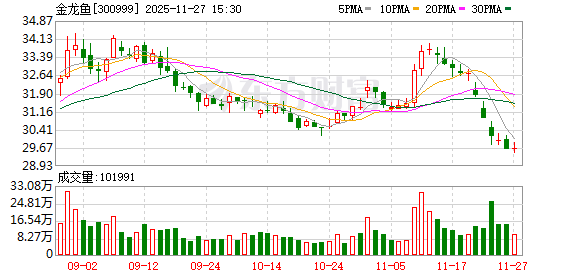
突发!金龙鱼遭剔除
Shen Zhen Shang Bao· 2025-11-24 07:29
Core Viewpoint - MSCI announced the results of its index review for November 2025, removing 20 stocks including the domestic edible oil leader, Jinlongyu, effective after the market close on November 24 [1] Group 1: Company Performance - Jinlongyu's main business includes the development, production, and sales of kitchen foods, feed raw materials, and oil technology products, and it is a significant player in the agricultural products and food processing industry in China [1] - In 2020, Jinlongyu was listed on the Shenzhen Stock Exchange with an initial price of 25.70 CNY per share, achieving a revenue of 194.92 billion CNY in its first year, a year-on-year increase of 14.16% [1] - From 2020 to 2024, Jinlongyu's net profit attributable to shareholders declined annually, with figures of 6.00 billion CNY, 4.13 billion CNY, 3.01 billion CNY, 2.85 billion CNY, and 2.50 billion CNY respectively [1] - The company's gross margin decreased significantly but showed slight recovery, with rates of 11.01%, 8.18%, 5.68%, 4.83%, and 5.35% over the same period [1] Group 2: Recent Financial Results - For the first three quarters of 2025, Jinlongyu reported a significant recovery, achieving a revenue of 184.27 billion CNY, a year-on-year increase of 5.02%, and a net profit of 2.75 billion CNY, up 92.06% [2][4] - The net profit excluding non-recurring gains and losses was 2.02 billion CNY, reflecting a substantial increase of 745.88% [4] - The cash flow from operating activities reached 27.60 billion CNY, marking a 119.97% increase [4] Group 3: Legal Issues - Jinlongyu's subsidiary, Guangzhou Yihai, was involved in a contract fraud case, facing a potential joint compensation liability exceeding 1.88 billion CNY [5] - The court found Guangzhou Yihai guilty as an accomplice in the fraud, imposing a fine of 1 million CNY and ordering compensation for economic losses [5] - Jinlongyu stated that Guangzhou Yihai was not involved in any fraudulent activities and plans to appeal the judgment [6] Group 4: Market Performance - As of November 24, Jinlongyu's stock price fell by 2.43% to 30.13 CNY per share, with a total market capitalization of approximately 163.35 billion CNY [6] - Compared to its peak in January 2021, the company's stock price has dropped over 70%, resulting in a market value loss of more than 360 billion CNY [6]