
YKA(300999)

Search documents
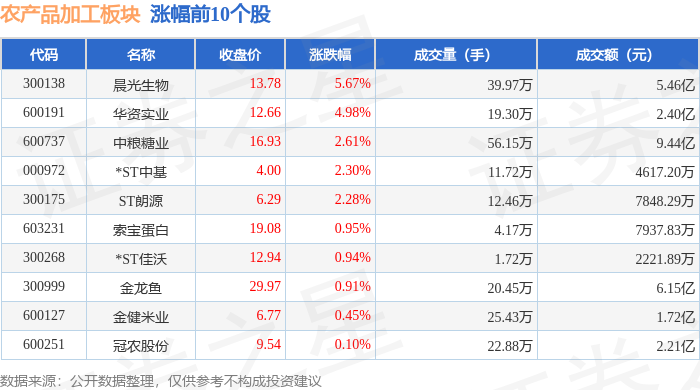
农产品加工板块1月14日涨0.82%,晨光生物领涨,主力资金净流入260.95万元
Zheng Xing Xing Ye Ri Bao· 2026-01-14 08:44
Group 1 - The agricultural processing sector increased by 0.82% on January 14, with Morning Light Biological leading the gains [1] - The Shanghai Composite Index closed at 4126.09, down 0.31%, while the Shenzhen Component Index closed at 14248.6, up 0.56% [1] - Key stocks in the agricultural processing sector showed varied performance, with Morning Light Biological rising by 5.67% to a closing price of 13.78 [1] Group 2 - The agricultural processing sector saw a net inflow of 260.95 million yuan from main funds, while retail investors experienced a net outflow of 8899.4 million yuan [2] - Major stocks like Jinlongyu and Zhongliang Sugar Industry had significant net inflows from main funds, amounting to 5739.86 million yuan and 5559.22 million yuan respectively [3] - Morning Light Biological had a notable retail net outflow of 8899.58 million yuan, despite a positive performance in main fund inflow [3]




金龙鱼在海南成立食品科技公司 注册资本1000万元
Mei Ri Jing Ji Xin Wen· 2026-01-14 04:37
Core Viewpoint - Recently, Yihai Kerry (Hainan) Food Technology Co., Ltd. was established, fully owned by Jinlongyu, with a registered capital of 10 million RMB [1] Group 1 - The legal representative of the newly established company is Chen Dong [1] - The registered capital of the company is 10 million RMB [1] - The business scope includes food sales, road cargo transportation, and import and export of goods [1]
金龙鱼在海南成立食品科技公司,注册资本1000万
Xin Lang Cai Jing· 2026-01-14 03:56
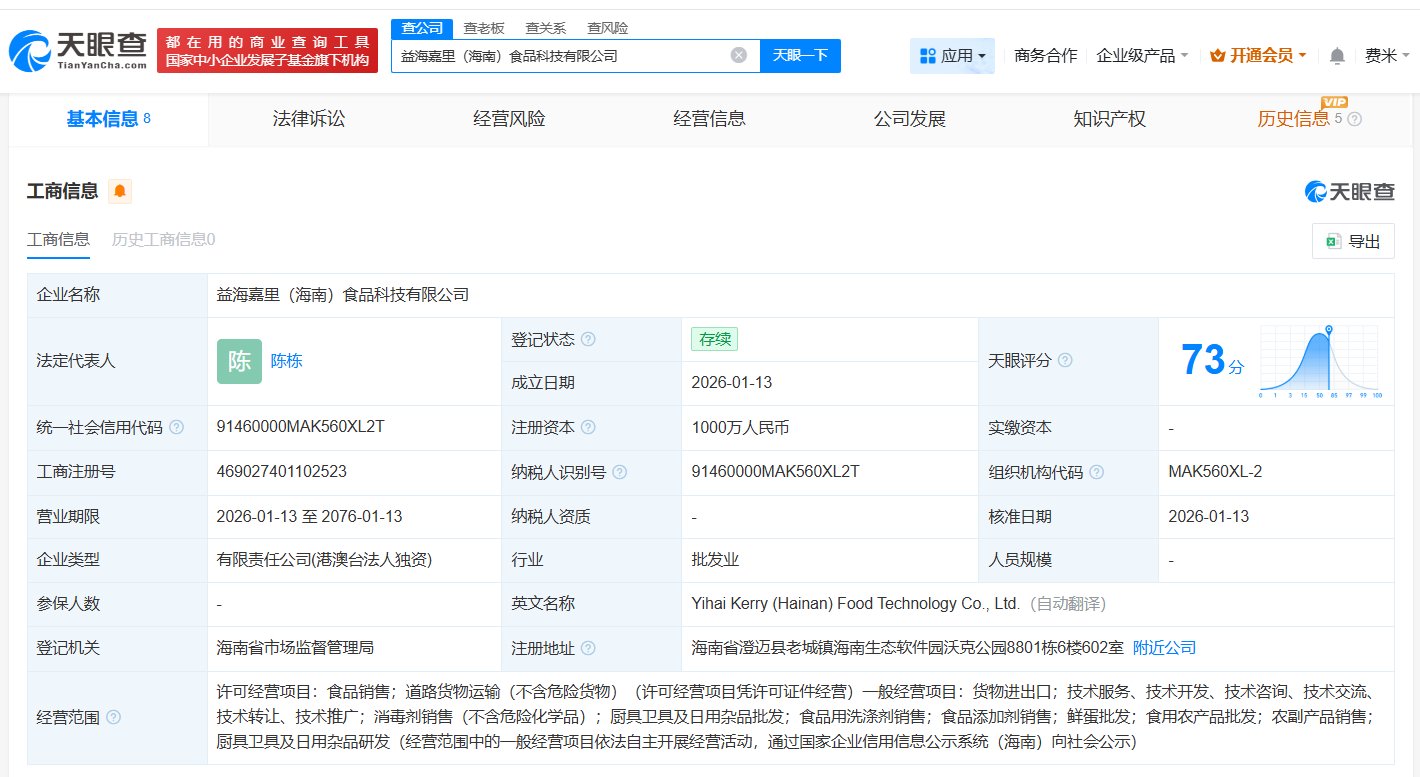
Core Viewpoint - Yihai Kerry (Hainan) Food Technology Co., Ltd. was established on January 13, with a registered capital of 10 million RMB, and is fully owned by Jinlongyu (300999) [1] Company Information - The legal representative of Yihai Kerry (Hainan) Food Technology Co., Ltd. is Chen Dong [1] - The company's business scope includes food sales, road cargo transportation, and import and export of goods [1] Shareholder Information - Yihai Kerry (Hainan) Food Technology Co., Ltd. is wholly owned by Jinlongyu [1]
益海嘉里(海南)食品科技有限公司成立,注册资本1000万人民币
Sou Hu Cai Jing· 2026-01-14 03:11
Core Viewpoint - Yihai Kerry (Hainan) Food Technology Co., Ltd. has been established with a registered capital of 10 million RMB, fully owned by Yihai Kerry Golden Dragon Fish Food Group Co., Ltd. [1] Company Summary - The legal representative of Yihai Kerry (Hainan) Food Technology Co., Ltd. is Chen Dong [1] - The company is registered with a capital of 10 million RMB and is classified as a limited liability company (wholly owned by Hong Kong, Macao, and Taiwan investors) [1] - The business scope includes food sales, road cargo transportation (excluding hazardous goods), import and export of goods, and various technical services [1] Business Operations - The company’s operational activities include the sale of disinfectants (excluding hazardous chemicals), wholesale of kitchenware and daily necessities, and sales of food additives and fresh eggs [1] - The company is located at Hainan Ecological Software Park, Walker Park, Building 8801, 6th Floor, Room 602, Chengmai County, Hainan Province [1] - The business registration is valid until January 13, 2026, with no fixed term thereafter [1]
豆油期货上市二十年:赋能油脂产业 筑牢发展根基
Zhong Zheng Wang· 2026-01-13 06:18
Core Insights - The core viewpoint of the articles emphasizes the transformative role of soybean oil futures in stabilizing and enhancing the domestic oil industry over the past two decades, evolving from a cautious financial tool to a critical support for the entire industry [1][2][11]. Industry Development - Since the launch of soybean oil futures in 2006, the domestic soybean oil industry has experienced significant growth, with production reaching 17.294 million tons and demand at 17.45 million tons by 2024, establishing a processing cluster concentrated in coastal ports and major regions [2][11]. - The volatility in soybean oil prices, which fluctuated from 5,200 yuan/ton to 12,280 yuan/ton and then down to 6,710 yuan/ton between 2020 and 2023, has underscored the importance of risk management through futures [3][11]. Risk Management Strategies - Companies have transitioned from limited understanding and cautious use of soybean oil futures to integrating them as a core strategic function for risk management, allowing for proactive profit locking rather than reactive management [3][4]. - The adoption of hedging strategies has been crucial for companies like Jiang Hai Grain and Oil, which utilized both forward and reverse hedging to manage market tensions and optimize inventory costs [4][5]. Trading Innovations - The introduction of basis trading has redefined the ecosystem, allowing companies to convert uncontrollable absolute price risks into relatively manageable basis risks, thus facilitating collaboration across the supply chain [5][6]. - Basis trading has become the mainstream model in soybean oil trade, enabling upstream and downstream companies to lock in prices and manage risks effectively [6][7]. Market Influence and Integration - The soybean oil futures market has become the largest globally, with daily average transactions and positions reaching 445,000 and 844,400 respectively by 2025, reflecting its robust liquidity and market influence [11][12]. - The integration of soybean oil futures with other commodities, such as cottonseed oil, demonstrates its pricing influence extending beyond its immediate market [8][11]. Future Outlook - The ongoing internationalization of soybean oil futures is seen as a significant milestone, enhancing China's position in the global pricing system and providing diverse risk management tools for the global oilseed industry [12][13]. - The evolution of soybean oil futures serves as a model for other futures products, highlighting the importance of aligning with industry needs and enhancing risk management capabilities [12][13].
金龙鱼入选“2025中国企业ESG百强”榜单
Xin Lang Cai Jing· 2026-01-13 05:46
Group 1 - The core viewpoint of the article emphasizes the growing importance of ESG (Environmental, Social, and Governance) as a key metric for high-quality corporate development and a vital link between corporate value and social value [1][2] - The "2025 China ESG Top 100" list was released by Sina Finance, evaluating over 5,000 A-share listed companies and mainland companies listed in Hong Kong using 18 industry-specific ESG evaluation models and over 150 ESG indicators [1][9] - The list serves as a benchmark for industry development and provides valuable decision-making references for investors [1][2] Group 2 - Jinlongyu was recognized for its outstanding ESG performance, ranking 51st on the "2025 China ESG Top 100" list, highlighting its commitment to sustainable development practices [2][3] - The release of the list is seen as an authoritative acknowledgment of the sustainable practices of the listed companies and aims to promote the core values of ESG across the industry [2] - Companies are encouraged to integrate ESG principles into their strategic planning, operations, and supply chain collaboration to achieve a balance between commercial and social value [2][10]

金龙鱼:截至2026年1月9日公司股东共计114556户
Zheng Quan Ri Bao· 2026-01-12 14:11
Group 1 - The core point of the article is that as of January 9, 2026, the company has a total of 114,556 shareholders [2]
透过“豆油期货”上市20周年,看中国油脂产业崛起
Qi Huo Ri Bao· 2026-01-11 23:29
Core Viewpoint - The 20th anniversary of Dalian Commodity Exchange's soybean oil futures marks its evolution into a cornerstone of China's oilseed market, reflecting the country's economic growth and the maturation of its futures market, while also enhancing risk management and price discovery functions [1] Group 1: Development and Achievements - Since its launch in 2006, soybean oil futures have grown significantly, with average daily trading volume increasing from 43,100 contracts to 445,000 contracts by 2025, and average open interest rising from 24,200 contracts to 844,400 contracts [4] - By the end of 2025, there are 33 delivery warehouses for soybean oil futures across seven provinces, ensuring ample delivery capacity and supporting industry participation in the futures market [4] - Over 90% of large and medium-sized soybean crushing enterprises in China utilize soybean oil futures for hedging, with the futures price becoming a key pricing benchmark for domestic soybean oil trade [4] Group 2: Market Adaptation and Risk Management - The Dalian Commodity Exchange has implemented various measures to ensure soybean oil futures remain closely aligned with the physical market, including expanding delivery regions and optimizing delivery standards based on raw material quality changes [2][3] - The introduction of dynamic premium and discount systems and the establishment of delivery warehouses in key production areas have enhanced the flexibility and efficiency of the delivery process [2][3] - Companies like Jianghai Grain and Oil Group have effectively utilized futures for risk management, demonstrating the integration of futures into their operational strategies to stabilize profits and manage price volatility [8][9] Group 3: Industry Transformation and Global Impact - The soybean oil industry has transitioned from reliance on foreign oil to a competitive landscape dominated by state-owned, private, and foreign enterprises, driven by the need for price risk management [5][6] - By 2025, China is projected to produce approximately 18.71 million tons of soybean oil, accounting for about 30% of global production and consumption, establishing itself as the largest producer and consumer [6] - The opening of the soybean oil futures market to foreign investors and the introduction of related contracts in international markets have enhanced China's pricing influence in global oilseed trade [14][15] Group 4: Future Directions and Strategic Importance - The development of soybean oil futures serves as a model for the broader Chinese futures market, emphasizing the importance of being rooted in the physical industry and driven by genuine risk management needs [16][17] - The collaborative efforts of regulatory bodies, exchanges, and industry participants have been crucial in nurturing a mature market that effectively serves the entire supply chain [17] - As the market evolves, companies are encouraged to enhance their risk management capabilities and leverage futures and options to navigate increasing market complexities and competition [18]
2025年第53周:食品饮料行业周度市场观察
艾瑞咨询· 2026-01-09 00:05
Group 1: Industry Trends - The condiment industry is seeing a surge in companies going public, focusing on overseas markets to combat rising costs and intense competition, with the industry expected to reach a scale of 498.1 billion yuan by 2024 [2][3] - The popularity of turmeric drinks is rising among young consumers, driven by health trends, with sales strong despite higher prices, and social media engagement showing over 13.2 million views on platforms like Xiaohongshu [4] - The food waste issue is prompting the emergence of the Upcycled Food industry, which is projected to reach a market size of 74.8 billion USD by 2029, utilizing innovative technologies to convert waste into high-value products [6][7] Group 2: Consumer Behavior - A survey indicates that 97.2% of young people have tried "light health" practices, with dietary health and fragmented exercise being the most popular methods, highlighting a shift towards more manageable health solutions [8] - The rise of health-conscious beverages, including sugar-free teas and functional drinks, is attributed to increased consumer awareness and the psychological need for immediate satisfaction in fast-paced lifestyles [10] - The trend of "punk health" in the health liquor sector is attracting younger consumers, with sales of health liquor on e-commerce platforms surging by 75.8% in the first eight months of 2025 [15] Group 3: Market Innovations - The introduction of cooking robots in restaurants is rapidly expanding, with the market expected to exceed 3.7 billion yuan by 2025, driven by AI technology and efficiency improvements [9] - The flavored water market is projected to grow from 22.1 billion USD in 2025 to 57.3 billion USD by 2035, with a compound annual growth rate of 10%, driven by health trends and innovative flavors [16] - The bottled water industry is facing intensified competition, with brands needing to diversify their product offerings and improve supply chain efficiency to maintain market share [17] Group 4: Brand Dynamics - The brand "Guozi Shule" is expanding its product line in the sugar-free tea market and has seen significant growth in its large bottle sales, indicating a strategic shift towards channel expansion [19] - "Tai Er" is undergoing a brand upgrade to focus on fresh ingredients and new dishes, responding to market changes and performance pressures, with a notable decline in revenue [20] - Danone's beverage brand "Pulse" is expected to reach nearly 7 billion yuan in revenue by 2025, with plans to expand into health drinks and face competitive pressures [21]





金龙鱼:常温米饭系列产品已出口到澳大利亚、新加坡、美国等多地
Cai Jing Wang· 2026-01-08 14:39
Core Viewpoint - The company, Jinlongyu (300999), has successfully exported its ambient rice series products to multiple countries including Australia, Singapore, and the United States, and will determine future product promotion based on business development plans and market demand [1] Group 1 - The ambient rice series products have been exported to Australia, Singapore, and the United States [1] - Future product promotion will be decided based on business development and market demand [1]