
YKA(300999)

Search documents
2025年上海市食用油、油脂及其加工品产品商品包装物减量(过度包装)监督抽查结果公布
Zhong Guo Zhi Liang Xin Wen Wang· 2026-01-16 07:59
Core Viewpoint - The Shanghai Municipal Market Supervision Administration conducted a supervision and sampling inspection of edible oils, fats, and their processed products, revealing that 2 out of 30 batches were non-compliant with packaging standards [2]. Group 1: Compliance Results - A total of 30 batches of edible oil products were inspected, with 2 batches found to be non-compliant [2]. - The inspection was based on GB 23350-2021 standards, focusing on packaging void ratio, number of packaging layers, and packaging costs [2]. Group 2: Compliant Products - Several compliant products were identified, including: - High Oleic Peanut Oil (750ml×2 bottles) from Lu Hua [2] - Organic Flaxseed Oil (110ml) from Grandpa's Farm [2] - Avocado Oil (110ml) from Grandpa's Farm [2] - Organic Walnut Oil (110ml) from Grandpa's Farm [2] - And many others, with various brands and specifications listed [2]. Group 3: Non-Compliant Products - The non-compliant products included: - Walnut Oil (500ml) from an unspecified brand, failing due to packaging void ratio [3] - Walnut Oil (500ml×2) from Golden Tree, also failing due to packaging void ratio [3].


1月16日重要公告一览
Xi Niu Cai Jing· 2026-01-16 02:51
Group 1 - Zhongyuan Neipei plans to acquire 59% stake in Zhongyuan Jikean for 143 million yuan, making it a wholly-owned subsidiary [1] - HNA Holding reports a 2.8% year-on-year increase in passenger transport volume for December 2025, with international passenger transport volume up by 21.95% [2] - Haolai Ke expects a net profit decrease of 75.16% to 83.23% for 2025, projecting a profit of 13.5 million to 20 million yuan [3] Group 2 - Chengdu Investment Holdings reports a 71.41% year-on-year decrease in signed sales amount for Q4 2025, totaling 2.318 billion yuan [4] - Zhong Rare Metals signs a strategic cooperation agreement with Xian Dao Group to enhance market share in rare metals [5] - Bofei Electric plans to invest 23.38 million yuan in Haining Qiyuan alongside its controlling shareholder [6] Group 3 - Rongchang Bio plans to increase the maximum repurchase price to 116 yuan per share [7] - Filihua's controlling shareholders and executives plan to reduce their holdings by up to 1.05% of the company's shares [8] - Jiu Zhi Tang's general manager plans to reduce holdings by up to 2% of the company's shares [10] Group 4 - Aerospace Development's controlling shareholder reduced 12.26 million shares during stock trading fluctuations [11] - Nong Shang Environment's subsidiary faces delays in a computing infrastructure project due to funding issues [12] - Xinhua Department Store denies rumors of injecting semiconductor assets into the company [13] Group 5 - Jin Ao Bo expects a net profit increase of 40.24% to 59.58% for 2025, projecting a profit of 174 million to 198 million yuan [21] - Zhejing Pharmaceutical receives approval for clinical trials of ZGGS18 and ZG005 for advanced solid tumors [22] - Guangdong Hongtu anticipates a net profit decrease of 7.99% to 17.87% for 2025, projecting a profit of 341 million to 382 million yuan [23] Group 6 - Aijian Group expects to report a net loss for 2025 [24] - Shuangliang Energy also anticipates a net loss for 2025 [25] - Jia Mei Packaging announces early redemption of convertible bonds due to stock price conditions [26] Group 7 - Jindao Technology plans to issue convertible bonds to raise up to 306 million yuan for various projects [27] - Xinlei Co. extends the lock-up period for shares held by its controlling shareholder and actual controllers until January 19, 2027 [28] - Genesis expects a net profit decrease of 30% to 45% for 2025, projecting a profit of 131 million to 166 million yuan [29] Group 8 - Defu Technology plans to repurchase shares for employee stock ownership plans, with a budget of 75 million to 150 million yuan [30] - Huasheng Tiancheng states that AI-related revenue is currently a small portion of overall revenue [32] - Hongchuan Wisdom's shareholder plans to reduce holdings by up to 2% of the company's shares [33] Group 9 - Century Huatong's subsidiary plans to invest 50 million yuan in a financial development fund [34] - Liou shares will be suspended for trading due to significant stock price fluctuations [35] - Golden Dragon Fish plans to transfer stakes in two subsidiaries to Mars China for a total of 60 million USD [36] Group 10 - Mountain Outside Mountain's shareholder plans to reduce holdings by up to 1% of the company's shares [37] - Keheng Co. plans to sign a cooperation framework agreement with Gree Supply Chain for procurement [38] - Tian Sheng New Materials announces a change in actual controller and resumes trading [40] Group 11 - Xinghua New Materials plans to acquire at least 51% of Tian Kuan Technology for cash [41] - Rongbai Technology continues to delay responses to the Shanghai Stock Exchange's inquiries, leading to ongoing stock suspension [42] - Longxin Zhongke's shareholders plan to reduce holdings by up to 3.03% of the company's shares [43]


6000万美元!金龙鱼向玛氏中国转让家乐氏上海和昆山各50%股权
Xin Lang Cai Jing· 2026-01-16 01:36
Core Viewpoint - The company, Yihai Kerry Arawana Holdings Co., Ltd. (referred to as "Jinlongyu"), announced the transfer of its 50% stakes in Yihai Kerry Kellogg Foods (Shanghai) Co., Ltd. and Yihai Kerry Kellogg Foods (Kunshan) Co., Ltd. to Mars Wrigley Confectionery (China) Co., Ltd. for a total consideration of $60 million, which is expected to significantly impact the company's 2026 earnings [1][2][7]. Group 1: Transaction Details - The company will transfer its 50% stake in Yihai Kerry Kellogg Foods (Shanghai) for $45 million and its 50% stake in Yihai Kerry Kellogg Foods (Kunshan) for $15 million [1][6]. - The assessed value of Yihai Kerry Kellogg Foods (Shanghai) is approximately 630 million RMB, while Yihai Kerry Kellogg Foods (Kunshan) is valued at over 210 million RMB [1][6]. - Post-transaction, the company will no longer hold stakes in the target companies, and the transaction will not affect the company's consolidated financial statements [1][6]. Group 2: Financial Impact - The transaction is expected to impact the company's 2026 revenue by more than 10% of the audited net profit attributable to shareholders for 2024 [2][7]. - The company reported a revenue of 68.588 billion RMB for Q3 2025, a year-on-year increase of 3.96%, with a net profit of 999 million RMB, reflecting a 196.96% increase [9][10]. - The growth in revenue is attributed to increased sales in kitchen foods, feed raw materials, and oil technology products [10]. Group 3: Industry Context - The transfer of stakes is part of Mars' broader strategy to complete its acquisition of Kellanova, a snack food company that owns brands like Kellogg's cereals and Pringles [2][7]. - Mars completed the acquisition of Kellanova for $35.9 billion (approximately 253 billion RMB), marking one of the largest deals in the global food industry [4][9].
金龙鱼公告:募投项目延期!转让参股公司股权!
Shen Zhen Shang Bao· 2026-01-16 01:07
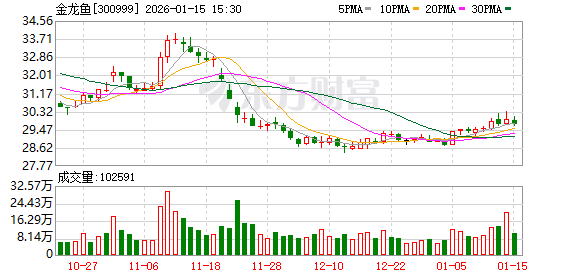
Core Viewpoint - The company, Jinlongyu, announced the transfer of its 50% stakes in Kellogg's Shanghai and Kellogg's Kunshan to Mars Wrigley Confectionery (China) for a total consideration of $60 million, reflecting a strategic decision based on current business conditions [1][2]. Group 1: Financial Performance - Jinlongyu's revenue for the first three quarters of 2025 reached 184.27 billion yuan, marking a year-on-year increase of 5.02%, with an average monthly income of 20.5 billion yuan [3]. - The company's net profit attributable to shareholders for the same period was 2.749 billion yuan, showing a significant year-on-year growth of 92.06%, with the third quarter net profit soaring by 196.96% [3]. - Since its IPO in October 2020, Jinlongyu's net profit has declined for four consecutive years, from 4.132 billion yuan in 2021 to 2.502 billion yuan in 2024 [2]. Group 2: Market Performance - Jinlongyu's stock price has experienced a continuous decline over the past five years, with decreases of 41.99% in 2021, 30.84% in 2022, 23.35% in 2023, 1.99% in 2024, and 11.57% in 2025, leading to a current stock price of 29.72 yuan and a market capitalization of 161.1 billion yuan [4]. - The company reached a peak market capitalization of 786.1 billion yuan, but has since lost over 600 billion yuan in value [4]. Group 3: Strategic Decisions - The company has decided to extend the timeline for several fundraising projects, including the "Yihai Kerry (Maoming) Grain and Oil Industrial Co., Ltd. Grain and Oil Processing Project" to June 30, 2026, and other projects in Lanzhou and Hunan to December 31, 2027 [3].
刚刚,玛氏再出手,全资拿下品客母企中国业务,玛氏箭牌在华年收入超150亿也浮出水面
3 6 Ke· 2026-01-16 00:35
Core Viewpoint - Kellanova's Chinese business will transition from a joint venture model to full ownership by Mars, marking a significant shift in its operational strategy in China [3][9]. Group 1: Transaction Details - The transaction involves the transfer of 50% stakes in two joint ventures, Kellogg's Shanghai and Kellogg's Kunshan, from Yihai Kerry to Mars Wrigley, with a total transaction value of $60 million (approximately 418 million RMB) [4][6]. - The stakes are valued at $45 million for Kellogg's Shanghai and $15 million for Kellogg's Kunshan, with the deal expected to close on the third business day after all conditions are met [8][4]. Group 2: Financial Performance - Mars Wrigley reported a registered capital of $91.49 million, with projected revenues exceeding 15 billion RMB and a net profit of nearly 860 million RMB for the year 2024 [4]. - Kellogg's Shanghai generated approximately 290 million RMB in revenue and 47.6 million RMB in net profit for 2024, while Kellogg's Kunshan had revenues of about 130 million RMB and net profits nearing 7.6 million RMB [6]. Group 3: Market Position and Future Opportunities - The acquisition allows Mars to fully control Kellanova's operations in China, enhancing its portfolio in the snack food sector, particularly in the salty snack category, where it previously had limited presence [19][15]. - Kellanova's market share in the Chinese oatmeal sector is currently at 5.3%, indicating significant room for growth under Mars's management [17]. - The integration of Kellanova's products, such as Pringles and breakfast cereals, into Mars's existing portfolio could lead to enhanced market penetration and innovation in the Chinese snack market [19][15].

8点1氪丨西贝关店102家,贾国龙最新发声;爱马仕客服回应一个悠悠球售价超1.8万;霸王茶姬及创始人起诉网民,公司回应
3 6 Ke· 2026-01-16 00:05
Group 1 - The People's Bank of China indicates there is still room for interest rate cuts this year, with the current average reserve requirement ratio at 6.3% [6] - Xiaomi launches a 7-year low-interest car purchase policy for its new electric SUV, with monthly payments starting at 2,593 yuan [10] - The Philippines announces visa-free entry for Chinese citizens starting January 16, 2026, allowing a stay of up to 14 days [10] Group 2 - Xunlei restarts litigation against former CEO Chen Lei, claiming he secretly siphoned off company assets, seeking 200 million yuan in damages [10] - Golden Dragon Fish plans to transfer 50% stakes in its Shanghai and Kunshan subsidiaries to Mars China for a total consideration of 60 million USD [11] - SF Express and Jitu Express announce a strategic mutual shareholding agreement, with a total investment amounting to 8.3 billion HKD [8] Group 3 - Wang's Restaurant announces the closure of 102 stores, representing 30% of its total outlets, while ensuring all employees will receive their wages and customers can refund their prepaid cards [1] - The luxury brand Hermès responds to the controversy over an 18,000 yuan yo-yo, stating it is a new product with thoughtful design [4] - The Louvre Museum increases ticket prices for non-European Economic Area visitors by approximately 45% to fund infrastructure upgrades [13] Group 4 - KKR completes fundraising of 2.5 billion USD for a private credit fund focused on high-quality credit assets in the Asia-Pacific region [21] - TSMC forecasts Q1 2026 revenue between 34.6 billion to 35.8 billion USD, indicating a 4.4% quarter-over-quarter increase [17] - Li Ning reports a low single-digit decline in retail sales for the fourth quarter, with a total of 6,091 sales points in China [18]





金龙鱼:第三届董事会第十次会议决议公告
Zheng Quan Ri Bao· 2026-01-15 14:12
证券日报网讯 1月15日,金龙鱼发布公告称,公司第三届董事会第十次会议审议通过《关于转让参股公 司股权的议案》等。 (文章来源:证券日报) ...
今日晚间重要公告抢先看——华胜天成公告目前涉及AI业务相关收入占公司整体营收比例较低 利欧股份将核查股票交易波动情况,16日起停牌




Jin Rong Jie· 2026-01-15 13:37
Group 1 - Huasheng Tiancheng's AI-related revenue currently accounts for a low proportion of overall revenue, indicating that it does not significantly impact the company's performance [2] - CICC's merger with Dongxing Securities and Xinda Securities is still undergoing audit work, which has not yet been completed [2] - Xinhua Department Store confirmed that there are no undisclosed major matters related to semiconductor asset injections, addressing market rumors [3] Group 2 - Zhong Rare Metals signed a strategic cooperation agreement with Xian Dao Group to enhance market share and industry influence in rare metals [4] - Zhongtian Rocket reported losses in its carbon/carbon thermal field materials business due to intensified competition in the photovoltaic industry [5] - Zhongyuan Nepe proposed to acquire 59% of Zhongyuan Jikean's equity for 143 million yuan, which will make it a wholly-owned subsidiary [5] Group 3 - Jiangxi Copper's subsidiary signed a cooperation agreement with First Quantum Minerals for exploration projects [6] - China Nuclear Power's Jiangsu Xuwei Nuclear Energy Heating Power Plant's first unit is set to pour its first concrete on January 16, 2026 [6] - ST Aowei's stock may be delisted if it continues to trade below par value [6] Group 4 - Triangle Tire plans to invest 3.219 billion yuan in a new high-performance tire project in Cambodia, expected to generate annual revenue of 2.585 billion yuan [7] - Baoxin Technology intends to publicly sell part of its subsidiary's assets, with a valuation of 50.2334 million yuan [7] - Nong Shang Environment's computing infrastructure project has not progressed as planned due to funding issues [8] Group 5 - Golden Dragon Fish plans to transfer stakes in two subsidiaries to Mars China for a total of 60 million USD, which is expected to impact its 2026 earnings significantly [8] - Jin Dao Technology intends to issue convertible bonds to raise up to 306 million yuan for various projects [8] - Aerospace Information expects a net loss of 700 million to 980 million yuan for 2025 due to industry changes [10] Group 6 - Tianji Co. forecasts a net profit of 70 million to 105 million yuan for 2025, recovering from a previous loss [10] - Muyuan Foods anticipates a net profit decrease of 12.2% to 17.79% for 2025 [11] - SAIC Group expects a net profit increase of 438% to 558% for 2025, driven by sales growth [12] Group 7 - Haolaike expects a significant drop in net profit for 2025, projecting a decrease of 75.16% to 83.23% [13] - Hainan Development anticipates a net loss of 440 million to 565 million yuan for 2025 [13] - Shuangliang Energy expects to report a loss for 2025 [14] Group 8 - Aijian Group also anticipates a loss for 2025 [14] - Meijin Energy forecasts a net loss of 850 million to 1.25 billion yuan for 2025 [14] - Kunlun Wanwei expects to report a loss for 2025 [14] Group 9 - Xue Rong Biological expects a net profit of 29 million to 40 million yuan for 2025, recovering from a previous loss [15] - Xin Nuo Wei anticipates a net loss of 170 million to 255 million yuan for 2025 due to increased R&D expenses [15] - Shengnuo Biological expects a net profit increase of 204.42% to 280.53% for 2025 [16] Group 10 - Longyuan Construction forecasts a net loss of 1 billion to 1.5 billion yuan for 2025 [17] - Kosen Technology expects a net loss of 245 million to 330 million yuan for 2025 [17] - Daqian Ecology anticipates a net loss of 100 million to 120 million yuan for 2025 [17] Group 11 - Lianfa Co. expects a net profit increase of 38.92% to 58.77% for 2025 [18] - Chongqing Steel anticipates a net loss of 2.5 billion to 2.8 billion yuan for 2025, but expects to reduce losses compared to the previous year [18] - Tongxing Technology forecasts a net profit increase of 74.2% to 125.44% for 2025 [19] Group 12 - Siyuan Electric expects a net profit of 3.163 billion yuan for 2025, a 54.35% increase year-on-year [19] - Luoyang Molybdenum expects a net profit increase of 47.8% to 53.71% for 2025 [20] - Nawei Technology anticipates a net profit increase of 54.51% to 75.03% for 2025 [20] Group 13 - Jingjia Micro expects a net loss of 120 million to 180 million yuan for 2025 [21] - Southwest Securities forecasts a net profit increase of 47% to 57% for 2025 [22] - Wankai New Materials expects a net profit of 156 million to 203 million yuan for 2025, recovering from a previous loss [22] Group 14 - Yilian Network anticipates a slight decrease in net profit for 2025, projecting a decline of 0% to 4% [23] - Baofeng Energy expects a net profit increase of 73.57% to 89.34% for 2025 [23] - Sanmei Co. forecasts a net profit increase of 155.66% to 176.11% for 2025 [23] Group 15 - Zhenyu Technology expects a net profit increase of 96.89% to 116.58% for 2025 [24] - Fute Technology anticipates a net profit increase of 121.98% to 164.26% for 2025 [24] - Guoli Electronics expects a net profit increase of 124.89% to 164.57% for 2025 [24] Group 16 - Shenyu Co. expects a slight decrease in net profit for 2025, projecting a decline of 0.05% to 11.37% [25] - Rongchang Biological plans to increase its share repurchase price limit to 116 yuan per share [26] - Defu Technology plans to repurchase shares for 75 million to 150 million yuan [26] Group 17 - ST Chengchang's stock will resume trading on January 16 after completing a trading fluctuation investigation [27] - Zhi Te New Materials will also resume trading on January 16 after confirming no major changes in business operations [27] - Lio Co. will suspend trading starting January 16 for stock fluctuation investigation [27]
金龙鱼(300999.SZ):拟转让家乐氏上海及家乐氏昆山股权
Ge Long Hui A P P· 2026-01-15 12:55
格隆汇1月15日丨金龙鱼(300999.SZ)公布,公司将分别持有的益海嘉里家乐氏食品(上海)有限公司 (简称"家乐氏上海")50%股权、益海嘉里家乐氏食品(昆山)有限公司(简称"家乐氏昆山",家乐氏 上海及家乐氏昆山以下合称"标的公司")50%股权转让给玛氏箭牌糖果(中国)有限公司(简称"玛氏 中国"),交易对价分别为4,500万美元及1,500万美元(简称"本次交易")。本次交易完成前,标的公司 未被纳入公司合并报表范围。本次交易完成后,公司不再持有标的公司股权,本次交易不会导致公司合 并报表范围发生变化。 ...
金龙鱼:拟转让家乐氏上海及家乐氏昆山股权
Ge Long Hui· 2026-01-15 12:45
格隆汇1月15日丨金龙鱼(300999.SZ)公布,公司将分别持有的益海嘉里家乐氏食品(上海)有限公司 (简称"家乐氏上海")50%股权、益海嘉里家乐氏食品(昆山)有限公司(简称"家乐氏昆山",家乐氏 上海及家乐氏昆山以下合称"标的公司")50%股权转让给玛氏箭牌糖果(中国)有限公司(简称"玛氏 中国"),交易对价分别为4,500万美元及1,500万美元(简称"本次交易")。本次交易完成前,标的公司 未被纳入公司合并报表范围。本次交易完成后,公司不再持有标的公司股权,本次交易不会导致公司合 并报表范围发生变化。 ...