
AbbVie(ABBV)

Search documents
特朗普想断中国新药出海“财路”,业内评:杀敌一千自损八百
3 6 Ke· 2025-09-12 09:29
Core Viewpoint - The Trump administration is preparing a new executive order targeting the Chinese pharmaceutical industry, particularly focusing on the licensing-out (BD) of innovative drugs, which may restrict U.S. pharmaceutical companies from importing new drugs from China and impose stricter reviews on drug licensing transactions and clinical data from China [1][3]. Group 1: Impact on the Market - Following the news, shares of innovative drug companies in both A-shares and H-shares fell, with companies like BeiGene and Rongchang Bio experiencing declines, while the Hang Seng Biotechnology Index saw a significant drop [1]. - Despite initial declines, the innovative drug sector showed signs of recovery, with a partial rebound observed on September 12 [1]. Group 2: Details of the Proposed Executive Order - The draft executive order includes four main points: limiting U.S. pharmaceutical companies from importing in-development drugs from China, requiring licensing transactions to undergo mandatory review by the Committee on Foreign Investment in the United States (CFIUS), enhancing FDA scrutiny on projects using Chinese clinical data, and promoting domestic drug production in the U.S. [3][5]. - The proposed restrictions are seen as a response to the increasing trend of U.S. pharmaceutical companies acquiring Chinese innovative drug pipelines, which has raised concerns among some U.S. investors [3][4]. Group 3: Industry Reactions and Feasibility - Industry insiders express skepticism about the feasibility of the executive order due to the complex interests involved, suggesting that even if the order is implemented, it may only affect the most sensitive areas like cell therapy and human genetic resources, while allowing other transactions to proceed normally [2][6]. - The potential impact of the order on U.S. pharmaceutical companies is significant, as it could limit their access to innovative drugs and hinder their development capabilities [6][7]. Group 4: Economic Implications - The executive order is perceived as a move that could harm both U.S. and Chinese companies, as it may restrict BD transactions that are crucial for innovation and collaboration in the pharmaceutical sector [2][6]. - The financial stakes in BD transactions are substantial, with the potential for significant profits for multinational companies, as evidenced by BioNTech's recent acquisition and subsequent sale of a Chinese innovative drug [7].


体内CAR-T带火上游卖水人?
Xin Lang Cai Jing· 2025-09-12 05:49
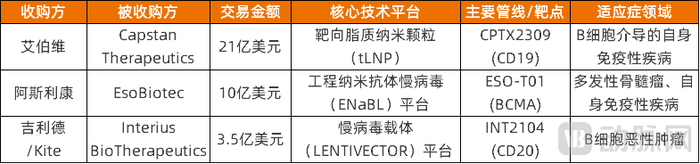
Core Insights - The in vivo CAR-T therapy market is rapidly gaining traction, with significant mergers and acquisitions by major multinational corporations (MNCs) indicating a strategic shift towards this innovative treatment approach [1][2][3] - The advancements in delivery vector technologies are driving the development of in vivo CAR-T therapies, with a focus on improving targeting efficiency and safety [3][4] Group 1: Mergers and Acquisitions - AstraZeneca acquired EsoBiotec for $1 billion to enhance its in vivo CAR-T therapy portfolio [1][2] - AbbVie announced the acquisition of Capstan Therapeutics for up to $2.1 billion, marking a significant investment in the in vivo CAR-T space [1][2] - Gilead's Kite acquired Interius for $350 million, further expanding its capabilities in cell therapy [1][2] Group 2: Technology Platforms - EsoBiotec's core technology is the engineered nanobody lentivirus (ENaBL) platform, which enhances the specificity of immune cell transfection [4] - Interius utilizes a lentiviral vector to deliver CAR genes, generating CAR-T and CAR-NK cells directly in vivo for targeting B-cell malignancies [3][4] - The mRNA-LNP (lipid nanoparticle) delivery system is gaining attention for its safety profile, allowing for transient CAR expression without permanent genetic modification [7][8] Group 3: Clinical Developments - EsoBiotec's product ESO-T01 has shown promising clinical trial results for multiple myeloma, indicating potential effectiveness in treating relapsed or refractory cases [15][17] - Capstan Therapeutics' candidate CPTX2309 is currently in Phase I trials for autoimmune diseases, showcasing the therapeutic potential of the LNP delivery approach [8][9] Group 4: Industry Trends - The shift from ex vivo to in vivo CAR-T therapies is reshaping the ecosystem, with increased collaboration among technology partners and a focus on delivery efficiency [3][6] - The reliance on upstream CXO (Contract Research Organization) services is significant, with over 65% of CGT (Cell and Gene Therapy) projects involving CXO participation [6][12] - The industry is witnessing a dual approach, with companies like AbbVie investing in both lentiviral and mRNA-LNP technologies to mitigate risks associated with single technology pathways [16][17]


艾伯维(ABBV.US)与仿制药企业就核心免疫药物Rinvoq达成和解
Zhi Tong Cai Jing· 2025-09-12 03:52
Core Viewpoint - AbbVie has reached a settlement with all involved generic drug companies regarding the lawsuits related to the planned launch of a generic version of Rinvoq, a key immunotherapy product in AbbVie's portfolio [1] Group 1: Legal Developments - AbbVie announced a settlement that resolves litigation against generic drug companies seeking to launch a non-patented version of Rinvoq [1] - The settlement and licensing agreement will prevent generic versions of Rinvoq tablets from entering the U.S. market until April 2037 [1] Group 2: Product Positioning - AbbVie positions Rinvoq and its sister drug Skyrizi as potential replacements for Humira, which lost its U.S. market exclusivity in 2023 [1] - Rinvoq's net sales reached $2.7 billion in the first half of 2025, reflecting a year-over-year growth of approximately 53% [1] Group 3: Market Comparison - In contrast, Humira's sales in the U.S. market declined by about 63% during the same period [1]
AbbVie shares rise with extension of RINVOQ patent protection to 2037
Proactiveinvestors NA· 2025-09-11 17:26
Core Insights - Proactive provides fast, accessible, and actionable business and finance news content to a global investment audience [2] - The company focuses on medium and small-cap markets while also covering blue-chip companies and broader investment stories [3] - Proactive's news team delivers insights across various sectors including biotech, mining, oil and gas, and emerging technologies [3] Technology Adoption - Proactive is committed to adopting technology to enhance workflows and content production [4] - The company utilizes automation and software tools, including generative AI, while ensuring all content is edited and authored by humans [5]
AbbVie shares hit record high as key immunology drug set for exclusivity until 2037
Reuters· 2025-09-11 16:25
Core Viewpoint - AbbVie shares increased by 4% to a record high following the announcement that there will be no generic competition for its immunology drug Rinvoq until 2037, extending the exclusivity period by four years [1] Company Summary - AbbVie is a U.S. drugmaker known for its immunology drug Rinvoq, which has been a significant contributor to its revenue [1] - The extension of exclusivity until 2037 is a positive development for AbbVie, as it allows the company to maintain its market position without facing generic competition for an additional four years [1] Industry Summary - The pharmaceutical industry is impacted by patent expirations and the introduction of generic drugs, which can significantly affect revenue streams for companies [1] - AbbVie's ability to extend the exclusivity of Rinvoq highlights the competitive landscape within the immunology sector, where companies strive to protect their blockbuster drugs from generic competition [1]
AbbVie in Settlement With Generic Drugmakers on Rinvoq
WSJ· 2025-09-11 16:17
The biopharmaceutical company doesn't expect U.S. generic entry for the drug before 2037 now that it has settled litigation. ...
AbbVie Stock Breaks Out As Its Cash Cow Lives To Fight Another Day
Investors· 2025-09-11 15:44
Core Insights - AbbVie has secured a settlement deal that extends the patent protection for its drug Rinvoq until April 2037, adding four years to its exclusivity period [2][3] - This development is expected to positively impact AbbVie's revenue projections, as Rinvoq generated $5.97 billion in sales last year, accounting for nearly 11% of total sales [5][7] - Analysts believe that the extension of exclusivity could lead to higher peak-year sales estimates for Rinvoq, potentially exceeding previous guidance of over $11 billion by 2027 [7] Company Developments - The settlement deal prevents generic versions of Rinvoq from entering the market until 2037, which is crucial for maintaining AbbVie's revenue stream [2][4] - Rinvoq is one of AbbVie's two major revenue drivers, treating various inflammatory conditions, and its sales performance has been strong, especially following the decline of Humira due to biosimilar competition [4][5] - AbbVie is also pursuing additional approvals for Rinvoq in new indications, which could further enhance its sales potential by an estimated $2 billion [6][7] Market Reaction - Following the announcement of the settlement, AbbVie’s stock price increased by 4.3%, indicating positive market sentiment towards the company's future prospects [3][5] - The stock performance suggests that investors are optimistic about the long-term viability of AbbVie's drug portfolio, particularly Rinvoq [3][7]
AbbVie: What's Happening With ABBV Stock?
Forbes· 2025-09-11 13:45
Core Insights - AbbVie has reached a significant agreement with generic drug manufacturers to delay the release of a generic version of its drug Rinvoq until 2037, which is expected to maintain its market dominance and potentially increase peak sales to over $12 billion [2] - AbbVie's stock has risen 18% this year, trading around $220 per share, but is still considered a strong buy due to solid financials and operations [2] - The company reported $6 billion in sales for Rinvoq last year, with a year-over-year growth of 50%, and $3.7 billion in sales in the first half of this year [2] Financial Performance - AbbVie's revenues have grown from $55 billion to $58 billion in the last 12 months, reflecting a growth rate of 6.1%, compared to 5.1% for the S&P 500 [6] - The company's quarterly revenues increased by 6.6% to $15 billion in the most recent quarter [6] - AbbVie's operating income over the last four quarters was $14 billion, with an operating margin of 23.5%, higher than the S&P 500's 18.6% [13] Valuation Metrics - AbbVie has a price-to-sales (P/S) ratio of 6.8, compared to 3.2 for the S&P 500, and a price-to-earnings (P/E) ratio of 104.8 versus 24.1 for the benchmark [6] - The company's price-to-free cash flow (P/FCF) ratio stands at 21.6, slightly above the S&P 500's 21.2 [6] - Despite a higher valuation, AbbVie is seen as a solid long-term investment with expected revenue growth improvement [11] Debt and Cash Position - AbbVie's debt was reported at $70 billion, with a market capitalization of $374 billion, resulting in a debt-to-equity ratio of 17.9%, which is favorable compared to the S&P 500's 20.9% [13] - The company holds $6.5 billion in cash, which constitutes a cash-to-assets ratio of 4.7%, lower than the S&P 500's 7.0% [13] Market Resilience - AbbVie's stock has shown resilience during downturns, performing slightly better than the S&P 500 in recent market declines [8] - The stock has fully recovered from previous declines, indicating strong recovery potential [14]
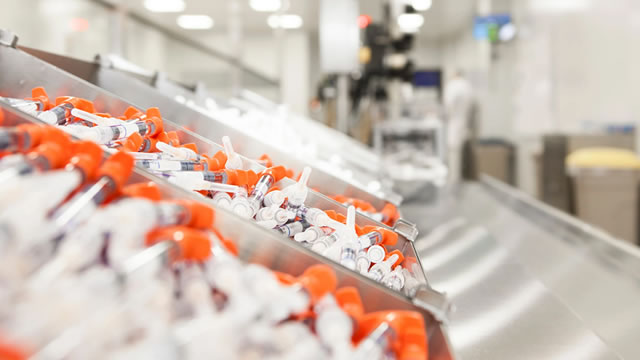
AbbVie settles with generic drugmakers for Rinvoq (ABBV:NYSE)
Seeking Alpha· 2025-09-11 12:01
Group 1 - AbbVie has reached settlements with all generic drugmakers regarding litigation over Rinvoq, a significant product in its immunology portfolio [4] - The settlements resolve challenges posed by generic manufacturers planning to introduce copycat versions of Rinvoq [4] - This development is expected to protect AbbVie's market position and revenue from Rinvoq, which is crucial for its immunology franchise [4]
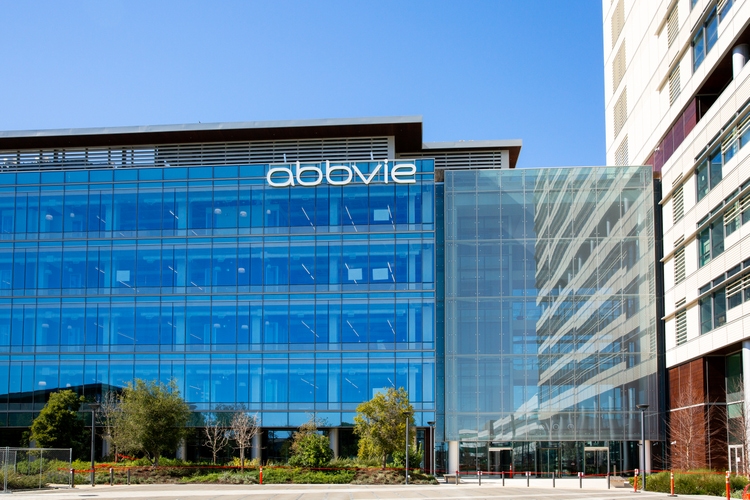
艾伯维就Rinvoq专利诉讼与仿制药商达成和解
Ge Long Hui A P P· 2025-09-11 11:59
Group 1 - AbbVie has reached a settlement with generic drug manufacturers regarding the patent litigation for Rinvoq [1] - AbbVie stated that Upadacitinib (Rinvoq) will not face generic competition until April 2037 [1]