BP(BP)

Search documents
丰业银行上调英国石油目标价至42美元
Ge Long Hui· 2025-08-14 14:55
丰业银行将英国石油的目标价从34美元上调至42美元,评级从"与行业同步"上调至"跑赢行业"。(格隆 汇) ...


英国石油(BP):业绩表现强劲,股息实现增长,重申业绩指引,资产剥离稳步推进
Haitong Securities International· 2025-08-13 12:05
Investment Rating - The report maintains an "Outperform" rating for BP, indicating an expected total return over the next 12-18 months that exceeds the relevant market benchmark [2][13][19]. Core Insights - BP's Q2 2025 performance is expected to be viewed positively by the market, with adjusted net income slightly exceeding consensus estimates at $1.629 billion, driven by strong performance across all business segments [2][3]. - The company has achieved a dividend per share of 8.320 cents, marking a 4% year-over-year increase, aligning with its annual dividend growth target of at least 4% [2][3]. - BP has reiterated its capital expenditure guidance for FY 2025 at approximately $15 billion, with asset divestitures progressing steadily, having completed $1.7 billion in asset sales in Q2 2025 [2][3]. Financial Performance Summary - BP's total revenue for Q2 2025 is projected at $46.627 billion, reflecting a 1% decrease year-over-year [5]. - Adjusted net income for Q2 2025 is forecasted at $1.629 billion, representing an 18% increase from the previous quarter but a 41% decline year-over-year [5]. - The adjusted diluted earnings per share for Q2 2025 is expected to be $0.90, a 70% increase quarter-over-quarter but a 10% decrease year-over-year [5]. - The natural gas and low-carbon energy segment reported adjusted operating income of $1.462 billion, exceeding expectations, while the oil production and operations segment also outperformed with adjusted operating income of $2.262 billion [3][5].
BP Eyes Petrobras Partnership for Brazil Pre-Salt Bumerangue Development
ZACKS· 2025-08-12 13:26
Key Takeaways Zacks Rank & Key Picks BP and PBR currently carry a Zack Rank #3 (Hold). Investors interested in the energy sector may look at a couple of better-ranked stocks like Antero Midstream Corporation (AM) and Enbridge Inc. (ENB) , each carrying a Zacks Rank #2 (Buy) at present. You can see the complete list of today's Zacks #1 Rank (Strong Buy) stocks here. BP plc (BP) is exploring the possibility of partnering with Petróleo Brasileiro S.A. – Petrobras (PBR) to develop its Bumerangue oil and gas dis ...


石油巨头上半年业绩集体大幅缩水,行业转型或仍在加速
Xin Hua Cai Jing· 2025-08-11 10:56
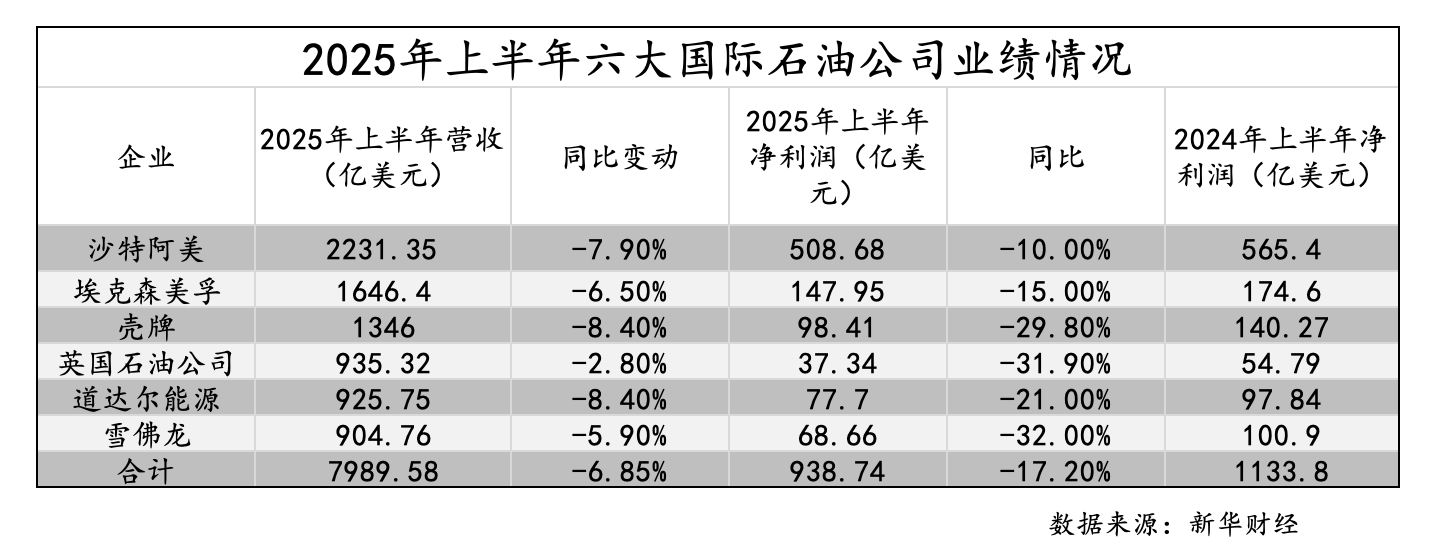
Core Viewpoint - The global oil industry is facing significant profitability challenges due to declining oil prices, with major oil companies reporting substantial decreases in revenue and net profit for the first half of 2025 compared to the previous year [1][3]. Group 1: Oil Price Trends - WTI crude oil futures averaged $67.52 per barrel in the first half of 2025, a year-on-year decline of 14.33%, while Brent averaged $70.81 per barrel, down 15.11% [1]. - Global crude oil inventories are expected to continue increasing, with an average daily growth of approximately 1.2 million barrels in the first half of 2025, maintaining a growth trend of 900,000 barrels per day in the second half [6]. Group 2: Financial Performance of Major Oil Companies - The combined adjusted profit of six major international oil companies, including Saudi Aramco, BP, Shell, Chevron, TotalEnergies, and ExxonMobil, was approximately $93.874 billion in the first half of 2025, a decrease of 17.2% from $113.38 billion in the same period of 2024 [1][2]. - Saudi Aramco reported a revenue of $223.135 billion, down 7.9%, and an adjusted net profit of $50.868 billion, down 10% [2][3]. - Other companies experienced even larger declines, with Chevron's adjusted net profit falling by 32% and BP's net profit dropping from $5.379 billion to $3.734 billion [3]. Group 3: Challenges and Strategic Responses - The oil companies are grappling with a "volume increase, price drop" dilemma, where rising transaction volumes only partially offset the impact of falling oil prices [3]. - Companies are increasingly focusing on energy transition and diversification to mitigate the risks associated with oil price volatility. For instance, Saudi Aramco is expanding its natural gas production and trade [7]. - Despite these efforts, companies face challenges in their transition strategies due to external environmental changes and internal strategic misjudgments, as seen with Shell's reduction in renewable energy investments and TotalEnergies' scaling back of solar energy goals [8]. Group 4: Future Outlook - The outlook for oil prices remains pressured, with major energy agencies predicting a continued oversupply in the global oil market through 2026, leading to sustained downward pressure on prices [5][6]. - Long-term strategies for achieving carbon neutrality are being set by companies, with China Petroleum aiming for a significant reduction in carbon emissions by 2040 and a balanced approach between oil, gas, and new energy by 2050 [8].



BP在巴西近海发现大型油田
Zhong Guo Hua Gong Bao· 2025-08-11 02:42
Core Insights - BP announced the discovery of the largest oil and gas field in the Santos Basin offshore Brazil in the past 25 years, indicating significant reserves of oil and gas [1] - This marks BP's 10th oil and gas discovery in 2023, with additional finds in Trinidad and Tobago, and Egypt [1] - Following a strategic shift towards renewable energy, BP has reaffirmed its commitment to fossil fuels, aiming to increase global oil and gas production to 2.3 to 2.5 million barrels of oil equivalent per day by 2030 [1] Production Plans - BP projects a production level of 2.4 million barrels of oil equivalent per day for 2024, with a slight decline expected in 2025 [1] - The company acquired the rights to the new discovery block in December 2022 under "very favorable commercial terms," holding 100% ownership [1] Management and Partnerships - The Brazilian state-owned company, Pre-Salt Petroleum, will act as the contract manager for production sharing in the newly discovered block [1]
X @The Economist
The Economist· 2025-08-08 20:20
Britain’s oil giant has unveiled an enormous discovery. Some 400km off the coast of Rio de Janeiro, BP has made its largest find in 25 years. It’s not the only driller betting big on South America https://t.co/g2n7dYku6q ...
X @Bloomberg
Bloomberg· 2025-08-06 11:00
BP's incoming chairman is poised to conduct a review of the company's entire portfolio as activist shareholder Elliott Investment Management turns up the heat. Here's what to know about the oil major's struggles. https://t.co/i10nUp9GAp ...
Will FTSE 100 Energy Giant BP Finally Give Investors Some Joy?
Forbes· 2025-08-05 19:25
Core Viewpoint - BP has indicated a potential turnaround with improved quarterly performance and significant oil and gas discoveries, signaling a shift back to traditional energy sources after years of challenges and executive changes [2][4][5]. Financial Performance - BP reported an adjusted net income of $2.4 billion for Q2 2025, a 14% decrease year-on-year, but exceeding market expectations of $1.7-$1.9 billion [3]. - The company raised its quarterly dividend by 4% to 8.32 cents per share and plans to repurchase $750 million in shares [8]. Strategic Focus - Under CEO Murray Auchincloss, BP is reducing its renewable energy investments and increasing focus on oil and gas, with plans to boost upstream investment by 20% to $10 billion annually through 2027 [5][6]. - The company is conducting a thorough review of its business portfolio to maximize shareholder value and has achieved $1.7 billion of its $4-$5 billion cost-cutting target for 2023-2027 [6][9]. Recent Developments - BP announced its largest oil and gas discovery in 25 years in the Santos basin off Brazil, which is expected to significantly impact the company's future [4]. - The company has completed $3 billion in divestments towards its goal of $3-$4 billion by the end of the current year [9]. Market Position - BP's share price increased by 3.3% since the beginning of the year, but remains down 3.4% on an annualized basis, with 5-year gains at approximately 45% compared to competitors like Shell and ExxonMobil [10][11].
美股异动|英国石油涨超2% Q2经调整纯利远胜预期+上调季度股息
Ge Long Hui· 2025-08-05 14:51
英国石油(BP.US)涨超2%,报33.16美元。消息面上,英国石油公布,以基本重置成本利润计,第二季度 经调整纯利24亿美元,同比下降约14%,但远胜预期的18亿美元。公司宣布,将季度股息从每股8美分 提高至8.32美分,并维持第二季7.5亿美元的股票回购计划规模。(格隆汇) ...
BP's Q2 Earnings Beat Estimates, Revenues Decline Y/Y
ZACKS· 2025-08-05 14:06
Core Insights - BP plc reported second-quarter 2025 adjusted earnings of 90 cents per American Depositary Share, exceeding the Zacks Consensus Estimate of 68 cents, but down from $1.00 in the previous year [1][10] - Total quarterly revenues were $47.7 billion, missing the Zacks Consensus Estimate of $60.7 billion and declining from $48.3 billion reported a year ago [1][10] - The better-than-expected earnings were primarily due to higher oil production, which was partially offset by lower price realizations [2] Operational Performance - BP's total production for the second quarter was 1,518 thousand barrels of oil equivalent per day (Mboe/d), an increase from 1,481 Mboe/d in the year-ago quarter, surpassing the estimate of 1,475.8 Mboe/d [3] - The company sold liquids at $59.74 per barrel, down from $73.01 a year ago, while natural gas was sold at $3.66 per thousand cubic feet, up from $2.02 [4] - Overall hydrocarbon price realization decreased to $49.03 per Boe from $55.78 year over year [4] Segment Performance - Underlying replacement cost earnings before interest and tax for the oil segment were $1.9 billion, down from $3.3 billion in the year-ago quarter and below the estimate of $2.8 billion, affected by lower price realizations for liquids [5] - The Gas & Low Carbon Energy segment reported profits of $1.5 billion, slightly up from $1.4 billion in the previous year, despite lower realizations and higher depreciation charges [6] - The Customers & Products segment's underlying replacement cost earnings were $1,533 million, higher than $1,149 million in the year-ago quarter, driven by stronger refining margins [7] Capital Expenditure and Financials - Organic capital expenditure for the quarter totaled $3.3 billion, matching total capital spending [11] - BP's net debt stood at $26 billion at the end of the second quarter, with a gearing of 24.6% [12] Outlook - BP anticipates a slight dip in upstream production for the third quarter of 2025, alongside a seasonal rise in customer business volumes and a significant decline in refinery turnaround activity [13] - For 2025, BP forecasts slightly lower overall upstream production compared to 2024, with flat oil output and a decrease in gas and low-carbon output, while expecting divestment proceeds of $3-$4 billion [14]