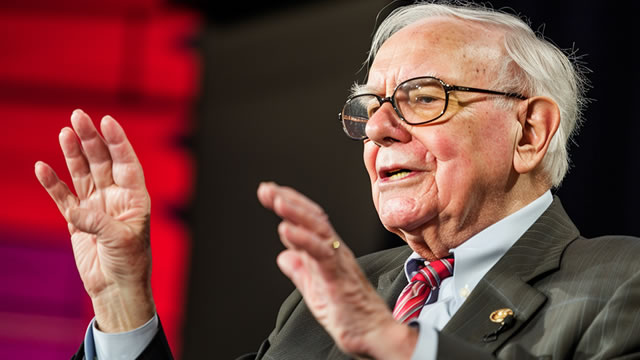
Berkshire Hathaway(BRK.B)

Search documents
3 Dividend-Paying and/or Blue-Chip Stocks Perfect for Baby Boomers to Add to Their Portfolios -- Including Warren Buffett's Berkshire Hathaway
The Motley Fool· 2025-11-08 12:15
Core Insights - Dividend-paying stocks are recommended for investors, particularly Baby Boomers aged 61 to 79, as they are more likely to own stocks [1][2] Group 1: Investment Opportunities - Berkshire Hathaway, led by incoming CEO Greg Abel, may introduce a dividend as the company holds a cash reserve of $382 billion [3][4] - Waste Management is considered a stable investment due to its essential services in trash collection and recycling, with a recent forward P/E ratio of 23.5, below its five-year average of 27.4 [6][8] - Realty Income, a REIT, offers a high dividend yield of 5.6% and has a strong track record of paying dividends for 664 consecutive months [10][12] Group 2: Financial Metrics - Berkshire Hathaway has a market cap of $1,077 billion, with a gross margin of 24.85% [4] - Waste Management has a market cap of $81 billion, with a gross margin of 28.92% and a dividend yield of 1.65% [8][9] - Realty Income has a market cap of $52 billion, a gross margin of 48.14%, and a 98.7% occupancy rate across its properties [12][14]





Global Markets Grapple with Geopolitical Tensions and AI Fears as Toy Brands Eye Asia’s Next Big Craze
Stock Market News· 2025-11-08 12:08
Group 1 - Chinese toy manufacturers are rapidly expanding into Thailand, driven by the popularity of characters like Labubu from Pop Mart International Group, indicating a competitive landscape for identifying the next major toy craze in Southeast Asia [2][7] - Berkshire Hathaway is showcasing resilience in a volatile market, narrowing the performance gap with the S&P 500, highlighting the appeal of value and stability amid concerns over artificial intelligence [3][7] - Ongoing geopolitical instability, such as recent violence in the Gaza Strip, contributes to a climate of global uncertainty that can affect investor sentiment and market stability [4][7]

Warren Buffett's cash fortress Berkshire closes gap with S&P 500 as AI worries depress Wall Street
CNBC· 2025-11-08 11:32
Core Insights - Berkshire Hathaway's stock has seen gains recently, reducing its underperformance against the S&P 500 from 12.2 percentage points to 4.3 percentage points since October 29 [1][2]. Financial Performance - Operating profits for Berkshire's wholly owned companies increased by 34% to nearly $13.5 billion in Q3, with insurance underwriting income rising by 200% [2]. - The company has not engaged in stock buybacks, indicating that Buffett does not view Berkshire shares as significantly undervalued despite recent weaknesses [2]. - As of September 30, Berkshire's cash reserves reached $381.7 billion, reflecting a 10.9% increase since the end of June [2]. Investment Strategy - There are indications of further sales of Apple shares, with a reported $1.2 billion decline in the cost basis for consumer product stocks, which includes Apple [7]. - Apple remains Berkshire's largest equity holding, valued at $75.2 billion, but the position has been reduced by 69% over the past two years [9]. - The company may have sold approximately 35 million shares of Apple for around $8 billion based on average prices during the quarter [9]. - Bank of America, another significant holding, has also seen a reduction of about 40% since the beginning of last year, with its current value at $32.2 billion [10]. Leadership Transition - Warren Buffett is expected to deliver a final message as CEO on November 10, which may include topics on philanthropy and other matters of interest to shareholders [4][5]. - Buffett will remain as chairman but will not participate in the next annual meeting, with new CEO Greg Abel taking over the responsibility of writing the annual letter to shareholders [5][6]. Market Activity - Berkshire's reported holdings in Japan have increased in value to approximately $33 billion, up from $31 billion in the previous month [11]. - The company has issued warnings regarding fraudulent YouTube videos impersonating Buffett, highlighting concerns over the misuse of AI technology [12].

Prediction: Eli Lilly Will Be Worth More Than Berkshire Hathaway by 2030
The Motley Fool· 2025-11-08 10:10
Core Insights - Eli Lilly is positioned to potentially become the first trillion-dollar pharmaceutical company, with a current market cap of $800 billion, while Berkshire Hathaway has a market cap of just over $1 trillion [2][3]. Eli Lilly's Growth Prospects - Eli Lilly is a leader in the rapidly growing weight management drug market, particularly with its product tirzepatide (Zepbound), which is driving significant sales growth [3]. - The company is also pursuing regulatory approval for orforglipron, an oral GLP-1 medication for weight management, which could attract patients averse to injections [4]. - Eli Lilly is developing retatrutide, which mimics the action of three gut hormones and has shown strong efficacy in phase 2 studies, potentially revolutionizing the GLP-1 space [6]. Berkshire Hathaway's Challenges - Berkshire Hathaway faces uncertainty regarding its long-term future as Warren Buffett steps down as CEO, leading to investor concerns about the new leadership under Greg Abel [7]. - The company's largest holding, Apple, is encountering challenges such as significant tariffs and competition in the AI market, which may hinder Berkshire's performance in the near term [9]. - Despite these challenges, Berkshire Hathaway's diversification and investment philosophy may still make it a viable long-term investment, though patience may be required [10].


Buffett's message to deepfake AI videos: "IT'S NOT ME."
Yahoo Finance· 2025-11-08 00:30
Fraud Concerns - Berkshire Hathaway expresses concern over AI-generated videos using Warren Buffett's image and a voice impersonating him [1] - Warren Buffett is worried about the proliferation of fraudulent AI videos [1] Investor Awareness - The statement highlights the potential for AI-generated content to mislead investors [1]

英伟达↓3.65%、特斯拉↓3.5%、苹果↓0.1%、微软↓1.98%、谷歌↑0.2%、亚马逊↓2.86%、Meta↓2.67%
财联社· 2025-11-06 23:45
Core Viewpoint - The article discusses the recent decline in major tech stocks due to concerns over the U.S. job market and misinterpretations of OpenAI executives' statements regarding government backing for AI investments [1][3]. Group 1: OpenAI's Financial Strategy - OpenAI's CFO, Sarah Friar, indicated the company is seeking a financial ecosystem involving banks, private equity, and federal government guarantees to support its substantial chip investments [2]. - Following public backlash, Friar clarified that OpenAI is not seeking government guarantees for its infrastructure investments, and the term "backstop" was misinterpreted [3][6]. - CEO Sam Altman emphasized that OpenAI does not intend to seek government backing and is prepared to face failure without federal support, while projecting annual revenues to exceed $20 billion and potentially reach "hundreds of billions" by 2030 [6]. Group 2: Market Reactions and Employment Trends - The Challenger report revealed that U.S. employers cut over 150,000 jobs in October, marking the highest number of layoffs in that month in over two decades, influenced by cost-cutting and AI adoption [8]. - The tech sector is experiencing greater labor market risks compared to 2022, as layoffs are not being absorbed by other industries as quickly as before [8]. Group 3: Stock Performance - Major tech stocks saw declines, with Nvidia down 3.65%, Apple down 0.14%, and Microsoft down 1.98%, among others, reflecting the overall market sentiment [9]. - Duolingo, a language learning platform, experienced a significant drop of 25% due to disappointing earnings guidance, while an unnamed food delivery platform fell 17.45% for similar reasons [11]. - Chinese stocks showed mixed performance, with Alibaba up 1.69% and JD down 0.28%, indicating varied investor sentiment in the Chinese market [12].


My Advice? Don't Get Distracted by Berkshire Hathaway Stock's Recent Slump.
Yahoo Finance· 2025-11-06 09:40
Core Viewpoint - Berkshire Hathaway's stock has declined by 11.9% since Warren Buffett announced he would remain chairman while transitioning the CEO role to Greg Abel by early 2026, contrasting with a 20% rally in the S&P 500 during the same period, indicating potential long-term investment opportunities despite short-term volatility [1]. Group 1 - Berkshire Hathaway has been performing well against major indexes earlier in the year, attracting investors seeking safe stocks amid tariff uncertainties, but has since faced challenges as megacap growth stocks, like Nvidia, have surged [3]. - The company reported strong third-quarter results, with cash, cash equivalents, and Treasury bills reaching a record $382 billion, reflecting a cautious investment strategy in a premium-priced market, despite a $9.7 billion acquisition in the energy sector [4]. - Some investors express disappointment over Berkshire's lack of investment in value-focused megacap growth stocks during market downturns, particularly missing opportunities in companies like Alphabet, which has significantly increased in value since its 52-week low [5]. Group 2 - Berkshire's substantial cash reserves during market sell-offs have led to perceptions of excessive caution in capital allocation, yet the focus should remain on future growth potential rather than past decisions [6]. - The appeal of value stocks like Berkshire may diminish in the face of soaring AI growth stocks, leading to mixed sentiments among investors regarding the company's investment strategy [7].
Warren Buffett Has Now Gone 16 Months Without Buying His Favorite Stock -- and the Likely Reason Why Is Frightening
Yahoo Finance· 2025-11-06 08:06
Core Viewpoint - The article discusses Warren Buffett's recent trend of being a net-seller of stocks, particularly highlighting his lack of purchases in Berkshire Hathaway shares over the past 16 months, attributed to high valuations in the market [1][4][14]. Group 1: Market Valuation - The "Buffett Indicator," which measures the total value of publicly traded companies against U.S. GDP, reached an all-time high of over 225%, significantly above its historical average of approximately 85% since 1970 [1]. - Berkshire Hathaway's stock has been trading at a premium of 60% to 80% above book value during the period Buffett has refrained from repurchasing shares, compared to a previous range of 30% to 50% above book value [15][16]. Group 2: Investment Activity - Warren Buffett has been a net-seller of stocks for 12 consecutive quarters, totaling $183.5 billion in net sales, despite having transformed Berkshire Hathaway into a trillion-dollar enterprise through acquisitions and investments [2][7]. - Buffett has not repurchased any shares of Berkshire Hathaway for 16 months, marking a significant shift from his previous strategy of buying back shares for 24 consecutive quarters, during which he spent nearly $78 billion [13][14]. Group 3: Investment Philosophy - Buffett remains a long-term optimist about the U.S. economy but is cautious about equity purchases when valuations are high, indicating a disciplined investment approach [3][19]. - The article emphasizes Buffett's patience and opportunistic investment style, suggesting that he is waiting for more favorable market conditions to deploy Berkshire's substantial cash reserves [18][22].
存储芯片概念股,继续大涨
财联社· 2025-11-05 23:44
Market Overview - The US stock market saw slight gains on Wednesday, with the S&P 500 index rising by 0.37% to 6796.29 points, the Nasdaq Composite increasing by 0.65% to 23499.8 points, and the Dow Jones Industrial Average up by 0.48% to 47311 points [1]. Economic Indicators - Following sharp questioning of Trump's tariffs by the US Supreme Court, traders reduced the probability of a government victory in the market [4]. - Ford and General Motors, as economic indicators, both rose over 2%, while Caterpillar saw an increase of nearly 4% [4]. Technology Sector - AI concept stocks experienced a turnaround, with AMD rebounding after an initial drop, and companies like Broadcom, Google, and Oracle also seeing gains [5]. - Micron Technology surged by 8.93%, reaching a historical high, driven by rumors of rising HBM4 chip prices. Other storage stocks like Seagate and SanDisk also rose over 10% [6]. - However, not all AI stocks rebounded; AMD's competitor, Supermicro, fell over 11%, and Arista Networks dropped nearly 9% [7]. Stock Performance - Notable stock performances included Nvidia down 1.75%, Apple up 0.04%, Microsoft down 1.39%, Google-C up 2.41% (hitting a historical closing high), Amazon up 0.35%, and Tesla up 4.01% [8]. Renewable Energy Sector - Solid Power's stock surged by 51.56% after a favorable earnings report, while SolarEdge rose by 28.91%, boosting the battery storage and solar panel sectors overall [9]. Chinese Stocks - The Nasdaq Golden Dragon China Index saw a slight increase of 0.15%. Key performances included Alibaba up 0.32%, JD.com up 0.69%, and Pinduoduo up 1.87%, while NIO fell by 3.97% [10].




Berkshire Hathaway Q3 Earnings Beat, Revenues Miss, Both Rise Y/Y
ZACKS· 2025-11-05 17:31
Core Insights - Berkshire Hathaway (BRK.B) reported better-than-expected third-quarter 2025 operating earnings, with a 33.8% year-over-year increase to $6.26 per share, surpassing the Zacks Consensus Estimate by 33.2% [1][8] - Total operating earnings reached $13.5 billion, reflecting a 3.4% year-over-year growth, driven by higher earnings in insurance underwriting, BNSF, and Manufacturing, service, and retailing [1] Revenue Performance - Revenues increased by 2.2% year over year to $92.5 billion, supported by growth in Insurance and Other, as well as Railroad, Utilities, and Energy segments, although it slightly missed the consensus estimate by 0.1% [2][8] - The Insurance and Other segment saw revenues rise by 2.4% year over year to $81.7 billion, attributed to higher premiums and service revenues [3] - Railroad, Utilities, and Energy operating revenues decreased by 1.5% year over year to $13.1 billion, primarily due to lower earnings at BHE [4] - Manufacturing, Service, and Retailing total revenues increased by 2.4% year over year to $54.7 billion, with earnings rising by 8.2% to $3.6 billion [5] Cost and Expense Management - Costs and expenses decreased by 2.6% year over year to $79.1 billion, mainly due to a decline in insurance losses and lower underwriting and administrative expenses [2][8] Financial Position - As of September 30, 2025, consolidated shareholders' equity was $700.4 billion, up 7.5% from December 31, 2024 [6] - Cash and cash equivalents increased by 62.7% to $72.2 billion compared to the end of 2024 [6] - Cash flow from operating activities totaled $34.8 billion in the first nine months of 2025, marking a 33.9% increase from the previous year [6]