Chagee(CHA)

Search documents
徒手拌奶茶、高含咖啡因,霸王茶姬真让人上头
阿尔法工场研究院· 2026-01-08 00:05
Core Viewpoint - The incident involving a staff member of Bawang Chaji preparing tea in an unsanitary manner has led to a significant trust crisis regarding food safety for the brand, despite the company's rapid expansion and unique positioning in the market [2][11][28]. Group 1: Incident Overview - A viral video showed a Bawang Chaji employee preparing tea without gloves or masks, leading to public outrage and scrutiny of the brand's food safety practices [1][4][5]. - The company quickly announced measures in response to the incident, including the indefinite closure of the involved store and the dismissal of the employee [11][10]. - Despite the company's claims that the incident was an isolated case, there are concerns about systemic food safety issues within the brand [16][19]. Group 2: Business Performance and Challenges - Bawang Chaji has experienced a decline in single-store GMV for seven consecutive quarters, raising questions about its ability to balance rapid expansion with food safety and profitability [2][24]. - The brand's aggressive expansion strategy has resulted in over 7,338 stores by Q3 2025, but this has led to increased competition and reduced profitability per store [22][24]. - The total GMV for Bawang Chaji was approximately 79.3 billion, down from 83.01 billion the previous year, indicating a significant drop in sales despite the increase in store numbers [24]. Group 3: Market Position and Competitive Landscape - Bawang Chaji's rapid growth has outpaced competitors like Heytea and Nayuki, but this has also resulted in high store density and intense competition in key markets [22][26]. - Other leading tea brands are slowing their expansion, contrasting with Bawang Chaji's aggressive growth strategy, which may lead to sustainability issues in the long run [26][27]. - The brand's high caffeine content in its products has also sparked consumer concerns, further complicating its market position [19][20]. Group 4: Operational and Management Issues - The company faces challenges in maintaining food safety standards across its franchise network, with reports of unsanitary practices and customer complaints about product quality [19][25]. - Bawang Chaji's franchise model, which accounts for over 80% of its stores, raises questions about the effectiveness of its management and oversight of franchisees [25][24]. - The need for a robust franchise management system is critical to prevent hygiene issues and service disputes, which could undermine the brand's reputation [25][28].


年终奖真相:为什么总感觉像在补发工资?
Xin Lang Cai Jing· 2026-01-07 10:07
Core Viewpoint - The year-end bonus system in state-owned enterprises (SOEs) creates a perception of "back pay" due to the fixed salary cap established at the beginning of the year, which is linked to the company's economic performance and profit targets [2][4][20]. Salary Cap Management - The total salary budget is predetermined annually, encompassing all forms of employee compensation, including salaries, bonuses, and allowances [2][18]. - The salary budget is linked to the company's economic performance; if profits decline, the salary budget must also decrease [4][20]. - This budgetary constraint leads to conservative monthly payouts, with significant adjustments made at year-end based on confirmed performance metrics [5][20]. Performance Pressure in 2025 - The major telecom operators are facing significant performance pressures, with emerging business revenue growth slowing down from 22.2% in 2023 to 9.9% in 2024, and further stagnation expected in 2025 [6][22]. - EBITDA for China Mobile and China Unicom has shown rare negative growth, while China Telecom's growth rate has also declined, indicating reduced profitability [6][22]. - Management salaries have been cut, with China Mobile's key management compensation decreasing from 10.1 million yuan in 2022 to 9.29 million yuan in 2024, a reduction of approximately 8% [6][22]. Year-End Bonus Disparities - There is a significant disparity in year-end bonuses among employees, with reported bonuses ranging from 6,000 yuan to 150,000 yuan depending on position and location [7][23]. - For example, a graduate from Hunan Mobile received a total of 100,000 yuan, while a master's degree holder from Anhui received around 30,000 yuan [7][23]. - The differences reflect the complex internal distribution logic within the operators [9][25]. Hierarchical Influence on Compensation - The fixed salary cap means that higher-ranking employees receive a larger share of the total compensation pool, leading to substantial differences in bonuses based on job level [10][26]. - For instance, an employee in a lower position may receive only a fraction of what a higher-ranking colleague earns for similar contributions [10][26]. Departmental Impact on Bonuses - Not all departments within the telecom operators are equally valued; R&D departments are prioritized, with significant increases in R&D budgets for AI and cloud computing [12][28]. - Conversely, traditional communication roles are under pressure, with bonuses likely to decrease as these services decline [12][28]. Year-End Bonus as a Management Tool - Year-end bonuses serve as a management tool rather than just a reward, with a portion of the total salary budget allocated to performance-based bonuses linked to company performance metrics [29][34]. - This system allows for differentiated bonuses to incentivize and manage employee performance effectively [29][34]. Future Trends in Year-End Bonuses - The trend of bonus disparities is expected to continue, with traditional communication roles facing further reductions while positions in AI and computing may see increases [15][31]. - The success of the operators' transformation into digital service providers will directly influence the potential for year-end bonuses to become genuine incentives rather than mere compensatory payments [33].



知名奶茶通报:门店无限期停业整顿,员工辞退,店长降职
2 1 Shi Ji Jing Ji Bao Dao· 2026-01-06 11:15
Core Viewpoint - The incident involving a Bawang Tea employee preparing drinks without gloves has sparked significant controversy, highlighting issues of food safety and brand integrity in the beverage industry [1][5][6]. Group 1: Incident Details - A video surfaced showing a Bawang Tea employee preparing drinks by handling ice and lemons without gloves, which led to public outrage [1]. - The employee claimed the actions were part of a mock demonstration using waste materials after closing, aiming to mimic "Indian tea" [1][5]. - Bawang Tea conducted an investigation confirming the incident occurred at their store in Fujian and that the materials used were disposed of after filming [5]. Group 2: Company Response - Bawang Tea expressed shock and anger at the employee's actions, stating they violated food safety protocols and company policies [5]. - The company has suspended the Fujian store indefinitely until it passes a thorough inspection and has terminated the involved employee for serious misconduct [5]. - The store manager and regional supervisor faced demotions due to management failures [5]. Group 3: Industry Context - The incident reflects broader issues in the new tea beverage market, where brands may prioritize viral marketing over food safety [6]. - The competitive landscape has led to a blurring of lines between entertainment and serious food safety standards, necessitating industry-wide reflection [6]. Group 4: Company Financials - Bawang Tea reported a revenue of 32.08 billion yuan for Q3 2025, a decrease of 9.40% year-over-year, and a net profit of 3.94 billion yuan, down 38.53% [7]. - The adjusted net profit under U.S. GAAP was 5.03 billion yuan, compared to 6.47 billion yuan in the previous year [7]. - As of January 5, Bawang Tea's stock was priced at $12.60 per share, with a market capitalization of $2.3 billion [7].

93 家成功突围!2025中企赴美上市总结:分化赛道中的机遇与底线坚守
Sou Hu Cai Jing· 2026-01-06 01:30
Group 1 - The core viewpoint of the article highlights the steady recovery of global capital markets in 2025, with US stock markets continuing to be a key platform for Chinese companies seeking cross-border financing, despite a notable structural differentiation in the number and scale of listings [3][17] - In 2025, a total of 93 Chinese companies successfully listed on US stock markets through various methods, marking a 7.8% increase from 64 companies in 2024, with 149 additional companies having publicly submitted applications for US listings, indicating strong future momentum [3][17] - The traditional IPO remains the dominant listing method, with 90.3% of the successful listings (84 out of 93) being through IPOs, while De-SPAC and OTC transfers accounted for 8.6% and 1.1% respectively, showcasing a clear preference for IPOs among Chinese companies [4][17] Group 2 - The fundraising characteristics of Chinese companies in the US IPO market are marked by a concentration of capital, with the top three companies (Smithfield, Bawang Chaji, and Yasheng Pharmaceutical) accounting for 33.9% of the total $2.822 billion raised, while over half (58.3%) of the companies raised less than $10 million [11][17] - The industry distribution of companies going public in the US is diverse, with significant representation from application software, traditional industries like construction and manufacturing, and modern service sectors such as pharmaceuticals and logistics, reflecting the dynamic nature of China's economic transformation [14][17] - The average listing cycle for Chinese companies in the US has improved, with an average duration of approximately 198 days and a median of 185 days, indicating enhanced efficiency in the listing process [16][17] Group 3 - The Nasdaq remains the most attractive exchange for Chinese companies, with 82 out of 93 companies choosing to list there, while one company opted for the NYSE and another for the AMEX, demonstrating the exchange's strong appeal for cross-border financing [8][17] - The structural characteristics of the 2025 US listings reflect the resilience and vitality of Chinese companies in their internationalization efforts, with a focus on compliance and strategic alignment with regulatory environments being crucial for future listings [17]

“信”达乡野 “报”传党音 甘肃电信为全省村党支部赠阅《甘肃农民报》助力乡村振兴
Xin Lang Cai Jing· 2026-01-06 00:55
甘肃电信相关负责人表示,此次赠报行动,核心是依托自身强大的云网融合能力与《甘肃农民报》专业 权威的内容生产力,共同为农村基层打造一个稳定、可靠、高质量的"信息动脉"。它旨在强化村党支部 的信息枢纽与引领核心作用,通过持续输送政策解读、产业趋势、实用技术、典型经验等"养分",有效 提升基层组织带领群众发展产业、治理乡村、迈向现代化的能力。 此举标志着甘肃电信在服务"三农"的路径上,从提供基础通信连接,向提供"连接+内容+赋能"的综合信 息服务迈出了坚实一步。它不仅是一次文化赠阅,更是以信息化、数字化手段助力建强农村基层党组 织,构筑乡村全面振兴"数字底座"的一次前瞻性布局,为绘就陇原"智慧新农景"贡献着独特的电信力 量。 责任编辑:郭林玉 "信"达乡野 "报"传党音 甘肃电信为全省村党支部赠阅《甘肃农民报》助力乡村振兴 每日甘肃网讯(新甘肃·甘肃农民报记者 阿旦增 何成军)自2026年1月起,中国电信甘肃公司(以下 简称"甘肃电信")以"报"为媒,以"信"为桥,正式启动向全省所有行政村党支部赠阅《甘肃农民报》的 专项工作。这一举措精准链接了"权威涉农媒体、信息通信国企、农村战斗堡垒"三大关键要素,旨在通 过多重 ...

2025年中企赴美上市盘点,93家企业成功登陆,149家企业递交申请
Sou Hu Cai Jing· 2026-01-05 03:46
Group 1 - By the end of 2025, 93 Chinese companies successfully listed on US stock markets, with 149 companies publicly submitting listing applications, showing moderate growth compared to 69 companies in 2024 [1] - Nasdaq maintained its absolute advantage with 89 companies listed, accounting for 96% of the total, while only 4 companies chose the New York Stock Exchange [1] - The industry distribution is diverse, with technology companies like application software leading, while traditional industries such as construction and industrial sectors follow steadily, and modern service industries like pharmaceuticals and food logistics show vibrant growth, reflecting the robust momentum of China's economic transformation [1] Group 2 - Among the three main listing paths, IPO remains the mainstream route, favored for its direct financing and brand premium advantages, with 84 Chinese concept stocks completing their US listings through IPOs [1] - Smithfield (SFD) topped the list with over $500 million raised, becoming the largest IPO project of the year, followed by Bawang Tea (CHA) with $411 million, and Ascentage Pharma (AAPG) with $126 million [1] - The majority of other companies raised amounts mostly under $20 million, with nearly 70% of companies financing not exceeding $10 million [1] Group 3 - De-SPAC (Special Purpose Acquisition Company) and OTC transfer models play important supplementary roles, with 8 companies listing through De-SPAC, including Global IBO Group Ltd, which achieved a valuation of $8.3 billion, marking one of the largest transactions of the year [2] - One company, Tianci International Inc (CIIT), successfully transferred from the OTC market to Nasdaq, a path more suitable for companies that have built liquidity and valuation on the OTC market [2] - The outlook for 2026 suggests that with new Nasdaq regulations increasing the net income standard by 200%, the barriers for traditional IPOs will rise, potentially providing greater opportunities for small and medium enterprises in OTC transfers [2]
走近大国工程 | 绿色电力支撑零碳算力探访全国首个高海拔岩洞式算力舱智算中心
Zhong Yang Ji Wei Guo Jia Jian Wei Wang Zhan· 2026-01-04 23:58
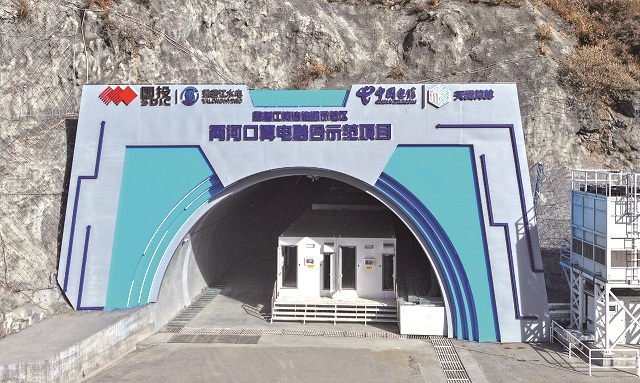
Core Viewpoint - The establishment of the "Lianghekou Power and Computing Integration Demonstration Project" marks a significant step towards building a digital China, integrating data as a key element of the digital economy, and promoting the fusion of the real economy and digital economy [1][22]. Group 1: Project Overview - The Lianghekou project is the first high-altitude rock cave computing center in China, officially launched on December 19, 2025, through a collaboration between Yalongjiang Company and China Telecom Sichuan Branch [4][12]. - The project features six computing cabins located in the construction tunnel of the Lianghekou Hydropower Station, which is situated at an altitude of approximately 2800 meters [6][10]. Group 2: Technical Innovations - The computing cabins are designed to meet stringent requirements for safety, reliability, and stable operating conditions, utilizing the stable geological structure of the tunnel to provide a secure environment for computing equipment [7][11]. - The project achieves a Power Usage Effectiveness (PUE) value of below 1.2, indicating high energy efficiency, with only 0.2 kilowatt-hours used for cooling and lighting per 1.2 kilowatt-hours consumed [11][21]. Group 3: Environmental Impact - The project is closely aligned with green and low-carbon development goals, utilizing green electricity from hydropower to support computing operations, thereby achieving "zero-carbon computing" [8][21]. - The integration of computing power and green energy is expected to enhance the efficiency of energy consumption and contribute to the national "dual carbon" goals [18][22]. Group 4: Applications and Benefits - The computing power provided by the project will support various applications, including artificial intelligence platforms, scientific data processing, and local government digital city construction [16][17]. - The project is part of a larger initiative to develop a comprehensive energy and computing service model, transitioning from an energy supplier to an integrated "energy + computing" service provider [22].
纳斯达克中国金龙指数大涨超4%
Ge Long Hui A P P· 2026-01-02 14:53
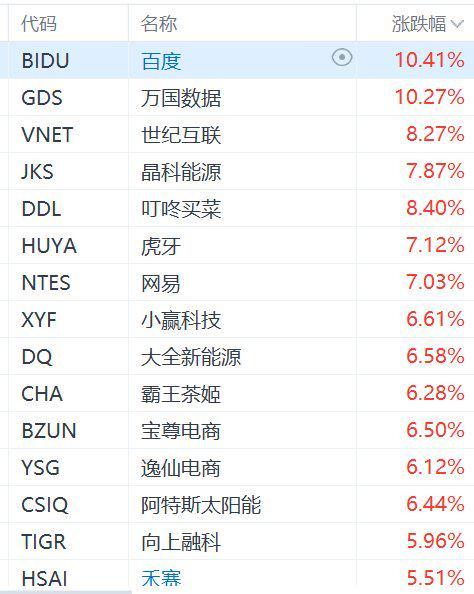
Group 1 - The Nasdaq Golden Dragon China Index saw a significant increase of over 4% in early trading, indicating a strong performance of Chinese stocks in the US market [1] - Notable individual stock performances included Baidu and GDS, both rising over 10%, while other companies like DDL and VNET also experienced substantial gains of over 8% [1] - The overall trend reflects a positive sentiment towards Chinese companies, with multiple stocks showing increases of 6% or more, suggesting a potential recovery or bullish outlook in the sector [1] Group 2 - Other companies such as Tencent Music, iQIYI, and Oriental also saw their stock prices rise by over 4%, contributing to the overall positive performance of Chinese stocks [2]





饮品会引发失眠、心悸?股价大跌!霸王茶姬回应质疑
Zhong Guo Jing Ji Wang· 2025-12-27 11:37
Core Viewpoint - Recent concerns regarding caffeine content in Bawang Chaji's beverages have led to discussions about potential health effects, impacting the company's stock performance significantly since its NASDAQ listing in April 2023 [1][2]. Financial Performance - For Q3 2025, Bawang Chaji reported a net revenue of 3.208 billion yuan, a year-on-year decline of 9.4%, and a net profit attributable to shareholders of 394 million yuan, down 35.8% year-on-year. The net profit margin decreased to 12.4% from 18.3% in the same period last year [2]. - In the first three quarters of 2025, the company achieved a net revenue of 9.933 billion yuan, reflecting a year-on-year growth of 9.5%, while the net profit attributable to shareholders was 1.107 billion yuan, down 37.6% year-on-year. Despite achieving profitability for 11 consecutive quarters, the net profit has declined for two consecutive quarters [2]. Company Response - Bawang Chaji addressed the concerns about caffeine levels, stating that the caffeine content in their tea drinks is comparable to that of a latte and significantly lower than that of an Americano. The company emphasized the presence of various beneficial compounds in tea, which contribute to its unique flavor and health benefits [2].
霸王茶姬美股大跌!公司深夜回应
证券时报· 2025-12-27 01:34
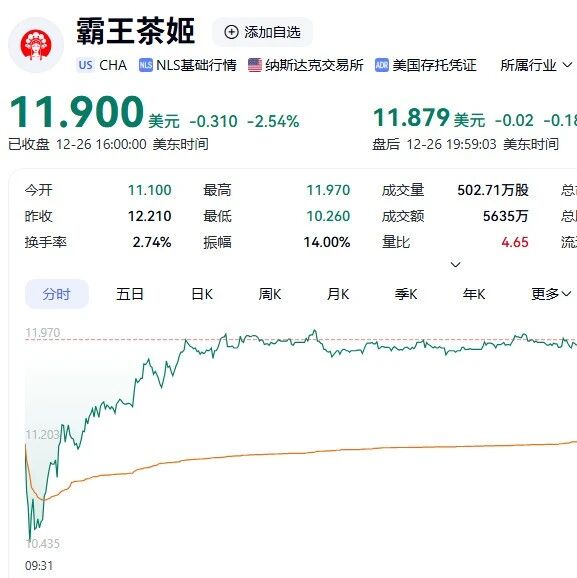
Core Viewpoint - The article discusses the recent stock performance and public response of Bawang Tea Ji, highlighting a significant drop in stock price and the company's efforts to address concerns regarding caffeine content in their products [1][10]. Stock Performance - On December 26, Bawang Tea Ji's stock price fell over 14% at one point, reaching a new low since its listing, and closed down 2.54% at $11.90 [1][2]. - The total market capitalization of Bawang Tea Ji is approximately $2.184 billion, with a price-to-earnings (P/E) ratio of 8.89 [2]. Caffeine Content Controversy - The company acknowledged public concerns regarding caffeine levels, stating that a cup of their tea has caffeine content comparable to a latte and significantly lower than that of an Americano [3][5]. - Bawang Tea Ji emphasized that caffeine is a naturally occurring compound in tea, not an additive, and is referred to as "theine" in cultural contexts [4][10]. Product Development and Innovation - The company has been exploring the development of low-caffeine and caffeine-free tea options, having already launched products that reduce caffeine content by approximately 50% [7][10]. - Bawang Tea Ji aims to maintain the authentic flavor of tea while catering to varying consumer needs, indicating a commitment to continuous research and collaboration with industry experts [8][10]. Legal Response to Misinformation - In response to negative online discussions and accusations regarding high caffeine levels, the company has initiated legal action against the spread of false information that could harm its reputation [10].