CHINA POWER(CPWIY)

Search documents
法国专家直言:中国电力令世界畏惧!但国人竟未察觉这硬核实力?
Sou Hu Cai Jing· 2026-01-24 07:16
Core Insights - China's total electricity consumption is projected to exceed 10.4 trillion kilowatt-hours by 2025, surpassing the combined annual electricity consumption of the EU, Russia, India, and Japan, and more than double that of the United States [4][6][40] - The rapid growth from 1 trillion to 10 trillion kilowatt-hours in just 20 years is unprecedented among major economies, showcasing China's economic strength [4][6] Electricity Consumption Growth - Electricity consumption is a key indicator of economic performance, reflecting China's steady economic development over decades [6] - Despite global economic uncertainties, China's electricity consumption is expected to grow by 5% year-on-year, demonstrating the resilience and vitality of its large-scale economy [6] Energy Supply and Infrastructure - By November 2025, China's installed capacity for wind and solar power is expected to reach 1.76 billion kilowatts, a 34% increase from the previous year, with non-fossil energy sources accounting for over 60% of total generation [8][10] - The country's electricity transmission capacity will reach 370 million kilowatts, supported by 46 ultra-high voltage lines, facilitating efficient energy distribution across regions [10][11] Structural Changes in Electricity Consumption - The industrial sector remains the largest consumer of electricity, accounting for approximately 64%, but the growth rate of high-energy-consuming industries is only 1.8%, while high-tech and equipment manufacturing sectors see a growth rate of 6.4% [18][20] - The rapid growth of the tertiary sector and residential electricity consumption is becoming a significant driver of electricity demand, with internet services and electric vehicle charging industries experiencing substantial increases [22][24] Transition to Electricity Exporter - China has transitioned from being a major electricity consumer to an electricity exporter, supplying power to 16 neighboring countries and offering comprehensive energy solutions and technical standards [28][34] - The successful implementation of ultra-high voltage technology has positioned China as a leader in the global electricity sector, with 20 international standards established [30][32] Global Influence and Responsibility - China's overseas investment in the electricity sector has reached $110.4 billion, enhancing its influence in the global electricity market [36] - The country's commitment to green development and energy transition is recognized globally, contributing to its status as a key player in the international energy landscape [36][40]



马斯克:美国AI发展遭电力卡脖 中国电力增长十分惊人
Xin Lang Cai Jing· 2026-01-23 12:57
Group 1 - Elon Musk warns that the biggest obstacle to AI development in the U.S. is insufficient power supply, while China does not face this issue [1][5] - Musk states that the production of AI chips is growing exponentially, but power supply limitations hinder the efficiency of AI data centers in training and deploying AI models [1][5] - Musk emphasizes that China's power growth rate is remarkable, particularly in the solar energy sector, giving it a decisive advantage in the AI race due to its large-scale power supply capabilities [1][5] Group 2 - The outdated U.S. power grid system, resulting from decades of underinvestment and aging infrastructure, threatens the speed of AI deployment and raises concerns about the U.S. falling behind in the AI competition [1][5] - Energy experts reveal that two large data centers in Santa Clara, California, home to Nvidia, may remain idle for years due to power supply shortages, while the high energy consumption of AI is driving up energy costs in the region [2][6] - Former President Trump encourages tech companies to build nuclear power plants for AI development, claiming that the government will approve such projects within three weeks, despite the lengthy approval process typically required for nuclear plants [2][6]

2025年中国电力市场交易电量同比增长7.4%
Zhong Guo Xin Wen Wang· 2026-01-23 12:49
Core Insights - In 2025, China's electricity market transaction volume reached 6.6 trillion kilowatt-hours, marking a year-on-year growth of 7.4% and accounting for 64.0% of the total electricity consumption, an increase of 1.3 percentage points compared to the previous year [1] Transaction Volume Overview - The provincial transaction volume was 5.0473 trillion kilowatt-hours, reflecting a year-on-year increase of 6.2% [1] - The inter-provincial and inter-regional transaction volume was 1.5921 trillion kilowatt-hours, with a year-on-year growth of 11.6%, including 3.4 billion kilowatt-hours from cross-grid operations [1] Transaction Types - The medium and long-term transaction volume was 6.3522 trillion kilowatt-hours, while the spot transaction volume was 287.2 billion kilowatt-hours [1] - Green electricity transaction volume reached 328.5 billion kilowatt-hours, showing a significant year-on-year increase of 38.3% [1] December 2025 Performance - In December 2025, the total electricity market transaction volume was 608 billion kilowatt-hours, up 6.6% year-on-year [1] - The provincial transaction volume for December was 464.1 billion kilowatt-hours, increasing by 5.3% year-on-year, while the inter-provincial and inter-regional transaction volume was 143.9 billion kilowatt-hours, up 11.3% [1] - The medium and long-term transaction volume for December was 582.2 billion kilowatt-hours, and the spot transaction volume was 25.8 billion kilowatt-hours [1] - Green electricity transaction volume in December was 31.7 billion kilowatt-hours, reflecting a year-on-year growth of 32.3% [1]
中国电力(中电国际)多个储能项目并网
Xin Lang Cai Jing· 2026-01-22 10:08
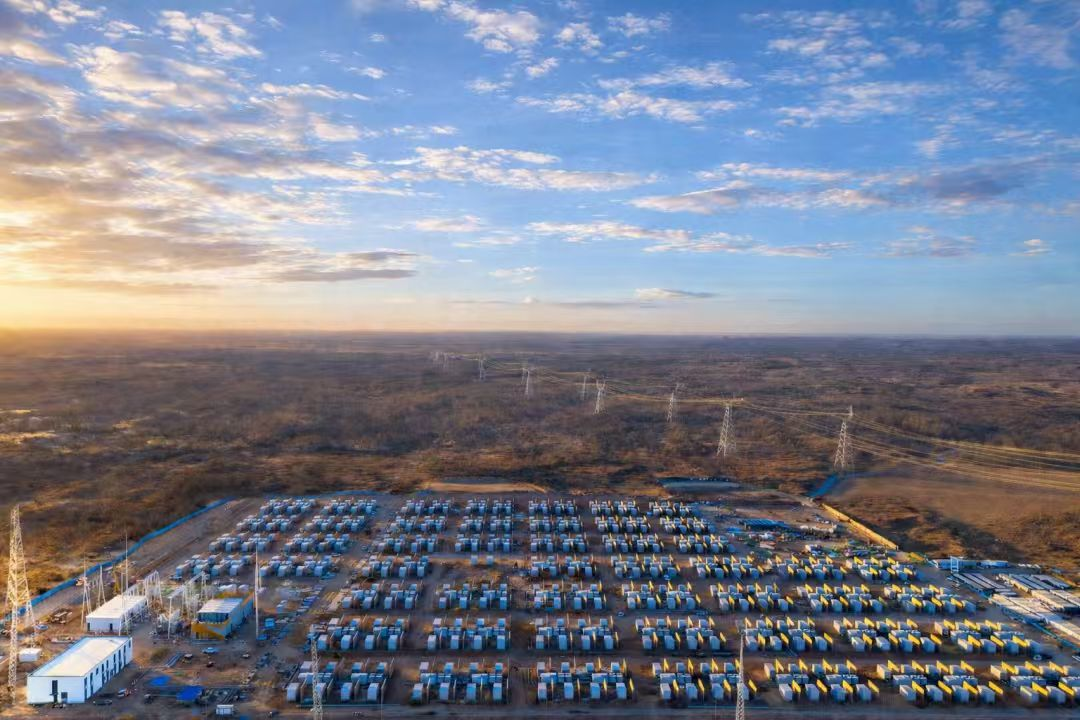
Core Viewpoint - The State Power Investment Corporation's China Power (China Electric International) has successfully commissioned multiple energy storage projects in Inner Mongolia, Gansu, Xinjiang, and Qinghai, which support regional grid peak shaving and frequency regulation, enhancing the optimization of the energy structure [1][5]. Group 1: Project Details - The Inner Mongolia Tongliao 150 MW/600 MWh energy storage project is located near the 500 kV substation in Naiman Banner, Tongliao City. It provides rapid and flexible power support and frequency regulation services to the eastern Inner Mongolia grid, significantly improving the grid's capacity to absorb fluctuating renewable energy sources like wind and solar [3][7]. - The Gansu Jingyuan 10 MW/20 MWh energy storage project is situated in Jingyuan County, Baiyin City, Gansu. The project team implemented specialized technical measures for wind and sand prevention and low-temperature construction, using storage equipment suitable for harsh environments. Once operational, it will provide frequency regulation and backup support for local renewable energy projects, enhancing power quality and renewable energy utilization [3][7]. - The Xinjiang Hami City Yizhou District 10 MW/20 MWh energy storage project serves as a distributed photovoltaic supporting storage project. It will provide rapid power adjustment and smooth output services for nearby photovoltaic power stations, improving the stability of the distribution system and aiding in the construction of a highly resilient and permeable new energy grid in Yizhou District [3][7]. - The Qinghai Gonghe 200 MW/800 MWh energy storage project is located in the Taratan area of Gonghe County, Hainan Prefecture, Qinghai. It has overcome several challenges related to the integration and installation of energy storage systems in cold regions. Upon commissioning, it will enhance the peak shaving and frequency regulation capabilities of the Hainan Prefecture grid, promoting efficient absorption of surrounding wind and solar power generation [4][8]. Group 2: Company Overview - The company, WETOWN Electric, is committed to its mission of "making the world trust Chinese electrical equipment" and adheres to core values of customer-centricity and innovation. It aims to provide solutions and quality services across various sectors, including renewable energy, industrial manufacturing, power grids, data communications, rail transit, and commercial real estate [5][9]. - WETOWN Electric encompasses three main business areas: distribution equipment, energy storage systems, and photovoltaic new materials. It positions itself as a leader in the distribution equipment sector and aims to create a comprehensive product line and industry chain in the energy storage field, contributing to a zero-carbon lifestyle through technological empowerment [5][9].

今年中国电力负荷三创冬季新高
Zhong Guo Xin Wen Wang· 2026-01-21 02:10
Core Insights - China's electricity load reached a record high in winter 2026, surpassing 1.4 billion kilowatts for the first time, peaking at 1.417 billion kilowatts, with daily electricity consumption exceeding 30 billion kilowatt-hours for the first time in winter [1] Group 1: Electricity Load Trends - The national maximum electricity load hit 1.351 billion kilowatts on January 4, setting a new winter historical high [1] - From January 18, due to a widespread cold wave, the national electricity load increased rapidly, rising by 150 million kilowatts in three days, equivalent to Japan's maximum annual electricity load [1] - On January 19 and 20, the electricity load reached new winter historical highs, with January 20 peaking at 1.417 billion kilowatts [1] Group 2: Regional Performance - The electricity load in North China, Northwest China, Northeast China, and 12 provincial-level power grids including Xinjiang and Tibet has set historical highs 75 times since the beginning of winter [1] Group 3: Electricity Consumption - Daily electricity consumption has remained high, with January 5 marking the first time daily consumption exceeded 30 billion kilowatt-hours in winter [1] - Daily electricity consumption also surpassed 30 billion kilowatt-hours on January 5-7 and January 19, indicating an improvement in China's winter energy security capabilities [1] Group 4: Future Actions - The National Energy Administration will guide and supervise local power companies to ensure winter heating and supply, monitoring electricity supply and demand changes daily to address potential risks and ensure stable electricity supply [1]
中国电力行业技能评价服务“走出去”实现突破
Zhong Guo Jing Ji Wang· 2026-01-20 06:06
Core Viewpoint - The China Electricity Council (CEC) is advancing the implementation of the "Belt and Road" initiative by establishing overseas talent evaluation bases and conducting skill assessments for employees in countries like Cambodia, Myanmar, and Uzbekistan, marking a significant breakthrough for the Chinese electricity industry's skill evaluation services abroad [1][2]. Group 1: Talent Evaluation and Training - CEC has successfully integrated four overseas evaluation bases into the electricity industry's skill talent evaluation system, completing skill assessments for enterprises in Cambodia, Myanmar, and Uzbekistan [1]. - A systematic training program was conducted for 18 foreign employees in Cambodia, Myanmar, and Uzbekistan, resulting in all participants passing the vocational ability assessment and obtaining certification [2]. - CEC organized training and evaluation for 47 Chinese employees and 17 Cambodian employees in various roles, marking the first training evaluation for foreign personnel, conducted in both Chinese and Cambodian [2]. Group 2: Future Plans and Market Expansion - CEC plans to further expand the international talent evaluation market by adhering to high standards and regulatory principles, enhancing management of overseas bases, and developing multilingual evaluation resources [3]. - The goal is to establish a stable and sustainable overseas talent training service system to support the construction of talent teams for Chinese electricity companies and contribute to the "Belt and Road" energy cooperation and global energy transition [3].
4万亿投资激活行业景气度,高盛看好中国电力设备企业:长期成长空间打开。
智通财经网· 2026-01-19 14:15
Core Insights - The electric power equipment sector has become a new market focus due to the State Grid's announcement of a 4 trillion yuan fixed asset investment plan, marking a 40% increase from the previous plan and setting a historical high [1] - Goldman Sachs predicts an average annual investment of at least 800 billion yuan, with a compound growth rate of at least 6%, potentially reaching 8% due to the demand from renewable energy consumption and AI data centers [1] Part 01: Transition from UHV to Smart Grid - The 4 trillion yuan investment is not evenly distributed but shows a clear phased structure, reflecting China's strategic shift from "backbone expansion" to "smart upgrades" [2] - By 2026, UHV is expected to be the fastest-growing segment with a year-on-year growth rate of 24%, transitioning to smart grid and distribution network construction thereafter [2] - UHV investment will experience a "short-term high growth, gradual slowdown" process, with a planned new construction of 5 UHV lines in 2026, decreasing to 4 lines annually from 2027 to 2030 [2] Part 02: Investment Trends and Market Dynamics - In 2025, the electric grid industry is expected to show a divergence with "investment growth below expectations but strong equipment bidding" [5] - From January to November 2025, the State Grid's fixed asset investment reached 560.4 billion yuan, a 6% year-on-year increase, with an expected annual growth rate of 11%, lower than Goldman Sachs' previous forecast of 13% [5] - The bidding market for equipment is robust, with a total bidding amount for transmission equipment increasing by 26% year-on-year [5] Part 03: Market Concentration and Competitive Landscape - The strong growth in the bidding market is leading to increased market concentration among leading companies, with the market share of core products like GIS and transformers improving [6] - In the circuit breaker sector, Siyi Electric's market share is projected to rise from 16% in 2023 to 49% in 2025, while TBEA remains the leader in power transformers with a 23% market share [6] - The concentration of market share is driven by technological barriers and capacity advantages, as companies with core technologies and scalable delivery capabilities continue to capture market share [6]


4万亿投资激活行业景气度,高盛看好中国电力设备企业:长期成长空间打开
Zhi Tong Cai Jing· 2026-01-19 14:00
Core Insights - The power equipment sector has become a new market focus due to the State Grid's announcement of a 4 trillion yuan fixed asset investment plan, marking a 40% increase from the previous plan and setting a historical high [1] - Goldman Sachs predicts an average annual investment of at least 800 billion yuan, with a compound growth rate potentially reaching 8% due to the demand from renewable energy consumption and AI data centers [1] Investment Structure and Trends - The 4 trillion yuan investment is characterized by a clear phased structure, reflecting a strategic shift from "backbone expansion" to "smart upgrades" in China's power grid [2] - By 2026, ultra-high voltage (UHV) is expected to be the fastest-growing segment with a year-on-year growth rate of 24%, transitioning to smart grid and distribution network construction thereafter [2] - Investment in distribution networks and smart grids is projected to increase, with distribution network investment growth surpassing that of transmission from 2026 to 2030 [2][3] Market Dynamics and Equipment Demand - The increasing share of renewable energy and the construction of over 40 million charging infrastructures will significantly increase grid volatility, necessitating the adoption of digital technologies [3] - The demand for smart grids will be further intensified by the surge in AI and data center electricity consumption expected between 2028 and 2030 [4] Equipment Bidding and Market Concentration - In 2025, the investment growth rate is expected to be lower than anticipated, but the bidding market remains strong, indicating a divergence in industry dynamics [5] - The total bidding amount for transmission equipment in 2025 is projected to grow by 26%, with significant increases in both primary and secondary equipment categories [5] - Market concentration is increasing, with leading companies gaining market share in key product areas, driven by technological barriers and capacity advantages [6] Long-term Investment Opportunities - The 4 trillion yuan investment presents two main investment lines: short-term beneficiaries from UHV demand and long-term gains from smart grid upgrades, particularly for companies like NARI Technology and Sanyuan Electric [7] - The ongoing concentration of market share among leading firms is expected to enhance their competitive advantages in the evolving landscape of the power equipment sector [7]
马斯克再次预言!2026年AGI降临,中国电力领跑,AI算力竞争
Sou Hu Cai Jing· 2026-01-19 13:11
Group 1 - Elon Musk predicts that AGI will fully arrive by 2026, emphasizing that the true battleground for AI is not chips but electricity, with China poised to dominate this hidden arena [3][13] - Musk states that the future currency will essentially be watts, indicating that electricity will become the hard currency of the future, surpassing Bitcoin and gold [4][13] - The construction of xAI's Colossus2 data center in Tennessee took a year just to secure power access, highlighting the challenges in electricity infrastructure [6][11] Group 2 - China is expected to have three times the power generation capacity of the U.S. by 2026, giving it a significant advantage in the upcoming "power race" [13][44] - The U.S. electrical grid is largely outdated, with many systems dating back to the 1960s and 70s, making it difficult to keep pace with China's advancements [11][44] - The efficiency of AI in processing information poses a threat to white-collar jobs, as AI can perform tasks traditionally requiring human intelligence at a much lower cost and higher efficiency [15][17] Group 3 - Musk predicts that by 2040, the number of robots will reach 10 billion, leading to a significant reduction in production costs and a potential shift towards universal basic income [25][44] - The upcoming Grok5 AI model from xAI will have a parameter count of 60 trillion, indicating a significant leap in AI capabilities [27][29] - Neuralink plans to launch large-scale production of brain-machine interfaces by 2026, which could revolutionize human interaction with technology [31][44] Group 4 - The transition to a new technological era will require individuals to acquire hard skills related to AI collaboration and renewable energy, as traditional educational pathways may become obsolete [40][44] - Companies must focus on electricity, computing power, models, and applications to remain relevant in the face of rapid technological change [46][48] - The urgency of preparing for the impending changes is emphasized, as the countdown to AGI has already begun [48]


不赚钱就停电?俄企断供中国电力,普京淡定抛出神预言定大局
Sou Hu Cai Jing· 2026-01-18 07:37
Core Viewpoint - The recent suspension of electricity exports from Russia to China has been interpreted by Western media as a sign of cooling relations between the two countries, but Russian President Putin's calm response suggests a deeper strategic consideration beyond mere trade disputes [3][5][15]. Group 1: Trade Dynamics - The suspension of electricity exports is a result of ongoing negotiations regarding pricing, with Russia's Inter RAO seeking a price increase of approximately 7% to balance operational costs [8][11]. - China has calculated that accepting the proposed price increase would negate the cost advantages of importing electricity from Russia, leading to a potential shift towards domestic power generation solutions [11]. - Electricity trade constitutes a minor portion of the over $200 billion annual trade volume between China and Russia, indicating that the overall energy cooperation is diversified and not solely reliant on electricity [13]. Group 2: Geopolitical Context - Putin's remarks during a meeting with new ambassadors from 30 countries highlighted a vision for a more equitable multipolar world order, suggesting that global dynamics are shifting beyond simple trade relationships [3][5]. - The focus of global power dynamics is transitioning from individual trade disputes to the broader contest for influence over the new international order, as evidenced by Canada's Prime Minister's visit to China to discuss cooperation [7]. - The Western media's portrayal of the electricity trade issue reflects a misunderstanding of the deeper strategic ties between China and Russia, as they continue to collaborate on various fronts despite minor trade disagreements [15][17]. Group 3: Economic Strategies - China is actively reducing its reliance on the US dollar by decreasing its holdings of US Treasury bonds and increasing its gold reserves, which supports the construction of a multipolar order [20]. - Russia is adapting to Western sanctions by deepening cooperation with emerging market countries and promoting the use of local currencies in trade, further diminishing dependence on Western markets [20]. - The strategic partnership between China and Russia remains robust, with ongoing collaboration in energy, military, and diplomatic areas, despite temporary disruptions in specific trade sectors [20].