HWORLD(HTHT)

Search documents
景林最新动向来了!新进买入英伟达、亚朵、华住集团
Ge Long Hui· 2025-08-10 06:41
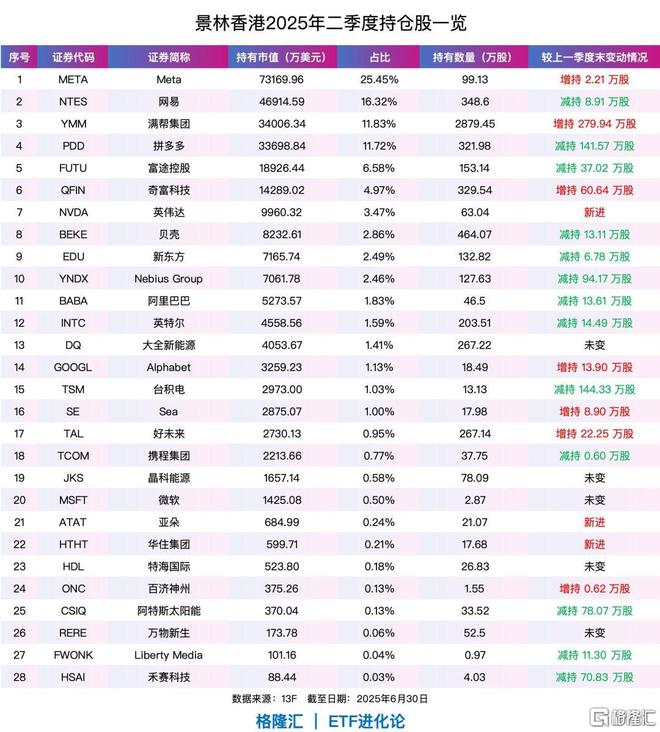
Core Insights - The latest holdings data from Jinglin Hong Kong shows a total market value of $2.873 billion in U.S. stocks as of the end of Q2, approximately 20.6 billion RMB [1] - The firm has made significant adjustments to its portfolio, including new purchases, increased positions, and reductions in several stocks [1] Holdings Summary - New purchases include NVIDIA, Atour, and Huazhu Group [4] - Increased positions in Meta, Manbang Group, Qifu Technology, Alphabet, Sea, TAL Education, and BeiGene [4] - Reduced holdings in NetEase, Pinduoduo, Futu Holdings, Beike, New Oriental, Nebius Group, Alibaba, Intel, TSMC, and Ctrip [4] - Cleared positions in Apple, UnitedHealth Group, Regeneron Pharmaceuticals, Pfizer, Legend Biotech, and ZTO Express [4] Major Holdings - Meta remains the largest holding, with the top ten stocks including NetEase, Manbang Group, Pinduoduo, Futu Holdings, Qifu Technology, NVIDIA, Beike, New Oriental, and Nebius Group, collectively valued at $2.534 billion, accounting for over 88% of total U.S. stock holdings [4] Investment Strategy - Jinglin Asset emphasizes the importance of identifying new companies and conducting forward-looking research on industry fundamentals, focusing on businesses with strong cash flow and effective business models [4] - The firm highlights the significance of monopolistic advantages in business models, including rights, technology, scarce resources, and brand recognition [4] Market Outlook - The firm notes that Hong Kong has become the leading market for IPO financing in the first half of the year, indicating a shift in international capital's perception of Chinese assets [5] - The influx of capital into Hong Kong is seen as a sign of a vibrant and prosperous market, suggesting a rebalancing process that may provide additional rewards for investment portfolios [5]


中信银行郑州分行联合华住集团举办国资公司存量资产盘活与焕新高峰论坛
Zhong Guo Jin Rong Xin Xi Wang· 2025-08-09 11:37
Core Viewpoint - The forum held by CITIC Bank and Huazhu Group focuses on revitalizing state-owned assets and exploring new cooperation opportunities in the context of financial empowerment and brand enhancement [1][2]. Group 1: Forum Overview - The forum titled "Financial Empowerment and Brand Enhancement" was attended by over 200 participants, including key figures from CITIC Bank, Huazhu Group, and local government [1]. - Keynote speeches were delivered by Huazhu Group CEO Jin Hui and CITIC Bank Zhengzhou Branch President Luo Dongwei, emphasizing the importance of activating dormant assets and enhancing brand value [1][2]. Group 2: Financial Solutions and Strategies - CITIC Bank aims to provide comprehensive financial solutions for revitalizing state-owned properties, covering the entire lifecycle from asset acquisition to operational management and industrial transformation [1]. - The bank's "financing + asset management + intelligence" model is designed to support the revitalization of existing assets in the tourism and cultural sectors [1]. Group 3: Industry Insights and Future Outlook - Jin Hui discussed the transformation and development trends in the hotel industry driven by current policies, highlighting the potential for state-owned "dormant assets" to generate new economic value [2]. - The forum included a roundtable discussion featuring leaders from various sectors, focusing on how to leverage financial support and brand empowerment to unlock the potential of state-owned assets [2]. Group 4: Commitment to Economic Development - The successful hosting of the forum reflects CITIC Bank's commitment to exploring new paths for state-owned asset transformation and building a new ecosystem for industrial-financial cooperation [2]. - CITIC Bank Zhengzhou Branch plans to continue deepening collaborations and innovating financial products and services to contribute to the prosperity of the Henan tourism industry and high-quality economic development [2].

H World Group Limited Schedules Second Quarter and Interim of 2025 Earnings Release on August 20, 2025
Globenewswire· 2025-08-08 10:15
Core Viewpoint - H World Group Limited, a significant player in the global hotel industry, is set to release its unaudited financial results for the second quarter and interim of 2025 on August 20, 2025, after trading hours in Hong Kong and before the U.S. market opens [1]. Company Overview - H World Group Limited operates 11,685 hotels with a total of 1,142,158 hotel rooms across 19 countries as of March 31, 2025 [5]. - The company’s hotel brands include HanTing Hotel, JI Hotel, Orange Hotel, Crystal Orange Hotel, IntercityHotel, Hi Inn, Ni Hao Hotel, Elan Hotel, Zleep Hotels, Starway Hotel, CitiGo, Manxin Hotel, Madison Hotel, MAXX, Blossom House, Joya Hotel, Steigenberger Hotels & Resorts, Jaz in the City, Steigenberger Icon, and Song Hotels [5]. - H World holds master franchisee rights for Mercure, Ibis, and Ibis Styles, along with co-development rights for Grand Mercure and Novotel in the pan-China region [5]. Business Model - H World employs a mix of leased and owned, manachised, and franchised models in its operations [6]. - As of March 31, 2025, 8% of H World’s hotel rooms are operated under the lease and ownership model, while 92% are under the manachise and franchise models [6].


华住集团-S(01179.HK)拟8月20日举行董事会会议以审批中期业绩
Ge Long Hui· 2025-08-08 10:06
格隆汇8月8日丨华住集团-S(01179.HK)公告,公司董事会审核委员会会议将于2025年8月20日(星期三) (香港时间)举行,藉以(其中包括)审议及批准公司截至2025年6月30日止3个月及6个月的未经审核财务业 绩及业绩发布。 ...
华住集团(01179) - 审核委员会会议日期及2025年第二季度及中期财务业绩公告日期及有关现金股...
2025-08-08 10:00
審核委員會會議日期 及 2025年第二季度及中期財務業績公告日期 及 有關現金股息的董事會決議日期 香港交易及結算所有限公司及香港聯合交易所有限公司對本公告的內容概不負責,對其準確性 或完整性亦不發表任何聲明,並明確表示概不會就本公告全部或任何部分內容而產生或因倚賴 該等內容而引致的任何損失承擔任何責任。 H World Group Limited 華住集團有限公司 (英文前稱Huazhu Group Limited) (於開曼群島註冊成立的有限公司) (股份代號:1179) 華住集團有限公司(「本公司」)宣佈,本公司董事會(「董事會」)審核委員會會議將 於2025年8月20日(星期三)(香港時間)舉行,藉以(其中包括)審議及批准本公司 截至2025年6月30日止三個月及六個月的未經審核財務業績(「業績」)及業績發佈。 華住集團有限公司 季琦 執行董事長 香港,2025年8月8日 於本公告日期,董事會包括董事季琦先生(執行董事長)及鄭潔女士(執行董事); 獨立董事吳炯先生、趙彤彤女士、尚健先生、許廷芳先生及曹蕾女士。 業績將於2025年8月20日(星期三)(香港時間)香港聯合交易所有限公司交易時段 後及美國市 ...
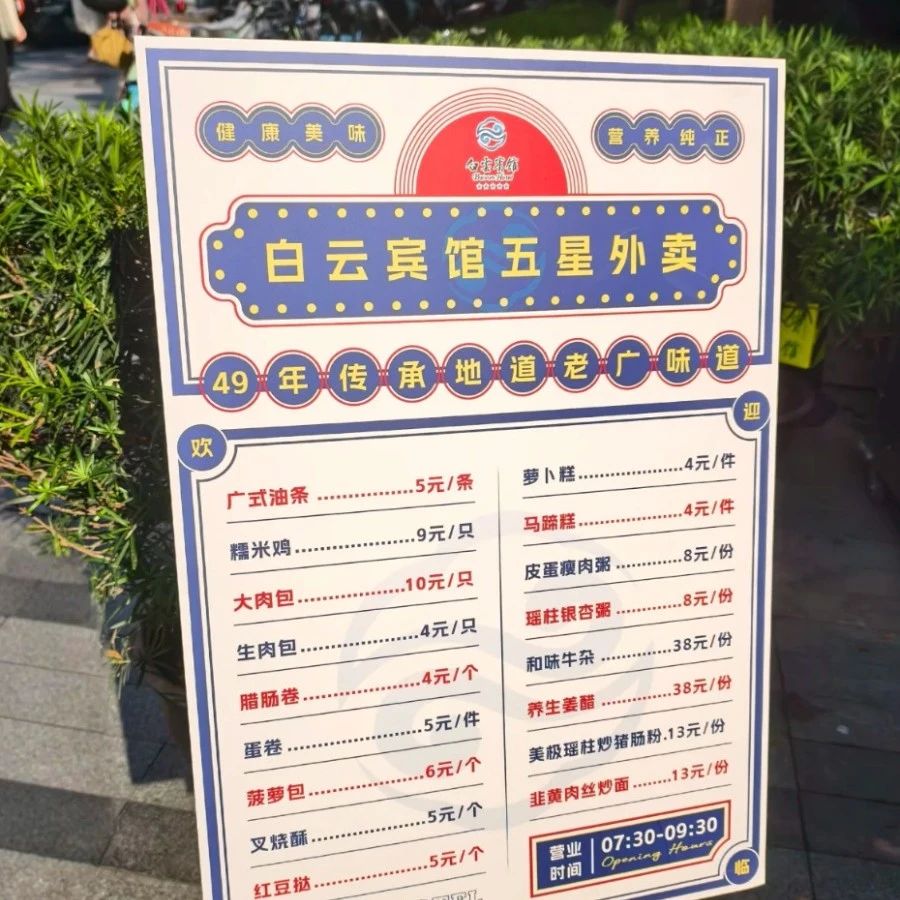
五星酒店摆摊自救,一天能卖6万元
21世纪经济报道· 2025-08-08 05:01
Core Viewpoint - The hotel industry is facing intense competition and is at a critical juncture where transformation is necessary for survival, leading to the emergence of street food stalls by luxury hotels as a new revenue stream [4][5][8]. Group 1: Industry Challenges - The hotel industry is experiencing oversupply, with major hotel groups rapidly expanding their presence, leading to a situation where more hotels are competing for fewer customers [5][8]. - Key performance indicators for major hotel chains have declined, with Jinjiang Hotels reporting a 5.78% drop in RevPAR and a 11.19 yuan decrease in ADR [5][7]. - The high-end hotel sector has seen a significant reduction in revenue from dining services, which were previously a major income source, as traditional banquet bookings have decreased [6][8]. Group 2: Transformation Strategies - Hotels are increasingly adopting street food stalls as a strategy to diversify income and attract customers, leveraging their brand reputation and supply chain advantages [9][12]. - The average daily revenue from these street food operations ranges from 10,000 to 60,000 yuan, indicating a potential but limited revenue source compared to traditional banquet services [11]. - The shift towards street food is seen as a temporary measure to generate additional revenue while hotels continue to focus on their core business of meetings and banquets [12][13]. Group 3: Consumer Perception and Market Response - Consumers appreciate the hygiene and quality associated with food from luxury hotels, which is a significant advantage over traditional street vendors [9][11]. - There are concerns regarding food safety and the sustainability of outdoor food stalls, prompting hotels to consider indoor setups and delivery options to enhance customer experience [11][12]. - Regulatory support is emerging to facilitate outdoor operations, indicating a potential for the "outdoor economy" to become a more structured part of the hotel industry [12][13].


2024年国内酒店业扩张加速,华住锦江争霸亚朵紧追
Sou Hu Cai Jing· 2025-08-08 03:46
Core Viewpoint - The domestic hotel industry is experiencing a paradox where, despite a booming tourism market in 2024, hotel profitability is declining due to increased competition and cost pressures, leading to a decrease in key performance metrics such as RevPAR, ADR, and occupancy rates [1][4][6]. Industry Overview - The domestic tourism market is thriving, with significant increases in travel volume and spending, yet the hotel industry is facing challenges with declining revenue per available room (RevPAR) across all hotel tiers [3][4]. - In 2023, the hotel industry transitioned from a high base to a normalized state, with many companies struggling due to intense competition and rising costs [6]. Financial Performance - Major hotel chains like Huazhu Group reported a revenue of 23.89 billion yuan, with a net profit of 3.048 billion yuan, reflecting a year-on-year revenue growth of 9.18% but a profit decline of 25.39% [7]. - RevPAR for Huazhu was 235 yuan, with an average daily rate (ADR) of 289 yuan, both showing declines of 3% and 3.2% respectively, while occupancy rate (OCC) slightly increased to 81.2% [8]. - Other hotel brands also reported similar declines in RevPAR and ADR, indicating a widespread trend across the industry [8]. Market Dynamics - The hotel market is shifting towards a supply-demand imbalance, with the number of hotels exceeding pre-pandemic levels while tourism numbers remain below 2019 figures [15]. - The total number of hotels in China surpassed 360,000 in 2024, representing 109% of the 2019 hotel count, while domestic tourism was only at 90% of 2019 levels [15]. Expansion Strategies - Despite the challenging environment, hotel companies continue to expand aggressively, with Huazhu Group planning to open 2,300 new hotels in 2025, maintaining a strong growth trajectory [13]. - Huazhu's expansion strategy focuses on a franchise and licensing model, with over 90% of new hotels opened under these models, allowing for a lighter asset operation [14]. - Other hotel chains like Jinjiang and Shoulv also reported significant new openings, indicating a competitive push for market share [12]. Emerging Trends - The hotel industry is increasingly targeting lower-tier cities for growth, as these areas show potential for higher revenue due to rising disposable incomes [15]. - The shift from a seller's market to a buyer's market is evident, with high-end hotels being put up for sale and increased competition leading to price reductions in hotel supplies [16]. Challenges and Risks - The rapid expansion of hotel chains may lead to intensified price wars and further pressure on profitability, as evidenced by declining ADR and RevPAR across the board [15]. - Companies like Atour are also diversifying into retail, with significant revenue from products like sleep pillows, but face increasing competition from other brands entering the retail space [20].



市场变了,酒店们压力更大了
3 6 Ke· 2025-08-08 02:48
Core Viewpoint - The domestic hotel industry is facing significant challenges despite a booming tourism market, with declining revenue per available room (RevPAR), average daily rate (ADR), and occupancy rates, leading to increased pressure on hotel operators [1][2][4]. Industry Overview - In 2024, the domestic tourism market is thriving, with significant increases in travel volume and spending, yet the hotel sector is experiencing operational difficulties [2][4]. - The overall RevPAR for the hotel industry decreased by 9.7% year-on-year, with ADR down by 5.8% and occupancy rates down by 2.5% [5][9]. Company Performance - Huazhu Group reported a revenue of 23.89 billion yuan, with a net profit of 3.048 billion yuan, marking a year-on-year growth of 9.18% in revenue but a decline of 25.39% in profit [4]. - Huazhu's RevPAR was 235 yuan, ADR was 289 yuan, and occupancy rate was 81.2%, showing a decline in RevPAR and ADR by 3% and 3.2% respectively [5]. - Jinjiang Hotels and Shoulv Hotels also reported declines in RevPAR, ADR, and occupancy rates, indicating a trend across the industry [5]. Market Dynamics - The hotel market is transitioning to a "stock era," with increased competition and cost pressures leading to a buyer's market [12]. - The supply-demand imbalance is evident, with over 360,000 hotels in China, surpassing pre-pandemic levels, while tourism numbers remain below 2019 figures [9][10]. Expansion Strategies - Despite the challenges, hotel companies are aggressively expanding, with Huazhu planning to open 2,400 new hotels in 2024, and other brands like Jinjiang and Atour also increasing their hotel counts [7][19]. - The shift towards a franchise and management model is prevalent, with over 90% of Huazhu's new hotels opened under these models [7]. Emerging Trends - The focus is shifting towards lower-tier markets, with significant growth potential in county-level cities, where hotel chain penetration is still low [10][11]. - Atour Group is also diversifying its revenue streams, with retail business contributing approximately 30% to its total revenue in 2024 [16]. Competitive Landscape - The competitive landscape is evolving, with Huazhu leading in revenue but Jinjiang still ahead in the number of hotels [19]. - Atour Group is also gaining ground, with a revenue of 7.248 billion yuan, narrowing the gap with Shoulv Hotels [19].
华住上涨2.36%,报31.2美元/股,总市值95.76亿美元
Jin Rong Jie· 2025-08-06 13:46
Core Viewpoint - H World Group (华住) reported a revenue of 5.395 billion RMB for the fiscal year ending March 31, 2025, reflecting a year-on-year growth of 2.22%, while the net profit attributable to shareholders reached 894 million RMB, marking a significant increase of 35.66% [1]. Financial Performance - As of August 6, H World Group's stock opened at $31.2 per share, with a trading volume of $1.3288 million and a total market capitalization of $9.576 billion [1]. - The company is set to disclose its mid-year financial report for the fiscal year 2025 on August 19, 2023 [1]. Company Overview - H World Group is a globally recognized hotel group originating from China, operating 8,176 hotels across 17 countries as of June 30, 2022, with a total of 773,898 rooms [2]. - The company manages a diverse portfolio of brands, including Hanting, Hi Inn, and others, and operates under various business models: leasing and ownership, management franchising, and licensing [2]. - As of June 30, 2022, 14% of the hotel rooms were operated under leasing and ownership, while 86% were managed through franchising and licensing models [2].
中共中央政治局召开会议;资金面均衡偏松,债市明显回暖
Dong Fang Jin Cheng· 2025-08-05 13:24
Monetary Policy and Economic Outlook - The Central Political Bureau of the Communist Party of China decided to hold the Fourth Plenary Session of the 20th Central Committee in October to discuss the 15th Five-Year Plan for economic and social development, emphasizing the need for stable and flexible policies[5] - The government plans to allocate approximately 90% of the 90 billion yuan budget for childcare subsidies from the central finance[6] Market Trends - The bond market showed signs of recovery, with the yield on the 10-year government bond decreasing by 2.75 basis points to 1.7200%[16] - The U.S. Federal Reserve maintained the federal funds rate at 4.25% to 4.5%, marking the fifth consecutive meeting without changes, while the U.S. GDP grew at an annualized rate of 3% in Q2, surpassing expectations[8][9] Financial Market Performance - The bond market experienced a net cash injection of 158.5 billion yuan on July 30, following a 3,090 billion yuan reverse repurchase operation by the central bank[12] - The weighted average interest rates for various repo transactions showed a downward trend, with DR001 and DR007 rates falling to 1.315% and 1.518%, respectively[13][14] Commodity Prices - International crude oil prices increased, with WTI rising by 1.36% to $70.99 per barrel, while natural gas prices fell by 1.89% to $3.016 per MMBtu[10] Bond Issuance and Trading - The bond auction results indicated a competitive bidding environment, with the 1-year agricultural development bond receiving a bid-to-cover ratio of 2.3[18] - The convertible bond market saw a decline, with major indices dropping, and a total trading volume of 84.376 billion yuan, down by 5.53 billion yuan from the previous day[24]