HWORLD(HTHT)

Search documents
战略得当:华住集团
citic securities· 2026-02-05 08:17
Group 1: Company Overview - Huazhu Group operates a multi-brand hotel group primarily in China and Germany through direct operation, franchising, and management models[9] - Directly operated and leased hotels account for only 4% of Huazhu's total hotel count but contribute 42% of domestic revenue in 2025[5] Group 2: Financial Insights - Huazhu's estimated fixed costs account for 68% of total costs, indicating high operating leverage with a leverage ratio of 2.1 times[5] - The company aims to reach 20,000 hotels by 2030, corresponding to a compound annual growth rate (CAGR) of 9%[6] Group 3: Market Trends - Consumer travel is expected to increase during the upcoming Spring Festival, continuing the positive trend in RevPAR (Revenue per Available Room)[5] - A survey indicates that consumers planning to spend over 5,000 yuan during the Spring Festival will decrease compared to last year, with more opting for self-driving trips[5] Group 4: Risks and Challenges - Key risks include significant deterioration of the Chinese macroeconomy, increased competition leading to margin declines, and rising operational costs that cannot be passed on to consumers[8] - External factors such as severe weather, pandemics, or social unrest could temporarily hinder travel activities[8]

酒店行业研究框架及酒店REITs资产分析
2026-02-04 02:27
第三个就是可能站在管管理公司的角度,它是一个轻资产化管理的模式。主要是因为这个 市场,来看的话,对于决定管理公司来说,他们这个要获得规模的扩张,主要还是以轻资 产化的这种方式去快速获得这个规模的提升。第四个就这个行业的格局,相对比较好一点 因为主要是行业来看,它的整个产品的这个变革是比较小的。因为产品,主要还是围绕着 住宿的这个需求。那主要还是这个,包括这个行业的这个需求单来看,就是它其上除了商 务可能是相对高频,休闲度假其实是个偏低频的。 彭心瑶 兴业证券分析师: 各位线上的投资者,大家晚上好。这边是新政瑞兹和商社分析师彭心瑶。那很感谢大家今 晚在这个时间能接入我们的会议。今年可以说是整个我国 REITs 发展里程碑式的一个一年。 商业不动产的一个发布,为整个行业的资产方,包括投研方都带来了很大的一个变化。那 这一次发布的一个资产类别,除了咱们的老朋友,包括说奥莱、购物中心、写字楼等等, 也出现了酒店这一种新的业态。那刚好借这一次的一个机会。也是很荣幸邀请到了我们研 究院这边酒店行业的一个资深分析师,熊超总熊超老师给我们分享整个酒店行业的研究框 架和发展的一个情况。 那同时也从他本身研究酒店十余年的一个视角 ...

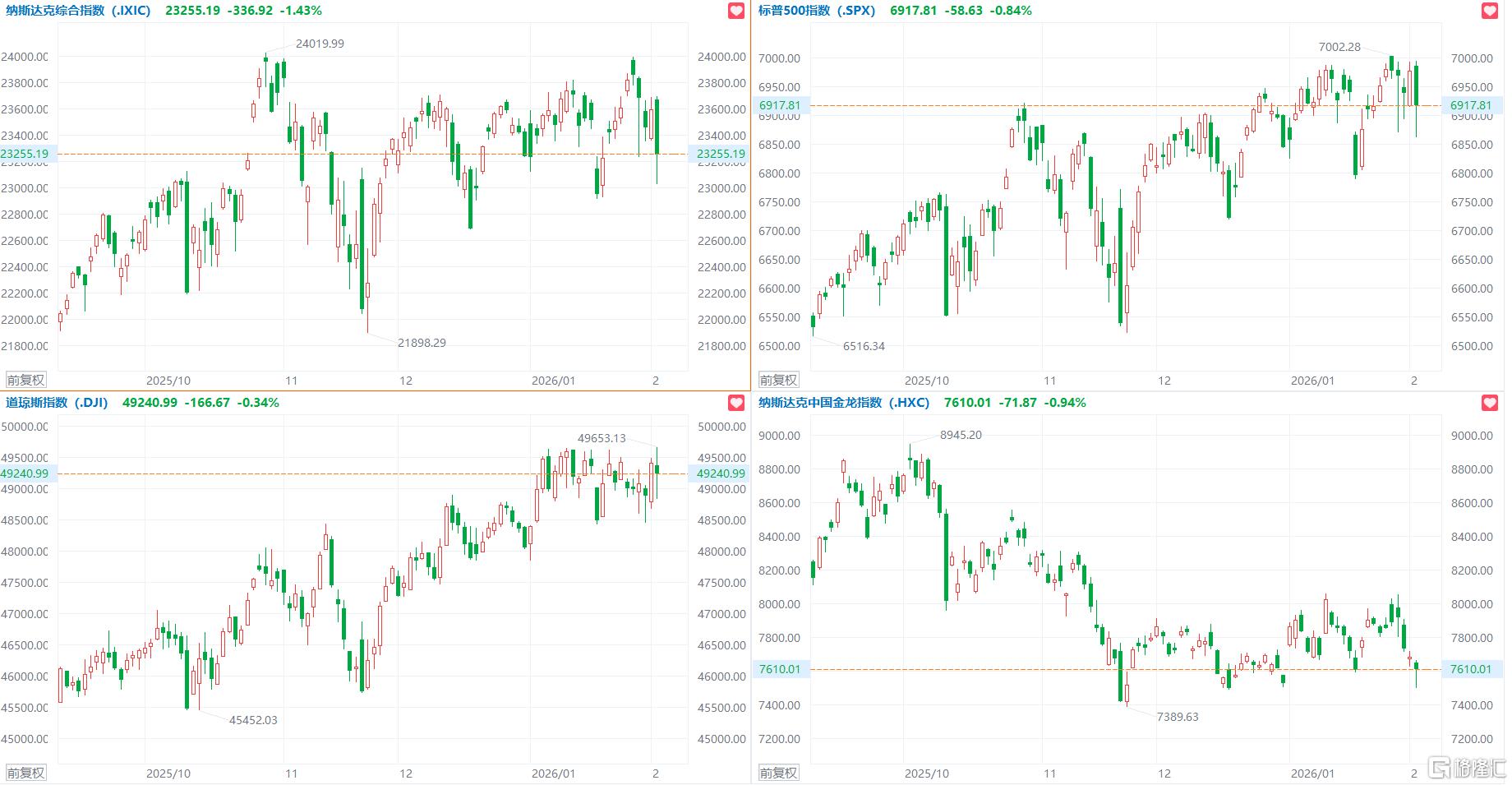
纳指收跌1.43%,沃尔玛市值首次突破1万亿美元,中概指数跌0.94%
Ge Long Hui· 2026-02-04 00:33
Market Overview - The three major U.S. stock indices closed lower, with the Dow Jones down 0.34%, the Nasdaq down 1.43%, and the S&P 500 down 0.83% [1] - Popular technology stocks experienced declines, with Broadcom falling over 3%, and Microsoft, Nvidia, and Meta each dropping over 2% [1] Sector Performance - The rare earth, non-ferrous metals, and precious metals sectors saw significant gains, with gold resources rising over 20%, Southern Copper up over 11%, Americas Silver up over 8%, and Pan American Silver up over 5% [1] - Conversely, application software, cryptocurrency, and weight loss drug stocks faced notable declines, with Novo Nordisk down over 14%, Coinbase and Circle each down over 4%, and Eli Lilly and Pfizer each down over 3% [1] Notable Company Movements - Walmart's stock increased by 2.94%, marking its market capitalization surpassing the $1 trillion milestone for the first time [1] - The Nasdaq Golden Dragon China Index fell by 0.94%, with significant declines in popular Chinese stocks such as Daqo New Energy down 5.6%, Bilibili down 4%, and Kingsoft Cloud down 3.5% [1] - Alibaba dropped 2.9%, while NIO rose 0.8%, Pony.ai increased by 2%, Huazhu up 2.2%, New Oriental up 2.3%, Li Auto up 2.7%, Canadian Solar up 4.1%, and Xpeng up 4.3% [1]


不止于稳!这家公司的“固收 +” 硬核实力藏不住了
21世纪经济报道· 2026-02-02 07:11
想赚点超额收益,又怕本金亏了;想求稳,又不甘心只拿存款利息"—— 这大概是当下大多数投 资者的共同纠结。 l 对 于 希 望 平 衡 收 益 与 波 动 的 稳 健 型 投 资 者 , 均 衡 稳 健 ( 如 汇 添 富 鑫 享 添 利 六 个 月 持 有 混 合)与均衡积极(如汇添富双享回报债券、双鑫添利债券)两类策略提供了精细化的解决方 案。前者更注重组合的稳定性,后者则在稳固底仓基础上,通过更积极的资产再平衡或多资 产阿尔法挖掘,力求在可控波动内争取更大回报空间。 l 对 于 看 好 经 济 转 型 、 愿 意 在 约 束 框 架 内 分 享 成 长 红 利 的 进 取 型 投 资 者 , 积 极 成 长 类 产 品 (如汇添富双利增强债券)则为其提供了专属通道。这类产品在明确的波动控制下,将"+"的 部分聚焦于高景气赛道中的优质成长股,为组合注入显著的弹性。 为了更直观地展现这一矩阵的实战效果,我们不妨聚焦两只极具代表性的产品:汇添富双颐 债券与汇添富多元收益债券。 先看汇添富双颐债券,其基金经理为深度价值风格代表人物蔡志文,他始终将低估值与安全 边际奉为选股铁律,着力捕捉三类确定性机会:一是核心价值 ...

“史上最长”春节引发出行热潮,酒店预订量激增七成
Xuan Gu Bao· 2026-01-29 23:13
Group 1 - The travel trend during the Spring Festival is significantly increasing, with hotel bookings during the holiday period rising by 71% year-on-year [1] - Major hotel groups have shown robust pre-sale data for the Spring Festival, with average daily room rates (ADR) for Atour and Huazhu increasing by 46% and 32% respectively on a week-on-week basis [1] - The longer holiday period this year (9 days compared to 8 days last year) is expected to drive higher hotel demand, with anticipated government support measures for the industry [1] Group 2 - The hotel sector is currently at a historical cycle bottom, with leading companies shifting their strategy from prioritizing occupancy rates (OCC) to optimizing revenue per available room (RevPAR) [1] - Huazhu has already seen a positive turn in ADR in Q3, indicating a strengthening of pricing power among leading hotel chains [1] - Jin Jiang Hotels is identified as the largest hotel chain in China, while ShouLai Hotels is focusing on the development of standard management and mid-to-high-end hotels, with the proportion of mid-to-high-end hotel rooms increasing to 42.5% by Q3 2025 [1]


华住,如何成为供应商的「佣金之王」?
36氪· 2026-01-28 01:04
Core Viewpoint - The article discusses how Huazhu has leveraged high commission rates to enhance its performance, positioning itself as a leading player in the hotel industry despite challenges faced by its franchisees [4][7][36]. Group 1: Commission Structure and Revenue - Huazhu's overall commission rate is estimated to reach 12%, significantly higher than Ctrip's hotel booking commission rate of approximately 8%-10% [4][26]. - In 2025, Huazhu's total revenue is projected to be 800 billion, with franchisees contributing 703 billion, and Huazhu earning 87 billion from franchisees, resulting in a commission rate of 12.38% [25][26]. - Huazhu has managed to collect service fees from Ctrip, amounting to 1.12 billion and 1.46 billion in 2023 and 2024, respectively, effectively recouping nearly half of its commission expenses [11][12]. Group 2: Franchisee Challenges - Many franchisees report difficulties due to a lack of distance protection, leading to multiple franchises opening within close proximity, which has resulted in declining single-store revenue [7][43]. - Franchisees are increasingly dissatisfied, with reports of high turnover among store managers and complaints about operational inefficiencies [41][46]. - The average occupancy rate and daily room price for Huazhu's franchisees have declined, with single-store revenue dropping from 637 million to 630 million [43][44]. Group 3: Membership and User Base - Huazhu has built a robust membership system, with over 300 million members as of Q3 2025, contributing significantly to its order volume [15][16]. - The central reservation system accounted for 65.1% of Huazhu's room nights, indicating a lower reliance on OTA platforms compared to competitors [16][17]. Group 4: Expansion and Market Strategy - Huazhu has aggressively expanded its franchise model, increasing the number of franchise hotels from 5,746 to 10,380 between 2020 and 2024 [30][31]. - The company has focused on upgrading older hotels, with the proportion of outdated stores dropping from 29% to 4%, while newer versions have increased from 34% to 71% [32][35]. - Despite the rapid expansion, the competitive landscape has intensified, leading to franchisee concerns about profitability and market saturation [38][46].

中国酒店:中国机遇论坛调研要点-China Hotel Sector_ Takeaways from China Opportunity Forum
2026-01-26 15:54
Summary of Key Points from the Conference Call Industry Overview - **Industry**: China Hotel Sector - **Context**: The industry is transitioning into a more normalized phase after post-pandemic volatility, with supply growth slowing due to structural reasons [1][4] Core Insights - **Supply Growth**: - Supply growth has decelerated from double-digit expansion in 1H25 to approximately 7-8% year-over-year in 2H25, and further to 5-6% in 4Q25. This trend is expected to continue into 2026 [4] - Factors contributing to this slowdown include softer RevPAR performance and the end of the post-pandemic rebound, leading to more cautious investment decisions [4] - **RevPAR Outlook**: - Both H World and Atour expect RevPAR to improve year-over-year in 2026, but with differing levels of optimism. H World is more positive about a return to growth, while Atour remains cautious due to macro uncertainties, particularly in business travel [4] - **Regulatory Environment**: - Regulatory scrutiny on Trip.com is expected to have limited direct impact on large hotel groups like H World and Atour, as Trip.com accounts for a small percentage of their traffic. However, it may improve industry transparency and pricing norms [5] Company-Specific Insights - **H World and Atour**: - Both companies are expected to outgrow the industry with sustainable hotel expansion and projected EPS CAGRs of 19% and 27% from 2025 to 2027, respectively [1] - H World and Atour are trading at P/E ratios of 20x and 17x for 2026E, respectively, following strong performance in 2025 [1] - **Atour's Retail Business**: - Atour's retail segment is viewed as a core engine for long-term revenue growth, targeting a five-year CAGR of over 15%, which is expected to outpace hotel revenue growth. The current retail revenue constitutes about 40% of total revenue [5] - The total market for Atour's retail products is approximately RMB 300 billion, with significant room for growth as online penetration and brand awareness increase [5] Additional Considerations - **Market Performance**: - In 2025, H World and Atour's stock prices increased by 42% and 47%, respectively, compared to a 28% increase in MSCI China [1] - **Investment Recommendation**: - The recommendation is to accumulate Atour shares, given its growth potential and current valuation compared to H World [5]
中国住宿业:聚焦高质量增长以提升利润率-China Lodging Focusing on quality growth to drive margins
2026-01-26 15:54
Summary of Conference Call Notes Industry Overview - The lodging industry in China is experiencing a shift towards quality growth, with consumers prioritizing "value-for-quality" as spending power has not fully recovered [3][11] - Domestic travel showed resilience in 2025, with a 18% year-over-year (YoY) growth in domestic travel, although per capita spending decreased by 6% YoY [3][18] - The lodging industry is still under pressure, with overall RevPAR (Revenue per Available Room) remaining sluggish due to oversupply and slow business travel recovery [3][29] Company-Specific Insights H World (HTHT US / 1179 HK) - **Recommendation**: Outperform with a target price of USD 59 / HKD 46, benefiting from an asset-light business transformation aimed at expanding margins [3][11][60] - **Financial Performance**: - Expected RevPAR growth of 4% YoY in 2026, with EBITDA margins projected to increase from 29% in 2024 to 35% in 2026 [4][11] - Net income forecasted to rise from RMB 3,048 million in 2024 to RMB 5,433 million in 2026 [4] - **Market Position**: H World is focusing on midscale and upper midscale segments, with 53% of its portfolio in these categories as of Q3 2025 [34] - **Direct Booking Strategy**: Direct bookings have reached 80%, reducing reliance on online travel agencies (OTAs) [3][37] Atour (ATAT US) - **Recommendation**: Outperform with a target price of USD 48 [3][11][60] - **Financial Performance**: - Expected RevPAR growth of 3% YoY in 2026, with EBITDA margins projected to stabilize around 24% [4] - Revenue growth forecasted to increase from RMB 9,783.9 million in 2025 to RMB 14,107.7 million in 2027 [9] - **Market Position**: Atour is well-positioned in the midscale segment, with a focus on quality hotels and a strategic goal of operating 2,000 quality hotels [34] Jinjiang (600754 CH) - **Recommendation**: Underperform with a target price of RMB 20 [3][11][60] - **Financial Performance**: - Expected RevPAR growth of 3% YoY in 2026, but lower operating efficiency compared to peers [4][11] - Revenue forecasted to increase from RMB 13,464.9 million in 2025 to RMB 15,039.7 million in 2027 [10] - **Market Position**: Jinjiang is focusing on the midscale segment, which accounts for 62% of its total network, but faces challenges with older properties needing renovation [34] Key Trends and Insights - **Consumer Behavior**: There is a notable shift towards quality accommodations at reasonable prices, with consumers prioritizing value over luxury [34] - **Direct Booking Growth**: Major hotel groups are enhancing their membership systems and direct booking channels, leading to improved customer loyalty [3][37] - **Market Dynamics**: The hotel industry is experiencing a consolidation phase, with leading brands gaining market share despite overall sluggish RevPAR recovery [3][29] Risks and Challenges - Potential risks include slower-than-expected RevPAR growth, prolonged recovery in business travel, and market competition leading to potential market-share loss [13][47] - Jinjiang faces specific challenges related to its operating efficiency and the need for a turnaround in its overseas business [11][13] Conclusion The lodging industry in China is navigating a complex landscape characterized by a focus on quality growth and changing consumer preferences. Leading companies like H World and Atour are well-positioned to capitalize on these trends, while Jinjiang faces challenges that may hinder its performance relative to peers.
国信证券:酒店业新周期开启 头部玩家重塑成长价值
智通财经网· 2026-01-26 07:26
Core Viewpoint - The current hotel industry is at a historical cycle bottom, with stock prices leading the fundamental recovery, suggesting a valuation repair is gradually starting [1] Group 1: Industry Overview - The hotel industry is expected to enter a new normal growth phase, with leading companies showing resilience in performance due to supply-side adjustments and demand policy options [2] - The RevPAR (Revenue per Available Room) for leading hotels is anticipated to rebound as the industry stabilizes, with a shift from occupancy-focused strategies to optimal RevPAR strategies [2] - The hotel REITs (Real Estate Investment Trusts) are providing capitalized opportunities for leading companies with operational efficiency advantages [2] Group 2: Company Performance - Leading hotel companies have shown non-linear growth characteristics, driven by cyclical turning points and capital integration, with long-term focus on scale and efficiency [1] - The valuation of leading hotels is influenced by macro supply-demand mismatches, with historical peaks reaching 40-50x during upcycles and dropping to 15-20x during downcycles [1] - Companies like Huazhu have demonstrated significant valuation expansion during mid-upgrade phases, while Atour has shown resilience by leveraging retail business to enhance valuation during industry downturns [1] Group 3: Market Dynamics - The current market dynamics indicate a divergence among companies, with leading firms benefiting from improved pricing power and operational efficiencies [2] - The growth of leisure travel and the decline in business travel demand are contributing to a favorable outlook for the hotel sector, supported by service consumption policies [2] - The ongoing valuation repair phase is characterized by different growth trajectories among leading companies, with Atour and Huazhu leading the charge in performance recovery [3]

全球头部酒店如何通过AI客服提升入住率?【502线上同行】
虎嗅APP· 2026-01-22 13:42
Core Insights - The hospitality and travel industry is facing a critical challenge where customer service is no longer just a response center but a key operational node that impacts conversion rates, repurchase rates, and service efficiency [3] - Travelers are increasingly impatient, prioritizing immediate responses over cleanliness or food quality, leading to rising labor costs exceeding 30% [3][4] Group 1: AI Integration in Customer Service - The integration of AI in customer service is evolving from a simple response system to a comprehensive concierge service that can drive repurchase [7] - AI can reduce ineffective inquiries and compress interaction rounds through dual engines of itinerary and location [7] - The boundaries of proactive care are defined by time thresholds, types of benefits, and push frequency [7] Group 2: Human-AI Collaboration in Customer Service - There is a need to identify which services should be handled by AI and which should remain human-operated across pre-stay, in-stay, and post-stay phases [8] - Examples of both successful and failed cases of intelligent distribution and human-machine collaboration are discussed [8] Group 3: Unique Challenges of AI in Hospitality - The hospitality sector cannot simply adopt retail models for AI customer service due to different operational needs [8] - The effectiveness boundary between scene-level knowledge graphs and Q&A knowledge bases is highlighted [8] - Compliance and safety issues arise when agents transition from "suggestion" to "execution" [8]