Kraft Heinz(KHC)

Search documents
Kraft Heinz to split into two companies
CNBC Television· 2025-09-02 11:04
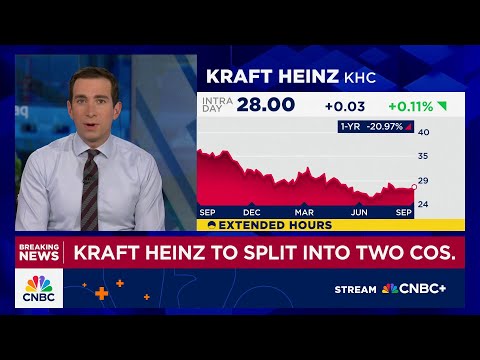
Meanwhile, breaking news. Craft Hind announcing it plans to separate into two companies. The names of the companies will be determined at a later date, but one which it refers to as Global Taste Elevation will include brands like Hines, Philadelphia Cream Cheese, Craft Mac and Cheese.That's obviously the favorite uh and other shelf stable uh meals. And then the other company is going to be called or at least temporarily, North American Grocery, not nearly as exciting. uh which is going to include uh brands ...


X @CNN Breaking News
CNN Breaking News· 2025-09-02 10:52
Corporate Strategy - Kraft Heinz, a packaged foods industry giant, plans to split into two separate publicly traded businesses [1]
Kraft Heinz to split into two companies
CNBC· 2025-09-02 10:38
Company Overview - Kraft Heinz will split into two companies, reversing much of the $46 billion merger from a decade ago that created one of the largest food companies globally [1] - The split aims to enhance capital allocation, prioritize initiatives, and drive scale in promising areas, according to Miguel Patricio, executive chair of the board [4] New Company Structure - The first new company will focus on shelf-stable meals, including brands like Heinz, Philadelphia, and Kraft mac and cheese, projected to have $15.4 billion in net sales for 2024, with approximately 75% of sales from sauces, spreads, and seasonings [2] - The second new company will consist of a "scaled portfolio of North America staples," including Oscar Mayer, Kraft singles, and Lunchables, with an estimated $10.4 billion in net sales for 2024 [3] Historical Context - The merger that created Kraft Heinz in 2015 was initiated by Berkshire Hathaway and 3G Capital, initially well-received by investors, but faced challenges as U.S. sales declined [4] - The company faced significant issues, including a subpoena from the SEC regarding accounting policies, a 36% dividend cut, and a $15.4 billion write-down on major brands [5] - Following these challenges, Kraft Heinz underwent leadership changes, additional write-downs, and divestitures of certain business units, including its cheese unit and nuts division [6] Industry Trends - The split aligns with a broader trend in the food industry, where companies are pursuing breakups to divest from slower-growth categories and enhance investor appeal [7] - Other companies, such as Keurig Dr Pepper and Kellogg, have also pursued similar strategies to separate their business units for better performance [7]
X @The Wall Street Journal
The Wall Street Journal· 2025-09-02 10:05
Breaking: Kraft Heinz is splitting into two public companies, unwinding a much-maligned megamerger from 2015 https://t.co/It2WDvezbH ...
雀巢、好时、百事、通用磨坊将逐步取消人工色素,中国食企如何接招?
3 6 Ke· 2025-09-02 09:47
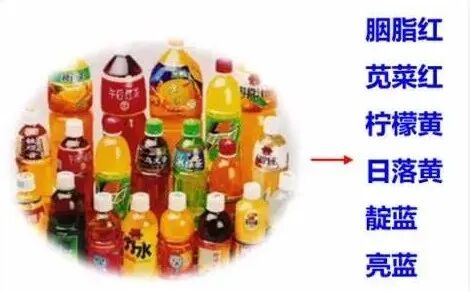
Core Viewpoint - The food and beverage industry is undergoing a significant transformation as major companies announce plans to eliminate artificial colors from their products by 2025, driven by regulatory changes and shifting consumer preferences towards healthier options [6][7][9]. Group 1: Artificial Colors and Their Role - Artificial colors are essential in the food and beverage industry, enhancing the visual appeal of products and masking imperfections [3][5]. - They help consumers identify flavors through color differentiation, such as orange juice being yellow and kiwi juice being green [3]. Group 2: Industry Changes and Regulatory Impact - Major food companies like Nestlé, Kraft Heinz, and PepsiCo plan to phase out artificial colors in response to a new FDA initiative requiring the elimination of certain synthetic colors by the end of 2026 [7][8]. - This shift marks a transition from voluntary clean label movements to mandatory regulatory actions in the U.S. food additive landscape [7]. Group 3: Market Demand and Alternatives - The growing consumer demand for healthier food options is accelerating the removal of artificial colors, as more people scrutinize ingredient lists [9]. - Natural colors are emerging as the primary alternative, although they present challenges in terms of cost and availability, being 3-5 times more expensive than synthetic options [13]. Group 4: Implications for Chinese Brands - Chinese food companies are likely to follow suit in eliminating artificial colors, especially as international brands introduce natural color products in the Chinese market [15][17]. - Some Chinese brands have already begun this transition, emphasizing clean labels and natural ingredients to meet consumer expectations [17].


巴菲特世纪合并十年后却“分家”,传卡夫亨氏(KHC.US)接近分拆
智通财经网· 2025-08-30 04:09
Core Viewpoint - Kraft Heinz Company is nearing a split plan to separate its grocery business from its faster-growing condiment business, with an announcement expected next week [1] Group 1: Split Plan Details - The grocery business, which includes products like Kraft Macaroni & Cheese and Capri Sun, is estimated to be valued at approximately $20 billion [1] - The remaining business will focus on ketchup and sauces, forming a smaller independent company [1] - This split represents a reversal of the 2015 merger between Kraft Foods Group and H.J. Heinz Company, which created the third-largest food and beverage company in the U.S. [1] Group 2: Historical Context - The 2015 merger was driven by Berkshire Hathaway and 3G Capital, with Kraft shareholders owning 49% and Heinz shareholders owning 51% of the combined entity [1] - Initially, the combined companies had revenues of about $28 billion, which later declined to $6.35 billion [1][2] Group 3: Financial Performance and Challenges - Following the merger, Kraft Heinz initiated cost-cutting measures and attempted acquisitions, including a failed $143 billion bid for Unilever in 2017 [2] - The company faced declining sales due to shifting consumer preferences towards healthier food options, leading to a $15 billion impairment charge for its Kraft and Oscar Mayer brands [2] - The stock price of Kraft Heinz has dropped 61% since the merger, while the S&P 500 has increased by 237% during the same period [2] Group 4: Current Situation and Analyst Opinions - Rising production costs have further eroded Kraft Heinz's profitability, with projections indicating losses by 2025 [4] - Analysts express skepticism about the split's potential to create value, with concerns that it may result in two struggling companies [4] - Since rumors of the split emerged, Kraft Heinz's stock has only risen by 3% [4]
报道称卡夫亨氏下周或宣布拆分,撤销2015年巴菲特牵头的合并交易
Hua Er Jie Jian Wen· 2025-08-29 22:01
Group 1 - Kraft Heinz is nearing a split plan to reverse the 2015 merger led by Buffett and 3G Capital [1] - The split could be announced as early as next week, with plans to divest most grocery businesses, potentially creating a new entity valued at up to $20 billion [1] - The split aims to refocus on faster-growing condiment businesses that align with current consumer preferences [1] Group 2 - The split reflects a broader trend in the food and beverage industry, where companies are reassessing their portfolios to attract investors [3] - Major companies like Kellogg and Dr Pepper are also undergoing splits to create more specialized and flexible business structures [3][4] - This trend indicates a demand for adaptability in response to changing consumer needs and market conditions [4]
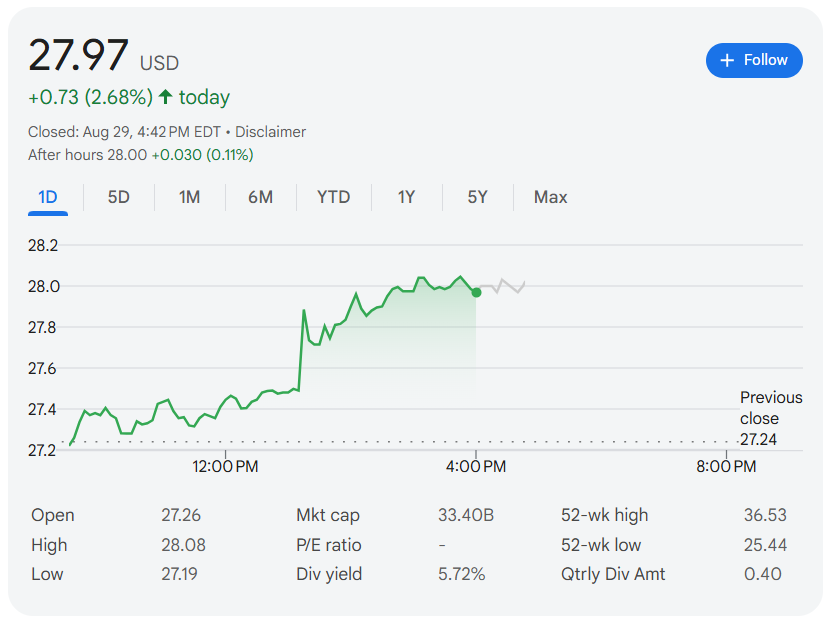
Why Is Kraft Heinz (KHC) Up 0.7% Since Last Earnings Report?
ZACKS· 2025-08-29 16:36
Core Insights - Kraft Heinz reported second-quarter 2025 results with adjusted earnings of 69 cents per share, surpassing the Zacks Consensus Estimate of 64 cents, but reflecting an 11.5% year-over-year decline [3] - The company generated net sales of $6,352 million, down 1.9% year over year, yet exceeding the Zacks Consensus Estimate of $6,286 million [4] - Organic sales decreased by 2% year over year, with a projected decline of 3.2% [4][12] Financial Performance - Adjusted gross profit was $2.17 billion, a decrease of 5.6% from the previous year, with an adjusted gross margin contraction of 140 basis points to 34.1% [6] - Adjusted operating income fell 7.5% year over year to $1.3 billion, primarily due to higher commodity cost inflation [7] - Cash and cash equivalents at the end of the quarter were $1.57 billion, with long-term debt of $19.3 billion and total shareholders' equity of $41.4 billion [10] Segment Performance - North America: Net sales of $4.76 billion declined 3.3% year over year, with organic sales down 3.2% [8] - International Developed Markets: Net sales of $897 million increased by 1.3% year over year, but organic sales declined by 2.2% [9] - Emerging Markets: Net sales of $698 million rose by 4.2% year over year, with organic sales growing by 7.6% [9] Future Outlook - For 2025, Kraft Heinz expects organic net sales to decline between 1.5% and 3.5% year over year, with management anticipating sequential improvement in organic sales [12] - The company projects adjusted earnings per share in the range of $2.51 to $2.67 [12] - Recent estimates have shown a downward trend, with a consensus estimate shift of -8.25% [13]

Can Kraft Heinz's Strategic Moves & Innovations Drive Growth in 2025?
ZACKS· 2025-08-18 16:01
Core Insights - Kraft Heinz Company is redefining the consumer goods space through a blend of tech-driven efficiency, product innovations, sustainable packaging, and a focused growth strategy [1] - The company is leveraging strategic pricing actions to boost performance, with a 0.7 percentage point increase in pricing year over year during Q2 2025, primarily driven by price increases in coffee [2] - Kraft Heinz's innovation strategy focuses on delivering high-quality, convenient solutions that meet evolving consumer needs, emphasizing family-friendly meals that can be prepared quickly [3][5] Product Innovation - The company is enhancing core products with globally inspired flavors, focusing on popular items like Mac & Cheese, Lunchables, and Mayo [4][11] - Kraft Heinz is pursuing a multi-pronged growth strategy centered on innovation and relevance, renovating its core portfolio while introducing bold flavors to appeal to modern tastes [5] Financial Performance - Kraft Heinz shares have decreased by 0.7% over the past three months, compared to a 3.4% dip in the industry [8] - The company trades at a forward price-to-earnings ratio of 10.52X, significantly lower than the industry average of 15.67X [9] - The Zacks Consensus Estimate for KHC's 2025 EPS indicates a year-over-year decline of 15.7%, while the estimate for 2026 shows growth of 2.9% [12]