
Lilly(LLY)

Search documents
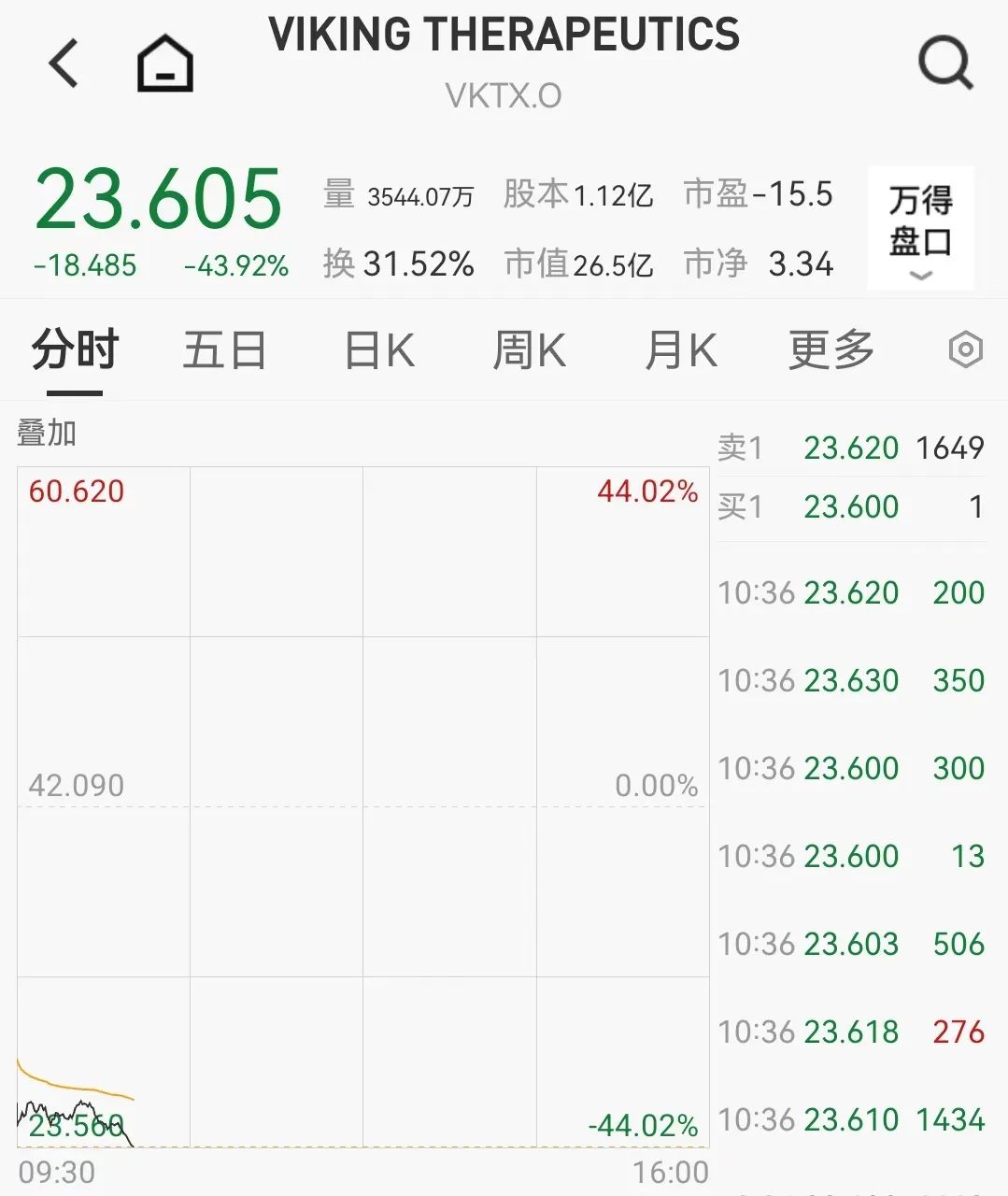
“减肥药”,史诗级暴跌!
Zhong Guo Ji Jin Bao· 2025-08-19 16:00
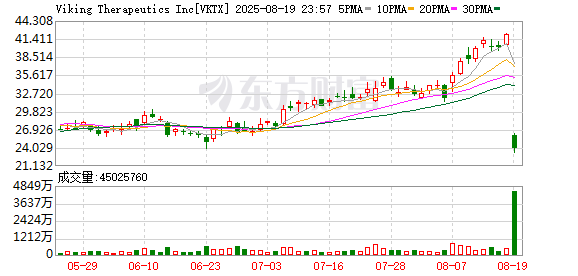
Core Viewpoint - Viking Therapeutics' stock plummeted nearly 44% following disappointing mid-stage trial results for its oral weight loss drug VK2735, raising concerns about its competitiveness against established players like Eli Lilly and Novo Nordisk [1][3]. Group 1: Company Performance - Viking Therapeutics' stock opened down nearly 44%, marking its largest intraday drop since April 2016, with a market capitalization of $2.65 billion [1][2]. - The company reported that VK2735 could help patients lose up to 12.2% of their weight, with 80% of participants losing more than 10% [3]. - However, approximately 28% of patients dropped out of the trial within three months, which negatively impacted investor confidence [3][4]. Group 2: Industry Context - Eli Lilly's oral weight loss drug Orforglipron also faced a stock drop of over 14% after its trial results showed a 12.4 kg average weight loss over 72 weeks, with 59.6% of participants losing at least 10% of their weight [6]. - Despite the drop, analysts believe the sell-off was an overreaction, citing the strength of Eli Lilly's core growth drivers [6][7]. - Comparatively, Viking's trial results appear less favorable due to the shorter trial duration and higher dropout rates, which could hinder its market position [7].


“减肥药”,史诗级暴跌!
中国基金报· 2025-08-19 16:00
Core Viewpoint - Viking Therapeutics experienced a significant stock drop of nearly 44%, marking its largest intraday decline since April 2016, following disappointing mid-term trial data for its oral weight loss drug VK2735 [2][5]. Group 1: Viking Therapeutics - The mid-term trial data for VK2735 indicated that patients could lose up to 12.2% of their weight, with 80% of participants reporting a weight loss exceeding 10% [5]. - However, approximately 28% of patients withdrew from the trial within three months, raising concerns about the drug's competitiveness against offerings from Eli Lilly and Novo Nordisk [6]. - In contrast, last year, Viking Therapeutics reported positive results from the second phase of VK2735 trials, where patients on weekly doses lost an average of 14.7% of their weight after 13 weeks [6]. Group 2: Eli Lilly - Eli Lilly's oral weight loss drug Orforglipron showed positive results in its phase three clinical trial, with participants losing an average of 12.4 kg (approximately 12.4%) after 72 weeks [9]. - Following the announcement of Orforglipron's results, Eli Lilly's stock fell over 14%, resulting in a market cap loss of about $100 billion [10]. - Despite the initial drop, analysts believe the sell-off was an overreaction, as Eli Lilly's core growth drivers remain strong, and Orforglipron has significant global market potential [10].

“减肥药” 史诗级暴跌!
Zhong Guo Ji Jin Bao· 2025-08-19 15:56
Core Viewpoint - Viking Therapeutics' stock plummeted nearly 44% following disappointing mid-term trial data for its oral weight loss drug VK2735, raising concerns about its competitiveness against established players like Eli Lilly and Novo Nordisk [2][3]. Group 1: Viking Therapeutics - Viking Therapeutics reported that its VK2735 can help patients lose up to 12.2% of their weight, with 80% of participants losing over 10% [3]. - Approximately 28% of patients dropped out of the trial within three months, which negatively impacted investor confidence [3]. - The company previously saw its stock price increase over 400% last year, peaking at $99.41 per share [4]. Group 2: Eli Lilly - Eli Lilly's oral weight loss drug Orforglipron showed a weight loss of 12.4 kg (approximately 12.4%) after 72 weeks of treatment at the highest dose [5]. - Following the announcement of Orforglipron's trial results, Eli Lilly's stock fell over 14%, resulting in a market cap loss of about $100 billion [6]. - Analysts believe the sell-off was an overreaction, as Eli Lilly's core growth drivers remain strong, and Orforglipron has advantages such as ease of use and global market potential [6][7].
Novo Nordisk to sell weight-loss drug for $499 to eligible customers
Fox Business· 2025-08-18 17:15
Core Insights - Novo Nordisk is offering its diabetes drug Ozempic for $499 per month to eligible cash-paying type 2 diabetes patients in the U.S. This follows a similar price cut for its weight-loss drug Wegovy, which is also priced at $499 [1][4] - Eli Lilly has announced plans to expand the supply and reduce costs of its weight-loss drug Zepbound, enhancing access for uninsured patients through its self-pay pharmacy [2][4] - Novo Nordisk's Ozempic will be available through its NovoCare pharmacy program and in partnership with telehealth service GoodRx, also at the price of $499 per month [6] Company Performance - Novo Nordisk's stock price increased by 4.60%, closing at $54.39 following the announcement of the price cut for Wegovy [4] - Eli Lilly's stock price rose by 2.68%, reaching $701.23, as it benefits from the increased demand for its weight-loss drugs [6] - GoodRx's stock price surged nearly 30% to $5.06 after the announcement of the partnership with Novo Nordisk [7] Market Context - The U.S. administration, under President Trump, is focused on lowering drug prices, with an executive order aimed at aligning U.S. drug prices with those in other countries [7][10] - A notable example highlighted by Trump involved a significant price discrepancy for the same drug purchased in New York and London, emphasizing the ongoing issue of high drug costs in the U.S. [10]

美股异动 | 医疗保健及医药板块走高 联合健康(UNH.US)涨超2.5%


智通财经网· 2025-08-18 14:30
Core Viewpoint - The healthcare and pharmaceutical sectors experienced gains on Monday, driven by notable stock movements following Warren Buffett's disclosure of holding shares in UnitedHealth [1] Group 1: Stock Performance - UnitedHealth (UNH.US) rose over 2.5% following the news of Buffett's investment [1] - Molina Health (MOH.US) increased by more than 2% [1] - Cigna (CI.US) saw a rise of over 1.5% [1] - Novo Nordisk (NVO.US) surged by 4.7% [1] - Johnson & Johnson (JNJ.US) experienced a slight increase of 0.22% [1] - Eli Lilly (LLY.US) rose by 0.4% [1]
Lilly Stock Down 5% This Month: Should You Buy the Dip?
ZACKS· 2025-08-18 14:15
Core Insights - Eli Lilly and Company's stock has declined 5.1% this month despite strong second-quarter results, beating estimates for both earnings and sales [1][10] - The company raised its financial outlook for the year, driven by robust growth from Mounjaro and Zepbound [2] - Data from a phase III study on orforglipron for obesity did not meet investor expectations, leading to a 14% stock drop [3][4] Financial Performance - Lilly's key drugs, Mounjaro and Zepbound, account for approximately 50% of total revenues, showcasing strong demand [7][10] - Sales of Mounjaro and Zepbound picked up in the first half of 2025, aided by new market launches and increased production capacity [8][9] - The company expects revenues between $60.0 billion to $62.0 billion in 2025, indicating over 30% year-over-year growth [34] Product Pipeline and Growth Drivers - Lilly has a strong portfolio in diabetes and cardiometabolic treatments, with Mounjaro and Zepbound being key drivers [6] - The company is expanding its pipeline with new drugs like Omvoh, Jaypirca, Ebglyss, and Kisunla, which are contributing to revenue growth [14][15] - Lilly is also investing in obesity treatments, with orforglipron and retatrutide in late-stage development [16][17] Competitive Landscape - The obesity market is projected to reach $100 billion by 2030, with intense competition from companies like Novo Nordisk, Amgen, and Viking Therapeutics [19][20][23] - Lilly's Zepbound faces challenges as CVS Caremark has excluded it from its preferred drug list, impacting prescriptions [25] Stock Valuation and Market Sentiment - Lilly's stock has underperformed the industry, declining 8.7% this year compared to a 1.2% decrease in the industry [26] - The stock is currently trading at a price/earnings ratio of 25.06, higher than the industry average of 14.45, but below its 5-year mean of 34.54 [29] - Recent earnings estimates for 2025 and 2026 have increased, reflecting a positive outlook from investors [32]
X @Bloomberg
Bloomberg· 2025-08-18 13:30
Eli Lilly is tapping the US investment-grade debt market with a deal that’s expected to include a 40-year bond, a rarity in a world characterized by high borrowing costs https://t.co/H93WdefP9X ...
Eli Lilly: A Textbook Insider Buying Play
Seeking Alpha· 2025-08-18 11:43
Investment Strategy - The company employs a contrarian investment style, focusing on high-risk, illiquid options and shares [1] - The investment portfolio is split approximately 50%-50% between shares and call options [1] - The typical investment timeframe ranges from 3 to 24 months [1] Stock Selection Criteria - The company targets stocks that have recently experienced sell-offs due to non-recurrent events, particularly when insiders are buying shares at lower prices [1] - Fundamental analysis is utilized to assess the health of companies, including leverage and financial ratios compared to sector and industry averages [1] - Professional background checks are conducted on insiders who purchased shares after sell-offs [1] Technical Analysis - Technical analysis is used to optimize entry and exit points, employing multicolor lines for support and resistance levels on weekly charts [1] - Trend lines are drawn in multicolor patterns to aid in analysis [1]
医药生物行业双周报:商保创新药目录初审名单发布,关注具备临床价值领先+商业化能力突出的企业-20250818
Great Wall Glory Securities· 2025-08-18 09:15
Investment Rating - The investment rating for the pharmaceutical and biotechnology industry is "Positive" and the rating has been maintained [2] Core Views - The report highlights the release of the preliminary list of innovative drugs for commercial insurance, focusing on companies with leading clinical value and commercialization capabilities [4] - The pharmaceutical and biotechnology industry index increased by 2.21%, ranking 21st among 31 primary industries, underperforming the CSI 300 index which rose by 3.64% [5][16] - The report suggests a focus on companies in the oncology, metabolic diseases, and rare diseases treatment sectors, particularly those with strong clinical pipelines and commercialization capabilities [8] Industry Overview - The pharmaceutical and biotechnology industry PE (TTM, excluding negative values) as of August 15, 2025, is 31.38x, up from 30.97x in the previous period, indicating an upward valuation trend but still below the average [5][21] - The top three sub-industries by PE are vaccines (62.98x), hospitals (40.19x), and medical consumables (39.11x), while the lowest is pharmaceutical distribution (15.85x) [21] Important Industry News - The National Healthcare Security Administration (NHSA) has published the preliminary list of innovative drugs for commercial insurance, with over 100 innovative drugs included, covering areas such as oncology and rare diseases [8][26] - The NHSA is also advancing the reform of medical insurance payment methods, emphasizing a disease-based payment model to enhance the quality of healthcare services [30] Company Dynamics - Insmed's "Brensocatib" has received FDA approval for treating non-cystic fibrosis bronchiectasis, marking a significant advancement in targeted therapies for this condition [42][44] - Precigen's "Papzimeos" has been approved by the FDA as the first-in-class gene therapy for recurrent respiratory papillomatosis, providing a new treatment option for patients [48] - The approval of "博优平" (Dulaglutide injection) by 博安生物 marks it as the first domestically produced biosimilar of its kind, aiming to compete in the diabetes treatment market [49][50]


美股异动丨礼来(LLY.US)盘前跌超1%
Ge Long Hui A P P· 2025-08-18 09:00
格隆汇8月18日|礼来(LLY.US)盘前跌超1%报693.4美元;消息面上,诺和诺德的Wegovy获美国食品药 品监督管理局(FDA)批准用于治疗肝病。 ...