Hello (MOMO)

Search documents
Hello (MOMO) - 2025 Q2 - Earnings Call Transcript
2025-09-09 13:02
Financial Data and Key Metrics Changes - Total group revenue for Q2 2025 was RMB 2.62 billion, down 3% year-over-year but up 4% quarter-over-quarter [19] - Domestic revenue reached RMB 2.18 billion, down 11% year-over-year, while overseas revenue was RMB 442 million, up 17.3% year-over-year [4][19] - Adjusted operating income was RMB 448 million, down 6% from Q2 last year, with a margin of 17% [4][23] - Non-GAAP net loss was RMB 96 million compared to RMB 449.2 million from the same period in 2024 [19] Business Line Data and Key Metrics Changes - MoMo app had 3.5 million paying users, a sequential decrease of 0.6 million due to user acquisition investment cuts [8] - MoMo VAS revenue reached RMB 1.85 billion, down 11% year-over-year, primarily due to soft spending sentiment among high-paying users [9] - Tang Tang's MAU reached 10.2 million, down 5% from last quarter, with 720,000 paying users, a decrease of 80,000 from Q1 [11] - Revenue from Tang Tang's onshore business in Q2 was RMB 116 million, down 18% year-over-year [12] Market Data and Key Metrics Changes - Overseas revenue accounted for 17% of total group revenue compared to 10% in the same period last year [15] - Overseas revenue reached RMB 442 million, up 17.3% year-over-year and 7% quarter-over-quarter, driven by audio and video-based social products in the MENA region [15] Company Strategy and Development Direction - Key priorities for 2025 include maintaining MoMo's productivity, improving Tang Tang's core dating experience, and deepening overseas market presence [4] - The company aims to balance growth and profitability, especially in overseas markets, while being cautious about user acquisition costs [16][17] Management's Comments on Operating Environment and Future Outlook - Management expects MoMo's overall revenue and profit in the second half of the year to be relatively controllable, despite potential pressures from new tax regulations [34] - The company anticipates a year-over-year growth of around 60% for overseas revenue in Q3, with a focus on optimizing user acquisition costs [49] Other Important Information - The company accrued an additional withholding income tax of RMB 547.9 million related to dividends, which is a one-off item and does not reflect normal business operations [19][24] - Cash reserves decreased to RMB 12.39 billion as of June 30, 2025, primarily due to loan repayments and cash dividends paid to shareholders [25][26] Q&A Session Summary Question: Can management discuss the second half outlook for MoMo and the strategy on AI application? - Management indicated that MoMo's situation in the second half should be controllable, with a focus on enhancing user experience through AI tools [32][36] Question: Can management elaborate on the measures taken to restructure Tang Tang's membership package? - Management explained that user classification and tailored monetization strategies were implemented to mitigate revenue pressure from product upgrades [41][42] Question: What are management's views on the sustainability of overseas revenue growth? - Management expressed confidence in the sustainability of overseas growth, expecting a moderation in growth rates but continued strong performance from emerging brands [47][49] Question: Will there be changes in profit margin due to the withholding tax issue? - Management noted potential fluctuations in revenue and gross margins due to tax scrutiny but emphasized that overall effects should remain manageable [53][55]

Hello (MOMO) - 2025 Q2 - Earnings Call Transcript
2025-09-09 13:00
Financial Data and Key Metrics Changes - Total group revenue for Q2 2025 was RMB 2.62 billion, down 3% year-over-year but up 4% quarter-over-quarter [19] - Adjusted operating income was RMB 448 million, down 6% from Q2 last year, with a margin of 17% [4] - Non-GAAP net loss was RMB 96 million compared to RMB 449.2 million from the same period of 2024 [19] Business Line Data and Key Metrics Changes - Domestic revenue reached RMB 2.18 billion, down 11% year-over-year, while overseas business revenue was RMB 442 million, up 17.3% year-over-year [4] - MoMo app had 3.5 million paying users, a sequential decrease of 0.6 million due to user acquisition investment cuts [8] - Revenue from Tang Tang's onshore business in Q2 was RMB 116 million, down 18% year-over-year [11] Market Data and Key Metrics Changes - Overseas revenue accounted for 17% of total group revenue compared to 10% in the same period last year [15] - Overseas revenue reached RMB 442 million, up 17.3% year-over-year and 7% quarter-over-quarter, driven by audio and video-based social products in the MENA region [15] Company Strategy and Development Direction - Key priorities for 2025 include maintaining MoMo's productivity, improving Tang Tang's core dating experience, and deepening overseas market presence [4] - The company aims to balance growth and profitability, especially in overseas markets, while being cautious about user acquisition costs [16] Management's Comments on Operating Environment and Future Outlook - The overall revenue and profit for MoMo in the second half of the year is expected to be relatively controllable, with no significant deterioration in consumer sentiment [34] - The company anticipates a year-over-year growth of around 60% for overseas revenue in Q3, with a focus on optimizing user acquisition costs [50] Other Important Information - The company accrued an additional withholding income tax of RMB 547.9 million related to dividends, which is a one-off item and does not reflect normal business operations [19][24] - Cash reserves decreased to RMB 12.39 billion as of June 30, 2025, primarily due to loan repayments and cash dividends paid to shareholders [25] Q&A Session Summary Question: Can management discuss the second half outlook for MoMo and the strategy on AI application? - Management indicated that MoMo's situation in the second half should be controllable, with industry-wide compliance being beneficial for long-term stability [32] - AI is being integrated into existing social products to enhance user experience, with significant efforts in AI-assisted icebreaking and a standalone AI character role-playing chat app launched in Japan [36][37] Question: What measures have been taken to mitigate the impact of Tang Tang's product upgrade on paying ratios? - Management explained that user classification and tailored monetization strategies were implemented to address revenue pressure from the product upgrade [41][42] Question: What are the expectations for the sustainability of overseas revenue growth? - Management noted that while year-on-year growth may slow slightly, overseas dating products are expected to continue performing well, with a focus on optimizing user acquisition costs [48][50] Question: Will there be changes in profit margin due to the withholding tax issue? - Management stated that fluctuations in revenue and gross margins are expected, particularly in Q3 and Q4, but overall effects should remain manageable [53][56]
Hello (MOMO) - 2025 Q2 - Earnings Call Transcript
2025-09-09 13:00
Financial Data and Key Metrics Changes - Total group revenue for Q2 2025 was RMB 2.62 billion, down 3% year-over-year but up 4% quarter-over-quarter [20] - Domestic revenue reached RMB 2.18 billion, down 11% year-over-year, while overseas business revenue was RMB 442 million, up 17.3% year-over-year [5][20] - Adjusted operating income was RMB 448 million, down 6% from Q2 last year, with a margin of 17% [5][24] - Non-GAAP net loss was RMB 96 million compared to RMB 449.2 million from the same period of 2024 [20] Business Line Data and Key Metrics Changes - MoMo app value-added service revenue was RMB 1.85 billion, down 11% year-over-year due to soft spending sentiment among high-paying users [10] - Tang Tang's revenue from the onshore business in Q2 was RMB 116 million, down 18% year-over-year [12] - Overseas revenue from value-added services was RMB 440.7 million, up 73% year-over-year [21] Market Data and Key Metrics Changes - Overseas revenue accounted for 17% of total group revenue compared to 10% in the same period last year [16] - Tang Tang's MAU reached 10.2 million, down 5% from last quarter [12] - The RP pool for Tang Tang increased 18% year-over-year, partially offsetting revenue pressure [13] Company Strategy and Development Direction - Key priorities for 2025 include maintaining MoMo's productivity, improving Tang Tang's core dating experience, and deepening overseas market presence [5] - The company aims to balance growth and profitability, especially in overseas markets, while being cautious about user acquisition costs [17][18] - The focus on AI applications includes enhancing user experience and developing new products, such as a standalone AI character role-playing chat app in Japan [36][38] Management Comments on Operating Environment and Future Outlook - Management expects the second half of the year to be relatively controllable for MoMo, with no significant deterioration in consumer sentiment [33][35] - The company anticipates a year-over-year decline in domestic revenue in the low teens, while overseas revenue is expected to grow around 70% for the year [55] - Recent tax scrutiny may impact revenue and gross margins, but adjustments in revenue sharing policies are being made to mitigate these effects [54][56] Other Important Information - The company accrued an additional withholding income tax of RMB 547.9 million related to dividends, which is a one-off item [25][26] - Cash reserves decreased to RMB 12.39 billion as of June 30, 2025, primarily due to loan repayments and cash dividends [27] Q&A Session Summary Question: Can management discuss the second half outlook for MoMo and the strategy on AI application? - Management indicated that the situation for MoMo is controllable, with a stable consumer sentiment and regulatory environment [33][34] Question: What measures have been taken to mitigate the impact of the product upgrade on Tang Tang's paying ratios? - Management explained that user classification and tailored monetization strategies were implemented to address revenue pressure from the product upgrade [42][43] Question: What are the expectations for the sustainability of overseas revenue growth? - Management noted that while growth may moderate slightly, overseas business is expected to continue delivering robust growth, particularly from new brands [48][50] Question: Will there be changes in profit margins due to the withholding tax issue? - Management stated that there could be fluctuations in revenue and gross margins, but overall effects should remain manageable [54][56]
Hello Group Inc. Announces Unaudited Financial Results for the Second Quarter of 2025
Prnewswire· 2025-09-09 08:56
Core Viewpoint - Hello Group Inc. reported a mixed financial performance for the second quarter of 2025, with a decline in overall net revenues but significant growth in overseas revenues, indicating a shift in business dynamics and market conditions [3][11]. Financial Results - Total net revenues for Q2 2025 were RMB2,620.4 million (US$365.8 million), a decrease of 2.6% from RMB2,691.4 million in Q2 2024 [4]. - Value-added service revenues were RMB2,579.3 million (US$360.1 million), also down by 2.6% year-over-year [5]. - Net revenues from the Chinese mainland decreased from RMB2,435.1 million in Q2 2024 to RMB2,177.9 million (US$304.0 million) in Q2 2025, while overseas revenues increased from RMB256.3 million to RMB442.4 million (US$61.8 million), marking a growth of 72.7% [7][11]. Cost and Expenses - Total costs and expenses were RMB2,227.7 million (US$311.0 million), a decrease of 2.1% from RMB2,275.2 million in Q2 2024 [8]. - Non-GAAP costs and expenses were RMB2,183.6 million (US$304.8 million), compared to RMB2,223.8 million in the same period of 2024 [9]. Income and Loss - Income from operations was RMB403.5 million (US$56.3 million), down from RMB425.0 million in Q2 2024 [10]. - The net loss attributable to Hello Group Inc. was RMB140.2 million (US$19.6 million) in Q2 2025, compared to a net income of RMB397.8 million in the same period of 2024 [11][14]. Cash Flow and Financial Position - As of June 30, 2025, the company's cash and cash equivalents totaled RMB12,390.6 million (US$1,729.7 million), down from RMB14,728.5 million at the end of 2024 [16]. - Net cash provided by operating activities in Q2 2025 was RMB250.1 million (US$34.9 million), a decrease from RMB475.2 million in Q2 2024 [16]. Business Outlook - For Q3 2025, the company expects total net revenues to be between RMB2.59 billion to RMB2.69 billion, reflecting a potential decrease of 3.2% to an increase of 0.6% year-over-year [20]. Recent Developments - As of September 9, 2025, the company has repurchased 48.9 million ADSs for US$300.3 million under its share repurchase program, with a remaining size of US$185.8 million [19].
挚文集团上涨2.09%,报8.3美元/股,总市值13.34亿美元
Jin Rong Jie· 2025-08-22 14:06
Group 1 - The core viewpoint of the news highlights the financial performance and market position of Zhihui Group (MOMO), indicating a mixed revenue trend but significant profit growth [1][2]. - As of March 31, 2025, Zhihui Group reported total revenue of 2.521 billion RMB, a year-on-year decrease of 1.55%, while the net profit attributable to the parent company reached 358 million RMB, showing a remarkable year-on-year increase of 6805.75% [1]. - The company's stock price increased by 2.09% to $8.3 per share, with a total market capitalization of $1.334 billion as of August 22 [1]. Group 2 - Zhihui Group is recognized as a leader in China's online social and entertainment sector, with its flagship product MOMO being a prominent location-based mobile social application [2]. - The company was established in 2011 and went public on the NASDAQ on December 11, 2014, under the ticker symbol MOMO, and operates multiple applications including MOMO, Tantan, and Hertz, alongside diverse business ventures such as film production and financial investment [2]. - The company is set to disclose its fiscal year 2025 interim report on September 9, 2023, before the market opens [2].
挚文集团上涨2.02%,报8.213美元/股,总市值13.20亿美元
Jin Rong Jie· 2025-08-15 14:20
Group 1 - The core viewpoint of the news highlights that Zhiyuan Group (MOMO) experienced a stock price increase of 2.02%, reaching $8.213 per share, with a total market capitalization of $1.32 billion as of August 15 [1] - Financial data indicates that as of March 31, 2025, Zhiyuan Group's total revenue was 2.521 billion RMB, reflecting a year-on-year decrease of 1.55%, while the net profit attributable to shareholders was 358 million RMB, showing a significant year-on-year increase of 6805.75% [1] - Zhiyuan Group is recognized as a leader in China's online social and entertainment sector, with its flagship product MOMO being a prominent location-based mobile social application [2] Group 2 - The company is set to disclose its fiscal year 2025 mid-term report on September 2, with the actual disclosure date subject to the company's announcement [2] - Established in 2011, Zhiyuan Group was listed on the NASDAQ on December 11, 2014, under the stock code MOMO, and operates multiple mobile applications including MOMO, Tantan, and Hertz, alongside diverse business ventures such as film production and financial investment [2]
Hello Group to Report Second Quarter 2025 Results on September 9, 2025
Prnewswire· 2025-08-13 11:00
Group 1 - Hello Group Inc. will release its unaudited financial results for Q2 2025 on September 9, 2025, before U.S. markets open [1] - An earnings conference call will be hosted by Hello Group's management on September 9, 2025, at 8:00 a.m. U.S. Eastern Time [1] - Participants can preregister for the conference call through a provided link and will receive details including dial-in numbers and a unique access PIN [2] Group 2 - A telephone replay of the conference call will be available until September 16, 2025, with specific dial-in details provided for U.S./Canada and Hong Kong [3] - Hello Group Inc. is a leading player in Asia's online social networking space, operating applications like Momo and Tantan to facilitate social interactions [4] - Tantan, acquired in May 2018, is a prominent social and dating application aimed at helping users establish romantic connections [4]


挚文集团上涨2.13%,报8.17美元/股,总市值13.13亿美元
Jin Rong Jie· 2025-08-12 16:35
Group 1 - The core viewpoint of the news highlights the financial performance and market position of Zhiyuan Group (MOMO), indicating a mixed financial outlook with a decrease in total revenue but a significant increase in net profit [1][2]. - As of August 13, MOMO's stock price increased by 2.13%, reaching $8.17 per share, with a total market capitalization of $1.313 billion [1]. - Financial data shows that as of March 31, 2025, Zhiyuan Group's total revenue was 2.521 billion RMB, a year-on-year decrease of 1.55%, while the net profit attributable to shareholders was 358 million RMB, reflecting a substantial year-on-year increase of 6805.75% [1]. Group 2 - Zhiyuan Group is recognized as a leader in China's online social and entertainment sector, with its flagship product, MOMO, being a prominent location-based mobile social application [2]. - The company was established in 2011 and went public on the NASDAQ on December 11, 2014, under the stock code MOMO, and operates multiple mobile applications including MOMO, Tantan, and Hertz, alongside diverse business ventures such as film production and financial investment [2]. - The company is set to disclose its fiscal year 2025 mid-term report on September 2, with the actual disclosure date subject to the company's announcement [2].
真有被现在的探探平台吓到....
3 6 Ke· 2025-07-19 02:31
Core Viewpoint - The article highlights the decline in user trust towards the social platform Tantan, driven by issues such as identity theft, ineffective customer service, and a lack of proactive measures to protect user privacy [10][12][22]. Group 1: User Trust and Financial Performance - Tantan's monthly active users decreased by 21.9% year-on-year, dropping from 13.7 million to 10.7 million, while the number of paying users fell by 300,000, from 1.1 million to 800,000 [9]. - Momo, another social platform, saw its paying users plummet from 3.8 million to 900,000, indicating a significant loss of user trust across similar platforms [9]. - The decline in user trust is linked to privacy breaches, rampant fake accounts, and slow platform responses to user complaints [10][12]. Group 2: Platform's Response Mechanisms - Tantan's customer service requires users to register an account to report issues, which is seen as unreasonable for victims of identity theft [5][6]. - The platform's so-called protective measures, such as "sensitive word pop-ups" and "manual review teams," are criticized as superficial and ineffective [11][14]. - Unlike other platforms that employ automated risk detection, Tantan relies on user reports to trigger action, which is viewed as a significant flaw in its operational model [19][20]. Group 3: Business Model and User Experience - Tantan's business model prioritizes low barriers for user acquisition while shifting the burden of safety onto users, creating a vicious cycle of declining user trust and increased operational costs [22]. - The platform's focus on attracting male users, who are more likely to spend money, leads to the marginalization of female users who prioritize safety and experience [24]. - The article suggests that Tantan's operational choices reflect a broader industry trend where platforms prioritize growth over user protection, resulting in a deteriorating user experience [22][26]. Group 4: Regulatory Environment - The article contrasts the regulatory frameworks in China with those in the EU and the US, highlighting the lack of effective enforcement mechanisms for user rights in China [27][33]. - Tantan's operational practices exploit legal loopholes, allowing it to evade accountability for user privacy violations [36]. - The absence of stringent regulatory oversight enables platforms like Tantan to continue their practices without fear of significant repercussions [36].

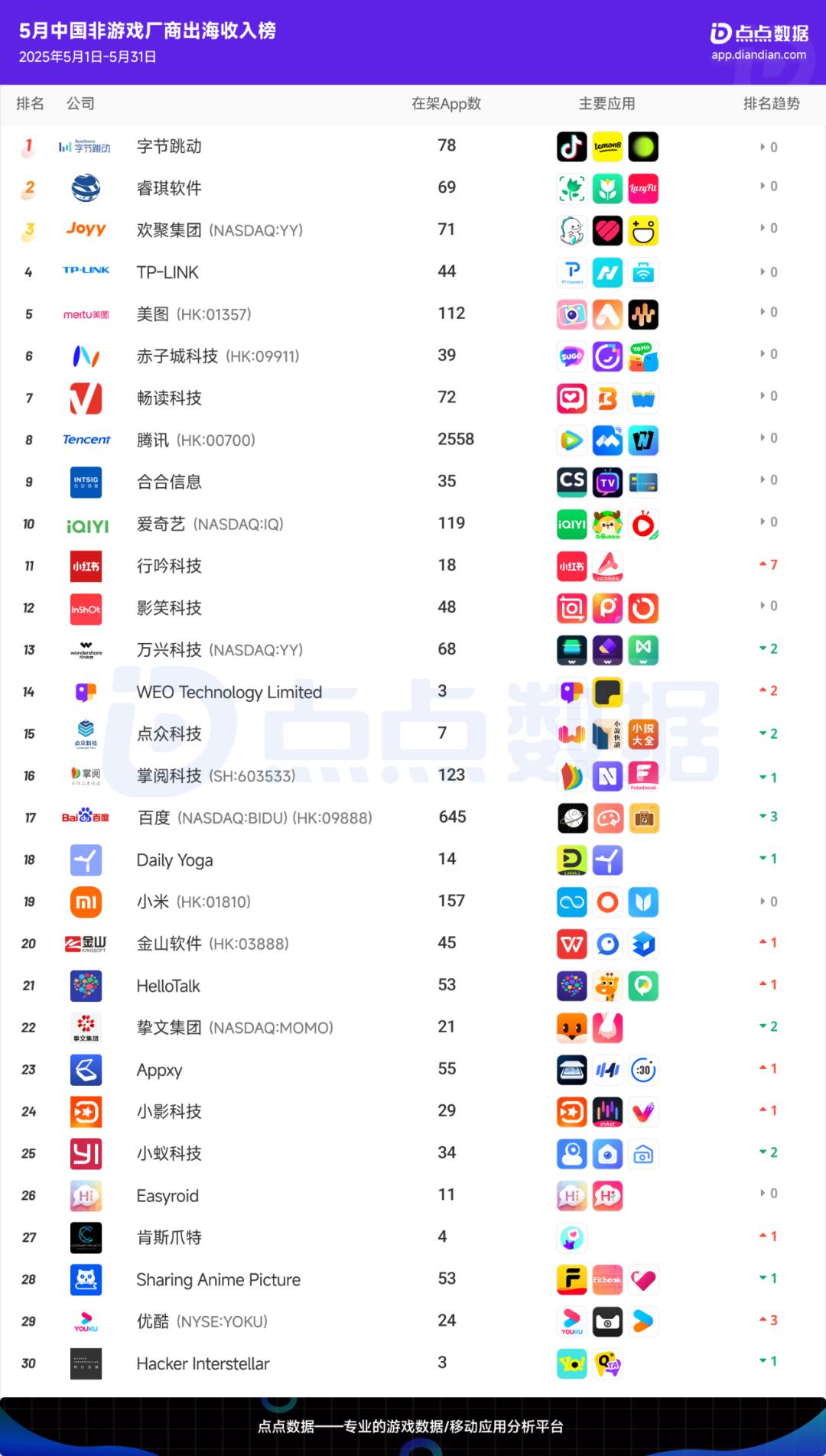
2025年5月中国应用/游戏厂商出海收入Top30榜
3 6 Ke· 2025-06-19 02:49
Core Insights - In May, ByteDance maintained a significant lead in overseas revenue among non-gaming Chinese companies, while Ruqi Software saw a revenue surge of over 32.4% due to its AI-enhanced app features [3][4] - Meitu's overseas revenue increased by over 12.4% driven by its AI features in the app "Wink," contributing to its stable ranking [3] - Xiaohongshu, rebranded as "rednote," experienced a 75% increase in overseas revenue, helping its parent company rise in rankings [4] Non-Gaming Companies - ByteDance ranked first with 78 apps, maintaining its leading position in overseas revenue [1] - Ruqi Software's app "PictureThis" achieved an estimated monthly revenue of nearly 100 million yuan, marking a continuous growth trend [3] - Meitu's "BeautyCam" and other apps are part of its strategy to embrace AI, contributing to revenue growth [3] - Xiaohongshu's global strategy has led to a stable monthly active user base exceeding 10 million [4] - Youku's overseas version saw an 18.9% revenue increase due to popular content, allowing it to return to the rankings [4] Gaming Companies - Diandian Interactive's new game "Kingshot" saw a revenue increase of over 81.7%, reaching an estimated 190 million yuan [7] - Lilith's game "AFK Journey" experienced a revenue growth of over 54.9%, particularly in the U.S. market [7] - NetEase's new game "Dunk City Dynasty" generated over 1 million USD in less than ten days, indicating potential for future growth [8] - Jiangyu Interactive's "Top Heroes" achieved an estimated revenue of nearly 230 million yuan, contributing to its ranking improvement [8] - Yishijie’s new game "Lands of Jail" generated over 8.21 million USD, with a growth rate of over 75.4% [9]