Netflix(NFLX)

Search documents
Paramount Just Challenged Netflix's Streaming Dominance. Here's What It Means for Investors
The Motley Fool· 2025-12-08 19:20
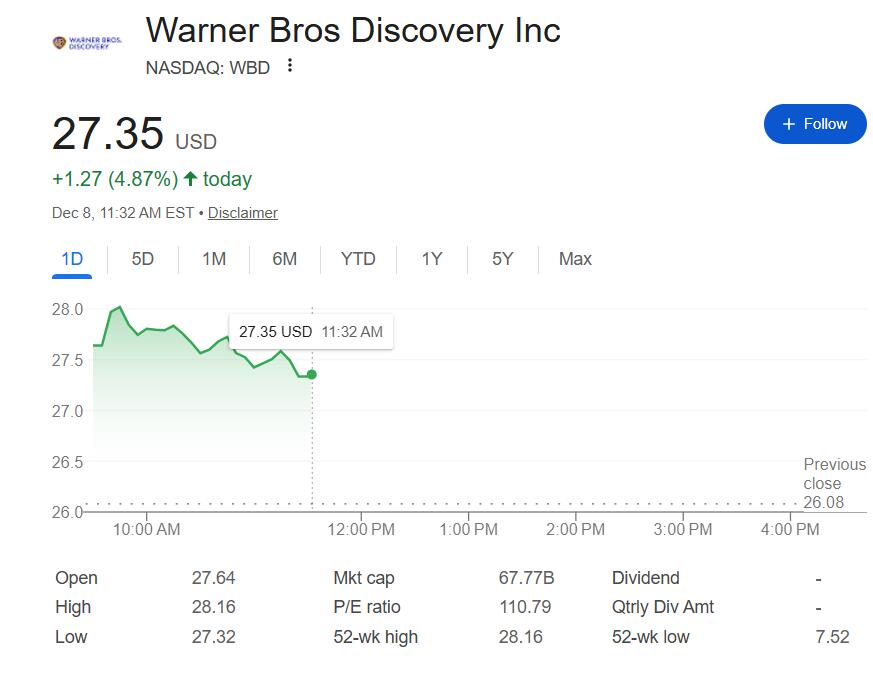
Core Viewpoint - Paramount's hostile takeover bid has disrupted Netflix's recent agreement with Warner Bros. Discovery for a $72 billion deal, introducing new dynamics in the media industry [1]. Group 1: Takeover Bid Details - Paramount Skydance is making a hostile takeover offer directly to shareholders, proposing a price of $30 per share for Warner Bros. Discovery (WBD), valuing its equity at $77.9 billion, or $108 billion including debt [2][3]. - This offer is higher than Netflix's bid of $27.75 per share, which includes $23.50 in cash and the remainder in stock [3]. Group 2: Market Reactions - Following the news of the Paramount bid, Warner Bros. Discovery's stock rose by 4%, indicating positive sentiment among shareholders despite still being below Netflix's offer [5]. - Conversely, Netflix's stock fell by 4% after the announcement, adding to a previous 3% drop, reflecting investor dissatisfaction and concerns over regulatory complications [6]. Group 3: Regulatory Implications - The introduction of Paramount's bid complicates the regulatory landscape for Netflix, which is already facing antitrust scrutiny [6]. - If WBD accepts Paramount's offer, it could prompt Netflix to increase its bid, further intensifying the competition [6]. Group 4: Investor Outlook - Investors in all three companies should prepare for increased volatility as the situation evolves, with the potential for significant changes in the media landscape [8].



The Netflix-Warner Bros. Deal Was Never Going to End Quietly. Now What?
Yahoo Finance· 2025-12-08 19:19
Core Insights - The Netflix acquisition of Warner Bros. is facing significant challenges, including a hostile takeover attempt from Paramount Skydance and potential antitrust concerns raised by influential figures, including President Trump [3][4][5]. Group 1: Deal Overview - Netflix has announced plans to acquire Warner Bros. assets, including its film and TV studios, gaming business, HBO, and HBOMax, in a deal valued at $83 billion [3][5]. - The deal includes substantial breakup fees: if Warner Bros. withdraws to pursue another suitor or fails to secure shareholder approval, it must pay Netflix $2.8 billion; if the deal collapses due to antitrust issues, Netflix owes Warner Bros. $5.8 billion [5][6]. Group 2: Competitive Landscape - Paramount Skydance has initiated a hostile takeover bid for Warner Bros., offering $30 per share, which Warner Bros. has rejected, claiming Netflix's offer of $27.75 per share is more favorable due to its structure [6][7]. - Paramount's bid is presented as superior, emphasizing its all-cash nature and the value of global television networks, while Netflix's deal involves a split of the entertainment company into two entities [6][7]. Group 3: Market Reactions - Following the announcement of the Netflix-Warner Bros. deal, shares of all three companies—Netflix, Warner Bros., and Paramount—are experiencing volatility as investors reassess the potential outcomes of the competing bids [4][7].

Netflix (NasdaqGS:NFLX) 2025 Earnings Call Presentation
2025-12-08 19:15
VIEW SHARE Netflix and Warner Bros. combined will have 9.2% TV viewshare in the U.S. Nielsen Share of U.S. TV Time By Distributor 1 October 2025 October 2025 Pro Forma YouTube The Walt Disney Company Netflix & Warner Bros. NBCUniversal FOX Paramount Discovery Global 12.9% 11.4% 9.2% 8.6% 4.4% 8.4% 8.2% 1.2% HBO / HBO Max YouTube 12.9% The Walt Disney Company NBCUniversal FOX Paramount Netflix 11.4% 8.6% 8.4% 8.0% 5.6% 8.2% Warner Bros. Discovery 1.2% HBO / HBO Max ...
特朗普质疑奈飞后派拉蒙抢购华纳兄弟!CEO放话多给股东176亿现金
Hua Er Jie Jian Wen· 2025-12-08 19:05
在美国总统特朗普对奈飞(Netflix)收购华纳兄弟探索(Warner Bros. Discovery)交易提出反垄断担忧后,与特朗普关系密 切的甲骨文CEO埃里森之子——派拉蒙(Paramount Skydance)CEO埃里森(David Ellison)绕过华纳董事会,直接向股东发 起敌意收购。 派拉蒙提出每股30美元的全现金报价,声称比奈飞的交易给股东多提供176亿美元现金,且这一交易获得监管批准的可能性 更高。派拉蒙在一份声明中表示,华纳兄弟探索在12周内提交了六份提案,但该公司"从未进行有意义的接触"。派拉蒙还致 信华纳兄弟,质疑其出售流程,指控公司放弃了公平竞标流程,并预先确定奈飞为赢家。 竞购战升级之际,12月8日周一,华纳兄弟和派拉蒙股价双双大涨,早盘刷新日高时,前者涨近8%,后者早盘涨幅扩大到 7%以上。而奈飞进一步下跌,早盘刷新日低时跌近5%。 从目前形势看,这场好莱坞巨头的争夺战远未结束,据eMarketer高级分析师Ross Benes表示,奈飞虽处于主导地位,但在抵 达终点前仍会经历曲折。 派拉蒙的敌意收购发生在华纳兄弟探索上周五刚与奈飞达成协议之后。奈飞当天公布,以总价720亿美 ...
'Cash Is Still King': Paramount CEO David Ellison Throws $108 Billion All-Cash Bid To WBD Shareholders
Benzinga· 2025-12-08 19:00
Core Viewpoint - Paramount Skydance Corp. has launched a hostile all-cash tender offer for Warner Bros. Discovery, Inc., valued at $30 per share or approximately $108.4 billion, directly appealing to shareholders and challenging Warner Bros.' agreement with Netflix [1][2]. The Bid - The bid is positioned as a "superior alternative" to Netflix's plan, which involves a mix of cash and stock for specific assets, while Paramount's offer aims for a full buyout of Warner Bros., including its linear cable networks [2][3]. Regulatory Considerations - Paramount's legal advisors argue that a Netflix-WBD merger would face significant antitrust challenges globally, as regulators would not accept that Netflix competes in the same ad-supported market as platforms like Instagram or YouTube [3]. - Concerns have been raised by Warner Bros. regarding Paramount's reliance on non-U.S. funding, which could lead to a strict review by the Committee on Foreign Investment in the United States (CFIUS) [4]. Investor Backing - Notable investors supporting Paramount's bid include Saudi Arabia's Public Investment Fund, the Qatar Investment Authority, and others, with the company highlighting its favorable relationship with the Trump administration as a potential advantage in navigating regulatory challenges [5]. Financial Incentive - Paramount is offering Warner Bros. shareholders $17.6 billion more in cash compared to the deal with Netflix, emphasizing that cash remains a strong incentive for shareholders [6]. Market Reaction - Following the announcement, Netflix shares fell by 4%, while Paramount Skydance and Warner Bros. Discovery shares rose by 9% and 3.5%, respectively [7].

All you need to know about the increasingly complex sale of Warner Bros. Discovery
Yahoo Finance· 2025-12-08 18:50
The long battle over control of Warner Bros. Discovery took another turn Monday when Paramount Skydance announced a hostile bid for the entertainment giant, following Warner Bros. Discovery’s acceptance of a competing offer from Netflix last week. Most Read from Fast Company Paramount, which many once deemed the front-runner in the original bidding war, announced a tender offer that tops the Netflix bid by $2.25 per share, appealing directly to shareholders. That adds another layer of complexity to the d ...
Paramount, Netflix spur Wall Street race to win jumbo loan deals
Fortune· 2025-12-08 18:40
In the space of less than a week, the bidding war for Warner Bros. Discovery Inc. has unleashed two multi-billion debt deals that rank among the largest in the past decade.The latest came from Paramount Skydance Corp. as it lined up as much as $54 billion of financing from Wall Street’s biggest firms to help support its $108 billion hostile bid for Warner Bros., just days after the company agreed to a deal with Netflix Inc.Loans of this size have been few and far between over the past couple of years amid s ...

Paramount Skydance Rallies On Hostile Bid, Netflix Tumbles: What's Moving Markets Monday?
Benzinga· 2025-12-08 18:33
U.S. stocks kicked off the week in a mixed pattern, with sentiment turning cautious as traders consider a Fed rate cut all but fully baked into current valuations. CME FedWatch tool currently assigns a 90% likelihood to a quarter-point reduction at the Dec. 10 meeting. Yet the odds of a follow-up move in January fell to 20%, signaling rising skepticism that the Fed will sustain its recent easing pace. • Warner Bros. Discovery stock is challenging resistance. What’s behind WBD new highs?Small caps led once a ...

X @Bloomberg
Bloomberg· 2025-12-08 18:28
The best defense of the Netflix deal is pretty much: more money. (via @opinion) https://t.co/76jMPKleJ4 ...
Warner Bros. Discovery Confirms Receipt of Paramount Skydance Unsolicited Tender Offer
Prnewswire· 2025-12-08 18:22
Core Viewpoint - Paramount Skydance Corporation has initiated an unsolicited tender offer to acquire all outstanding shares of Warner Bros. Discovery common stock [1] Group 1: Tender Offer Details - Warner Bros. Discovery's Board of Directors will review Paramount Skydance's offer in consultation with independent financial and legal advisors [2] - The Board will not change its recommendation regarding the existing agreement with Netflix and will inform stockholders of its recommendation on the tender offer within 10 business days [3] - Stockholders are advised not to take any action regarding Paramount Skydance's proposal at this time [3] Group 2: Advisory and Legal Support - Financial advisors for Warner Bros. Discovery include Allen & Company, J.P. Morgan, and Evercore, while legal counsel is provided by Wachtell Lipton, Rosen & Katz and Debevoise & Plimpton LLP [4] Group 3: Company Overview - Warner Bros. Discovery is a leading global media and entertainment company with a diverse portfolio of brands and products, including HBO Max, CNN, and Discovery Channel [5] Group 4: Regulatory Filings - Warner Bros. Discovery plans to file a solicitation/recommendation statement with the SEC regarding the tender offer within 10 business days [6] - Investors are encouraged to read all relevant documents filed with the SEC for important information about the tender offer [6]