相对强弱指数(RSI)

Search documents
Tesla Stock Testing Key Trendline as Options Traders Circle
Schaeffers Investment Research· 2026-03-23 19:31
Group 1 - Tesla Inc (NASDAQ:TSLA) stock has increased by 2.7% to $378.12, marking a strong start to the week and breaking a three-day losing streak that brought the stock to its lowest level since September [1] - Over the past two weeks, Tesla has seen significant options activity with 14.3 million calls and 11.1 million puts traded, indicating heightened interest among options traders [2] - Tesla's stock tested its 320-day moving average on Friday and has reclaimed this trendline, despite experiencing its fifth consecutive weekly loss [5] Group 2 - The Schaeffer's Volatility Index (SVI) for Tesla is at 44%, which is in the 7th percentile of annual readings, suggesting that options are affordably priced [7] - Tesla's Schaeffer's Volatility Scorecard (SVS) is rated at 6 out of 100, indicating that the stock has consistently exhibited lower volatility than what its options have priced in over the past year, making it a candidate for premium selling [7] - In the 10-day options volume comparison, Tesla ranks second with a total of 25.56 million options traded, behind NVIDIA [3]



金价将录得6年来最大单周跌幅
第一财经· 2026-03-20 08:22
Core Viewpoint - The article discusses the significant decline in gold prices due to rising energy prices from Middle East conflicts, leading to renewed inflation concerns and reduced expectations for interest rate cuts by central banks. Gold is experiencing its largest weekly drop in six years, with current prices around $4,685 per ounce, reflecting a nearly 7% decline this week [3][5][6]. Group 1: Market Dynamics - The current international gold price is around $4,685 per ounce, with a weekly drop of nearly 7%, marking the largest weekly decline since March 2020 [6]. - The decline in gold prices is attributed to rising U.S. Treasury yields, a stronger dollar, and investors selling profitable gold investments to cover losses in other areas [6][8]. - Gold ETFs have seen a continuous outflow of funds for three weeks, with holdings decreasing by over 60 tons during this period [8]. Group 2: Central Bank Policies - The Federal Reserve's recent meeting indicated a hawkish stance on future interest rate paths, with Chairman Powell emphasizing concerns over inflation risks [7]. - Powell noted that inflation has exceeded targets for five consecutive years and acknowledged high inflation in the services sector, raising concerns about potential second and third-round effects of inflation [7]. - The expectation for interest rate cuts has been pushed back due to short-term inflation risks stemming from the Middle East conflict and a relatively stable macroeconomic backdrop [7]. Group 3: Investor Behavior - Investors are reducing portfolio risks, contributing to the recent decline in gold prices, as they seek to sell assets that have performed well [9][12]. - The market is experiencing a general sell-off across various asset classes, including gold and U.S. Treasuries, as investors reassess their holdings in light of current uncertainties [12]. - Analysts suggest that the current volatility in gold and precious metal prices may lead to further selling before a stabilization occurs [11].

Down 16.6% in 4 Weeks, Here's Why You Should You Buy the Dip in Phinia (PHIN)
ZACKS· 2026-03-12 14:35
Core Viewpoint - Phinia (PHIN) has experienced significant selling pressure, resulting in a 16.6% decline over the past four weeks, but analysts anticipate improved earnings in the near future [1] Group 1: Technical Analysis - The Relative Strength Index (RSI) is utilized to determine if a stock is oversold, with a reading below 30 indicating oversold conditions [2] - PHIN's current RSI reading is 29.75, suggesting that the heavy selling may be nearing exhaustion, indicating a potential rebound [5] - The RSI helps identify price reversal points, allowing investors to seek entry opportunities when a stock is undervalued due to excessive selling [3] Group 2: Fundamental Indicators - Analysts have raised earnings estimates for PHIN by 0.2% over the last 30 days, indicating a consensus among sell-side analysts that could lead to price appreciation [7] - PHIN holds a Zacks Rank 2 (Buy), placing it in the top 20% of over 4,000 ranked stocks, which supports the potential for a near-term turnaround [8]


Kohl's Stock Testing a Key Trendline Ahead of Earnings
Schaeffers Investment Research· 2026-03-05 18:39
Core Viewpoint - Kohl's Corp (NYSE:KSS) has experienced significant stock volatility, reaching a 12-month high of $25.22 on December 1, but has since dropped 24% in 2026, with a recent 12 losses in 13 sessions, testing support at its 200-day moving average ahead of its fourth-quarter earnings report scheduled for March 10 [1][3]. Group 1: Stock Performance - KSS has only finished higher after three of its last eight earnings reports, with a notable 42.5% bull gap in November [1]. - The stock has averaged a move of 17.3% during earnings reports, with investors anticipating a larger-than-usual 18.9% move for the upcoming report [1]. Group 2: Short Interest and Market Sentiment - There is significant contrarian potential for KSS, as short interest has decreased by 8% in the last two reporting periods, yet 26.77 million shares sold short represent 24.7% of the available float [3]. - A potential bounce back in KSS could lead to an unwinding of bearish bets, potentially fueling a rally [3]. Group 3: Analyst Ratings and Technical Indicators - All 12 brokerages covering KSS have a "hold" or worse rating, indicating a cautious outlook [4]. - The 14-Day Relative Strength Index (RSI) for KSS is nearing "oversold" territory at 30, suggesting potential for a rebound [4]. Group 4: Options Activity - In the options market, KSS has a 10-day call/put volume ratio of 7.04, which is higher than 98% of all other annual readings, indicating strong interest in call options [5]. - Given the high short interest, some call options may be used by bearish bettors as a hedge [5].


CoreWeave首席执行官套现772万美元
Xin Lang Cai Jing· 2026-02-20 21:46
Core View - CoreWeave's stock experienced a significant decline of 8.12% on Friday, with a trading volume of $4.09 billion [1]. Stock Performance - The current trading price of CoreWeave's stock is $94.30, which is 3.3% lower than its 100-day simple moving average and 12.2% lower than its 200-day simple moving average [2]. - However, the stock is 1.6% higher than its 20-day simple moving average and 10.3% higher than its 50-day simple moving average, indicating some short-term resilience [2]. - Over the past 12 months, the stock has increased by 142.85%, reflecting a strong performance trend despite recent pullbacks [2]. Technical Indicators - The Relative Strength Index (RSI) is at 54.87, indicating that the stock is currently neither overbought nor oversold [3]. - The Moving Average Convergence Divergence (MACD) shows a bullish signal, with the MACD line at 1.8414, above the signal line at 1.7781; however, the histogram value of 0.0634 suggests moderate upward momentum [3].
黄金ETF持仓报告解读(2026-2-13)黄金遭遇猛烈抛售 金价日内暴跌
Sou Hu Cai Jing· 2026-02-13 06:59
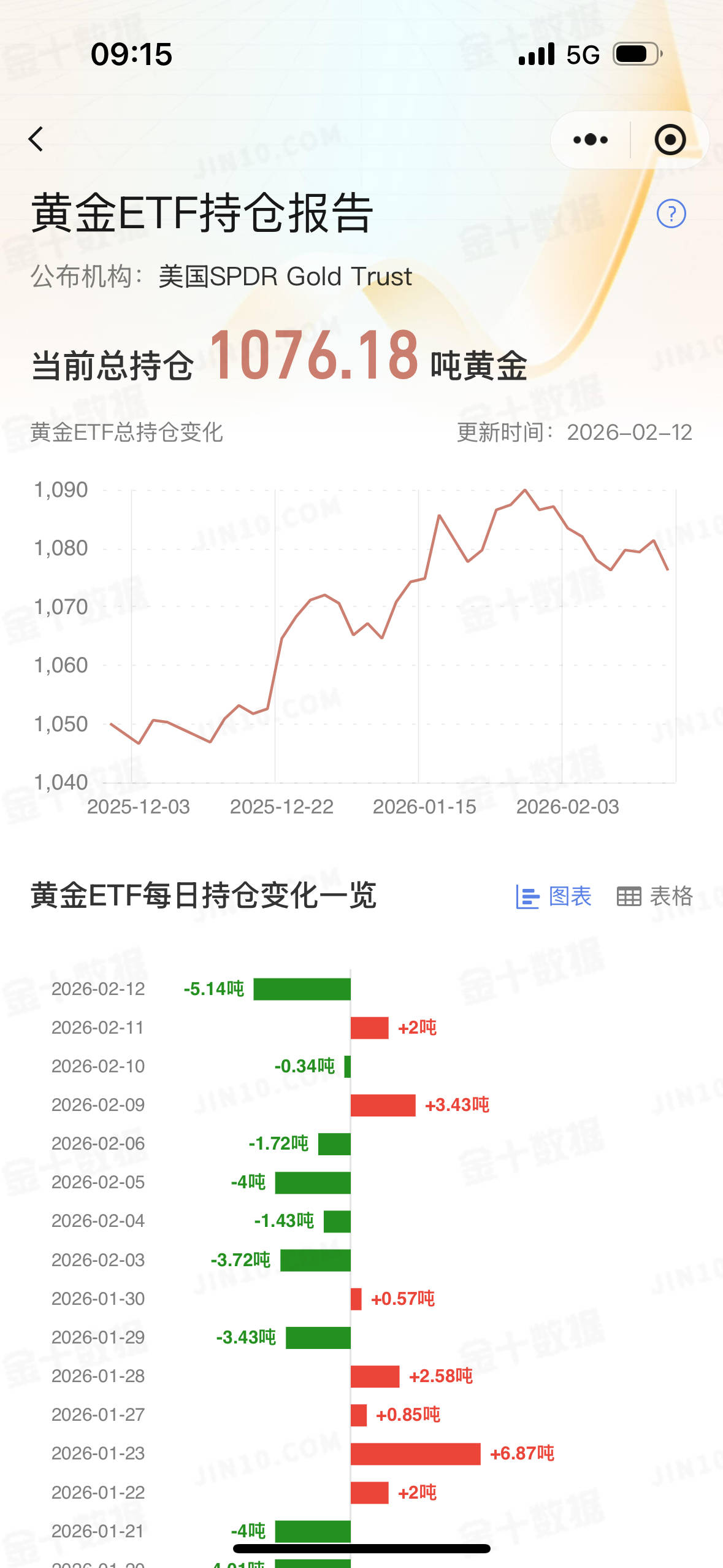
Core Viewpoint - The SPDR Gold Trust, the world's largest gold ETF, reported a significant decrease in holdings, dropping by 5.14 tons to a total of 1076.18 tons as of February 12, 2026, amid a sharp decline in gold prices due to algorithmic trading sell-offs and profit-taking by investors [5]. Group 1: Market Dynamics - On February 12, spot gold prices experienced a drastic drop, reaching a low of $4882.04 per ounce before closing at $4920.88, marking a decline of $163.65 or 3.22% [5]. - The sell-off in gold and silver was attributed to concerns over the viability of massive AI investments, leading to a downturn in U.S. tech stocks and prompting investors to liquidate positions in commodities for liquidity [5]. - The market is closely watching the upcoming U.S. Consumer Price Index (CPI) report, which is expected to show a year-on-year increase of 2.5%, as this data could influence the Federal Reserve's interest rate decisions [6]. Group 2: Technical Analysis - The overall trend for gold remains optimistic as long as prices stay above the 50% Fibonacci retracement level, with current prices above all moving averages [7]. - Short-term resistance for gold is identified at $5092.00 per ounce, with a subsequent target at $5598.25 per ounce. A sustained breakthrough of the first resistance level could lead to further upward movement [8]. - On the downside, maintaining above the psychological level of $5000 and the 100-period simple moving average is crucial; a drop below this area could increase downward pressure, with the next support level near $4850 [8]. Group 3: Analyst Outlook - Despite recent setbacks, many analysts expect gold to regain upward momentum, citing ongoing factors such as geopolitical tensions and a shift from traditional assets to alternative investments [6]. - JPMorgan Private Bank forecasts gold prices could reach between $6000 and $6300 per ounce by the end of the year, with Deutsche Bank and Goldman Sachs also maintaining bullish views [6].
金价整体处上升趋势之中 等待进一步突破
Jin Tou Wang· 2026-02-09 06:06
Core Viewpoint - Gold prices are experiencing an upward trend, currently trading around $5020.48 per ounce, testing the critical psychological resistance level of $5000, while also facing resistance from the EMA50 moving average [1] Group 1: Market Analysis - Analysts note that gold's failure to maintain the $5000 level last week was disappointing, but its relative stability compared to silver is noteworthy [1] - The market is expected to focus on geopolitical developments in Iran and Ukraine, as well as the upcoming non-farm payroll report, which could influence gold prices [1] - A decline in volatility could be beneficial for gold prices, even if it leads to a slight decrease in price [1] Group 2: Technical Indicators - The weekly chart indicates that gold prices have rebounded from a low, suggesting a potential for renewed strength, with key support levels at the 5/10 week moving averages [2] - The critical support level for the day is identified at $4964, with a further support level at $4936; maintaining these levels is crucial for a bullish outlook [2] - The 200-hour simple moving average (SMA) is a key resistance point, and a sustained breakout above this level would trigger new buying signals for bullish traders [2]
黄金波动后反弹修正 金价后续继续保持震荡
Jin Tou Wang· 2026-02-03 06:01
Group 1 - The core viewpoint of the articles indicates that gold prices have shown volatility but are currently rebounding, with a recent trading price around $4811.44 per ounce after hitting a support level of $4550, which has provided a solid foundation for upward momentum [1] - The Relative Strength Index (RSI) has indicated a positive signal after reaching oversold levels, further supporting the rebound and opening the path for recovering some of the previous losses [1] - Discussions among Ukrainian, European, and U.S. officials have led to an agreement on coordinated military actions in response to any violations of ceasefire agreements by Russia, with meetings scheduled in Abu Dhabi to negotiate an end to the conflict [1] Group 2 - If violations escalate into broader attacks, coordinated military actions involving U.S. forces will be implemented within 72 hours of the initial violation [2] - Gold prices have rebounded from a bullish support level at the 60-day moving average, indicating a potential bottoming out, although the bullish trend has not yet regained strength above key moving averages [2] - The 4-hour market trend shows resistance levels at $4863-$4875 and $4953-$4960, with support levels at $4700-$4713 and $4666-$4676, suggesting a cautious approach before further trading [2] Group 3 - The Moving Average Convergence Divergence (MACD) line is below the signal line and zero, reinforcing a bearish outlook, with an expanding negative histogram indicating increased downward momentum [3] - Any further upward movement may refocus on the 23.6% retracement level at $4995.94, while failure to maintain initial support could lead to further consolidation challenges [3]
史诗级崩盘!金银创40年最大单日暴跌,27万账户爆仓,普通人避坑指南藏不住了
Sou Hu Cai Jing· 2026-01-31 22:14
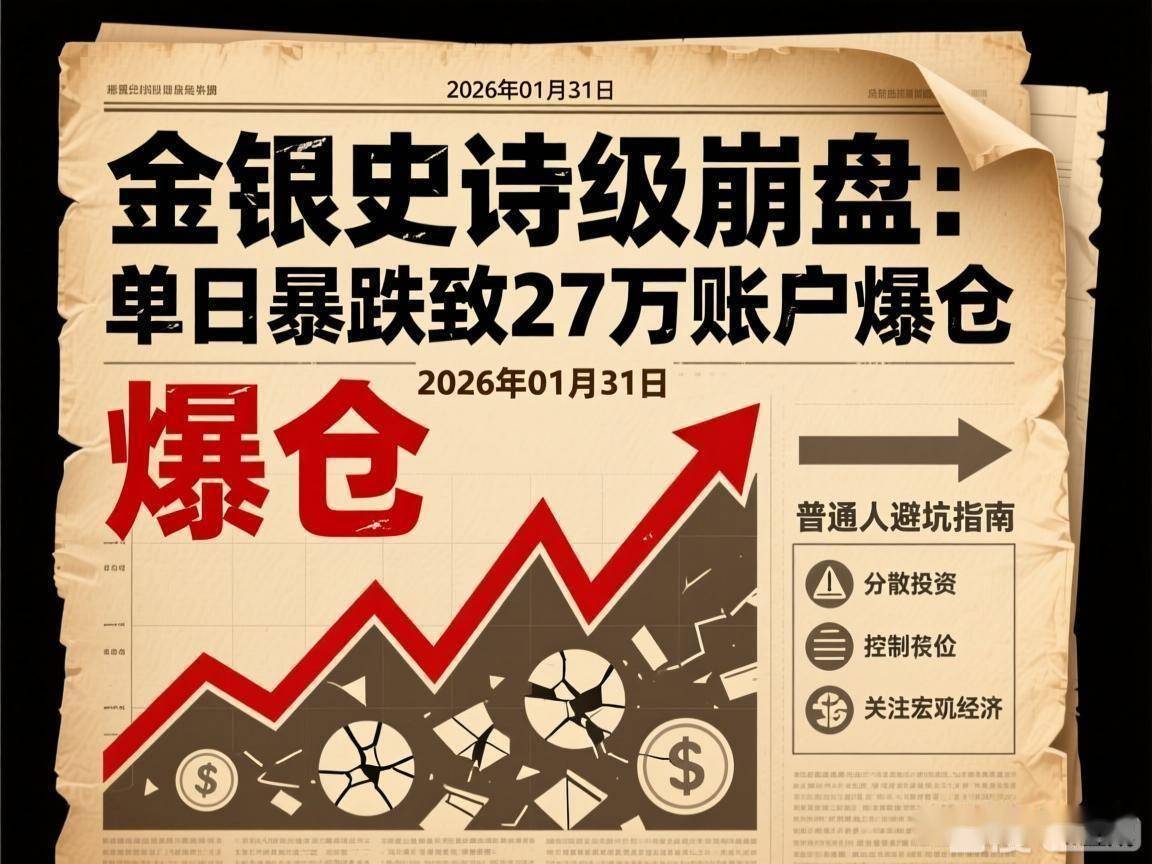
Core Viewpoint - The recent unprecedented crash in gold and silver prices marks the largest single-day decline in 40 years, with gold dropping by 12.92% and silver by 35.89%, leading to over 270,000 accounts being liquidated [1][7]. Market Reaction - The crash was triggered by the nomination of Kevin Warsh as the Federal Reserve Chairman, which raised concerns about potential tightening of monetary policy, leading to panic selling among investors [3][4]. - Prior to the crash, gold and silver had reached record highs, with gold at $5,598.75 per ounce and silver at $121.65 per ounce, prompting many investors to enter the market at peak prices [3][4]. Technical Indicators - Technical indicators showed that both gold and silver were in a severely overbought state, with gold's RSI reaching 90 and silver's exceeding 93.8, indicating a correction was overdue [5]. - The market's reaction was exacerbated by profit-taking from investors who had seen significant gains over the past six months, further intensifying the sell-off [5]. Geopolitical and Economic Factors - A decrease in geopolitical tensions, such as signals of negotiations with Iran and a temporary ceasefire in Ukraine, contributed to the decline in safe-haven demand for gold and silver [5]. - Economic data released by the U.S. Labor Department indicated rising inflation, which could lead to a prolonged neutral monetary policy by the Fed, negatively impacting non-yielding assets like gold [5]. Impact on Investors - The crash resulted in significant losses for both retail and institutional investors, with many facing substantial financial distress due to leveraged positions [7]. - The gold mining sector also suffered, with major companies experiencing declines of over 10%, and the A-share market reflecting similar trends with significant market value losses [7]. Industry Chain Reactions - The gold recycling market reacted by increasing buyback fees and halting operations, while domestic gold jewelry prices saw a sharp decline [7]. - The solar industry faced unexpected losses due to the drop in silver prices, which constitute a significant portion of solar panel production costs [8]. Diverging Opinions on Market Outlook - Analysts are divided on whether the bull market for gold and silver has ended, with some arguing that underlying factors for long-term growth remain intact, while others believe the recent price action indicates a bubble has burst [9][10]. - The debate continues on whether now is a good time to buy, with some suggesting potential opportunities while others caution against further declines [11][12]. Recommendations for Investors - For those holding physical gold and silver, it is advised to maintain positions for long-term value, while those with leveraged positions should consider reducing exposure to mitigate risks [14][15]. - New investors are cautioned against using leverage and are encouraged to adopt a conservative approach, focusing on long-term asset allocation rather than speculative trading [16][17].
沃什提名引爆贵金属血洗:金银遭遇历史性暴跌
Sou Hu Cai Jing· 2026-01-31 07:13
Group 1: Historical Market Crash - The nomination of Kevin Warsh as the Federal Reserve Chairman triggered a historic sell-off in the precious metals market, with gold and silver experiencing unprecedented declines [2][3] - Gold prices fell over 10%, reaching a low of $4,714.5 per ounce, marking the largest intraday drop in over 40 years, while silver plummeted more than 35%, also setting a record for the largest intraday decline [2][3] Group 2: Hawkish Expectations - The market attributed the sell-off to a sudden shift in investor expectations regarding Federal Reserve policy, with Warsh being perceived as more hawkish compared to other candidates [4] - The announcement of Warsh's nomination led to a rebound in the dollar, decreasing the attractiveness of dollar-denominated commodities, which further pressured the precious metals market [4] Group 3: Market Vulnerability - Analysts noted that the market's inherent fragility amplified the sell-off, as a significant number of long positions had accumulated during the recent price surge, creating a scenario ripe for a "gamma squeeze" [5] - The extreme levels of leverage and record-high call option purchases contributed to a bubble-like market condition, which was easily triggered by the news of Warsh's nomination [5] Group 4: Technical Indicators - Prior to the crash, several technical indicators had signaled an overbought condition in the gold and silver markets, with the Relative Strength Index (RSI) for gold reaching a historic high of 90 [6] - Despite the sharp decline, gold and silver had recorded substantial gains in January, with gold futures up 8.98% and silver futures up 11.63%, indicating a strong upward trend prior to the crash [6] Group 5: Mining Stocks Impact - The sharp decline in precious metals also adversely affected major mining companies, with stocks like Newmont and Barrick Mining dropping over 10% [7] - Silver ETFs faced even greater losses, with some funds experiencing declines of over 60%, marking their worst single-day performance in history [7] Group 6: Future Outlook - The recent crash serves as a warning for investors about the risks accumulated during the prolonged price increases, with uncertainty surrounding the future direction of the precious metals market [8][9] - Analysts suggest that if the Federal Reserve maintains a dovish stance, gold and silver could continue to rise after a correction, but a hawkish approach from Warsh could exert long-term pressure on the market [8][9]