NIKE(NKE)

Search documents
NIKE, Inc. (NKE) Down 10.8% Since Q2 2026, Wall Street Remains Positive
Yahoo Finance· 2025-12-28 15:58
Core Viewpoint - NIKE, Inc. is considered one of the best quality stocks to buy before 2026, despite a share price decline of over 10.8% following its fiscal Q2 2026 earnings release, with a positive analyst consensus indicating a potential upside of more than 31% from current levels [1][2]. Financial Performance - NIKE, Inc. reported a revenue growth of 0.59% year-over-year, reaching $12.43 billion, which exceeded estimates by $218.31 million. The earnings per share (EPS) of $0.53 also surpassed expectations by $0.16 [2]. - The company's gross profit margins declined by 300 basis points, and sales in China fell by 17%, contributing to a negative investor sentiment [2]. Analyst Ratings and Price Targets - Following the earnings release, analysts from Citi and UBS reiterated a Hold rating on NIKE, Inc., with both lowering their price targets from $70 to $65 and from $71 to $65, respectively [3]. - Analyst Jay Sole from UBS noted that the company's turnaround is taking longer than anticipated, suggesting a need for more time to resize inventory [4]. Future Outlook - Despite current challenges, NIKE, Inc. is expected to achieve mid-single-digit percentage sales growth and approximately 10% EBIT margin over the long term [4].

Is Nike (NKE) One of the Most Active US Stocks to Buy According to Analysts?
Yahoo Finance· 2025-12-28 15:05
Core Viewpoint - Analysts are cautious about Nike Inc.'s stock performance, with recent price target reductions indicating concerns over inconsistent recovery and future revenue outlook [1][2]. Financial Performance - Nike reported a total revenue increase of 1% year-over-year, amounting to $12.43 billion, which exceeded estimates by $218.31 million [3]. - The company achieved an EPS of $0.53, surpassing guidance by $0.16 [3]. Sales Channel Performance - There was a notable shift in sales channels, with wholesale revenues growing by 8% globally, while Nike Direct revenues declined by 9% [3]. - Nike Digital sales experienced a significant drop of 14%, contributing to the overall decline in direct sales [3]. Regional Performance - North America showed strong performance with a 9% overall revenue increase, driven by a 24% surge in wholesale growth [4]. - In contrast, Greater China faced challenges, with revenue decreasing by 16% and Nike Digital sales dropping by 36% [4]. - Other international regions also reported declines, with EMEA revenue down 1% and APLA revenue falling 4% [4]. Analyst Ratings - UBS analyst lowered the price target for Nike to $62 from $71, maintaining a Neutral rating [1]. - Stifel analyst cut the price target to $65 from $68 while keeping a Hold rating, citing difficulties in justifying significant stock upside due to Nike's current valuation premium [2].
Nike: On A Long And Winding Road To Recovery - Buy (NYSE:NKE)
Seeking Alpha· 2025-12-28 11:26
Core Viewpoint - The article discusses the investment potential and market position of Nike (NKE), highlighting its strong brand presence and financial performance as key factors for investors to consider [1]. Financial Performance - Nike reported a revenue increase of 10% year-over-year, reaching $12.3 billion in the latest quarter [1]. - The company's net income rose to $1.5 billion, reflecting a 15% increase compared to the previous year [1]. Market Position - Nike maintains a leading position in the athletic footwear and apparel market, with a market share of approximately 27% [1]. - The brand's global reach and innovative product lines contribute significantly to its competitive advantage [1]. Investment Considerations - Analysts suggest that Nike's strong financial metrics and brand loyalty make it a compelling investment opportunity [1]. - The company's strategic initiatives in sustainability and digital transformation are expected to drive future growth [1].

Nike: On A Long And Winding Road To Recovery - Buy
Seeking Alpha· 2025-12-28 11:26
Core Insights - The article discusses the investment potential of Nike (NKE) shares, highlighting a beneficial long position held by the analyst [1]. Group 1 - The analyst expresses a personal opinion on the investment outlook for Nike, indicating a positive sentiment towards the company's stock [1]. - There is no compensation received for the article other than from Seeking Alpha, suggesting an independent analysis [1]. - The article does not provide specific investment advice, emphasizing that opinions are subjective and should not be treated as definitive guidance [2][3].
纺织服装行业周报:滔搏FY26Q3运营稳健,期待Nike复苏带动产业链-20251228
Shenwan Hongyuan Securities· 2025-12-28 06:42
Investment Rating - The report maintains a "Buy" rating for the industry, particularly highlighting the potential recovery of Nike and its impact on the supply chain [17]. Core Insights - The textile and apparel sector has underperformed the market recently, with the SW textile and apparel index rising by 0.6%, lagging behind the SW All A index by 2.2 percentage points [3][4]. - Retail sales in the apparel and textile categories showed a total of 1.36 trillion yuan from January to November, reflecting a year-on-year growth of 3.5% [3][34]. - The report emphasizes the ongoing price increase in Australian wool, with a significant year-on-year rise of 39.9% [39]. - The operational metrics for Tmall in FY26 Q3 were stable, with inventory levels remaining healthy, although demand recovery is still awaited [10][14]. Summary by Sections Textile Sector - The textile manufacturing sector is recommended for investment, particularly focusing on the Australian wool price cycle and non-woven fabric growth. The supply side is expected to contract, with a forecasted wool production of 244,700 tons for the 25/26 fiscal year, down 12.6% year-on-year [9]. - New Australia Holdings is highlighted as a key beneficiary of the rising wool prices, with significant growth potential anticipated in Q4 2025 [9]. - Non-woven fabric companies like Nobon and Yanjing are also recommended due to their strong market positions and growth prospects in the hygiene product segment [9]. Apparel Sector - The report notes that Tmall's operational indicators for FY26 Q3 were in line with expectations, with retail and wholesale sales experiencing a high single-digit decline year-on-year. However, inventory levels are healthy, and discount rates are stabilizing [10][14]. - Nike is focusing on product innovation and retail capability enhancement, with expectations for recovery in 2026 as inventory issues are addressed [12][16]. - The report suggests positioning in Bosideng for the winter apparel segment, citing favorable conditions due to recent cold weather and an extended sales window leading up to the Spring Festival [13]. Market Dynamics - The report indicates that the textile and apparel sector's performance is influenced by broader market trends, with a noted decline in exports, particularly in apparel, which fell by 10.9% year-on-year in November [34]. - The report also highlights the competitive landscape, with a focus on the global tariff dynamics that do not alter the core manufacturing competitiveness [9].
耐克在华失速 高层坦言需调整策略
Zhong Guo Jing Ying Bao· 2025-12-28 04:57
Core Viewpoint - Nike is facing significant challenges in the Greater China market, necessitating a strategic overhaul to enhance brand differentiation and adapt to local consumer insights [1][3]. Financial Performance - For Q2 of FY2026 (September-November 2025), Nike reported total revenue of $12.427 billion, a year-on-year increase of approximately 1%, while net profit fell to $0.792 billion, a decline of 32% [1]. - Revenue from the Greater China region was $1.423 billion, down about 17% year-on-year, with direct sales (Nike Direct) declining by 18% and digital sales (Nike Digital) dropping by 36% [1]. - Earnings before interest and taxes (EBIT) in the Greater China region halved, decreasing by 49% [1]. Challenges Faced - Nike's management highlighted several ongoing challenges in the Greater China market, including decreased foot traffic, lower sell-through rates, and aging channel inventory [2]. - The brand's frequent discounting in digital channels has weakened its market influence, leading to increased discount rates, higher return rates, and rising costs associated with inventory clearance [2]. - In the fiscal quarter ending August 31, 2025, revenue in the Greater China region also declined to $1.512 billion, a 10% year-on-year drop [2]. Strategic Adjustments - Nike is implementing various measures in the Chinese market, including store upgrades, a focus on sports, reduced promotions, self-service inventory clearance, and adjusted purchasing plans [2]. - Total inventory has decreased by double digits compared to the previous year, with a 20% reduction in inventory items [2]. - Despite a 35% year-on-year drop in sales during the "Double 11" shopping festival, management indicated this was in line with their expectations [2]. Organizational Changes - Nike is undergoing a structural transformation, eliminating the positions of Chief Technology Officer and Chief Commercial Officer, while creating a new Chief Operating Officer role [3]. - The new COO will oversee end-to-end operations, including the technology department, and regional leaders will report directly to the CEO [3]. - The company is reducing manpower in stores and enhancing the management of product displays and retail presentation [3]. Competitive Landscape - The decline in Nike's performance in China is attributed to increasing competition, with local brands capturing approximately 60% of the market share among the top 20 brands [5]. - The 2025 version of a report by McKinsey and WFSGI indicates that traditional sports brands have lost 3% of market share from 2019 to 2024, while challenger brands are rising through targeted cultural marketing and omnichannel strategies [5]. - Local brands like Anta and Li Ning are gaining traction by investing in R&D and aligning closely with Chinese cultural symbols, creating a new consumer paradigm that emphasizes quality, cultural recognition, and price advantages [6]. Market Dynamics - The rise of domestic sports brands and the outdoor market is exerting pressure on Nike's market position [6]. - Local brands are perceived to better understand consumer psychology, focusing on product performance, unique design, and alignment with consumer values [6]. - Nike's recent product strategy has been criticized for being rigid, with a tendency towards luxury pricing, which contrasts with the more competitively priced offerings from local brands [6].
耐克(NKE.US)深陷四十年来最长熊市 瑞银找到了看涨信号
智通财经网· 2025-12-28 00:52
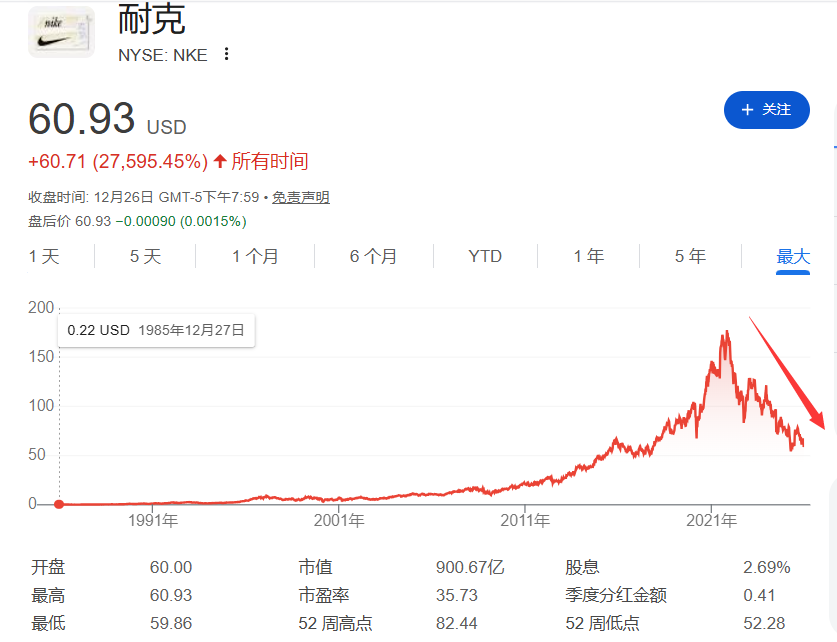
Core Viewpoint - Nike's stock has experienced a historic decline, but recent investments by Apple CEO Tim Cook and UBS's latest survey data suggest that the company may be building a bottom, although a full recovery will take time [1][6]. Group 1: UBS Survey Insights - UBS analyst Jay Sole highlighted that Nike's new CEO Elliott Hill's strategies of "returning to wholesale channels" and "refocusing on athletic attributes" are showing positive results [3]. - The survey indicates an increase in the global consumer perception of Nike products being "easy to find" in stores and online, rebounding to a new high after a decline from 2019 to 2022 [3]. - The percentage of consumers who believe Nike is "suitable for sports" has returned to peak levels seen in 2019 [3]. Group 2: Key Brand Metrics - Nike holds the highest Net Promoter Score (NPS) globally, ranking first in all major regions surveyed (U.S., U.K., Germany, China) and showing an upward trend [4]. - The brand ranks first or second globally in categories such as "high-quality products," "suitable for sports," "prestigious brand," and "innovative brand" [5]. - There is an increase in global consumers' intent to purchase more Nike footwear and apparel in the next 12 months [5]. Group 3: Executive Actions and Market Response - Tim Cook invested approximately $2.9 million in Nike, purchasing 50,000 shares at an average price of $58.97, nearly doubling his personal holdings [7]. - This significant insider buying is interpreted as a vote of confidence in Nike's long-term strategy and valuation, leading to a notable rebound in Nike's stock price following the announcement [7]. Group 4: Analyst Ratings and Future Outlook - Despite the positive survey results, UBS maintains a "neutral" rating on Nike, indicating that the recovery process will take longer than market expectations [9]. - UBS sets a target price of $62 based on a projected earnings per share (EPS) of $2.15 for the fiscal year 2028, applying a 29x price-to-earnings ratio [9]. - The survey also revealed a slight decline in brand awareness among the 16-24 age group, suggesting a potential challenge for Nike in maintaining its appeal to younger consumers [9].
AST SpaceMobile, Nike, Nvidia And More: 5 Stocks Investors Couldn't Stop Buzzing About This Week - Apple (NASDAQ:AAPL)
Benzinga· 2025-12-27 13:30
Core Insights - Retail investors have shown significant interest in five stocks this week, driven by retail hype, AI developments, and corporate news [1] Group 1: AST SpaceMobile Inc. (NASDAQ:ASTS) - AST SpaceMobile made headlines with the successful launch of its BlueBird 6 satellite, which is the largest commercial communications array in low Earth orbit, providing 10 times the capacity of previous satellites for direct-to-smartphone 4G/5G broadband [5] - The stock is trading around $78 to $80 per share, with a 52-week range of $17.51 to $102.79, reflecting a year-to-date increase of 260.67% and a 216.25% rise over the year [6] Group 2: Trump Media & Technology Group Corp. (NASDAQ:DJT) - DJT experienced volatility following its $6 billion all-stock merger announcement with TAE Technologies, with concerns raised by ethics watchdogs regarding the deal [6] - The company stated it did not make new Bitcoin purchases, countering on-chain data suggesting over $40 million in BTC acquisitions, leading to panic among some retail investors [6] Group 3: Nike Inc. (NYSE:NKE) - Nike's stock is trading around $14 to $15 per share, down 57.94% year-to-date and 61.36% over the year, with a 52-week range of $10.18 to $43.45 [11] - The stock remains under pressure due to concerns over China's economic weakness and margin compression, but a significant purchase by Apple CEO Tim Cook sparked renewed interest among retail investors [11] Group 4: Nvidia Corp. (NASDAQ:NVDA) - Nvidia's shares are trading around $188 to $190 per share, with a 52-week range of $86.63 to $212.19, reflecting a year-to-date increase of 36.37% and a 34.79% rise over the year [18] - Positive sentiment was boosted by the announcement of plans to ship advanced H200 AI chips to China and a major licensing deal with AI startup Groq [17] Group 5: Tesla Inc. (NASDAQ:TSLA) - Tesla's stock is trading around $485 to $486 per share, with a 52-week range of $214.25 to $498.82, showing a year-to-date increase of 27.98% and a 6.89% rise over the year [20] - The stock is buoyed by momentum from the reinstatement of Elon Musk's pay package and positive developments in AI testing, although some investors remain skeptical about the company's growth prospects [18]



耐克深陷四十年来最长熊市,瑞银找到了看涨信号
Hua Er Jie Jian Wen· 2025-12-27 03:59
Core Viewpoint - Nike's stock has experienced a historic decline, but recent investments by Apple CEO Tim Cook and UBS's latest survey data suggest that the company may be building a bottom, although a full recovery will take time [1][10]. Group 1: UBS Survey Insights - UBS's global sports apparel survey indicates a bullish trend for Nike, driven by new CEO Elliott Hill's strategies of "returning to wholesale channels" and "refocusing on athletic attributes" [3]. - The availability of Nike products has improved, with the percentage of global consumers finding Nike products "easy to find" in stores and online rebounding to a new high after a decline from 2019 to 2022 [3]. - The perception of Nike as "suitable for sports" has returned to peak levels seen in 2019, indicating a successful repositioning of the brand [3]. Group 2: Key Brand Metrics - Nike's Net Promoter Score (NPS) is the highest among all brands, showing an upward trend across major regions including the US, UK, Germany, and China [6]. - The brand ranks first or second globally in categories such as "high-quality products," "suitable for sports," "well-known brand," "innovative brand," and "fashionable" [6]. - There is an increase in global consumer intent to purchase more Nike footwear and apparel in the next 12 months, reflecting improved brand perception [6]. Group 3: Insider Buying Activity - Tim Cook invested approximately $2.9 million in Nike, purchasing 50,000 shares at an average price of $58.97, nearly doubling his personal holdings [7]. - This significant insider buying is interpreted as a vote of confidence in the company's long-term strategy and valuation, contributing to a notable rebound in Nike's stock price following the announcement [7]. Group 4: Analyst Ratings and Projections - UBS maintains a "neutral" rating on Nike, suggesting that while brand strength is improving, the path to profitability will take longer than market expectations [10]. - The target price for Nike is set at $62, based on a projected earnings per share (EPS) of $2.15 for the fiscal year 2028, applying a price-to-earnings ratio of 29 times [10]. - Two mild negative data points were noted: a slight decline in brand recognition among the 16-24 age group and lackluster performance from the Converse brand [11].
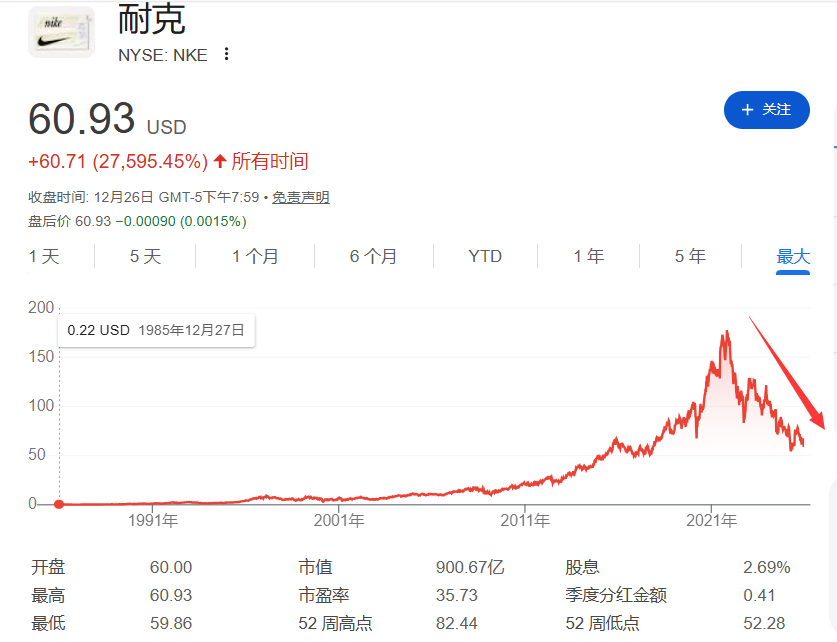
耐克兵败中国?所有人都在逃离,为何库克在逆行抄底。
Xin Lang Cai Jing· 2025-12-26 23:20
Core Viewpoint - Apple CEO Tim Cook made a significant investment in Nike, purchasing over 50,000 shares for nearly $3 million, marking his first personal investment in the company since joining its board in 2005, despite Nike's recent poor financial performance [3][4][20]. Group 1: Nike's Current Situation - Nike's recent Q2 financial report revealed a 16% decline in revenue from Greater China, with its digital business in the region plummeting by 36% [11][12]. - The company is facing intense competition from local brands like Anta and Li-Ning, which have capitalized on the "national trend" and better understand local consumer preferences [13][14]. - Nike's reliance on single-brand stores has backfired, leading to a decline in brand appeal and customer traffic [14][15]. Group 2: Tim Cook's Investment Strategy - Cook's investment is seen as a confidence booster for Nike, especially as the company undergoes a painful transformation under new CEO Elliott Hill, who is implementing a "Win Now" reform plan [20][21]. - Cook's purchase, along with that of Nike's audit committee chair Robert Swan, signals a belief that Nike's stock price has reached a bottom, establishing a "Cook bottom line" at around $59 [22][23]. Group 3: Potential for Digital Integration - There is speculation about the potential integration of Apple's digital ecosystem with Nike, which could enhance customer experience through seamless payment options and health data integration [24][25][26]. - The collaboration could lead to personalized marketing strategies based on health data, significantly improving customer engagement and sales [30][31]. Group 4: Long-term Value Perspective - Despite current challenges, Nike's long-standing brand equity and technological advantages are viewed as resilient, suggesting that the company may recover in the long term [35]. - The current price-to-earnings ratio of Nike is around 33, a historically low level, indicating potential undervaluation amidst market panic [34].