NIKE(NKE)

Search documents
美股市场速览:小盘带头回撤,资金加速流出
Guoxin Securities· 2026-02-01 09:18
Market Performance - S&P 500 increased by 0.3% while Nasdaq decreased by 0.2% this week[1] - Small-cap stocks led the decline with Russell 2000 value down by 1.0% and Russell 2000 growth down by 3.1%[1] - Key sectors showing gains include telecommunications (+9.0%) and technology hardware (+4.6%) while software and services fell by 6.9%[1] Fund Flows - Estimated fund flow for S&P 500 components was -$84.1 million this week, a significant drop from +$5.6 million last week[2] - Major inflows were seen in technology hardware (+$40.3 million) and media and entertainment (+$39.5 million) while software and services experienced outflows of -$106.0 million[2] Earnings Forecast - S&P 500's forward 12-month EPS expectation increased by 0.8% this week, up from 0.2% last week[3] - Notable upward revisions were in technology hardware (+5.6%) and automotive (+3.2%) sectors, while energy saw a downward revision of -2.7%[3] Risk Factors - Economic fundamentals, international political uncertainties, U.S. fiscal policy, and Federal Reserve monetary policy present significant risks[3]




美股市场速览:盘带头回撤,资金加速流出
Guoxin Securities· 2026-02-01 09:13
Market Performance - S&P 500 increased by 0.3% while Nasdaq decreased by 0.2% this week[1] - Small-cap stocks led the decline with Russell 2000 value down by 1.0% and Russell 2000 growth down by 3.1%[1] - 13 sectors saw gains, while 10 sectors experienced losses, with telecommunications leading at +9.0%[1] Fund Flows - Estimated fund flow for S&P 500 components was -$84.1 million this week, down from +$5.6 million last week[2] - Major inflows were seen in technology hardware (+$40.3 million) and media & entertainment (+$39.5 million)[2] - Significant outflows occurred in software & services (-$106.0 million) and healthcare equipment & services (-$57.7 million)[2] Earnings Forecast - S&P 500's forward 12-month EPS expectation increased by 0.8% this week, up from 0.2% last week[3] - 21 sectors had upward revisions, with technology hardware & equipment seeing the largest increase at +5.6%[3] - Energy sector saw a downward revision of -2.7%[3] Risks - Economic fundamentals, international political situations, U.S. fiscal policies, and Federal Reserve monetary policies present uncertainties[3]
Is Wall Street Bullish or Bearish on NIKE Stock?
Yahoo Finance· 2026-01-30 17:33
Core Viewpoint - NIKE, Inc. has experienced significant underperformance in its stock over the past year, primarily due to weaker financial results and market challenges impacting investor confidence [2][4]. Company Overview - NIKE, Inc. is a leading global company in athletic footwear, apparel, and related services, with a market capitalization of approximately $91.7 billion [1]. Stock Performance - Over the past 52 weeks, NIKE's shares have declined by 20.9%, while the S&P 500 Index has increased by 15.4% [2]. - Year-to-date, NIKE's shares are down 2.7%, contrasting with a 1.8% rise in the S&P 500 [2]. Market Comparison - NIKE has underperformed compared to the State Street Consumer Discretionary Select Sector SPDR ETF, which has returned 3.7% over the past year [3]. Financial Performance - In the most recent quarterly results for Fiscal Q2 2026, NIKE reported revenues of $12.4 billion, reflecting a modest year-over-year increase of 1% [5]. - Earnings per share (EPS) for the quarter was $0.53, beating expectations but representing a 32% decline from the same quarter last year [5]. - Revenue from Greater China fell by approximately 17%, contributing to the overall growth slowdown [5]. Future Earnings Outlook - Analysts project a 27.3% year-over-year decline in NIKE's EPS for the current fiscal year, estimating it to be $1.57 [6]. - Despite the anticipated decline, NIKE has a positive earnings surprise history, having beaten consensus estimates in the last four quarters [6].
由于就业市场降温,美国大型公司计划裁员至少5.2万人
Xin Lang Cai Jing· 2026-01-30 14:48
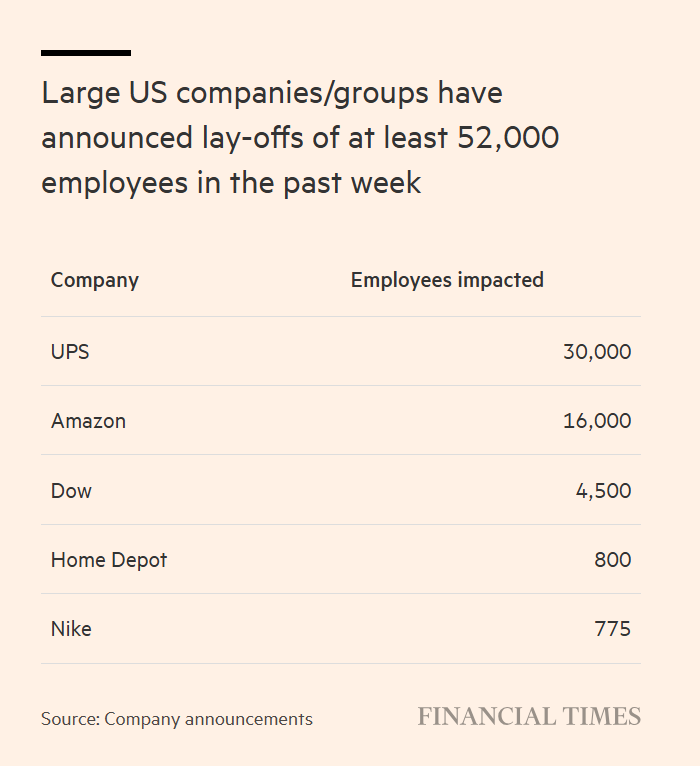
Core Viewpoint - A significant number of large U.S. companies, including Amazon, UPS, Dow Chemical, Nike, and Home Depot, have announced plans to lay off over 52,000 employees, indicating a trend of workforce reduction amid ongoing economic uncertainty and increasing pressure to invest in artificial intelligence [1][4][5]. Group 1: Layoff Announcements - Amazon plans to cut 16,000 jobs in its second round of layoffs within three months, aiming to streamline bureaucracy [7]. - UPS will lay off up to 30,000 employees due to a decrease in package volume for Amazon deliveries, offering voluntary departure incentives [7]. - Dow Chemical will implement a comprehensive operational simplification plan, resulting in the reduction of 4,500 jobs [7]. Group 2: Economic Context - The layoffs reflect concerns from Federal Reserve policymakers and economists about a cooling job market after years of strong hiring [5]. - The U.S. economy added only 50,000 jobs in December, with the median duration of unemployment rising to 11.4 weeks, the longest since 2021 [2][5]. - Despite the increase in layoffs, the overall scale of layoffs in the past year is not considered unusually high compared to pre-pandemic levels [2][5]. Group 3: Labor Market Dynamics - Employers are hesitant to hire new employees or lay off existing ones, leading to stagnation in the job market [5]. - The unemployment rate decreased from 4.5% in November to 4.4% in December, showing signs of stabilization [5]. - The Federal Reserve has cut interest rates by 0.75 percentage points in response to signs of a cooling job market [6].


“Nike (NKE)’s Moves in China Will Lead to a Turn,” Says Jim Cramer
Yahoo Finance· 2026-01-30 13:23
Group 1 - NIKE, Inc. (NYSE:NKE) shares have decreased by 14% over the past year and are flat year-to-date, indicating struggles in its turnaround efforts led by CEO Elliott Hill [2] - Jim Cramer has consistently defended CEO Elliott Hill and expressed optimism about the company's potential turnaround in China, especially following recent earnings [2][3] - Needham downgraded NIKE's stock to Hold from Buy, while RBC Capital reduced the price target from $85 to $78, citing concerns over the timeline for profitability improvements [2] Group 2 - Cramer believes that NIKE's strategic moves in China will eventually lead to a positive turnaround, although the timing remains uncertain [4] - The article suggests that while NIKE has potential as an investment, there are AI stocks that may offer higher returns with lower risk [4]
阿迪“弯腰”赞助苏超、耐克换帅:国际运动巨头在华战略悄然变阵
Hua Xia Shi Bao· 2026-01-30 13:17
Core Insights - Recent strategic adjustments by international sports brands, particularly Nike and Adidas, highlight a fundamental shift in their market position in China, facing increasing competition from local brands and other international players [2][6] - Adidas has announced a partnership with the Jiangsu Province City Football League for 2026, marking a significant move to sponsor a provincial event, which is seen as a re-evaluation of regional sports IP value [3][4] - Both companies are adopting defensive strategies to maintain their market share amid declining performance and increased competition [6][9] Adidas Sponsorship of Jiangsu Super League - Adidas will provide financial support and custom gear for 13 participating teams in the Jiangsu Super League, with a reported investment of 21 million yuan (approximately 3 million USD) [3] - The league has gained significant popularity, with over 2.43 million attendees and 2.2 billion online views during its inaugural season, establishing itself as a major provincial sports event [3][4] Market Performance and Competition - Nike's revenue in Greater China has declined from 8.29 billion USD in FY2021 to 6.586 billion USD in FY2025, indicating ongoing performance challenges [6] - Adidas experienced a significant drop in net sales from 4.597 billion USD in 2021 to 3.179 billion USD in 2022, with slow recovery in subsequent years [6] - Market share for Nike decreased from 18.1% in 2021 to 15.1% in 2024, while Adidas fell from 15% to 9.3% in the same period, contrasting with local brand Anta's rise from 9.8% to 10.7% [7] Strategic Responses - Nike has appointed Cathy Sparks as the new General Manager for Greater China, aiming to revitalize its operations in the region [5] - Adidas emphasizes the integration of global strategy with local insights through its partnership with the Jiangsu Super League, aiming to strengthen its brand connection with Chinese consumers [4][8] - The acquisition of Puma shares by Anta is seen as a potential threat to Nike and Adidas, prompting their recent strategic moves to enhance local engagement [8][9]



就业降温信号再现!美大型企业本周宣布裁员逾5.2万人
Jin Shi Shu Ju· 2026-01-30 08:15
Group 1 - Major US companies, including Amazon, UPS, Dow, Nike, and Home Depot, announced layoffs totaling over 52,000 employees due to ongoing economic uncertainty and pressures from investments in artificial intelligence [1][2] - UPS is set to lay off 30,000 employees, while Amazon will cut 16,000 jobs, Dow will reduce its workforce by 4,500, Home Depot will let go of 800, and Nike will lay off 775 [2] - The frequency of discussions about layoffs among companies is increasing, with a clear urgency to utilize AI to reduce labor costs [3] Group 2 - The US labor market is showing signs of stagnation, with companies hesitant to hire new employees or make significant layoffs due to uncertainties from trade issues and AI developments [6] - In December, the US economy added only 50,000 jobs, marking a significant slowdown in hiring, with the average unemployment duration extending to 11.4 weeks, the longest since 2021 [9] - Despite the increase in layoffs among well-known companies, the overall scale of layoffs in the past year has not reached abnormal levels compared to pre-pandemic figures [6][9] Group 3 - Companies are primarily implementing layoffs to streamline operations and improve efficiency rather than responding to macroeconomic trends [12] - UPS CFO Brian Dykes indicated that the layoffs are part of a strategy to adjust to a reasonable scale due to reduced package volumes for Amazon [12] - Amazon's recent announcement of a second round of layoffs within three months aims to "streamline bureaucratic structures" [12]
5.2万人!美企巨头本周密集裁员,想用AI降本
Sou Hu Cai Jing· 2026-01-30 08:02
Group 1 - Major companies in the U.S. have announced large-scale layoffs, totaling over 52,000 job cuts [1] - Companies are increasingly discussing layoffs as a strategy to reduce labor costs, particularly through the use of artificial intelligence [1][6] - The layoffs are concentrated among a few large firms, raising concerns among Federal Reserve policymakers and economists about the weakening job market [1] Group 2 - In December, the U.S. added only 50,000 jobs, with the median duration of unemployment rising to 11.4 weeks, the longest since 2021 [2][4] - Companies like Amazon, UPS, Dow Chemical, Nike, and Home Depot have disclosed layoff plans aimed at streamlining operations and increasing efficiency [3] - UPS plans to cut up to 30,000 jobs, while Amazon announced a second round of layoffs affecting 16,000 employees, citing the need to eliminate bureaucracy [3] Group 3 - The labor market, which expanded rapidly after the pandemic, has stagnated due to uncertainties related to trade and artificial intelligence, leading employers to hesitate in hiring or laying off staff [4][5] - Although overall layoff data may not seem alarming, the experience of unemployment is becoming increasingly challenging for workers in a slowing hiring environment [5] - Recent announcements of layoffs indicate that companies are shifting towards proactive cost-cutting measures amid increasing pressure to invest in AI [6]
英媒:随着就业市场降温,美国大型企业预计将裁员至少超5万人
Xin Lang Cai Jing· 2026-01-30 06:15
Core Insights - Major U.S. companies are announcing significant layoffs, with a total of over 52,000 employees expected to be cut, indicating a shift from years of strong hiring to workforce reductions [1] Group 1: Layoff Announcements - Companies such as Amazon, United Parcel Service, Dow Chemical, Nike, and Home Depot are among those planning to reduce their workforce [1] - The layoffs are attributed to ongoing economic uncertainty and increased pressure to streamline operations due to investments in artificial intelligence [1] Group 2: Economic Implications - The recent layoffs highlight concerns among Federal Reserve policymakers and private economists regarding the cooling of the previously hot job market [1] - David Mericle, Chief Economist at Goldman Sachs, noted that companies are increasingly discussing layoffs and are eager to leverage artificial intelligence to reduce labor costs [1]

国信证券:运动品牌行业增长难掩价格战隐忧 关注价格内卷中引领新方向的品牌机遇
智通财经网· 2026-01-30 03:33
Core Insights - The sports brand industry is experiencing a duality, with a strong growth in overall market demand but intense price competition, leading to a critical point in the product lifecycle [1][2] Industry Overview - The sports and outdoor market continues to grow, with apparel showing a clear "volume and price increase" trend driven by high-priced brands, while footwear is experiencing a "volume increase and price drop" trend [2][3] - In Q4 2025, the overall sports category saw a slight price increase of 0.9% but a sales volume decline of 1.7%, with outdoor products achieving a sales growth of 13.5% [3] International Brands - Nike is undergoing significant adjustments, with a 15.5% year-on-year sales decline and a market share drop to 9.7%, while Adidas also saw a 6.2% sales decline but maintained a market share of 8.5% [4] - Adidas' basketball shoes and casual shoes are experiencing growth despite overall declines in other categories [4] Domestic Brands - Domestic brands are facing substantial price competition, with a slight decline in market share across four major brands, while professional products are receiving positive market feedback [5] - The pricing strategy of domestic brands has led to only marginal sales increases, particularly in footwear [5] Key Takeaways - The industry shows strong growth potential, with a stable penetration rate in the sports and outdoor sector, while price competition intensifies [6] - Nike is under pressure with ongoing product adjustments, while Adidas stabilizes its market share with specific product growth [6] - Domestic brands are leveraging professional product lines to maintain market presence amidst increasing price competition [6]