Novo Nordisk(NVO)

Search documents
Penny Stock Skye Bioscience Drug Combo With Wegovy Shows Over 22% Weight Loss After One Year
Benzinga· 2026-02-02 18:26
Core Insights - Skye Bioscience, Inc. has shared interim data from the Phase 2a CBeyond study of nimacimab, a negative allosteric modulating antibody targeting obesity, in combination with a GLP-1R agonist, semaglutide [1][2] Interim Data Summary - The extension phase of the CBeyond study for combination cohorts began in May 2025, with participants receiving either nimacimab plus semaglutide or placebo plus semaglutide [2] - In the nimacimab plus semaglutide arm, participants experienced a mean weight loss of 14.4% at 26 weeks [2] - Seven participants in the nimacimab plus semaglutide arm completed an additional 26 weeks, achieving a total mean weight loss of 22.3% after 52 weeks, with no weight loss plateau observed [3] Safety and Tolerability - The combination therapy of nimacimab and semaglutide demonstrated safety and was well-tolerated, with no serious adverse events reported during the extension period [3] Placebo Group Results - In the placebo plus semaglutide arm, participants had a mean weight loss of 13.9% at 26 weeks, and those who completed the additional 26 weeks lost an additional 5.8%, resulting in a total mean weight loss of 19.7% after 52 weeks [4] Comparison of Treatment Efficacy - Top-line data indicated that the combination of nimacimab and semaglutide achieved a clinically meaningful weight loss of -13.2% compared to -10.25% for semaglutide alone, with no plateau observed [5] - The nimacimab monotherapy did not meet the primary endpoint, showing a weight loss of -1.52% compared to -0.26% for placebo [5] Weight Regain Analysis - Participants treated with nimacimab + semaglutide regained only 17.8% of their weight loss at 26 weeks during a 13-week off-therapy follow-up, indicating a potential durable response [6] - In contrast, those on semaglutide alone experienced a weight regain of 37.3% from the weight lost at 26 weeks [6] Future Expectations - Topline data from the CBeyond Phase 2a extension, including monotherapy data and follow-up results, is anticipated in the third quarter of 2026 [7] Analyst Perspective - Analysts from William Blair noted that with a cash runway extending into the fourth quarter of 2026, further analysis of the Phase 2a study could attract investor interest, contingent on supportive data regarding the exposure/weight loss relationship [8] - At the time of publication, Skye Bioscience shares were down 5.53% to $0.95 [8]

诺和诺德:CagriSema在减重和糖化血红蛋白降低两方面优于司美格鲁肽
Jin Rong Jie· 2026-02-02 16:48
Core Insights - Novo Nordisk announced the core results of the Phase 3 trial REIMAGINE 2 from its global REIMAGINE clinical trial program, demonstrating that CagriSema outperformed semaglutide in reducing hemoglobin A1c levels and weight loss at week 68 [1] Group 1 - CagriSema showed superior efficacy in both weight loss and reduction of hemoglobin A1c levels compared to single-component medications [1] - The safety and tolerability of CagriSema were found to be good, consistent with the characteristics of therapies based on incretin and insulin [1]
Novo Nordisk says CagriSema outperforms semaglutide in late-stage trial of type-2 diabetes patients
Reuters· 2026-02-02 16:05
Core Insights - Novo Nordisk's experimental weight-loss drug CagriSema demonstrated superior efficacy in reducing blood sugar levels and body weight compared to semaglutide alone in a late-stage trial involving patients with type 2 diabetes [1] Group 1 - CagriSema is a next-generation weight-loss drug developed by Novo Nordisk [1] - The late-stage trial focused on patients diagnosed with type 2 diabetes [1] - Results indicated that CagriSema outperformed semaglutide in both blood sugar reduction and weight loss [1]
Novo Nordisk A/S: CagriSema demonstrated superior HbA1c reduction of 1.91%-points and weight loss of 14.2% in adults with type 2 diabetes in the REIMAGINE 2 trial
Globenewswire· 2026-02-02 15:43
Core Insights - Novo Nordisk announced positive results from the REIMAGINE 2 trial, showing that CagriSema outperformed semaglutide in reducing HbA1c and promoting weight loss after 68 weeks [1][7]. Trial Overview - REIMAGINE 2 was a 68-week phase 3 trial assessing the efficacy and safety of once-weekly CagriSema, a combination of cagrilintide and semaglutide, in 2,728 adults with type 2 diabetes inadequately controlled with metformin [2][11]. - The trial compared two doses of CagriSema (2.4 mg/2.4 mg and 1.0 mg/1.0 mg) against semaglutide (2.4 mg and 1.0 mg), cagrilintide (2.4 mg), and placebo [2][11]. Efficacy Results - CagriSema 2.4 mg/2.4 mg achieved a superior HbA1c reduction of 1.91%-points compared to 1.76%-points with semaglutide 2.4 mg, from a baseline HbA1c of 8.2% [3][4]. - Weight loss with CagriSema 2.4 mg/2.4 mg was 14.2%, significantly higher than the 10.2% observed with semaglutide 2.4 mg, with no weight loss plateau noted [3][4]. - 43% of participants on CagriSema achieved ≥15% weight loss, and 24% achieved ≥20% weight loss [3][8]. Safety Profile - CagriSema demonstrated a safe and well-tolerated profile, with the most common adverse events being mild to moderate gastrointestinal issues that diminished over time [6][8]. Future Directions - Novo Nordisk plans to discuss the regulatory pathway for CagriSema with authorities, following the positive outcomes from REIMAGINE 1 and REDEFINE 3 trials [7][8].
[Earnings]Earnings Outlook: Tech, Pharma, and Industrials Lead a Busy Week


Stock Market News· 2026-02-02 14:13
Earnings Reports Overview - Major tech companies Alphabet Inc. and Amazon.com Inc. are set to report earnings, with Alphabet scheduled for after the market close on Wednesday and Amazon for after the market close on Thursday [1] - Key pharmaceutical companies including Eli Lilly and Company, AbbVie Inc., Novartis AG, and Novo Nordisk A/S will report earnings pre-market on Wednesday [1] - Significant earnings activity is expected in the industrials and energy sectors on Tuesday, while the insurance, semiconductors, and real estate sectors will see multiple reports throughout the week, extending into the following Monday [1]
诺和诺德、礼来迈入新时代,减肥药市场销售潜力遇冷
Xin Lang Cai Jing· 2026-02-02 12:55
Core Viewpoint - The certainty of the global weight loss drug market reaching $150 billion in the next decade has significantly decreased due to price reductions of GLP-1 drugs by Novo Nordisk and Eli Lilly, alongside increasing competition in the self-pay market [1][8]. Market Predictions - Analysts have revised down the market size forecast for 2030 by approximately 30% to around $100 billion, with some institutions pushing the $150 billion peak target to 2035 [1][8]. - Jefferies has lowered its peak market expectation from over $100 billion in the early 2030s to $80 billion, a 20% reduction from earlier predictions [1][8]. Company Performance - Novo Nordisk and Eli Lilly, the leading companies in the weight loss drug market, are set to release their Q4 financial reports soon, with Eli Lilly's market capitalization surpassing $1 trillion last year [2][9]. - Analysts expect Novo Nordisk to forecast a decline in sales and operating profit for 2026, while Eli Lilly is projected to see over 21% revenue growth compared to 2025 [2][9]. Price Dynamics - Goldman Sachs has adjusted its 2030 market size prediction from $130 billion to $105 billion due to accelerated price declines and changes in consumer medication patterns [4][11]. - The initial retail price for Novo Nordisk's and Eli Lilly's drugs was around $1,000 per month, but due to political pressure, the current price has dropped to between $149 and $299 per month [4][11]. Prescription Trends - Recent data shows that the total prescriptions for GLP-1 drugs reached 730,000 in the week ending January 23, with a 4% increase in new prescriptions for Novo Nordisk's products, driven mainly by the new oral formulation [11][12]. Market Outlook - Some institutions remain optimistic, with Pfizer's CEO predicting a $150 billion market size by 2030, and Montreal Bank projecting $158 billion in sales by 2033, attributing potential growth to price reductions [6][13]. - Analysts from various firms express that if self-pay market sales can offset price declines, there is still room for upward adjustments in market size predictions [14].
Eli Lilly CEO Says Medicare Coverage Of Obesity Drugs Could Be Game-Changer For Its Weight-Loss Pill
Yahoo Finance· 2026-02-02 11:46
Group 1 - Medicare's upcoming coverage of obesity treatments is expected to significantly increase access to Eli Lilly's experimental weight-loss pill, orforglipron, according to CEO Dave Ricks [1][2] - The new policy will allow 20 million to 30 million Medicare beneficiaries to access obesity drugs immediately following the launch of orforglipron, making GLP-1 treatments more affordable and widely used [2] - Eli Lilly plans to launch orforglipron in the second quarter, coinciding with the Medicare coverage taking effect later this year, with initial pricing agreements leading to a "step down" in costs [3] Group 2 - Early users of competitor Novo Nordisk's Wegovy are primarily new to GLP-1 treatments, indicating strong untapped demand in the market [4] - Eli Lilly's orforglipron is expected to compete effectively and reach a broader patient base beyond existing injection users [4] - Novo Nordisk has significantly increased its advertising spending for GLP-1 drugs, outpacing Eli Lilly, with an estimated $316 million spent on Wegovy and $169 million on Ozempic from January to September 2025 [5][6]
Analysis-Obesity market sales potential tightens as Novo and Lilly enter new era
Yahoo Finance· 2026-02-02 11:07
Market Overview - The global market for obesity drugs, previously expected to reach $150 billion in the next decade, is now facing uncertainty due to falling U.S. prices for GLP-1 treatments and increased competition in the cash-pay consumer market [1][2] - Analysts have revised their peak market forecasts downward, with projections for 2030 now around 30% lower at approximately $100 billion, and the $150 billion target pushed to 2035 for some [3] Analyst Insights - Jefferies has reduced its forecast for the weight-loss market by 20%, estimating a peak of $80 billion, down from over $100 billion [4] - Goldman Sachs has also adjusted its expectations, lowering its estimate for global obesity drug sales by 2030 to $105 billion from $130 billion, citing price erosion and changing customer-use patterns [7] Company Performance - Novo Nordisk and Eli Lilly are the dominant players in the obesity drug market, with Lilly achieving a $1 trillion valuation last year and Novo's Wegovy weight-loss pill performing strongly [5] - Analysts anticipate that Novo will forecast a decline in sales and operating profit for 2026, while Lilly is expected to see over 21% revenue growth and adjusted earnings growth of over 40% in 2026 compared to 2025 estimates [6]
速递|减肥神药开始治肝!司美格鲁肽获欧盟EMA推荐
GLP1减重宝典· 2026-02-01 09:48
Core Viewpoint - The article discusses the positive opinion from the European Medicines Agency (EMA) regarding the conditional marketing authorization for Novo Nordisk's semaglutide (Kayshild) for the treatment of non-alcoholic steatohepatitis (MASH) with liver fibrosis, marking a significant development in the GLP-1 receptor agonist market [5][7]. Group 1: Regulatory Developments - The EMA's Committee for Medicinal Products for Human Use has recommended Kayshild for conditional approval, which would make it the first GLP-1 receptor agonist approved in Europe for MASH [5][7]. - Semaglutide, initially approved for type 2 diabetes under the brand name Ozempic, has shown significant weight loss effects and was later approved as Wegovy for obesity management in the U.S. [7]. Group 2: Market Potential - The approval of semaglutide for MASH could reshape a potential market worth billions, as there are currently no widely available drug treatments for MASH [8]. - The combined effects of metabolic improvement and weight loss from GLP-1 drugs are attracting attention from the pharmaceutical and investment sectors [8]. Group 3: Mechanism of Action - Semaglutide works by promoting insulin secretion, inhibiting glucagon release, and regulating appetite through central nervous system action, leading to reduced energy intake and weight loss [7][15].
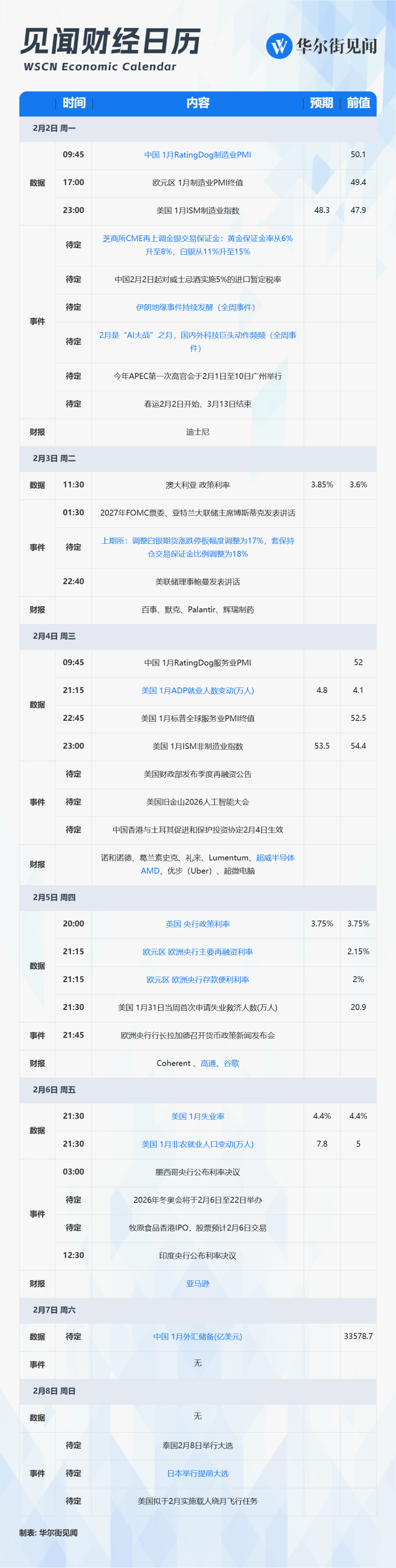
下周重磅日程:美非农、欧英央行决议、日本大选、伊朗局势、谷歌亚马逊AMD财报
Hua Er Jie Jian Wen· 2026-02-01 03:53
Economic Data - China's January Manufacturing PMI is expected to be 50.1, indicating a slight recovery in manufacturing activity [3] - Eurozone's January Manufacturing PMI final value is reported at 49.4, showing continued contraction [3] - The US ISM Manufacturing Index for January is anticipated to rise to 48.3 from 47.9, suggesting a potential stabilization in manufacturing [3] Central Bank Decisions - The Reserve Bank of Australia is expected to raise its policy rate to 3.85% from 3.6% [4] - The European Central Bank and the Bank of England are both expected to maintain their current interest rates during their upcoming meetings [9] Major Corporate Earnings - Key earnings reports are expected from major companies including Disney, Pepsi, Merck, and Pfizer, with a focus on their performance in the current economic climate [4][26] - Tech giants like Google and Amazon will report on their cloud business growth, which is critical for assessing AI monetization capabilities [6][26] Geopolitical Events - Ongoing tensions in Iran are highlighted, with the US increasing military presence in the region, which may impact global markets [12] - Japan and Thailand are set to hold significant elections on February 8, which could influence regional political stability [15][17] IPOs and Market Movements - Muyuan Foods is set to launch its IPO in Hong Kong, potentially raising up to 14 billion HKD (approximately 1.8 billion USD) [28] - The Shanghai Futures Exchange has adjusted the trading limits and margin requirements for silver futures, reflecting a tightening in trading conditions [11] Commodity Market Changes - CME has raised the margin requirements for gold from 6% to 8% and for silver from 11% to 15%, indicating a move to reduce leverage in the precious metals market [10] - The Chinese government has implemented a temporary 5% import tax on whiskey starting February 2 [19]