PepsiCo(PEP)

Search documents
金十图示:2025年07月24日(周四)美股热门股票行情一览(美股盘中)


news flash· 2025-07-24 16:39
Market Overview - The market capitalization of major US stocks shows varied performance, with Oracle at 762.30 billion, Mastercard at 321.36 billion, and Visa at 770.15 billion, reflecting increases of +0.66%, +0.86%, and +0.68% respectively [3] - Exxon Mobil's market cap is 679.53 billion, with a slight decrease of -0.98%, while Johnson & Johnson and Netflix show minor changes of -0.08% and -0.05% respectively [3] - Companies like Wells Fargo and Cisco have market caps of 270.15 billion and 279.59 billion, with respective increases of +0.98% and -0.58% [3] Notable Stock Movements - T-Mobile US Inc experienced a significant increase of +6.20%, reaching a market cap of 272.19 billion [3] - General Electric and Coca-Cola saw market caps of 285.05 billion and 298.76 billion, with increases of +0.37% and +0.91% respectively [3] - Companies like Disney and Goldman Sachs have market caps of 229.06 billion and 221.80 billion, with slight changes of +0.01% and -0.60% [3] Sector Performance - The technology sector shows mixed results, with Intel at 991.05 billion, down -3.28%, while AMD increased by +2.46% to 254.92 billion [5] - The consumer goods sector is represented by companies like Procter & Gamble and Coca-Cola, with market caps of 371.68 billion and 298.76 billion, showing slight increases [3][4] - The energy sector, represented by Exxon Mobil and Chevron, shows varied performance, with Exxon down -0.98% and Chevron up +0.66% [3] Summary of Key Companies - Oracle's market cap stands at 762.30 billion, reflecting a positive trend [3] - Mastercard and Visa show strong performance with market caps of 321.36 billion and 770.15 billion, both increasing [3] - Companies like Pfizer and Comcast have market caps of 1579.81 billion and 1332.00 billion, with Pfizer showing minimal change and Comcast down -3.16% [4][5]


Celsius vs. PepsiCo: Which Beverage Stock Packs More Growth Ahead?
ZACKS· 2025-07-24 16:11
Core Insights - Celsius Holdings, Inc. (CELH) and PepsiCo, Inc. (PEP) are significant players in the beverage industry, with CELH focusing on functional, sugar-free energy drinks and PEP being a diversified multinational with a broad portfolio [1][2] Group 1: Celsius Holdings (CELH) - Celsius Holdings is strengthening its position in the energy beverage market, with the acquisition of Alani Nu contributing to approximately 20% of the total dollar growth in the energy drink category in Q1 2025 [3][4] - The company's strategy emphasizes sugar-free, better-for-you products, with sugar-free energy drinks accounting for 86% of the total growth in the energy category during the same period [4] - Innovation is key for CELH, as it launched new Vibe and ESSENTIALS flavors and CELSIUS HYDRATION, targeting the $1.4 billion hydration powder market [5] - Retail expansion is a growth driver, with distribution increased through over 1,800 Home Depot locations and 18,000 Subway restaurants [6] - Despite strong brand momentum, CELH faces operational and financial pressures, including rising costs and competition [7] Group 2: PepsiCo (PEP) - PepsiCo generated net revenues of $22.7 billion in Q2 2025, maintaining a strong market share in carbonated soft drinks, hydration, and sports beverages [8][9] - The company is integrating its North American businesses to enhance operational efficiency through investments in AI and unified data platforms [9][10] - PepsiCo is repositioning key brands to elevate real-food credentials, with growth in the $2 billion permissible snack segment and innovations in no-sugar colas and functional hydration platforms [11][12] - The company is targeting a return to the low end of its long-term top-line growth algorithm, supported by strong international momentum [12] Group 3: Financial Performance and Valuation - The Zacks Consensus Estimate for CELH's 2025 earnings per share (EPS) remains at 82 cents, while PEP's EPS estimate has increased by 13 cents to $8.00 [13][14] - Over the past month, CELH shares fell 0.7%, underperforming the S&P 500 Index, while PEP's stock surged 13.8% [16] - CELH trades at a forward price-to-earnings (P/E) ratio of 44.59X, compared to PEP's more modest forward P/E of 17.95X [17]


The 4 Dividend Stocks Smart Money Is Grabbing Right Now
MarketBeat· 2025-07-24 13:30
Group 1: Bond Market Outlook - The yield on the 10-year treasury is expected to remain in the low-to-mid 4% range in 2025, with the FOMC on track to reduce interest rates by approximately 2% over time, suggesting a similar decline in bond yields [1] Group 2: High-Yield Stocks - Mid-2025 is identified as an opportune time to invest in high-yield stocks, with companies like Verizon, Stanley Black & Decker, J.M. Smucker, and PepsiCo trading near historically low valuations and offering yields of at least 4% [2] - Verizon's dividend yield is projected to be 6.5% in mid-2025, supported by a mid-single-digit equity gain and a modest single-digit growth pace expected in 2025 [4][5] - Stanley Black & Decker's shares have hit a decade low, presenting a generational buying opportunity, with a dividend yield of 4.42% and a strong dividend increase track record of 58 years [7] - J.M. Smucker Company has a dividend yield of 3.96%, with a solid balance sheet and a share price expected to rebound strongly in the latter half of the year [10][12] - PepsiCo's dividend yield is substantial at 3.91%, with a diversified growth strategy that has allowed it to maintain a healthy balance sheet while covering capital returns [14][16]

PepsiCo: Traction, But Path To Turnaround Still Bumpy
Seeking Alpha· 2025-07-24 11:15
Core Insights - PepsiCo reported better than expected Q2 earnings, resulting in a share price increase of over 6% [1] Financial Performance - The earnings report indicates that the company still has work to do despite the positive results [1] Investor Sentiment - The increase in share price may lead to heightened investor excitement, but caution is advised as challenges remain for the beverage giant [1]

国产饮料拼抢可乐赛道
Bei Jing Shang Bao· 2025-07-23 14:30
Core Viewpoint - The carbonated beverage market, valued at over 1 trillion yuan, is facing new challenges as domestic brands like Daya Beverage introduce innovative products such as Ice Red Tea Cola, directly competing with Coca-Cola and PepsiCo, which dominate the market [1][5]. Group 1: Market Dynamics - Daya Beverage announced the launch of Ice Red Tea Cola, combining flavors of iced tea and cola, aiming to compete with Coca-Cola and PepsiCo [3]. - Domestic brands like Yuanqi Forest, Zhenzhen, and Unification are increasingly introducing new cola products, intensifying competition in the soft drink market [1][4]. - The carbonated beverage market in China was valued at approximately 123.2 billion yuan in 2023, with cola accounting for 45%-50% of the market, indicating a significant opportunity for growth [5][6]. Group 2: Consumer Trends - There is a growing consumer demand for innovative flavors and local brands, leading to a shift in market dynamics as domestic brands leverage their local advantages to capture market share [4][6]. - The trend towards health consciousness is prompting major players like Coca-Cola and PepsiCo to adapt by introducing low-sugar and no-sugar options [8][9]. Group 3: Competitive Landscape - Coca-Cola and PepsiCo reported stable performance in the Chinese market, but acknowledged the challenges posed by rising local competition and changing consumer preferences [8][9]. - Daya and Zhenzhen are focusing on differentiated products to attract younger consumers seeking unique flavors, thereby avoiding direct competition with the core products of Coca-Cola and PepsiCo [6][7]. - The rise of domestic brands is contributing to a significant shift in market share, with traditional carbonated drinks facing competition from ready-to-drink tea and other beverage categories [7].

2 Magnificent S&P 500 Dividend Stocks Down 2% and 16% to Buy and Hold Forever
The Motley Fool· 2025-07-23 00:00
Group 1: Home Depot - Home Depot has experienced a decline of 1.8% over the past year, affected by macroeconomic factors such as interest rates and housing sales [1][5] - The company reported a 0.3% decrease in same-store sales for the fiscal first quarter, with foreign-currency translations contributing a 0.7 percentage point decline [5] - Despite current challenges, Home Depot offers a 2.6% dividend yield, which is more than double the S&P 500's yield of 1.2%, and has a history of increasing dividends since 2010 [6][7] - Management expects diluted earnings per share to fall about 3% from $14.91 to approximately $14.26, which will comfortably cover the annual dividend of $9.20 [8] Group 2: PepsiCo - PepsiCo's sales have been sluggish, with adjusted sales rising only 2% in the second quarter, while volume pressure subtracted 1.5 percentage points [10] - The company relies on price increases for revenue growth, which contributed a 4-percentage-point increase, but will need to boost volume for sustainable growth [11] - PepsiCo has increased its quarterly dividend by 5%, maintaining a streak of 53 consecutive years of dividend increases, making it a Dividend King with a 4% dividend yield [12]


Set It And Collect It - 3 Dividend Giants You'll Want To Own 'Forever'
Seeking Alpha· 2025-07-22 11:30
Group 1 - The S&P 500 is expected to experience a significant slowdown in earnings growth, with a projected growth rate of only 5.0% for Q2 2025, which is considerably lower than the growth rates of 11.7% in Q4 2024 and 7.2% in Q1 2025 [1]
Is PepsiCo Stock a Buy After Earnings?
The Motley Fool· 2025-07-22 07:05
Core Viewpoint - PepsiCo reported second-quarter earnings for 2025, showing a slight revenue increase but a significant drop in profits, leading to a 6% rise in stock price due to reiterated outlook and cost-cutting plans [1][6]. Financial Performance - Net revenue for the second quarter was $22.7 billion, reflecting a year-over-year increase of just under 1% [4]. - Revenue in Latin America declined by 7%, offsetting an 8% gain in Europe, the Middle East, and Africa [4]. - The cost of sales increased by 4%, contributing to lower earnings, alongside a $1.9 billion impairment in intangible assets, resulting in net income of approximately $1.3 billion compared to $3.1 billion in the same quarter last year [5]. Outlook and Strategy - The company maintains a revenue growth outlook in the low single digits for the remainder of 2025 [6]. - PepsiCo's turnaround plan focuses on healthier snacks and cost reduction, with an anticipated return of $8.6 billion to shareholders, including $1 billion for share buybacks and $7.6 billion for dividends [6]. Dividend Information - PepsiCo is recognized as a Dividend King, having increased its dividend for 53 consecutive years, with the current annual payout at $5.69 per share, yielding 3.8% [7][9]. Market Position and Challenges - The stock is appealing to income investors due to its high dividend yield compared to the S&P 500 average of 1.2% [9]. - However, stagnant revenue growth has been a persistent issue, with negligible growth in 2024 and a slight decline in Q1 [11]. - The packaged food industry faces challenges from health-conscious consumers and increased regulatory scrutiny on ingredients [11]. Competitive Landscape - Competitors like Coca-Cola are making ingredient changes, which may pressure PepsiCo to follow suit, potentially increasing costs while trying to appeal to health-conscious consumers [12]. Valuation Considerations - PepsiCo's P/E ratio stands at 21, which, despite being above a multiyear low, may not be sufficient to attract growth-oriented investors due to the lack of significant revenue growth [13][16].
特朗普想让可乐改回蔗糖,之前的配方已经用了41年
3 6 Ke· 2025-07-22 02:37
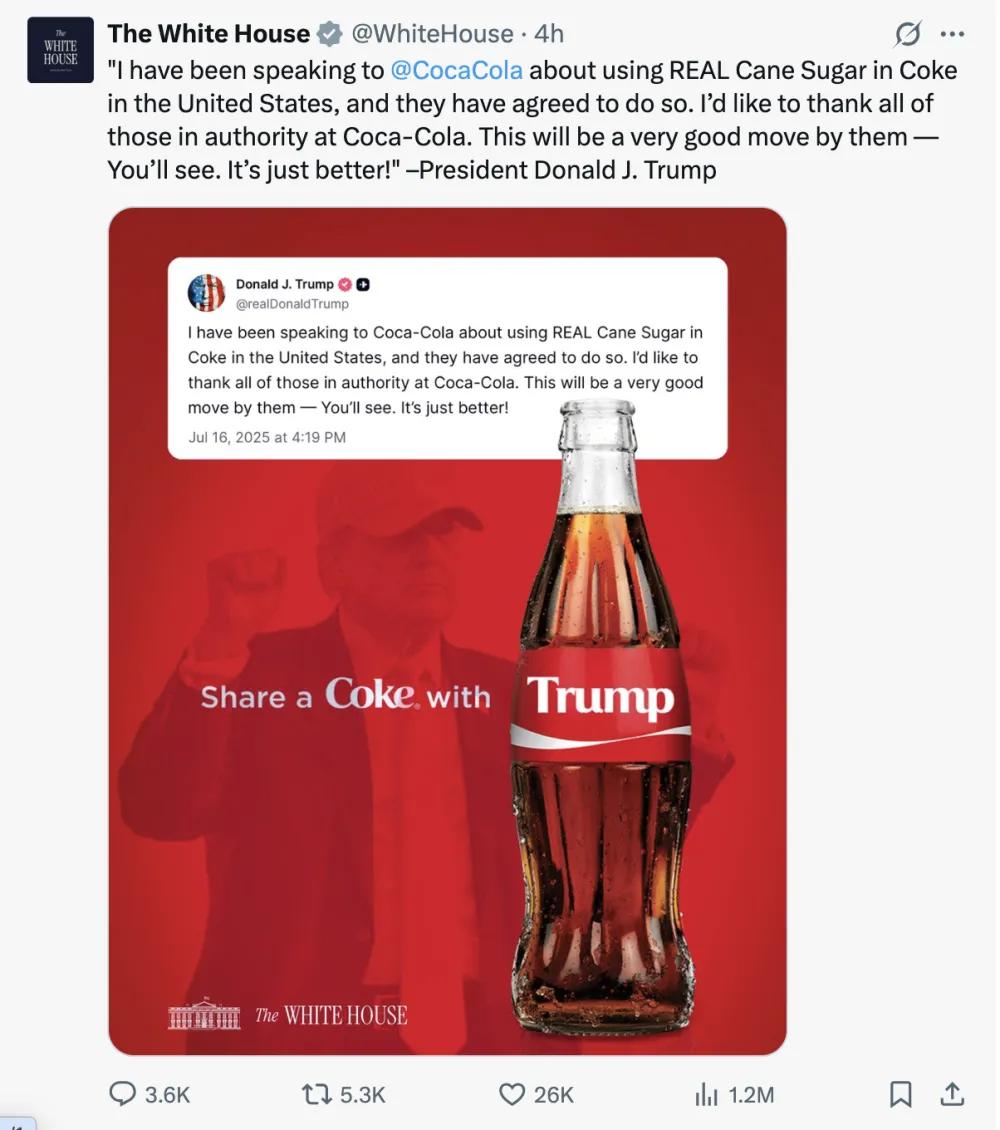
Core Viewpoint - The discussion around Coca-Cola's sweetener source has intensified following former President Trump's comments advocating for the use of real cane sugar instead of high fructose corn syrup (HFCS) in Coca-Cola products sold in the U.S. [1][3][5] Group 1: Trump's Comments and Company Responses - Trump expressed gratitude towards Coca-Cola's management for agreeing to consider using cane sugar in their products, labeling it a positive move [1][3] - Coca-Cola acknowledged Trump's enthusiasm for their brand and indicated that they would soon share more information about innovative products in their lineup [3] - PepsiCo's CEO stated that they would cater to consumer preferences for sugar and natural ingredients if there is a clear demand [3][5] Group 2: Historical Context of Sweetener Use - The switch from cane sugar to HFCS in Coca-Cola began in 1984, driven by cost considerations and the availability of cheap corn in the U.S. [5][19] - HFCS became popular due to government subsidies for corn production, which lowered its production costs compared to cane sugar [5][19] - Consumer calls for a return to cane sugar have persisted since the initial switch, reflecting a growing awareness and concern over ingredient sourcing [5][19] Group 3: Economic Implications of Sweetener Choices - The cost of HFCS is significantly lower than that of cane sugar, with estimates suggesting that switching to cane sugar could increase product costs by 10% to 15% [19][26] - In 1985, Coca-Cola and PepsiCo anticipated substantial savings from using HFCS, with Coca-Cola estimating a savings of approximately $30 million annually [26] - The market for HFCS surged, with its usage in the U.S. expected to increase by 500,000 tons annually following the switch [26] Group 4: Consumer Sentiment and Advocacy - Consumer backlash against the use of HFCS has been notable, with some advocating for a return to cane sugar due to health concerns associated with HFCS [31] - The discussion around sweeteners has gained traction, with political figures also voicing opposition to HFCS, linking it to health issues like childhood obesity [31] - Over the past two decades, the usage of HFCS in the U.S. has been gradually declining, while the consumption of cane sugar has been on the rise [31]
Pepsi introduces prebiotic cola months after Poppi acquisition
CNBC· 2025-07-21 19:08
Core Insights - PepsiCo is launching a prebiotic cola named Pepsi Prebiotic Cola this fall, following its $1.95 billion acquisition of Poppi, a functional beverage company [1][2] - The U.S. soda consumption has declined over the past two decades, but prebiotic sodas have gained popularity among health-conscious consumers [1] - Pepsi's North American beverage volume decreased by 2% in the second quarter, prompting the company to focus on health trends to attract customers [2] Product Details - Pepsi Prebiotic Cola will be available for online purchase this fall and in retailers next year, containing three grams of prebiotic fiber and five grams of cane sugar [3] - The fiber content in Pepsi Prebiotic Cola is one gram more than Poppi's soda but significantly lower than Olipop's fiber content [3] Competitive Landscape - Coca-Cola has also entered the prebiotic soda market with its Simply Pop brand, launched in February, indicating a growing trend in functional beverages [5] - The competition is intensifying as both Pepsi and Coca-Cola adapt to changing consumer preferences towards healthier options [5]