
Palantir Technologies(PLTR)

Search documents
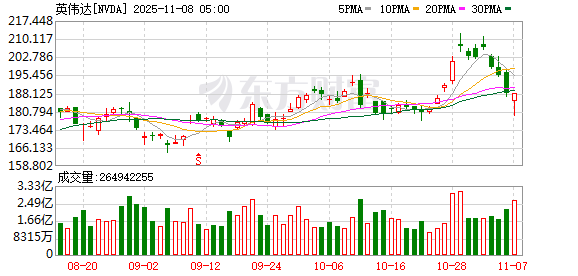
美股AI八巨头市值一周蒸发5.6万亿 高盛:未来1~2年市场或回撤20%
2 1 Shi Ji Jing Ji Bao Dao· 2025-11-09 09:37
Group 1: Market Performance - The Nasdaq index, primarily composed of technology stocks, experienced a weekly decline of over 3%, marking its worst performance since April [2] - The S&P 500 index fell by 1.6% during the week, ending a three-week streak of gains [2] - Eight leading companies closely associated with AI saw a combined market value drop of approximately $800 billion, with U.S. companies linked to AI losing nearly $1 trillion in market capitalization [2] Group 2: Individual Company Performance - Nvidia, which recently became the world's most valuable company, saw its stock drop over 7%, resulting in a market value loss of about $350 billion [2] - Microsoft experienced a decline of more than 4%, with a market value reduction exceeding $150 billion [2] - Oracle's stock fell nearly 8%, leading to a loss of over $66 billion in market capitalization [2] - Other AI-related stocks, such as Duolingo and Palantir, also faced significant declines, with Duolingo dropping over 24% and Palantir over 11% [2] Group 3: AI Market Sentiment - There is a growing consensus in the U.S. that the AI "myth" is unsustainable, as companies heavily invest in uncertain paths towards general artificial intelligence (AGI) [3] - A survey indicated that 95% of companies using generative AI have not yet turned a profit from the technology, suggesting a bubble driven by narrative rather than fundamentals [3] - Concerns are rising that excessive spending on AI with low returns could lead to the collapse of many leading companies in the sector [3] Group 4: Competitive Landscape - The U.S. industry recognizes that nearly half of the global AI talent is based in China, which may leverage this advantage in the long-term competition [4] - Unlike the U.S. focus on uncertain AGI investments, China is pursuing a more pragmatic approach driven by industrial applications, providing it with cost and application advantages [4] - Analysts from Goldman Sachs and Morgan Stanley predict a potential 10% to 20% market correction in the U.S. stock market due to the tech bubble, while expressing optimism about the Chinese market, particularly in AI, electric vehicles, and biotechnology [4] Group 5: Cryptocurrency Market - The cryptocurrency market saw a significant downturn, erasing nearly all gains accumulated over the first ten months of the year within just over a month [5] - Major cryptocurrencies like Bitcoin and Ethereum continued to decline, with trading volumes dropping by 40% to 50% in a 24-hour period [6] - The market experienced a substantial liquidation event, leading to over 130,000 traders being liquidated, indicating a collapse in liquidity and confidence [6] Group 6: Institutional Demand - For the first time in seven months, institutional demand for Bitcoin has fallen below the rate of new coin mining, suggesting that large buyers may be retreating from the market [8]






Is It Time to Buy Palantir on the Dip as Revenue Continues to Accelerate?
The Motley Fool· 2025-11-09 09:24
Core Insights - Palantir Technologies is recognized as a leading artificial intelligence (AI) company, showcasing significant growth in its Q3 results despite a decline in stock price due to high valuation concerns [1][2]. Financial Performance - Palantir's Q3 revenue reached $1.18 billion, exceeding management's guidance of $1.083 billion to $1.087 billion, marking a year-over-year growth acceleration from 13% in Q2 2023 to 63% in Q3 2023 [3][4]. - U.S. commercial revenue surged 121% to $397 million, with remaining deal value increasing by 199% to $3.63 billion, and total contract value for U.S. commercial deals rose 342% year-over-year to $1.31 billion [4][5]. - Government revenue climbed 55% year-over-year to $633 million, with U.S. government revenue increasing by 52% to $486 million, driven by demand for AI solutions [6]. Profitability Metrics - Adjusted earnings per share (EPS) rose from $0.10 to $0.21 year-over-year, surpassing the analyst consensus of $0.17, while adjusted EBITDA increased by 51% to $606.5 million [7]. Future Outlook - The company forecasts Q4 revenue between $1.327 billion and $1.331 billion, indicating a 61% growth at the midpoint, and raised its full-year revenue guidance to a range of $4.396 billion to $4.4 billion, representing 52% growth [8]. - U.S. commercial revenue is expected to grow by at least 104% [8]. Market Position - Despite a recent stock price drop, Palantir's stock is still up over 150% year-to-date and over 350% in the past 12 months, but it trades at a high forward price-to-sales (P/S) ratio of about 81 times the 2026 analyst consensus [2][9]. - The company is positioned as a critical player in AI, particularly with its Artificial Intelligence Platform (AIP), which is gaining traction among large language models for real-world applications [10]. Technological Advancements - Palantir is leveraging its AI Hivemind technology to orchestrate AI agents for solving complex problems, with commercial customers already utilizing it to address supply chain issues [11].

Billionaire Michael Burry Sends Investors a $1 Billion Warning About the AI Boom. History Says the Stock Market Will Do This Next.
The Motley Fool· 2025-11-09 09:06
Core Viewpoint - Hedge fund billionaire Michael Burry has made a significant bet against popular AI stocks Palantir and Nvidia, indicating a potential downturn in the AI sector [1][4]. Group 1: Michael Burry's Investment Strategy - Burry's hedge fund, Scion Capital Management, has allocated 66% of its $1.4 billion portfolio to put options on Palantir and 14% to put options on Nvidia, totaling over $1 billion in bets against these stocks [3][4]. - This strategy reflects Burry's historical approach, as he previously profited from a similar strategy during the 2008 financial crisis by betting against subprime mortgage-backed securities [1][2]. Group 2: Performance of AI Stocks - The AI boom, initiated by OpenAI's ChatGPT in November 2022, has led to substantial stock price increases, with Palantir and Nvidia shares rising 2,000% and 1,300%, respectively [5]. - Palantir has gained popularity among retail investors, particularly due to its AI platform launched in April 2023, which has driven nine consecutive quarters of revenue growth [6]. - Nvidia is recognized as a leader in AI infrastructure, holding over 90% market share in data center GPUs and establishing a strong position in generative AI networking equipment [7]. Group 3: Market Context and Comparisons - The S&P 500 has increased by 75% since the launch of ChatGPT, with an annual compounding rate of 20%, drawing parallels to the dot-com bubble [8]. - The S&P 500's cyclically adjusted price-to-earnings (CAPE) ratio reached 39.5 in October, the highest in 25 years, indicating extreme market valuations similar to those seen during the dot-com bubble [10]. - Historical data suggests that the S&P 500 has typically performed poorly following such high CAPE ratios, with an average decline of 30% over three years after surpassing a CAPE of 39 [12].

Palantir's Q3 Proved It's A $1 Trillion Company In The Making
Seeking Alpha· 2025-11-09 08:53
Group 1 - Palantir Technologies (PLTR) has become a highly discussed and controversial technology stock since its IPO in September 2020 [1] - The company has garnered attention for its unique approach to data analytics and its role in various sectors, including government and commercial enterprises [1] Group 2 - The article emphasizes the importance of gaining out-of-consensus information for investment strategies, highlighting the need for strategic insight and analysis in the current market environment [1]
X @The Wall Street Journal
The Wall Street Journal· 2025-11-09 05:57
Palantir is offering 22 teens a chance to skip college for its fellowship, which includes a four-week seminar on Western civilization https://t.co/3FeFiGWh9i ...
美股8家巨头单周暴跌超8000亿美元
Xin Lang Cai Jing· 2025-11-09 04:49
Core Viewpoint - The market capitalization of U.S. companies closely related to artificial intelligence has evaporated by nearly $1 trillion over the past week, raising concerns about the sustainability of current high valuations [1] Group 1: Market Impact - Eight of the most valuable AI-related companies, including Nvidia, Meta, Palantir, and Oracle, saw their total market value shrink by over $800 billion in just one week [1] - Analysts are increasingly questioning the sustainability of high valuations amid signs of a weakening labor market and declining consumer confidence [1] Group 2: Economic Indicators - The University of Michigan's Consumer Sentiment Index fell to a three-year low in November, indicating a drop in consumer confidence [1] - The historic government shutdown in the U.S. has led to the absence of key economic data, heightening investor concerns about a significant deterioration in the labor market since the end of September [1] Group 3: Analyst Commentary - Mike Zigmont from Visdom Investment Group suggested that the risk of an economic recession may be unfolding right before our eyes [1]

利空突袭,全线大跌!5.7万亿,发生了什么?
Xin Lang Cai Jing· 2025-11-09 04:49
Core Viewpoint - The recent sell-off in the U.S. tech sector, particularly in AI-related stocks, has led to significant market declines, raising concerns about overvaluation and potential economic downturns [1][2][3] Group 1: Market Performance - The Nasdaq index, heavily weighted with tech stocks, experienced a weekly decline of over 3%, marking its worst performance since April [1][2] - Eight major AI-related companies saw a combined market value loss exceeding $800 billion in just one week, with the total market loss for AI-related U.S. companies nearing $1 trillion [1][2] - Nvidia alone lost approximately $348.5 billion in market value, while Microsoft and Oracle also faced significant declines [2][3] Group 2: Investor Sentiment - Concerns over high valuations in the AI sector have prompted investors to withdraw from the market, leading to the first weekly decline in three weeks for the broader U.S. market [2][3] - Retail investors, typically known for buying on dips, chose to remain cautious this week, reducing their holdings following Palantir's disappointing earnings report [3] Group 3: Economic Indicators - Signs of a weakening labor market and declining consumer confidence have emerged, with the Michigan Consumer Sentiment Index dropping to a three-year low [3] - The Chicago Fed reported a continuous decline in hiring rates for six consecutive months, further unsettling investors [3] Group 4: Company-Specific Issues - Palantir's recent earnings report triggered concerns about its high valuation, leading to a sharp decline in its stock price and affecting related companies [1][3] - Meta has been implicated in generating significant revenue from fraudulent advertisements, with internal documents revealing that about $16 billion, or 10% of its projected 2024 revenue, comes from such ads [5][6]

利空突袭,全线大跌!5.7万亿,发生了什么?
券商中国· 2025-11-09 04:46
Group 1: Market Overview - The Nasdaq index, primarily composed of technology stocks, experienced a weekly decline of over 3%, marking its worst performance since April [1][2] - Eight major AI-related companies saw a total market value loss exceeding $800 billion in one week, with the overall market loss for AI-related U.S. companies nearing $1 trillion [1][2] - Nvidia alone lost nearly $350 billion in market value, while Microsoft and Oracle also faced significant declines [2] Group 2: Concerns Over Valuations - The sell-off in tech stocks was triggered by concerns over the high valuations of AI companies, particularly following Palantir's disappointing earnings report [3][4] - Analysts are increasingly questioning the sustainability of current high valuations, especially in light of rising capital expenditures and reliance on debt financing in the AI sector [3][4] Group 3: Economic Indicators - Weak signals from the U.S. labor market and declining consumer confidence are contributing to investor anxiety, with the Michigan Consumer Sentiment Index dropping to a three-year low [3][4] - The Chicago Fed's hiring rate has declined for six consecutive months, and recent layoffs from major companies have further unsettled investors [3] Group 4: Meta's Advertising Revenue Issues - Internal documents revealed that Meta is projected to earn approximately $16 billion in 2024 from fraudulent and prohibited advertisements, highlighting regulatory vulnerabilities in its advertising business [5][6] - Meta's platforms have been criticized for failing to adequately identify and block a significant number of scam ads, exposing users to various online frauds [5][6] Group 5: Future Outlook - Analysts suggest that if investor confidence does not recover, other sectors may also be impacted, leading to broader market volatility [4] - The financial health and future prospects of major tech companies will be closely monitored as they prepare to release upcoming earnings reports [4]

Michael Burry's Bets Against AI Stocks Nvidia and Palantir: What Investors Should Know
The Motley Fool· 2025-11-08 20:00
Core Viewpoint - The Nasdaq Composite index experienced its worst week since April, primarily due to hedge fund manager Michael Burry's bearish bets on AI stocks Nvidia and Palantir, leading to declines in major indexes [1][2]. Market Performance - The S&P 500 and Nasdaq Composite indexes fell by approximately 1.6% and 3% respectively, while the Dow decreased by over 1% [1]. - Nvidia shares dropped 7.1% this week, and Palantir shares fell 11.2%, with significant declines occurring after the news of Burry's bets [10]. Hedge Fund Activity - Michael Burry's Scion Asset Management filed an SEC Form 13F revealing bearish positions on Nvidia and Palantir, which began impacting the market shortly after the filing [2][3]. - Burry's reputation as a stock forecaster stems from his successful predictions prior to the 2007-2008 financial crisis, which has led investors to pay attention to his market moves [4]. Specifics of Burry's Bets - In Q3, Burry purchased 1 million put options on Nvidia, valued at $186.6 million, and 5 million put options on Palantir, valued at $912.1 million [6][7]. - Burry's fund also held six other stocks worth about $283 million at the end of Q3, including Pfizer and Halliburton [8]. Investor Sentiment - Following the initial drop, Nvidia and Palantir stocks stabilized on Friday, indicating that some investors may have already exited their positions due to uncertainty [11][12]. - The advice for investors is to maintain their existing positions on Nvidia and Palantir, regardless of Burry's actions, as the influence of hedge fund managers can sometimes lead to overreactions in the market [14][15].

The 'Big Short' Guy Just Bet $1.1 Billion Against AI Giants—And Markets Are Still Absorbing It
Yahoo Finance· 2025-11-08 19:01
Core Insights - Michael Burry disclosed a $1.1 billion short position against Nvidia and Palantir Technologies, leading to a sell-off in tech markets [1] Company Performance - Palantir's stock dropped as much as 16% before closing down approximately 8%, despite beating third-quarter earnings estimates and raising full-year guidance [2] - Nvidia's stock fell between 2% and 4% during the same trading session, but it did not drop below its 50-day benchmark, indicating stronger fundamentals [2][5] - Palantir trades at a price-to-earnings ratio of approximately 254 and a price-to-sales ratio of around 115, making it vulnerable to bearish pressure [3] Market Reaction - The sell-off triggered by Burry's position affected global markets, with significant declines in Asian and European indices, particularly in Japan and South Korea [3] - The Nasdaq Composite recorded its largest one-day percentage drop in nearly a month at roughly 2%, with all members of the "Magnificent Seven" AI-related stocks closing lower [2] Valuation Concerns - The current trading prices for both stocks are below the average of the last 50 days, raising concerns for technical analysts [4] - Burry's disclosure has injected volatility into the AI sector, making investors cautious about buying at high valuations [6] Broader Market Sentiment - Major Wall Street executives, including CEOs from Morgan Stanley and Goldman Sachs, warned investors to prepare for potential market corrections of 10% to 20% in equity markets over the next couple of years [7] - Deutsche Bank is reportedly exploring strategies to hedge its exposure to AI-driven investments in data centers [7] - Burry highlighted "circular financing" in tech, questioning the sustainability of reported growth in the sector [7]