Raytheon Technologies(RTX)

Search documents
2027: Defense Boom As The AI Trade Unwinds
Seeking Alpha· 2026-01-09 14:20
Group 1 - Defense spending has become a crucial focus amid the context of Cold War II, despite general voter unpopularity towards war [1] - The primary objective in this environment is risk management, as state actors navigate increasingly fragmented geopolitical landscapes [1]



法巴银行预警:航空国防股大涨15%后,财报不及预期风险骤升
智通财经网· 2026-01-09 07:05
Group 1 - The aerospace and defense sector is experiencing high expectations for earnings performance as it enters the fourth quarter reporting season, with stock prices rising approximately 15% since early December, significantly outperforming the market [1] - Despite strong industry fundamentals, the recent rebound in stock prices has increased the risk of underperformance, particularly for Boeing, where investor optimism regarding free cash flow may be overblown [1] - The report indicates that investor sentiment towards Boeing's free cash flow has shifted from extreme pessimism to excessive optimism, with expectations for a rebound from around $2 billion to over $10 billion, which may not align with the bank's more cautious outlook [1] Group 2 - For GE Aerospace, the preliminary earnings guidance for 2026 is expected to align with previous management expectations, rather than exceeding them, with a projected EBIT increase of around $1 billion [2] - The initial earnings outlook for GE Aerospace is anticipated to be close to $10 billion, which may be viewed as conservative, thus limiting downside risk for the stock [2] - The bank maintains a positive outlook on Raytheon Technologies, believing the stock is undervalued despite mixed market sentiment, supported by growth in Collins Aerospace and potential for margin improvement [2] Group 3 - The bank has adjusted target prices for most companies in the sector to reflect recent re-ratings, expressing a relative preference for Raytheon Technologies over Boeing and GE Aerospace ahead of earnings announcements [3]


美国推进空中交通系统升级
Xin Lang Cai Jing· 2026-01-09 04:19
Core Points - The U.S. government has signed a supply contract with Raytheon Technologies and Indra Sistemas for new radar systems to update the aging air traffic control system, marking a critical step in a multi-billion dollar upgrade plan [1] - This contract is part of a $12.5 billion air traffic control system reform plan approved by Congress last year [1] - The urgency for system upgrades has been highlighted by recent incidents, including a catastrophic helicopter crash in January 2025 that resulted in 67 fatalities [1] Financial and Project Details - The Federal Aviation Administration (FAA) plans to invest $6 billion in telecommunications infrastructure and radar monitoring systems as part of this upgrade [1] - An additional $20 billion is expected to be required to complete the entire air traffic control system upgrade [1] - The contract aims to replace up to 612 radar systems by June 2028, with the replacement work starting this quarter and prioritizing areas with high air traffic [1] Infrastructure Enhancements - The project will also involve the installation of ground replacement radars at 44 airports and the procurement of 27,625 radio devices [1] - Additionally, 110 new weather stations will be established in Alaska as part of the upgrade [1]
特朗普创纪录1.5万亿军费要打“世界大战”?军工股大反弹,无人机厂商两位数高涨
Hua Er Jie Jian Wen· 2026-01-08 19:04
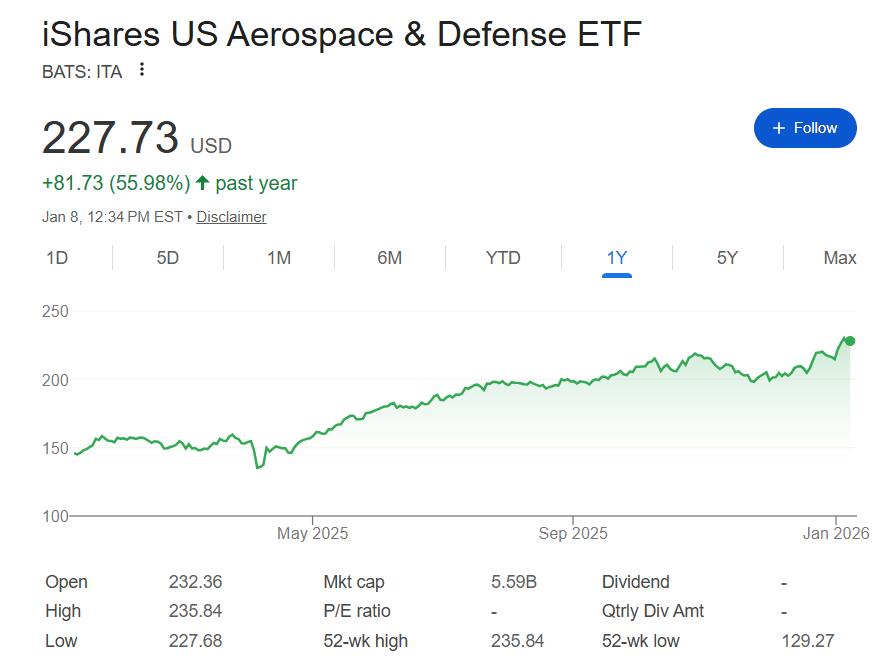
Core Viewpoint - President Trump's recent statements have caused significant volatility in the defense sector, with threats to limit dividends and stock buybacks for defense contractors leading to a sharp decline in military stocks, followed by a strong rebound after his proposal to increase military spending to $1.5 trillion for fiscal year 2027, a 50% increase from the current budget of $901 billion [1][2][10]. Group 1: Market Reactions - Following Trump's statements, defense stocks experienced a dramatic rebound, with major companies like Lockheed Martin (LMT) rising over 9%, Northrop Grumman (NOC) nearly 11%, and Raytheon Technologies (RTX) up nearly 6% [5][9]. - The iShares U.S. Aerospace & Defense ETF (ITA) has seen a cumulative increase of over 50% in the past 12 months, reflecting strong performance in the defense sector [2]. - Global defense stocks also rose, with European defense stocks increasing by up to 3.8% on the same day, and notable gains in companies like BAE Systems and Rheinmetall [9]. Group 2: Budget Proposal and Challenges - Trump's proposal to increase the defense budget by 50% is historically rare, with the last similar increase occurring during the Korean War in 1951 [10]. - The feasibility of this budget increase faces challenges, as the Congressional Budget Office (CBO) estimates a budget deficit of 5.5% of GDP for the current year, with projected tax revenues falling short of the anticipated defense spending growth [10][11]. - Political hurdles exist, as the proposed budget would require significant support in the Senate, and there are concerns about whether defense contractors can absorb such a large increase in spending [11]. Group 3: Analyst Perspectives - Analysts generally express cautious optimism regarding the direction of U.S. defense spending, with expectations for higher expenditures amid stricter scrutiny of companies [12][13]. - Some analysts suggest that limiting capital returns could free up billions for capacity expansion or acquisitions, indicating a potential shift in investment strategies within the defense sector [13]. - The geopolitical landscape is driving increased defense spending, with analysts noting that the world is becoming a more dangerous place, further justifying the proposed budget increase [13][14].




Factbox-Billions at stake as Trump targets US defense sector dividends, buybacks
Yahoo Finance· 2026-01-08 18:31
Core Viewpoint - U.S. defense companies face pressure from President Trump to halt dividends and share buybacks until production is accelerated, highlighting a shift in priorities towards national defense over investor returns [1] Group 1: Defense Companies' Financial Activities - Lockheed Martin paid dividends of $3.30 per share for Q1 to Q3 2025, with a slight decrease to $3.45 in Q4 2025, and cumulative dividend payments reached $2.3 billion by September 2024, alongside $2.3 billion in share repurchases [2] - RTX's dividends were $0.68 per share for Q1 to Q3 2025, decreasing to an estimated $0.66 in Q4 2025, with cumulative dividend payments of $2.7 billion by Q3 2024 and $50 million in share repurchases [2] - Northrop Grumman's dividends were $2.31 per share for Q1 to Q3 2025, decreasing to an estimated $2.30 in Q4 2025, with cumulative dividend payments of $964 million by Q3 2024 and $1.17 billion in share repurchases [3] - L3Harris Technologies paid dividends of $1.20 per share for Q1 to Q3 2025, increasing to an estimated $1.25 in Q4 2025, with cumulative dividend payments of $678 million by Q3 2024 and $998 million in share repurchases [4] - General Dynamics paid dividends of $1.50 per share for Q1 to Q3 2025, decreasing to an estimated $1.48 in Q4 2025, with cumulative dividend payments of $1.19 billion by Q3 2024 and $600 million in share repurchases [4] Group 2: Boeing's Financial Status - Boeing suspended dividends and share buybacks in March 2020, and these remain on hold despite the lifting of the flight ban on its 737 MAX in November 2020 [3]

RTX Technologies: In Trump's Crosshairs, Defense Spending Whispers Boost Shares
Seeking Alpha· 2026-01-08 17:42
Core Insights - The Aerospace & Defense industry is experiencing significant volatility at the start of the year, particularly influenced by regulatory changes announced by President Trump [1] Group 1: Regulatory Impact - President Trump announced plans to limit the ability of aerospace companies to buy back shares, specifically targeting RTX Technologies [1]

Lockheed Martin Leads Defense Stock Rally as Trump Calls For Military Spending Surge
Investopedia· 2026-01-08 16:15
Core Insights - Defense contractors' shares surged following President Trump's proposal to significantly increase the military budget to $1.5 trillion for 2027, up from $1 trillion [1][6] Group 1: Stock Performance - Shares of Lockheed Martin (LMT), Huntington Ingalls (HII), and L3 Harris (LHX) rose over 7%, leading gains in the S&P 500 index [2] - General Dynamics (GD) and Northrop Grumman (NOC) saw increases of more than 4%, while RTX Corp. (RTX) gained 2% [2] Group 2: Budget Details - The Department of Defense had a budget of $850 billion in fiscal 2025, which was an increase of $34 billion from the previous year [3] - The White House proposed an increase of over $113 billion for the fiscal 2026 defense budget [3] - Trump's proposed budget represents a roughly 50% increase from the current budget levels [3] Group 3: Market Reactions - The gains in defense stocks on Thursday reversed losses from the previous day, when Trump criticized companies for spending on stock buybacks and dividends instead of enhancing manufacturing processes [4]

RTX And Potential Restrictions On Capital Allocation
Seeking Alpha· 2026-01-08 16:10
Robert F. Abbott has been investing his family’s accounts since 1995, and in 2010 added options, mainly covered calls and collars with long stocks. He is a freelance writer, and his projects include a website that provides information for new and intermediate-level mutual fund investors. A resident of Airdrie, Alberta, Canada, Robert has earned Bachelor of Arts and Master of Business Administration (MBA) degrees.Analyst’s Disclosure:I/we have no stock, option or similar derivative position in any of the com ...

美股军工股大涨
Shang Hai Zheng Quan Bao· 2026-01-08 15:56
Group 1 - U.S. defense stocks, including Lockheed Martin and Raytheon Technologies, showed strong performance with Lockheed Martin rising over 9% and Raytheon Technologies increasing nearly 6% during trading [2] - President Trump proposed increasing the U.S. military budget for fiscal year 2027 from $1 trillion to $1.5 trillion, emphasizing the need for a stronger military in light of current global tensions [2] - Trump's statement indicates a strategic move to build a "dream army" for the United States, reflecting a significant shift in defense spending priorities [2] Group 2 - Former Fox News host Tucker Carlson suggested that the proposed budget increase to $1.5 trillion signals that the U.S. may be preparing for a potential "world war" [2] - Carlson's commentary highlights concerns that such a substantial military budget is characteristic of a nation gearing up for global or regional conflict [2] - This trend suggests a growing perception that the U.S. is moving towards a possible escalation in military engagements on a global scale [2]
US stocks open lower on Thursday: Dow slips 100 points, Nasdaq down 0.3%
Invezz· 2026-01-08 15:00
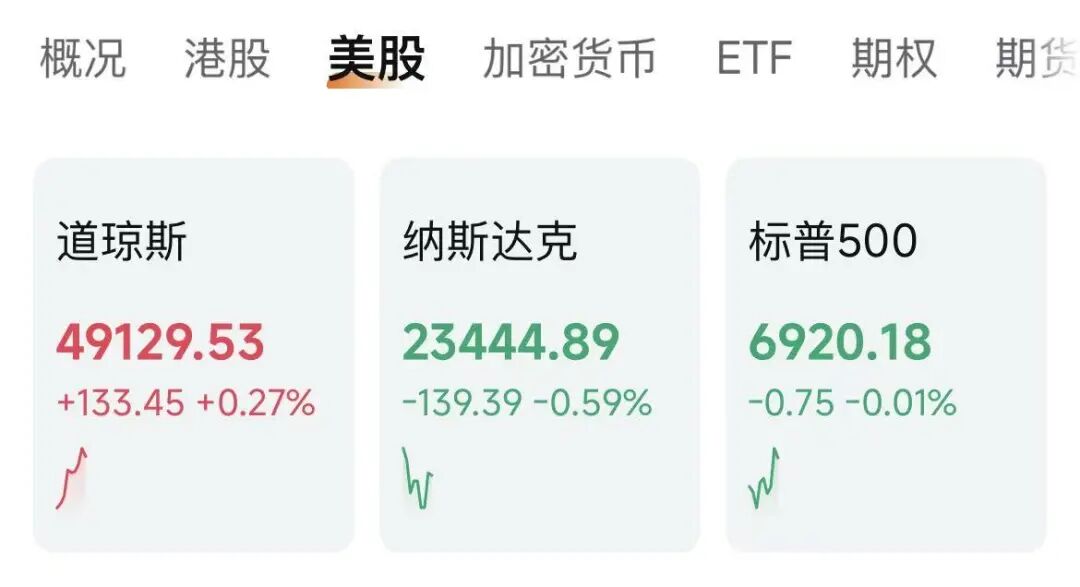
Market Overview - US equities opened lower, with the S&P 500 down 0.1% and the Dow Jones Industrial Average falling 108 points or 0.2%, as major technology stocks weakened despite a rally in defence stocks [1] - The Nasdaq Composite underperformed, sliding 0.3% due to pressure on large-cap technology stocks that have driven recent market gains [1][3] Technology Sector - Technology stocks, including Meta Platforms, Apple, and Netflix, experienced declines, which limited market upside even as other sectors showed strength [3] - The pullback in tech stocks followed a cautious tone from the previous session, where both the S&P 500 and the Dow finished in the red after reaching all-time highs [3] Defence Sector - Defence stocks surged following President Trump's proposal for a $1.5 trillion defence budget for 2027, a significant increase from the $901 billion budget approved for 2026 [5] - Northrop Grumman rose over 8%, Lockheed Martin climbed 6%, RTX advanced more than 3%, and Kratos Defence jumped nearly 13%, making defence one of the strongest-performing segments [5][6] Economic Indicators - Initial jobless claims for the week ended Jan. 3 were reported at 208,000, up from 200,000 the previous week, but below economists' expectations of 210,000, indicating resilience in the US labour market [7][8] - Claims data has shown volatility recently, but initial claims remain near the lower end of the range seen over the past year, suggesting employers are retaining their workforces [8][9]