
劳动力市场韧性

Search documents
澳大利亚:揭示劳动力市场的韧性(英)2026
IMF· 2026-03-02 08:40
Investment Rating - The report does not explicitly provide an investment rating for the industry. Core Insights - The Australian labor market has shown remarkable resilience despite economic slowdown, with strong employment growth and low unemployment rates, but limited wage pressure [5][15][16]. - Recent dynamics reflect a combination of cyclical and structural forces, with indicators like job vacancies and unemployment rates potentially overstating cyclical tightness due to sectoral shifts, particularly in healthcare [5][16]. - The rapid growth in labor supply is driven by structural trends and cyclical responses to high living costs and interest rates, leading to increased participation rates and part-time employment [5][16][28]. - Strong labor supply and concentrated demand in specific industries have suppressed wage pressures, suggesting a temporary reduction in the natural rate of unemployment (NAIRU) [5][16][30]. Summary by Sections A. Overview of Australia's Labor Market Dynamics - The Australian labor market has demonstrated significant resilience post-pandemic, with labor demand surging after the easing of restrictions, leading to record-high job vacancies [17][19]. - Despite a slowdown in economic growth, robust labor demand and supply have supported stable employment growth and kept unemployment rates low [17][19]. B. Paradox 1: Low Unemployment and High Job Vacancy Rates Amid Economic Slowdown - Unemployment rates reached a record low of 3.4% in July 2022, gradually rising to 4.5%, still below pre-pandemic levels [32]. - Job vacancy rates remain significantly higher than the highest levels seen in the decade before the pandemic, indicating persistent labor market tightness [32][40]. C. Paradox 2: Continued Strong Labor Force Participation Rate Post-Pandemic - Labor force participation rates have shown a long-term upward trend, accelerated by structural changes and cyclical developments, particularly due to rising living costs and high interest rates [49][60]. - The influx of migrants has also supported labor force participation, with net migration trends normalizing post-pandemic [54][60]. D. Paradox 3: Slow Wage Growth Despite Tight Labor Market Conditions - Wage growth has remained subdued despite tight labor market conditions, with real wage growth reaching near-record lows in 2022 and 2023 [63][68]. - Structural and cyclical shifts may explain the slow wage growth, with productivity declines and increased labor supply contributing to reduced wage pressures [64][65][70].
劳动力市场仍显韧性!美国上周初请失业金人数意外回落至逾1月新低
智通财经网· 2026-02-19 13:51
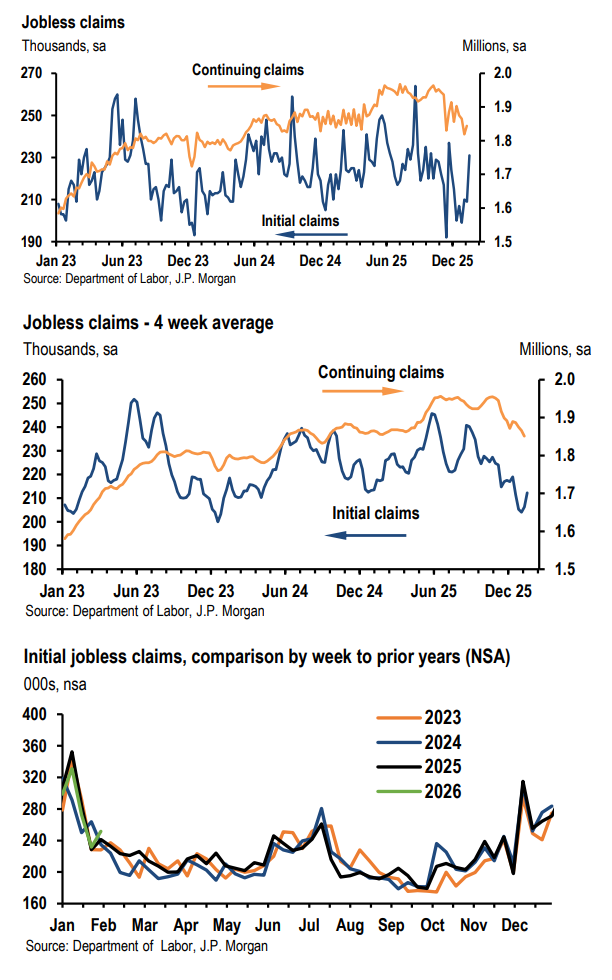
Core Viewpoint - The latest unemployment claims data indicates resilience in the U.S. labor market, with initial claims falling to 206,000, the lowest since January 10, and below market expectations of 225,000 [1][1][1] Group 1: Unemployment Claims Data - Initial unemployment claims for the week ending February 14 dropped to 206,000, lower than the revised previous value of 229,000 [1][1] - Continuing claims for the week ending February 7 were reported at 1.869 million, exceeding market expectations of 1.86 million and the revised previous value of 1.852 million [1][1] - The four-week moving average of initial claims was 219,000, slightly below the revised previous value of 220,000, indicating a stable labor market [1][1] Group 2: Inflation and Federal Reserve Outlook - Concerns over inflation are resurfacing, which may dampen investor expectations for interest rate cuts by the Federal Reserve [1][1] - The recent tensions between the U.S. and Iran have led to rising oil prices, contributing to inflation worries [1][1] - Federal Reserve officials expect inflation to trend down towards 2%, but the pace and timing of this decline remain uncertain, with risks of inflation staying above target [1][1]
裁员数据真的崩了?摩根大通:数据不如标题所示严峻
Hua Er Jie Jian Wen· 2026-02-06 12:51
Core Viewpoint - Morgan Stanley indicates that despite alarming headlines regarding the labor market data, such as the surge in initial jobless claims and the highest number of layoffs since 2009, these figures are significantly distorted by seasonal factors, extreme weather, and statistical recalibrations [1][9]. Group 1: Initial Jobless Claims - The number of initial jobless claims in the week ending January 31 rose sharply from 209,000 to 231,000, marking the highest level since mid-October of the previous year when excluding seasonal distortions [1][9]. - Morgan Stanley believes this increase is not a cause for excessive concern, as it aligns with expected seasonal trends [8]. Group 2: Weather Impact - The rise in claims is partly attributed to short-term disruptions caused by weather events, specifically "Winter Storm Fern," which likely temporarily inflated the number of individuals applying for unemployment benefits [9]. Group 3: Continued Claims Data - The number of continued jobless claims increased slightly from 1.819 million to 1.844 million, but Morgan Stanley views this as a "good number," indicating resilience in the labor market [10]. - The four-week moving average of continued claims is at its lowest level since October 2024, suggesting that the ability or willingness of unemployed individuals to find new jobs remains intact [10]. Group 4: Challenger Layoff Report - The Challenger layoff report for January indicated a total of 108,000 announced layoffs, the highest for January since 2009, but Morgan Stanley argues that this portrayal is misleading [11]. - The report's figures are closer to historical averages for January in recent years, rather than indicative of a crisis similar to 2009 [11]. Group 5: Layoff Data Breakdown - Within the 108,000 layoffs, 30,000 were attributed to UPS and 16,000 to Amazon, with UPS reducing its transportation business for Amazon and Amazon's layoffs primarily affecting office staff [13]. - There is a concern regarding potential double counting in Amazon's layoffs, as the company had previously announced a layoff target of 30,000 in October, which may have already been included in earlier reports [13].


【UNFX财经事件】美元强势延续 英镑在美联储谨慎基调下面临上行压力
Sou Hu Cai Jing· 2026-01-16 04:23
Group 1 - The Federal Reserve officials are signaling a cautious approach to monetary policy, emphasizing that inflation remains above target and the labor market is resilient, indicating no immediate need for further rate cuts [1][2] - There is a growing consensus within the Fed for an "extended observation period," with officials like Chicago Fed President Goolsbee and Kansas City Fed President George opposing premature rate adjustments [1][3] - Recent economic data supports the Fed's stance, showing a slight decrease in unemployment to 4.4% and initial jobless claims dropping to 198,000, indicating stability in the job market despite high interest rates [2][3] Group 2 - The current inflation rate is hovering around 3%, significantly above the Fed's long-term target of 2%, which reinforces the decision to maintain a cautious policy [2][3] - The market's expectation for rate cuts has diminished, with futures pricing indicating a lower probability of rate reductions before June, suggesting a slowdown in the pace of monetary easing [2] - The strength of the US dollar is attributed to stable interest rate expectations, impacting non-US currencies like the British pound, which is facing resistance in its upward movement [2][3] Group 3 - The independence of the Federal Reserve remains a potential variable of concern, with officials expressing support for Chair Powell and emphasizing that policy decisions should be based on data rather than political pressure [3] - The foreign exchange market has largely priced in the scenario of a pause in rate cuts, with the dollar's strength reflecting the continuation of stable rate expectations rather than the beginning of a new trend [3] - In the absence of new policy signals or key data, major currency pairs are expected to remain within critical ranges, with market focus shifting towards upcoming inflation data and Fed officials' statements [3]
光大期货:1月16日有色金属日报
Xin Lang Cai Jing· 2026-01-16 01:13
Copper - Copper prices fluctuated overnight, with domestic refined copper imports remaining unprofitable. The macroeconomic context shows that initial jobless claims in the U.S. fell to 198,000, significantly below the market expectation of 215,000 and the previous value of 208,000, indicating a resilient labor market [2][12] - The U.S. Kansas City Fed President stated there is currently no reason to cut interest rates, as doing so could hinder progress in controlling inflation and would not benefit the labor market [2][12] - The People's Bank of China announced a 0.25 percentage point reduction in various structural monetary policy tool rates. Inventory levels showed a decrease in LME copper stocks by 500 tons to 141,125 tons, while Comex stocks increased by 4,653 tons to 488,720 tons [2][12] - Domestic copper prices rose again, but downstream enterprises are cautious in purchasing, focusing on essential needs. Additionally, import losses have widened, and the export window is gradually opening, which may benefit first-quarter export demand [2][12] - Trump indicated that there would be no temporary tariffs on key minerals like copper. The geopolitical situation between the U.S. and Iran, along with volatility in precious metals, has spilled over, causing instability in high copper prices [2][12] Nickel & Stainless Steel - LME nickel prices fell by 1.04% to $18,590 per ton, while SHFE nickel prices decreased by 0.24% to 146,880 yuan per ton. LME nickel inventory increased by 624 tons to 285,282 tons, and SHFE warehouse receipts rose by 1,700 tons to 41,972 tons [3][13] - The Indonesian Ministry of Energy and Mineral Resources announced a reduction in the nickel ore production target for 2026 from 364 million tons to approximately 250-260 million tons, which may create a global primary nickel supply-demand gap, potentially driving nickel prices higher [3][13][14] - The production of primary nickel increased significantly by 18.5% to 37,200 tons, indicating strong demand for hedging in the market [3][13] Aluminum & Aluminum Alloys - Aluminum oxide prices showed a weak trend, with AO2605 settling at 2,749 yuan per ton, down 1.33%. SHFE aluminum prices also declined, with AL2603 at 24,320 yuan per ton, down 0.59% [6][15] - The SMM aluminum oxide price fell to 2,650 yuan per ton, and aluminum ingot spot premiums expanded to 130 yuan per ton. The market is experiencing high inventory levels, leading to low premium purchasing sentiment and continued cost pressure [6][15] - The end of environmental controls and the cancellation of export tax rebates are expected to impact the market, with aluminum prices maintaining a high rhythm and spot premiums continuing to narrow [6][15] Industrial Silicon & Polysilicon - Industrial silicon prices showed a slight increase, with the main contract at 8,730 yuan per ton, up 0.46%. The inventory of industrial silicon is gradually shifting towards intermediate links, with hidden inventory increasing [7][16] - Polysilicon prices experienced a slight decline, with the main contract at 48,670 yuan per ton, down 0.38%. The market is facing pressures from logistics disruptions and speculative trading sentiment is cooling down [7][16] Lithium Carbonate - Lithium carbonate futures fell by 1.31% to 163,220 yuan per ton, with average prices for battery-grade lithium carbonate dropping by 4,000 yuan to 159,000 yuan per ton [8][17] - Supply-side production increased by 70 tons to 22,605 tons, while demand for lithium materials is expected to decline in January 2026, with a projected decrease in production for various battery types [8][17] - Despite current raw material price increases potentially suppressing terminal demand, the overall market sentiment remains bullish on lithium prices due to low inventory levels and speculative demand [8][17]

美联储穆萨莱姆:失业救济申请、裁员公告及其他指标显示劳动力市场具有韧性。
Sou Hu Cai Jing· 2026-01-13 15:17
Core Viewpoint - The labor market shows resilience as indicated by unemployment claims, layoff announcements, and other metrics [1] Group 1 - Unemployment claims are reflecting a stable labor market [1] - Layoff announcements are not significantly increasing, suggesting job security [1] - Other economic indicators also support the notion of a robust labor market [1]
Asia-Pacific markets set to open higher, tracking Wall Street gains on U.S. jobs data
CNBC· 2026-01-11 23:55
Group 1 - Asia-Pacific markets opened higher, influenced by Wall Street gains following a U.S. job report indicating fewer jobs created in December than expected, despite a decrease in the unemployment rate, suggesting labor market resilience [1] - Investors are monitoring oil prices as protests in Iran continue, resulting in over 500 fatalities, with President Trump considering intervention options [2] - Brent crude futures increased by 0.84% to $63.87 per barrel, while U.S. West Texas Intermediate crude rose by 0.83% to $59.62 [2] Group 2 - Spot gold prices surged over 1.6% to reach an all-time high of $4,581.29 per ounce [3]

加拿大连续第四个月新增就业 但失业人数增幅创三年来最大
Xin Lang Cai Jing· 2026-01-10 04:03
Group 1 - Canada's economy experienced job growth for the fourth consecutive month, with an increase of 8,200 jobs in December and a total of 188,800 jobs added over the past four months [1] - The unemployment rate rose by 0.3 percentage points to 6.8%, marking the largest monthly increase in unemployment in three years, with 72,900 more people unemployed in December [1] - The labor force participation rate increased to 65.4%, driven by an increase of 81,000 in the labor force population, the largest gain since November 2024 [1] Group 2 - The report indicates a certain resilience in the labor market, which may provide room for economic activity to rebound by 2026, although the extent of the rebound may be limited [2] - The overnight swap market traders expect the Bank of Canada to maintain the key interest rate at 2.25% for most of the year, as long as economic growth and inflation trends meet expectations [2] - The next interest rate decision and monetary policy report from the Bank of Canada is scheduled for January 28 [2]
US stocks open lower on Thursday: Dow slips 100 points, Nasdaq down 0.3%
Invezz· 2026-01-08 15:00
Market Overview - US equities opened lower, with the S&P 500 down 0.1% and the Dow Jones Industrial Average falling 108 points or 0.2%, as major technology stocks weakened despite a rally in defence stocks [1] - The Nasdaq Composite underperformed, sliding 0.3% due to pressure on large-cap technology stocks that have driven recent market gains [1][3] Technology Sector - Technology stocks, including Meta Platforms, Apple, and Netflix, experienced declines, which limited market upside even as other sectors showed strength [3] - The pullback in tech stocks followed a cautious tone from the previous session, where both the S&P 500 and the Dow finished in the red after reaching all-time highs [3] Defence Sector - Defence stocks surged following President Trump's proposal for a $1.5 trillion defence budget for 2027, a significant increase from the $901 billion budget approved for 2026 [5] - Northrop Grumman rose over 8%, Lockheed Martin climbed 6%, RTX advanced more than 3%, and Kratos Defence jumped nearly 13%, making defence one of the strongest-performing segments [5][6] Economic Indicators - Initial jobless claims for the week ended Jan. 3 were reported at 208,000, up from 200,000 the previous week, but below economists' expectations of 210,000, indicating resilience in the US labour market [7][8] - Claims data has shown volatility recently, but initial claims remain near the lower end of the range seen over the past year, suggesting employers are retaining their workforces [8][9]




美国“小非农”数据今晚公布
Sou Hu Cai Jing· 2026-01-07 08:35
Group 1 - The upcoming release of the ADP employment numbers for December and the JOLTs job openings for November is expected to provide insights into the labor market's resilience [1] - The data is anticipated to support the Federal Reserve's decision to maintain its current stance in January [1]