Starbucks(SBUX)

Search documents
Baristas are rallying at Starbucks stores across the country this weekend. Here's why
Fastcompany· 2025-10-25 10:17
Core Points - Union Starbucks workers are voting to authorize a strike for better pay and hours, which could disrupt operations during the peak pumpkin spice latte season [1] Group 1 - The strike authorization vote is aimed at improving compensation and working conditions for employees [1] - The potential strike could affect numerous stores across the nation, particularly during a high-demand period for seasonal products [1]



X @The Wall Street Journal
The Wall Street Journal· 2025-10-25 08:36
The coffee chain that won't leave Starbucks alone is now coming for America. 🔗 https://t.co/BBgWxNUTCs https://t.co/eXccrhl3oF ...
Unlocking Q4 Potential of Starbucks (SBUX): Exploring Wall Street Estimates for Key Metrics
ZACKS· 2025-10-24 14:16
Core Viewpoint - Starbucks is expected to report quarterly earnings of $0.56 per share, a 30% decline year-over-year, with revenues projected at $9.35 billion, reflecting a 3% increase compared to the previous year [1]. Earnings Projections - Over the last 30 days, the consensus EPS estimate has been revised downward by 10%, indicating a reassessment by analysts of their initial forecasts [2]. - Changes in earnings projections are crucial for predicting investor reactions, as empirical studies show a strong correlation between earnings estimate trends and short-term stock price movements [3]. Revenue Estimates - Analysts predict 'Net Revenues- Company-operated stores' to be $7.70 billion, a 3.4% increase year-over-year [5]. - The estimate for 'Net Revenues- Licensed stores' is $1.13 billion, suggesting a 0.5% year-over-year increase [5]. - 'Net Revenues- Other' is expected to reach $523.41 million, indicating a 4.2% increase from the previous year [5]. - 'Net Revenues- Channel Development' is forecasted at $474.41 million, reflecting a 1.9% year-over-year increase [6]. - 'Net Revenues- North America' is projected to be $6.85 billion, a 2.4% increase from the prior year [6]. - 'Net Revenues- Company-operated stores- International' is expected to reach $1.54 billion, indicating an 8.5% increase year-over-year [6]. Store Metrics - 'Net Revenues- Licensed stores- International' is estimated at $477.96 million, reflecting a 4.8% year-over-year increase [7]. - 'Net Revenues- Licensed stores- North America' is projected to be $670.80 million, indicating a slight decline of 0.4% year-over-year [7]. - The total number of stores is expected to reach 41,207, up from 40,199 in the previous year [7]. - The consensus estimate for 'Total Stores - International' stands at 22,691, compared to 21,775 last year [8]. - 'Total Stores - North America' is expected to reach 18,570, up from 18,424 year-over-year [8]. - 'Total Licensed stores EOP' is projected to be 19,520, an increase from 19,181 in the same quarter last year [8]. Stock Performance - Starbucks shares have increased by 1.9% over the past month, compared to a 1.3% increase in the Zacks S&P 500 composite [8].
星巴克开启咖啡原产地文旅体验 “云南咖啡主题航班”顺利首航
Jing Ji Wang· 2025-10-24 01:20
Group 1 - Starbucks China has launched a new collaboration with China Eastern Airlines, introducing a Yunnan coffee-themed flight, MU5814, which successfully completed its inaugural journey [1] - Over 200 passengers on the inaugural flight enjoyed cold brew coffee made from Starbucks' selected Yunnan Menglian sun-dried Bourbon coffee beans in a specially designed cabin [1] - The partnership aims to leverage complementary resources, focusing on co-creation in the Yunnan coffee sector and exploring the integration of coffee and travel industries [1] Group 2 - In recent years, Starbucks China has been exploring the "coffee + cultural tourism" concept, investing over 17 million yuan in the "Shared Value Beautiful Star Village" project in Yunnan, aimed at rural revitalization through coffee-themed integration of agriculture, culture, and tourism [2] - In August 2024, Starbucks plans to launch the "Shared Value Seeking Beans in Yunnan" project, committing 4 million yuan to support 10 coffee-growing villages in Pu'er, focusing on talent and cultural revitalization [2] - In September, Starbucks announced a collaboration with Xiaohongshu to create an "Interest Community Space" project [2]

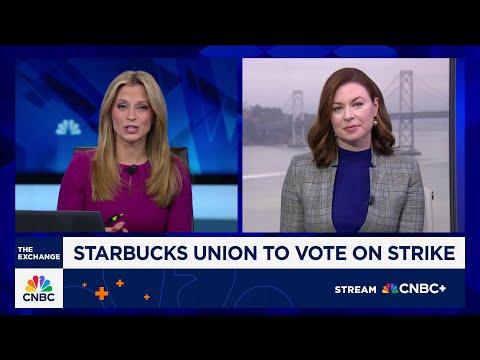
Starbucks Union set to vote on strike authorization
CNBC Television· 2025-10-23 18:53
Labor Relations - Starbucks workers are scheduled to vote on authorizing a strike, potentially disrupting CEO Brian Nichols' turnaround plans [1] - Workers United is advocating for improved working hours, increased take-home pay, and resolution of unfair labor practice charges [2] - The two parties are currently not engaged in active negotiations, with a previous proposal from Starbucks rejected by the union in April [2] - Workers United represents approximately 4% of Starbucks' partners, but the union is committed to securing a contract [3] Financial Performance & Strategy - Starbucks' earnings are due next Wednesday, with same-store sales having been negative for six consecutive quarters [3] - The holiday season typically sees a sales increase for Starbucks, which is currently undergoing a turnaround under CEO Brian Nichols [3] Operational Impact - The specifics of a potential strike, including duration, location, and timing, are yet to be determined pending the authorization vote [4] - Approximately 650 unionized stores exist out of 18,000 licensed and company-operated stores in the US and Canada [5]
Starbucks Union set to vote on strike authorization
Youtube· 2025-10-23 18:53
Core Viewpoint - Starbucks workers are set to vote on authorizing a strike, which could disrupt CEO Brian Nichol's turnaround plans for the company [1] Group 1: Strike Authorization and Union Demands - Voting on the strike will begin tomorrow and will be open for several days, with the potential for an open-ended strike if approved [1] - Workers United is advocating for a contract that includes better hours, higher take-home pay, and resolution of numerous outstanding unfair labor practice charges, although specific pay figures are not disclosed [2] - Currently, there are no active negotiations between Starbucks and the union, following a mediation process last spring that resulted in the union rejecting a proposal from Starbucks in April [2] Group 2: Company Response and Financial Context - Starbucks stated that Workers United represents only about 4% of its workforce and expressed willingness to resume negotiations if the union is ready [3] - The company is experiencing negative same-store sales for six consecutive quarters, highlighting the importance of the upcoming earnings report and the effectiveness of the turnaround plan under CEO Brian Nichol [3] - The holiday season typically boosts sales for Starbucks, which may be impacted by the potential strike [3] Group 3: Potential Impact of the Strike - If a strike occurs, the specifics regarding duration, location, and timing remain undetermined, making it unclear how many stores will be affected [4] - There are 650 unionized stores among Starbucks' 18,000 licensed and company-operated stores in the US and Canada, indicating that while the unionized workforce is small, it could still have a meaningful impact [5][6]
Starbucks workers union to begin voting on strike amid stalled contract talks
Reuters· 2025-10-23 15:08
Core Point - The union representing Starbucks baristas announced plans to vote on authorizing an unfair labor practice strike at unionized locations, aiming to pressure the company to return to negotiations [1] Group 1 - The union's decision reflects ongoing tensions between Starbucks and its employees regarding labor practices [1] - The strike authorization vote is a strategic move to enhance bargaining power in negotiations with the company [1] - This action indicates a growing trend of unionization efforts within the retail and service industries, particularly in large corporations like Starbucks [1]
The threat of a new barista strike looms as shareholders urge Starbucks to return to the bargaining table
Business Insider· 2025-10-23 13:38
Core Points - Unionized Starbucks baristas are planning a national strike authorization vote to escalate ongoing labor conflicts and push for their first union contract [1][2][3] - The vote is scheduled from October 24 to November 2, and if authorized, the strike would be open-ended [3] - The union represents over 12,000 baristas across more than 600 locations, but recent store closures have reduced this number significantly [11] Labor Relations - The union's demands include higher wages, better working hours, and resolution of legal issues, with a push to finalize a contract before the holiday season [3] - Starbucks has faced pressure from shareholders to improve relations with unionized employees, highlighted by an open letter urging the company to resume contract talks [13][14] - The company has been accused of unfair labor practices, including retaliation and union-busting, with hundreds of charges filed against it [10] Recent Developments - The union has planned 70 practice pickets and rallies across 60 cities to encourage voting in favor of the strike [4] - Starbucks has stated its commitment to bargaining and reaching contract agreements, claiming the union walked away from negotiations [4][17] - The labor tensions have escalated under the leadership of CEO Brian Niccol, with previous strikes occurring in November 2023, December 2024, and May 2025 [19][20][21] Shareholder Concerns - Shareholders, including activist investment firm Trillium, have expressed ongoing concerns about Starbucks' labor relations and have urged the company to reach fair agreements with unionized workers [15][18] - An independent assessment of labor practices was supported by 52% of shareholders in 2023, indicating significant investor interest in the company's labor relations [18]
消息称星巴克员工联合组织将于本周五启动罢工授权投票
Xin Lang Cai Jing· 2025-10-23 10:19
Core Viewpoint - Starbucks employees' union plans to initiate a strike authorization vote this Friday, indicating rising labor tensions within the company [1] Labor Relations - Over 100 labor complaints, store protests, and strikes have been reported this year, reflecting significant unrest among Starbucks employees [1]
Starbucks Workers United set to vote on strike authorization
CNBC· 2025-10-23 09:00
Core Points - Starbucks Workers United is initiating a strike authorization vote to secure a contract with Starbucks, alongside planned rallies and pickets across the country [1][2] - The strike authorization voting will last several days, and if approved, the strike will be open-ended, with 70 rallies occurring in 60 cities from Friday through November 1 [2] - The union is not currently in active negotiations with Starbucks, as previous talks collapsed in December 2024, and a proposed economic package was rejected by barista delegates [3] Union Demands - Workers United is advocating for better staffing hours, increased take-home pay, and resolution of outstanding unfair labor practice charges [4] - The union represents over 12,000 workers across more than 650 stores, which is a small fraction of Starbucks' total of over 18,000 locations in North America [4] Company Response - Starbucks claims that Workers United represents only about 4% of its partners and is open to negotiations if the union is willing to return to the bargaining table [6] - The company emphasizes that its hourly partners earn over $30 per hour on average, and it is investing over $500 million to enhance staffing during peak times [6] - Starbucks reports high partner engagement, low turnover rates compared to industry averages, and receives over 1 million job applications annually [6]