Starbucks(SBUX)

Search documents
星巴克中国与东方航空合作后进行全新跨界 打造云南咖啡主题航班
Xin Jing Bao· 2025-10-22 14:10
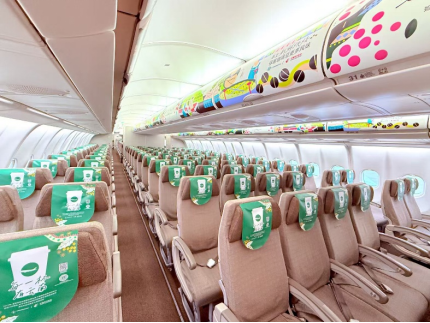
Core Insights - Starbucks China has announced a comprehensive partnership with China Eastern Airlines, focusing on the integration of coffee and travel industries, particularly through the creation of Yunnan coffee-themed flights [1][2]. Group 1: Partnership Details - The collaboration aims to leverage complementary resources, with a significant focus on co-creating Yunnan coffee experiences [1]. - The inaugural flight, MU5814, successfully took off, featuring a specially decorated cabin where over 200 passengers enjoyed cold brew coffee made from Starbucks' selected Yunnan Menglian sun-dried Bourbon coffee beans [2]. Group 2: Thematic Flight Experience - Passengers on the inaugural flight received exclusive gifts, including themed neck pillows, earplugs, Starbucks and Eastern Airlines co-branded badges, themed refrigerator magnets, and a Yunnan coffee manual [3]. - The Yunnan coffee-themed flights will operate for a month, expanding to more routes following the successful first flight [3]. Group 3: Community and Cultural Initiatives - Starbucks China has been actively exploring the "coffee + cultural tourism" model, having invested over 17 million yuan in the "Shared Value Beautiful Star Village" project in Yunnan, aimed at rural revitalization through coffee-themed integration of agriculture, culture, and tourism [3]. - In August 2024, Starbucks plans to launch the "Shared Value Seeking Beans Yunnan" project, committing 4 million yuan to support 10 coffee-growing villages in Pu'er, focusing on talent and cultural revitalization [3]. - In September, Starbucks also announced a collaboration with Xiaohongshu to create an "interest community space" project [3].



星巴克中国与东方航空合作后进行全新跨界,打造云南咖啡主题航班
Xin Jing Bao· 2025-10-22 14:01
Core Insights - Starbucks China has launched a new collaboration with China Eastern Airlines to create a Yunnan coffee-themed flight, with the inaugural flight MU5814 successfully completed [1] - The flight featured over 200 passengers enjoying cold brew coffee made from Starbucks' selected Yunnan Menglian sun-dried Bourbon coffee beans in a specially decorated cabin [1] - This initiative is part of a broader partnership established in July 2023, focusing on the integration of coffee and travel industries, particularly in Yunnan [1] Group 1 - The Yunnan coffee-themed flight is a significant component of the collaboration between Starbucks China and China Eastern Airlines, emphasizing the theme "Every cup has Yunnan" [1] - Passengers on the inaugural flight received exclusive gifts, including themed neck pillows, earplugs, a Starbucks and Eastern Airlines co-branded badge, themed refrigerator magnets, and a Yunnan coffee manual [1] - The Yunnan coffee-themed flights will operate on more routes over the next month following the successful inaugural flight [1] Group 2 - In recent years, Starbucks China has been exploring the "coffee + cultural tourism" concept, with initiatives such as the "Shared Value Beautiful Star Village" project launched in December 2021, which involved over 17 million yuan in donations [2] - The "Shared Value Seeking Beans Yunnan" project was announced in August 2024, with an investment of 4 million yuan to support 10 coffee-growing villages in the Pu'er region, focusing on talent and cultural revitalization [2] - In September 2023, Starbucks also launched a project in collaboration with Xiaohongshu to create "interest community spaces" [2]
Jim Cramer Says “It is Time to Buy Starbucks, Not to Sell It”
Yahoo Finance· 2025-10-22 11:29
Group 1 - Starbucks Corporation is undergoing a turnaround under CEO Brian Niccol, who emphasizes that the process will take time and is not focused on overpromising to analysts [1] - The company's strategy involves reducing workforce and increasing reliance on technology, which has led to challenges and a recent stock downturn [1] - Analysts have criticized the stock's decline, attributing it to the slow pace of the turnaround and a lack of recognition of Niccol's approach [1] Group 2 - Starbucks sells coffee, tea, ready-to-drink beverages, and food items through both company-operated and licensed stores [2]
星巴克云南咖啡主题航班首飞 开启咖啡原产地文旅体验
Zheng Quan Ri Bao· 2025-10-22 07:16
Core Insights - Starbucks China and China Eastern Airlines launched the "Yunnan Coffee Themed Flight," marking a new collaboration in the "coffee + travel" sector [1][2] - The flight features specially designed cabin decor and offers passengers a unique tasting experience with Yunnan coffee [1][2] - Starbucks has been actively involved in promoting Yunnan coffee since establishing a support center in 2012, showcasing the quality improvements over the years [1][3] Group 1: Collaboration and Initiatives - The partnership between Starbucks China and China Eastern Airlines aims to leverage complementary resources to explore the integration of coffee and travel [1][2] - The themed flight will operate for a month, spreading the story of Yunnan coffee to various destinations [2] - Starbucks has invested over 17 million yuan in rural revitalization projects in Yunnan, focusing on integrating agriculture, culture, and tourism [2] Group 2: Product Development and Marketing - In 2025, Starbucks will introduce Yunnan's Yellow Bourbon coffee beans for the ninth consecutive year, highlighting the collaboration with local farmers [3] - A series of promotional activities themed "Every Cup, with Yunnan" will take place in October 2025, coinciding with the global coffee month [3] - Starbucks will host coffee tasting events and classes across over 7,800 stores nationwide to showcase the quality of Yunnan coffee [3]
星巴克云南咖啡主题航班首飞
Xin Lang Cai Jing· 2025-10-22 06:48
Core Insights - Starbucks China and China Eastern Airlines launched the "Yunnan Coffee Themed Flight" on October 22, marking a significant collaboration to promote Yunnan coffee [1][2] - The partnership aims to leverage complementary resources, focusing on co-creation in the Yunnan coffee sector [1] - Starbucks has been actively exploring the integration of coffee with cultural tourism, investing over 17 million yuan in the "Shared Value Beautiful Star Village" project in Yunnan [1] Summary by Sections Collaboration and Initiatives - The "Yunnan Coffee Themed Flight" successfully took off from Shanghai Hongqiao Airport to Kunming Changshui Airport [1] - Starbucks China announced a comprehensive partnership with China Eastern Airlines in July, emphasizing Yunnan coffee co-creation [1][2] Community and Cultural Engagement - In December 2021, Starbucks invested over 17 million yuan in a project aimed at rural revitalization in Baishapo Village, Pu'er City, integrating agriculture, culture, and tourism [1] - In August 2024, Starbucks will launch the "Shared Value Seeking Beans Yunnan" project, contributing 4 million yuan to support 10 coffee-growing villages in the Simao District of Pu'er City [1] Product Offerings - In 2025, Starbucks will introduce Yunnan's specialty coffee beans for the ninth consecutive year, including the Yellow Bourbon variety for the first time [2] - The Chief Growth Officer of Starbucks China expressed the desire to share the rich aroma of Yunnan coffee with a broader audience through the themed flight initiative [2]
Starbucks baristas in Cloverdale join growing movement for fairness and respect
Globenewswire· 2025-10-21 21:38
BURNABY, British Columbia, Oct. 21, 2025 (GLOBE NEWSWIRE) -- Starbucks workers at Cloverdale’s Clover Square Village in Surrey, B.C., are the latest to join a growing movement of baristas across Canada who are standing together for fairness, respect and better working conditions. The United Steelworkers union (USW) proudly welcomes these workers as they take an important step toward building a stronger future at Starbucks. The Clover Square Village baristas organized in response to concerns about job secur ...
星巴克CEO称,“AI咖啡师”可实时辅助咖啡制作
财富FORTUNE· 2025-10-21 13:04
Core Insights - Starbucks CEO Brian Niccol confirmed that the company is deeply engaged in artificial intelligence (AI) trials, with a focus on enhancing customer service and operational efficiency [2][3] - The internal AI tool "Green Dot Assistant" has been implemented to assist baristas in daily operations, providing quick solutions to equipment issues and drink preparation methods [2] - The company aims to integrate AI into its app for a frictionless ordering experience, allowing customers to place orders through voice commands [6][7] AI Implementation - The "Smart Q" backend technology addresses operational chaos caused by multiple ordering channels, improving order processing speed and accuracy [4][5] - The system ensures that customers receive their drinks within four minutes and allows real-time tracking of order status through digital displays [5] Future Vision - Starbucks plans to enhance its app with AI capabilities to predict customer orders, aiming for a seamless experience where customers can order without opening the app [6] - The company is shifting its strategic focus from efficiency to providing exceptional customer service, emphasizing the importance of baristas in creating personalized experiences [7] Broader AI Applications - Niccol mentioned that Starbucks is exploring AI applications in various business areas, including visual recognition, inventory management, and demand forecasting, although these are not yet widely implemented [8]

县城消费崛起:山姆抢滩超级县,国际酒店品牌布局小县城
Di Yi Cai Jing Zi Xun· 2025-10-21 10:03
Core Insights - The rise of county-level consumption is driven by economic development and improved infrastructure, leading major brands to expand into these markets [1][2][4] - Sam's Club has opened its fourth store in Suzhou, targeting strong economic counties and cities, with a focus on customized and high-quality products [1] - The county market is becoming increasingly vital, with the county and township market accounting for 38.8% of total retail sales in the first three quarters of the year [2] Group 1: Market Expansion - Major brands, including international hotel chains and coffee shops, are entering county markets due to saturation in first and second-tier cities [3][4] - The hotel industry is seeing significant growth in county tourism, with brands like Hilton and Marriott establishing a presence in these areas [3] - Starbucks has expanded to 7,758 stores in China, covering over 1,000 county-level markets, indicating a competitive push into lower-tier cities [3] Group 2: Economic Factors - The county market offers lower property and operational costs compared to urban centers, making it attractive for businesses [4] - Rapid economic growth, urbanization, and rising income levels in counties are contributing to increased consumer spending [4] - Counties serve as crucial points for rural revitalization, enhancing local attractiveness and investment environments through the presence of high-quality brands [4]


星巴克中国,到底卖给谁?
Sou Hu Cai Jing· 2025-10-21 02:01
Core Viewpoint - Starbucks is in the process of selling a majority stake in its China operations, with Carlyle Group and Boyu Capital as the main bidders, valuing the business at approximately $4 billion, excluding ongoing franchise fees [1][3]. Group 1: Transaction Details - The estimated valuation of Starbucks' China business is around $4 billion, and Starbucks will retain up to 49% of the shares, likely maintaining its position as the largest shareholder in the Chinese market [1][3]. - If the deal is finalized, it may signal a shift from a direct operation model to a franchise model for Starbucks in China, which could be more advantageous in the current market [7][8]. Group 2: Market Dynamics - Starbucks has experienced an 8% year-on-year revenue growth in China, reaching $790 million (approximately 5.625 billion RMB) for the latest fiscal quarter, despite facing stiff competition from Luckin Coffee, which reported a 47.1% revenue growth [3][5]. - The competitive landscape is challenging, with Luckin Coffee leveraging a significantly larger store network and aggressive pricing strategies, which have made Starbucks' traditional model of customer experience less appealing [5][8]. Group 3: Strategic Implications - The decision to retain 49% ownership suggests that Starbucks aims to maintain some control over its brand and operations in China while leveraging the expertise of local partners [11]. - The rise of new-style tea drinks and low-cost competitors poses a significant threat to Starbucks, necessitating rapid innovation in product offerings and pricing strategies to remain relevant in the market [8][9][11]. - The potential shift to a franchise model could allow Starbucks to reduce operational risks and costs while expanding its presence in lower-tier cities, but it must also adapt its brand positioning to attract a broader customer base [7][11][13].
Starbucks' Turnaround: Watch for AI Ordering, New Drapes—and Teens
Investopedia· 2025-10-20 20:11
Core Insights - Starbucks is exploring the use of AI to enhance customer experience through its app, potentially allowing for voice orders and better personalization of preferences [2][3][7] - The company is focused on reducing friction in customer interactions and aims to serve customers quickly, with a target of serving at the counter within four minutes as part of its "Back to Starbucks" campaign [3][4] - Starbucks is undergoing a turnaround effort to revitalize sales and improve its stock performance, which has declined by about 7% this year [3] Technology and Customer Experience - The CEO envisions a future where customers can place orders by speaking into their phones, streamlining the ordering process [3][7] - Currently, Starbucks is primarily using technology behind the scenes while maintaining a warm and inviting atmosphere in its cafes [3][7] - Other hospitality businesses are cautious about using AI in customer-facing roles, often focusing on back-of-house efficiencies instead [4] Store Strategy - Starbucks has announced multiple store closures for locations that do not align with its vision and is renovating others to create a more inviting environment [5] - The company is considering enhancements such as adding rugs, drapes, and plants to improve the ambiance [5] - The goal is to encourage drive-thru and grab-and-go customers to consider staying and enjoying the café experience [5][8]