TAL(TAL)

Search documents
金十图示:2025年07月29日(周二)中国科技互联网公司市值排名TOP 50一览


news flash· 2025-07-29 02:54
Group 1 - The article presents the market capitalization rankings of the top 50 Chinese technology and internet companies as of July 29, 2025 [1] - Alibaba leads the list with a market capitalization of 2,913.7 billion [3] - Xiaomi and Pinduoduo follow, with market capitalizations of 1,823.48 billion and 1,657.58 billion respectively [3] Group 2 - Meituan ranks sixth with a market capitalization of 990.12 billion [3] - Semiconductor Manufacturing International Corporation (SMIC) is in eighth place with a market cap of 530.08 billion [4] - JD.com and Kuaishou rank tenth and eleventh, with market capitalizations of 478.87 billion and 388.76 billion respectively [4] Group 3 - The list includes various companies from different sectors, such as Baidu at 307.33 billion and NIO at 109.38 billion [4][5] - The rankings reflect the competitive landscape of the Chinese tech industry, showcasing the significant market presence of these companies [1] - The data is calculated based on the market capitalization in USD, converted using the day's exchange rate [6]


投资者推介:中国互联网行业-Investor Presentation-China Internet
2025-07-29 02:31
Summary of Key Points from the Conference Call Industry Overview - **Industry Focus**: China Internet and AI Services - **Overall Industry View**: Attractive outlook for the China Internet sector, particularly in AI applications and services [3][4][19] Core Insights - **AI Adoption**: - 18% of enterprise workload is expected to be replaced by AI within three years [20] - Rapid enterprise adoption of AI is noted, but monetization of AI applications may lag behind [14][19] - **Investment Trends**: - Major players in the industry are ramping up capital expenditures (capex) on AI technologies [8][27] - Total capex by top internet players is projected to reach Rmb 383.768 billion by 2030 [25] - **Consumer and Enterprise AI Demand**: - Consumer usage of AI is projected to grow from Rmb 5.801 million in 2023 to Rmb 555.975 million by 2030, reflecting a compound annual growth rate (CAGR) of 39% [25] - Enterprise AI software spending is expected to increase significantly, with projections of Rmb 249.860 billion by 2030 [25] Company-Specific Insights - **Tencent**: - Strong visibility in consumer AI monetization, particularly through advertising [34][39] - Daily active users (DAU) for Yuanbao, Tencent's AI assistant, are ramping up, integrating AI into WeChat [41] - Long-term annual ad revenue from Video Accounts is estimated to reach Rmb 50 billion [47][50] - **Alibaba**: - Alicloud revenue is expected to double in three years, indicating strong growth potential [52] - Facing near-term earnings pressure due to intense competition in food delivery and quick commerce [56][62] - **Baidu**: - Limited visibility in core advertising turnaround, with core revenue under pressure [92][100] - Ernie Bot has seen significant user growth, with plans for further enhancements in AI capabilities [100][102] - **Meituan**: - Intense competition in the food delivery sector is expected to lower long-term profitability [62][75] - Quick commerce market share is projected to be split among multiple players, impacting profitability [75][78] - **PDD Holdings**: - Strong momentum for Temu, with expectations of GMV growth of 45% year-over-year to US$77 billion in 2025 [114][116] Market Dynamics - **Competition**: - The food delivery market is experiencing aggressive competition, with significant investments from major players like JD and Alibaba [74][75] - Price wars are leading to unsustainable practices, prompting regulatory scrutiny [74][75] - **E-commerce Growth**: - The e-commerce market in China is projected to continue expanding, with online retail sales growing by 6.3% year-over-year in 2Q25 [103][104] Additional Insights - **AI Model Development**: - Major Chinese tech firms are developing proprietary AI models and integrating them into their platforms, enhancing their competitive edge [9][10] - **Consumer Behavior**: - Increased consumer engagement with AI applications is expected to drive growth across various sectors, including e-commerce and social media [25][27] This summary encapsulates the key points discussed in the conference call, highlighting the trends, company-specific insights, and market dynamics within the China Internet and AI services sector.


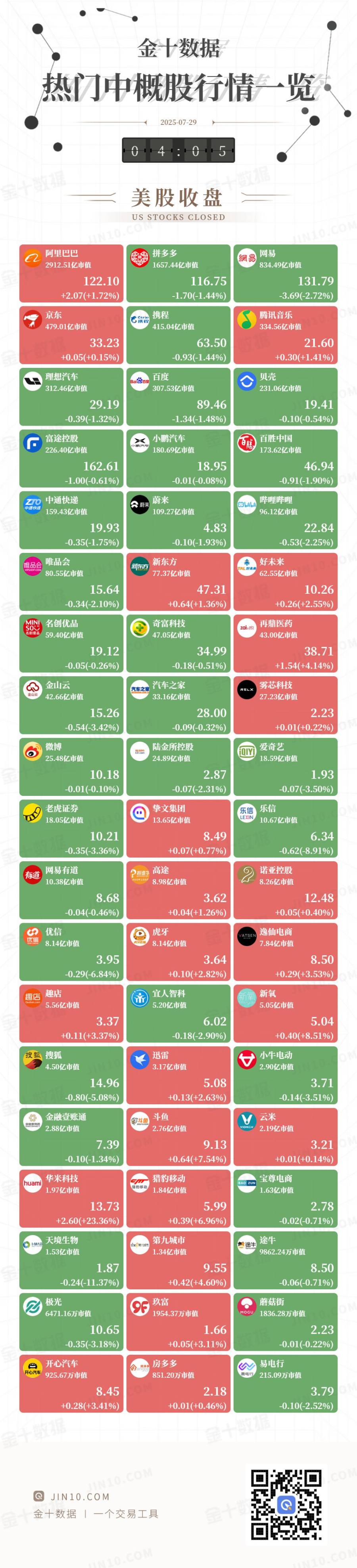
金十图示:2025年07月28日(周一)热门中概股行情一览(美股收盘)





news flash· 2025-07-28 20:08
Market Capitalization Summary - New Oriental has a market capitalization of 15.943 billion [2] - TAL Education has a market capitalization of 10.927 billion [2] - Vipshop has a market capitalization of 9.612 billion [2] - NIN (Miniso) has a market capitalization of 5.940 billion [2] - JD.com has a market capitalization of 27.23 billion [2] - iQIYI has a market capitalization of 2.548 billion [2] Stock Performance - New Oriental's stock decreased by 0.35 (-1.75%) [2] - TAL Education's stock decreased by 0.10 (-1.93%) [2] - Vipshop's stock decreased by 0.53 (-2.25%) [2] - Miniso's stock increased by 0.64 (+1.36%) [2] - JD.com's stock decreased by 0.54 (-3.42%) [2] - iQIYI's stock decreased by 0.07 (-2.31%) [2] Additional Company Insights - Huami Technology has a market capitalization of 1.97 billion [3] - Cheetah Mobile has a market capitalization of 1.63 billion [3] - Baosheng E-commerce has a market capitalization of 1.84 billion [3] - Tuniu has a market capitalization of 1.34 billion [3] - The stock of Tuniu increased by 0.42 (+4.60%) [3]
金十图示:2025年07月28日(周一)中国科技互联网公司市值排名TOP 50一览



news flash· 2025-07-28 02:55
Core Insights - The article presents the market capitalization rankings of the top 50 Chinese technology and internet companies as of July 28, 2025, highlighting significant shifts in valuations and market positions [1]. Group 1: Market Capitalization Rankings - The top three companies by market capitalization are Alibaba with 1,000.00 billion, Tencent at 800.00 billion, and Baidu at 600.00 billion [3]. - Notable companies in the top 10 include JD.com at 478.29 billion and Kuaishou at 398.09 billion [3]. - The rankings show a decline in market value for several companies, with Tencent Music and Li Auto both experiencing a decrease of 1% [3]. Group 2: Changes in Valuation - Companies like Kingsoft and China Software have shown slight increases in their market capitalization, with Kingsoft rising by 1% to 62.09 billion [4]. - Conversely, companies such as New Oriental and Kingdee International have seen declines, with New Oriental at 76.34 billion and Kingdee at 76.33 billion, both down by 2% [4]. - The overall trend indicates a mixed performance among the top 50 companies, with some gaining value while others are losing [5]. Group 3: Additional Insights - The data reflects daily calculations of market capitalization based on the current exchange rates between USD and HKD [5]. - The rankings serve as a tool for investors to gauge the performance and market position of leading technology firms in China [5].

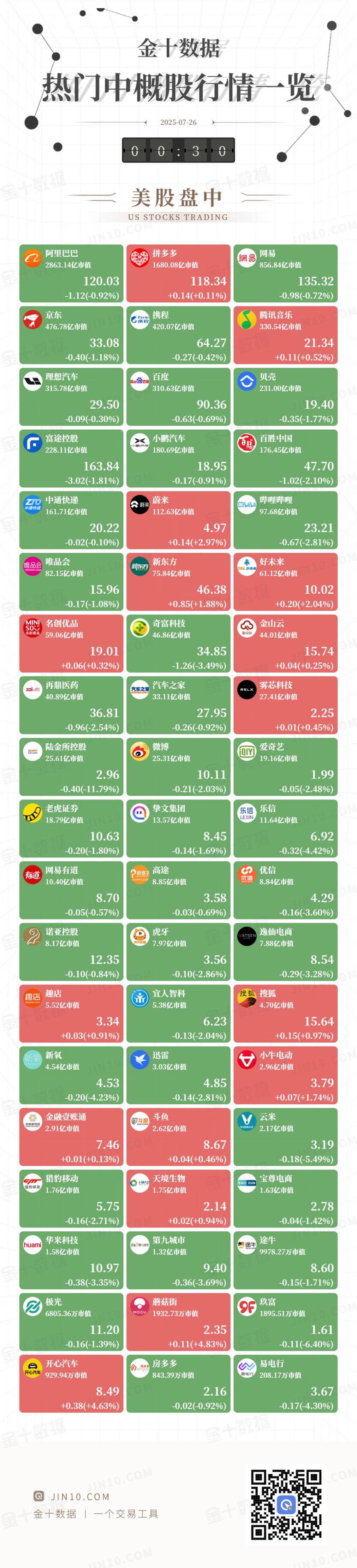
金十图示:2025年07月25日(周五)热门中概股行情一览(美股盘中)



news flash· 2025-07-25 16:34
Market Capitalization Summary - New Oriental has a market capitalization of 16.17 billion [2] - TAL Education (好未来) has a market capitalization of 11.26 billion [2] - Vipshop (唯品会) has a market capitalization of 8.21 billion [2] - MINISO (名创优品) has a market capitalization of 5.91 billion [2] - Kingsoft Cloud (金山云) has a market capitalization of 4.40 billion [2] - 51Talk (在线教育) has a market capitalization of 1.75 billion [4] Stock Performance - New Oriental's stock decreased by 0.02 (-0.10%) [2] - TAL Education's stock increased by 0.14 (+2.97%) [2] - Vipshop's stock decreased by 0.17 (-1.08%) [2] - MINISO's stock increased by 0.20 (+2.04%) [2] - Kingsoft Cloud's stock decreased by 1.26 (-3.49%) [2] - 51Talk's stock decreased by 0.16 (-2.71%) [4] Additional Company Insights - Huya (虎牙) has a market capitalization of 7.88 billion [4] - Sohu (搜狐) has a market capitalization of 4.70 billion [4] - 9F Group (玖富) has a market capitalization of 1.89 billion [4] - Financial One Account (金融壹账通) has a market capitalization of 2.91 billion [4]
金十图示:2025年07月25日(周五)中国科技互联网公司市值排名TOP 50一览
news flash· 2025-07-25 03:04
Core Insights - The article presents the market capitalization rankings of the top 50 Chinese technology and internet companies as of July 25, 2025, highlighting their respective valuations in billions of dollars [1]. Group 1: Market Capitalization Rankings - The top three companies by market capitalization are: 1. Alibaba: $1,000.00 billion 2. Tencent: $800.00 billion 3. Baidu: $600.00 billion [3] - Other notable companies in the top 10 include: - JD.com: $482.47 billion - SMIC (Semiconductor Manufacturing International Corporation): $519.90 billion - Tencent Music: $328.83 billion [3][4] Group 2: Additional Rankings - Companies ranked from 11 to 20 include: - Li Auto: $316.74 billion - Xpeng Motors: $182.36 billion - NIO: $109.38 billion [4][5] - The rankings continue with companies such as: - New Oriental: $74.44 billion - Kingsoft: $61.55 billion - Perfect World: $38.92 billion [5]

金十图示:2025年07月24日(周四)热门中概股行情一览(美股盘中)
news flash· 2025-07-24 16:35
Market Capitalization Overview - The market capitalizations of various companies are listed, with New Oriental at 16.195 billion, TAL at 10.802 billion, and Vipshop at 6.051 billion [2]. - Other notable companies include MINISO at 5.930 billion, Kingsoft Cloud at 4.975 billion, and Weibo at 2.586 billion [2][3]. Stock Performance - New Oriental's stock increased by 0.78 (+4.01%), while TAL's stock decreased by 0.15 (-3.05%) [2]. - Vipshop's stock fell by 0.29 (-1.76%), and MINISO's stock saw a decrease of 2.93 (-7.34%) [2]. - Kingsoft Cloud's stock rose by 1.53 (+8.71%), indicating a positive performance [2]. Company Comparisons - The market value of various companies shows significant differences, with New Oriental leading the list, followed by TAL and Vipshop [2]. - Companies like Huya and iQIYI have market values of 1.984 billion and 2.724 billion, respectively, reflecting their positions in the market [2][3]. Sector Insights - The data reflects a mixed performance across different sectors, with some companies experiencing gains while others face declines [2][3]. - The overall market sentiment appears to be cautious, as indicated by the fluctuations in stock prices across various companies [2][3].
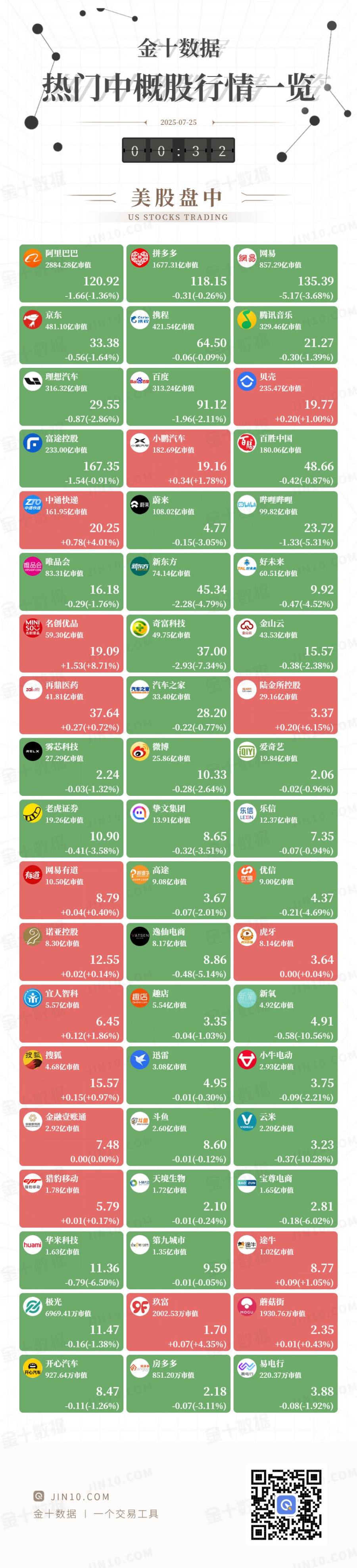
金十图示:2025年07月24日(周四)中国科技互联网公司市值排名TOP 50一览


news flash· 2025-07-24 03:01
Group 1 - The article presents the market capitalization rankings of the top 50 Chinese technology and internet companies as of July 24, 2025 [1] - The highest-ranked company is Alibaba, with a market capitalization of 1,000 billion [3] - Other notable companies in the top 10 include Tencent with 600 billion and Baidu with 320 billion [3][4] Group 2 - The rankings show significant market values, with companies like JD.com at 489.1 billion and Kuaishou at 431.56 billion [3] - The list includes various sectors such as e-commerce, automotive, and software, indicating a diverse technology landscape [4][5] - Companies like Xpeng Motors and NIO are also featured, with market caps of 179.5 billion and 111.42 billion respectively [3][4]

教育巨头生存样本:2025上半场分化加剧,AI重构行业分水岭
3 6 Ke· 2025-07-23 00:54
Financial Performance Divergence - New Oriental's total revenue for the latest quarter was $1.18 billion, a slight decrease of 2% year-on-year, but core education business revenue reached $1.04 billion, up 21.2% [2] - TAL Education reported a revenue of $610 million, a year-on-year increase of 42.1%, but its operating loss expanded to $16 million [3] - Duolingo's total revenue was $230.7 million, a year-on-year increase of 38%, with a net profit of $35.1 million, up 30% [4] - Gaotu's quarterly revenue was approximately $207 million, a year-on-year increase of 57.7%, with a net profit of $12.4 million [5] - NetEase Youdao's revenue was $1.3 billion, a year-on-year decrease of 7%, but operating profit surged by 247.7% to $104 million [5] Strategic Adjustments and Innovations - New Oriental's strategic adjustment led to a significant increase in its core education business, with overseas exam preparation and adult education providing growth drivers [2] - TAL Education emphasized a "demand-driven" offline expansion strategy, focusing on high-potential markets while enhancing online course retention through AI [3] - Duolingo's AI-driven model allowed for rapid course development, achieving a daily active user count of 46.6 million, a year-on-year increase of 49% [4] - Gaotu's non-subject tutoring business saw an 80% growth, supported by AI tools that improved operational efficiency [5] Technological Transformation - AI is reshaping content production logic, with Duolingo developing 148 language courses in a short time using AI tools [6] - New Oriental introduced AI assessment tools for essay scoring and oral correction, optimizing operational costs [6] - The competition in the education sector is increasingly reliant on the maturity of data platforms rather than just content or channel advantages [8] Market Dynamics and Trends - The adult education market is experiencing a resurgence, with New Oriental's adult and university business growing by 17% year-on-year [10] - Quality education is evolving from a compliance-driven choice to a user-recognized value service, as seen in the growth of non-subject tutoring courses [11] - New Oriental's overseas exam preparation and learning consulting business remains a crucial revenue pillar, with a year-on-year growth of 7.1% [12] Challenges and Future Outlook - The "double reduction" policy continues to impact the industry, with some companies facing profit declines due to regulatory pressures [13] - The education sector's technology investments are characterized by long-term returns, requiring management to balance between spending and profitability [14] - The demand for education is shifting towards capability cultivation, necessitating a reconfiguration of product logic by educational institutions [15]

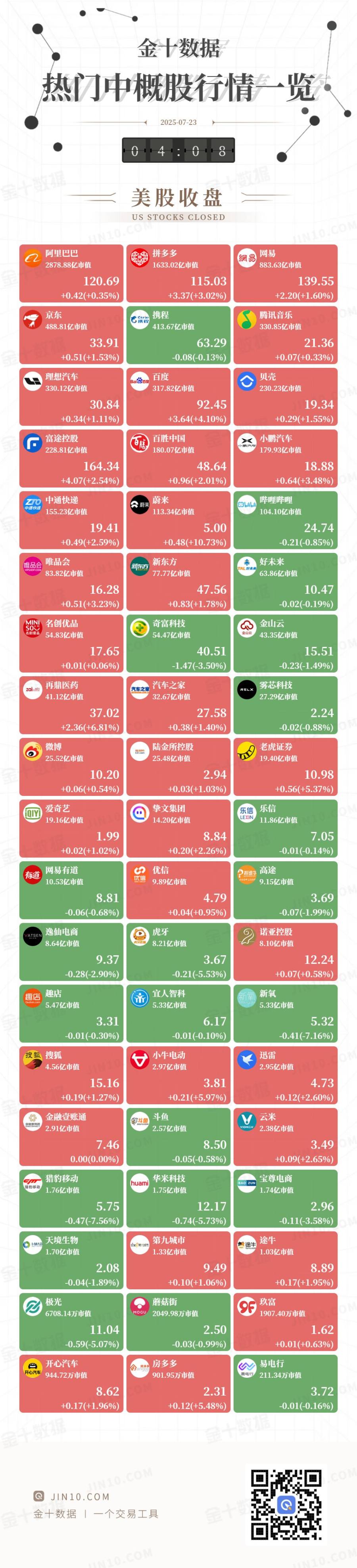
金十图示:2025年07月22日(周二)热门中概股行情一览(美股收盘)

news flash· 2025-07-22 20:11
Market Capitalization Summary - New Oriental has a market capitalization of 10.41 billion [2] - TAL has a market capitalization of 15.52 billion [2] - Vipshop has a market capitalization of 6.38 billion [2] - Miniso has a market capitalization of 5.48 billion [2] - Kingsoft Cloud has a market capitalization of 4.35 billion [2] - Zai Auto has a market capitalization of 2.73 billion [2] - Lufax has a market capitalization of 2.55 billion [2] - Weibo has a market capitalization of 1.94 billion [2] - iQIYI has a market capitalization of 1.42 billion [2] - Huya has a market capitalization of 0.81 billion [2] Stock Performance - New Oriental's stock increased by 0.49 (+2.59%) [2] - TAL's stock increased by 0.48 (+10.73%) [2] - Vipshop's stock increased by 0.51 (+3.23%) [2] - Miniso's stock decreased by 1.47 (-3.50%) [2] - Kingsoft Cloud's stock decreased by 0.23 (-1.49%) [2] - Zai Auto's stock increased by 2.36 (+6.81%) [2] - Lufax's stock increased by 0.06 (+0.54%) [2] - Weibo's stock increased by 0.56 (+5.37%) [2] - iQIYI's stock decreased by 0.01 (-0.14%) [2] - Huya's stock increased by 0.07 (+0.58%) [2] Additional Company Insights - Sohu's stock decreased by 0.01 (-0.30%) [3] - Xunlei's stock increased by 0.21 (+5.97%) [3] - Huami's stock decreased by 0.11 (-3.58%) [3] - Tuniu's stock increased by 0.17 (+1.95%) [3] - The market capitalization of various companies such as Financial One Account and Douyu is also noted, with values of 2.91 billion and 2.57 billion respectively [3]