小猿AI

Search documents
北京海淀:春晚同款机器人返场,硬核科技“打开”庙会
Xin Lang Cai Jing· 2026-02-20 08:19
Core Viewpoint - The 2026 Haidian New Year Technology Fair emphasizes a blend of technology and cultural traditions, showcasing over 150 interactive exhibits from more than 70 companies, aiming to enhance public engagement with advanced technologies during the festive season [1][3][6]. Group 1: Event Overview - The fair opened on February 19, 2026, at the Wukesong Wanda Plaza, featuring a variety of performances and interactive experiences, including robot shows and AI-driven activities [1][3]. - The event is designed to be free for the public, integrating five themed exhibition areas that combine traditional New Year customs with technological experiences [3][5]. Group 2: Technological Highlights - The fair showcases 43 robotic exhibits, including 34 humanoid robots, along with AI models, digital humans, VR, and AIGC technologies, highlighting Haidian's innovation capabilities [3][5]. - Interactive experiences include a robot serving as a cashier, a 3V3 autonomous football match, and various educational projects aimed at engaging youth in scientific exploration [5][6]. Group 3: Cultural Significance - The event represents a continuation of Haidian's efforts to merge technology with cultural festivities, following the success of the inaugural technology fair in 2025, which set a precedent for integrating AI into traditional celebrations [5][6]. - The fair is positioned as a model for urban renewal and cultural enhancement, contributing to Haidian's reputation as a center for technological innovation and cultural vitality [6]. Group 4: Event Schedule - The fair will run until February 23, 2026, featuring a diverse program of performances, including magic shows, dance, and interactive robot demonstrations scheduled throughout the event [8][10].


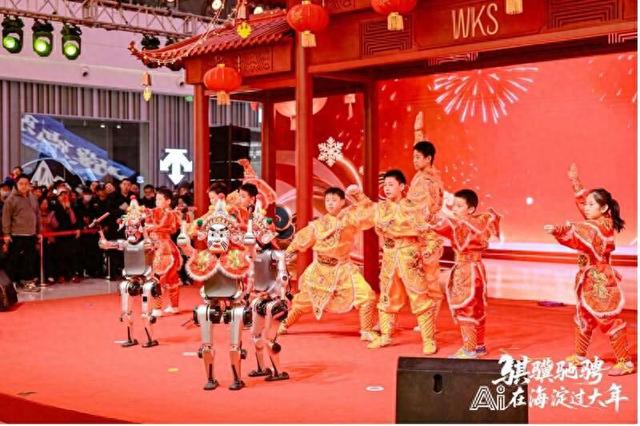
春晚机器人“组团”秀才艺!海淀新春科技庙会人气爆棚
Bei Jing Ri Bao Ke Hu Duan· 2026-02-19 12:11
Core Viewpoint - The 2026 Haidian New Spring Technology Temple Fair redefines traditional celebrations by integrating cutting-edge technology and cultural elements, showcasing a blend of innovation and festive spirit [1][24]. Group 1: Event Overview - The event, themed "Galloping Steeds, AI Celebrating the New Year in Haidian," commenced on February 19, 2026, at the Wukesong Wanda Plaza [1]. - Over 70 companies and 150 interactive exhibits were featured, including top robots and international technology showcases from events like CES 2026 [3][9]. - The fair aims to create a unique cultural symbol for Haidian, merging traditional customs with modern technology [9][11]. Group 2: Technological Integration - The fair included 43 embodied robot exhibits and 34 humanoid robot displays, featuring advanced technologies such as AI models, digital humans, VR, and AIGC [9]. - Robots performed traditional Chinese cultural acts, such as Peking opera and martial arts, demonstrating the fusion of metal aesthetics with traditional charm [4][11]. - Interactive experiences like AI calligraphy and digital shadow puppetry were designed to engage visitors and preserve cultural heritage [12][14]. Group 3: Community Engagement - The event attracted significant public interest, with families enjoying interactive robot performances and technology-driven experiences [6][14]. - The fair provided a platform for all age groups, including elderly-friendly services and activities for children, emphasizing inclusivity [14][24]. - Local businesses collaborated with technology firms to enhance consumer experiences, offering smart vending solutions and interactive entertainment [17][19]. Group 4: Economic Impact - The fair is part of Haidian's strategy to position itself as a global AI hub, promoting innovation and cultural soft power [24]. - The integration of technology and commerce at the fair is expected to stimulate new consumer behaviors and economic activity during the festive season [17][21]. - The event runs until February 23, 2026, providing ongoing opportunities for community engagement and economic benefits [24][25].
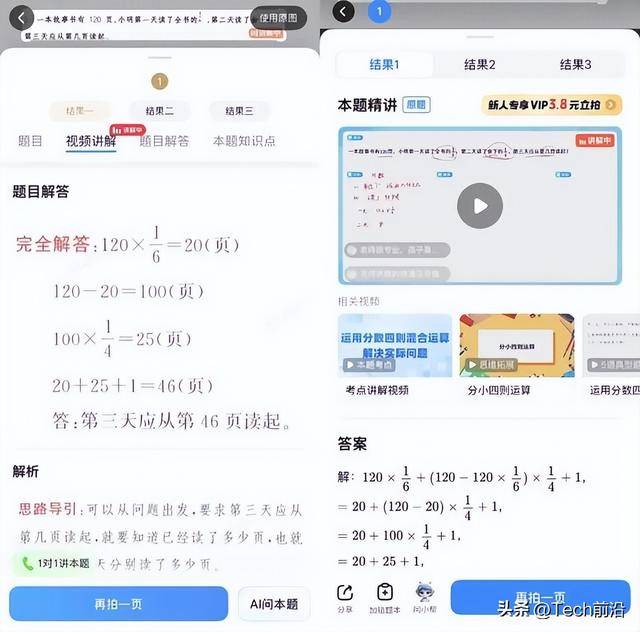
月活破1.2亿!AI教育频繁出错,学生被错误答案误导谁来负责?
Sou Hu Cai Jing· 2026-02-13 10:53
Core Insights - The education sector is experiencing renewed interest from major tech companies, with ByteDance and Alibaba launching AI-driven educational tools to capture market share [1][2] - The AI education market in China has seen significant growth, with monthly active users of AI education apps surpassing 120 million, a 340% year-on-year increase as of Q3 2025 [1] - The competition is primarily between tech giants leveraging their existing user bases and traditional education companies with established research capabilities [2] Group 1: Market Dynamics - The AI education landscape is dominated by three main players: tech giants like ByteDance and Alibaba focusing on rapid iteration and user acquisition, traditional education firms like Yuanfudao and Zuoyebang enhancing their services with AI, and smaller startups targeting niche markets [2] - Major companies are pursuing three business lines: AI problem-solving tools, AI teaching assistants for schools, and AI-driven personalized learning, with varying degrees of market maturity and profitability [3][4] Group 2: Competitive Advantages - Major tech companies benefit from the reuse of large model technologies, existing user traffic, and lower development costs due to economies of scale [4] - However, their fast-paced, traffic-driven strategies may conflict with the slower, more methodical nature of the education sector, potentially hindering long-term success [4] Group 3: Product Differentiation - There are notable differences in user experience among AI education products, with tech giants offering integrated AI assistants that streamline user interaction, while traditional education apps maintain a more segmented approach [6][7] - The interaction styles of AI explanations vary significantly, with tech companies focusing on real-time analysis and engagement, contrasting with traditional firms that rely on pre-existing content and less interactive formats [10][12] Group 4: Challenges and Future Outlook - Major tech companies face challenges in educational content development due to a lack of deep educational research compared to traditional players, which may affect the quality and trustworthiness of their offerings [14] - The sustainability of the business model for tech giants remains uncertain, as they currently offer AI features for free without clear monetization strategies, raising questions about long-term profitability [15][16] - Future opportunities may lie in targeting specific segments such as B2B solutions for schools and adult education, where demand is stable and user willingness to pay is higher [16]


2026,巨头大战AI教育
3 6 Ke· 2026-02-10 01:14
Core Insights - The education sector is experiencing renewed interest from major tech companies, with ByteDance and Alibaba launching AI-driven educational tools to capture market share [1][2] - The AI education market in China has seen significant growth, with monthly active users of AI education applications surpassing 120 million, a 340% year-on-year increase [1] - The competition is primarily between tech giants leveraging their traffic and technology and traditional education players focusing on content and educational services [1][2] Group 1: Market Dynamics - Major tech companies are entering the education market due to clear demand and vast market potential, utilizing large model technology to reduce development costs and time [5][6] - The AI education landscape is divided into three main factions: tech giants focusing on rapid iteration and scenario validation, traditional education companies enhancing content with AI, and small startups targeting niche markets [1][2] - The monetization paths in the education market vary, with AI problem-solving tools being a low-barrier entry point for attracting users [2] Group 2: Business Models - The AI teaching assistant model for B-end clients is clearer in terms of commercial pathways, but its implementation is slower than expected [4] - The primary focus of major companies is on AI teaching, which requires a deep integration of technology and educational research, yet conversion rates and willingness to pay remain challenges [4][6] - The profitability of AI education products from major tech companies is uncertain, as they often prioritize data and traffic over direct revenue generation [6][20] Group 3: Product Differentiation - There are significant differences in the AI capabilities of various educational applications, with major tech companies offering integrated AI assistants while traditional players maintain a more segmented approach [7][14] - User experience varies greatly, with tech giants emphasizing seamless interaction and traditional companies relying on established educational methodologies [7][14] - The core functionalities of leading applications are similar, but the underlying technology and user engagement strategies differ significantly [6][7] Group 4: Challenges and Opportunities - Major tech companies face challenges in educational research, as their data often lacks the systematic organization and validation found in traditional education firms [17] - The phenomenon of "AI hallucination," where AI provides incorrect answers, poses a risk to user trust and product reliability [18][20] - The future of the education sector may lie in niche markets such as B/G-end solutions for schools and adult education, where demand is stable and payment structures are clearer [21][22]

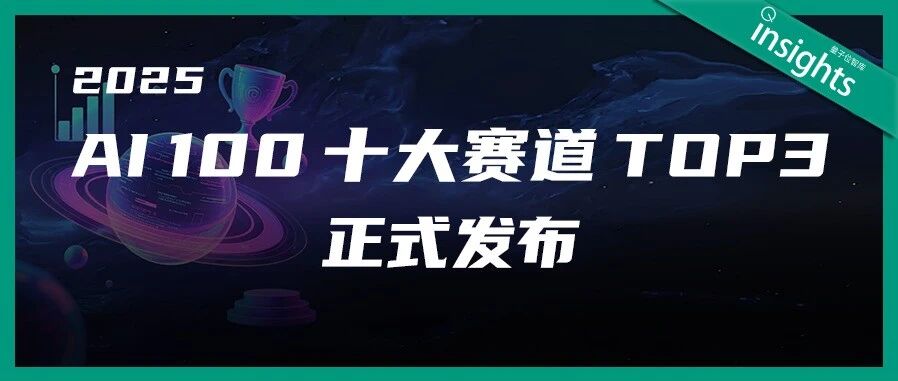
年度AI产品十大赛道TOP 3|量子位智库AI 100
量子位· 2026-01-31 07:30
Core Insights - The article discusses the significant evolution of AI products in 2025, highlighting a shift from merely "talking" to "doing" [3][4] - The focus is on the transformation of interaction paradigms and the integration of AI into both digital and physical realms [5][6] - The article introduces the "AI 100" product list, categorizing AI products into flagship and innovative segments, along with five major application categories [6][9] Group 1: AI Product Development - AI products have shown differentiated growth across various sectors, with strong demand in general scenarios and AI efficiency, while AI life products are exploring better user experiences [14] - The common goal across all sectors is moving towards end-to-end delivery of productivity, shifting the value measurement from "how well it answers" to "how completely it delivers" [14][15] Group 2: Flagship AI Products - The "Flagship AI 100" and "Innovative AI 100" categories represent the strongest and most promising AI products, respectively [7][13] - The article outlines ten core tracks for AI applications, including AI smart assistants, AI agents, AI browsers, AI workstations, Vibe Coding, AI education, AI entertainment, AI health, multimodal creation, and AI consumer hardware [9][10] Group 3: AI Smart Assistants - AI smart assistants are the most traffic-intensive and revenue-near segment, evolving from answering questions to solving problems [16] - Top products in this category include: - Doubao from ByteDance, with over 57 million daily active users [18] - DeepSeek, known for its innovative interaction method that showcases AI reasoning [20] - Tencent Yuanbao, integrating various social networks for enhanced user experience [22] Group 4: AI Agents - AI agents have transitioned from mere conversational tools to executing tasks [23] - Notable products include: - Nano AI from 360 Group, which integrates over 80 large models for task execution [24] - Kouzi, a one-stop AI office space from ByteDance, automating complex workflows [26] - Xingliu, a new generation AI creation tool from Singularity Star, facilitating end-to-end creative processes [30] Group 5: AI Browsers - AI browsers are evolving from passive information displays to active task executors [32] - Key products include: - QQ Browser from Tencent, which integrates AI capabilities to understand user intent [33] - Quark from Alibaba, combining search, reading, and creation functionalities [36] - Fellou, focusing on a unified search and task experience [40] Group 6: AI Workstations - The competition in AI workstations has shifted from the number of features to complete workflow integration [41] - Leading products include: - Baidu Wenku, transforming from a document tool to a knowledge productivity platform [42] - Feishu, integrating AI capabilities into team workflows [46] - Tiangong, focusing on enhancing office and creative efficiency [50] Group 7: AI Education - AI education products are evolving to provide personalized tutoring and enhance learning experiences [61] - Top products include: - KuaiDui AI from Zuoyebang, focusing on personalized tutoring [62] - XiaoYuan AI from Yuanfudao, assisting parents and teachers in managing homework [65] - CapWords, an innovative language learning tool [69] Group 8: AI Entertainment - AI entertainment products are exploring how to provide unique value beyond traditional non-AI products [70] - Notable products include: - Kapi Camera, which enhances user photography experiences [73] - Xingye, a platform for emotional companionship and content creation [76] - DouDou Game Partner, focusing on gaming companionship [79] Group 9: AI Health - The AI health sector is cautiously exploring compliance and user experience [80] - Key products include: - Antifufu, a health management assistant from Ant Group [81] - XiaoHe AI Doctor, providing health consultations based on authoritative medical data [85] - OtterLife, a gamified health management product [88] Group 10: Multimodal Creation - AI creation tools are becoming integral to daily workflows for content creators [90] - Leading products include: - Jidream AI, focusing on video creation processes [91] - Liblib AI, a comprehensive AI creation platform [95] - Keling AI, a creative productivity platform leveraging short video and advertising [97] Group 11: AI Consumer Hardware - The AI consumer hardware sector is characterized by rapid innovation and high turnover [98] - Notable products include: - Plaud Note, an AI note-taking tool [99] - Thunderbird V3 AI glasses, integrating various functionalities [102] - CocoMate, an emotional companion toy [107]
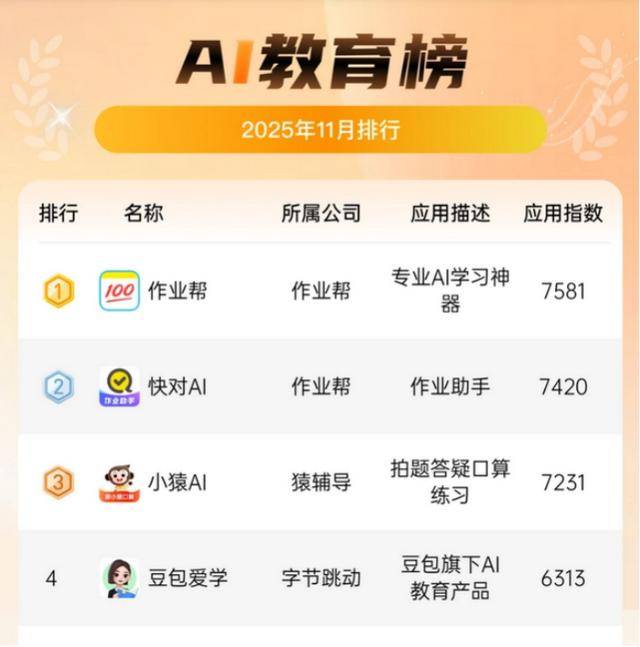
AI教育“神仙打架”:作业帮、豆包爱学、小袁AI谁能笑到最后?
Sou Hu Cai Jing· 2025-12-15 01:42
Core Insights - Xiaomi is rumored to be entering the AI education sector, as indicated by multiple AI education-related job postings on its recruitment page, sparking speculation about potential educational offerings [1] - The AI education market is highly competitive, with various players leveraging their resources to penetrate diverse learning scenarios, including ByteDance's "Doubao Aixue" and Alibaba's "Quark Learning" [1] Group 1: Market Dynamics - The AI education sector is characterized by intense competition and increasing product homogeneity, with many offerings focusing on common functionalities such as photo-based question answering and homework correction [2] - The market is witnessing a significant shift towards AI integration in online education platforms, with leading companies like Zuoyebang leveraging their long-standing educational expertise to gain a competitive edge [3][4] Group 2: Company Strategies - Zuoyebang has established a comprehensive commercial ecosystem that includes live classes, subscription services, and smart learning devices, enhancing user lifetime value and generating stable revenue [3] - ByteDance's "Doubao Aixue" utilizes a unique combination of technology and traffic to rapidly penetrate the K12 smart learning market, benefiting from the vast user base of its super apps [6][8] Group 3: Product Differentiation - Zuoyebang's AI tools have evolved from basic functionalities to intelligent tutoring services, capitalizing on its extensive user base and data assets for effective AI model training [3][4] - "Doubao Aixue" integrates ByteDance's proprietary model, showcasing advanced capabilities in natural language understanding and dynamic response, although it faces challenges in educational content depth [6][8] Group 4: Challenges and Opportunities - Despite its advantages, Zuoyebang has faced public scrutiny due to marketing practices and content oversight, highlighting the need to balance rapid growth with educational integrity [4] - "Doubao Aixue" must address its lack of a systematic research and development framework and broaden its educational service offerings to remain competitive [8] - Xiaoyuan AI focuses on a robust educational research foundation, aiming to evolve AI from a mere tool to a more comprehensive educational entity, but faces challenges in user acquisition and brand recognition [9][11] Group 5: Future Outlook - The AI education sector is evolving, driven by technological advancements and market demands, but it also faces challenges such as sustainability of business models and the need for deeper integration of technology with educational practices [12] - Companies must transition from a focus on functionality to a deeper understanding of educational principles to establish a differentiated value proposition in the long run [12]
全球31位女性企业家走进猿力科技 共探人工智能教育赋能新路径
Zheng Quan Ri Bao Wang· 2025-09-19 12:19
Group 1 - The event organized by the Ministry of Commerce and UNCTAD focused on enhancing the e-commerce and digital economy capabilities of women entrepreneurs from developing countries, highlighting international cooperation opportunities [1] - The visit to Yuanli Technology Group showcased the company's advancements in AI-driven education, including the development of large-scale educational knowledge graphs and specialized AI models for students [1][3] - Yuanli Technology's innovations in personalized learning and precise teaching demonstrate its global leadership in the smart education sector, emphasizing the company's commitment to educational equity [1][3] Group 2 - Beijing's digital economy is projected to exceed 2.2 trillion yuan in value added by 2024, with a core industry growth rate of 10.1% [2] - The city hosts over 2,400 AI companies, with a core industry scale surpassing 300 billion yuan, indicating strong momentum in digital economic development [2] - Beijing is actively promoting itself as a global digital economy benchmark city, focusing on building an internationally competitive digital industry cluster driven by AI [2]
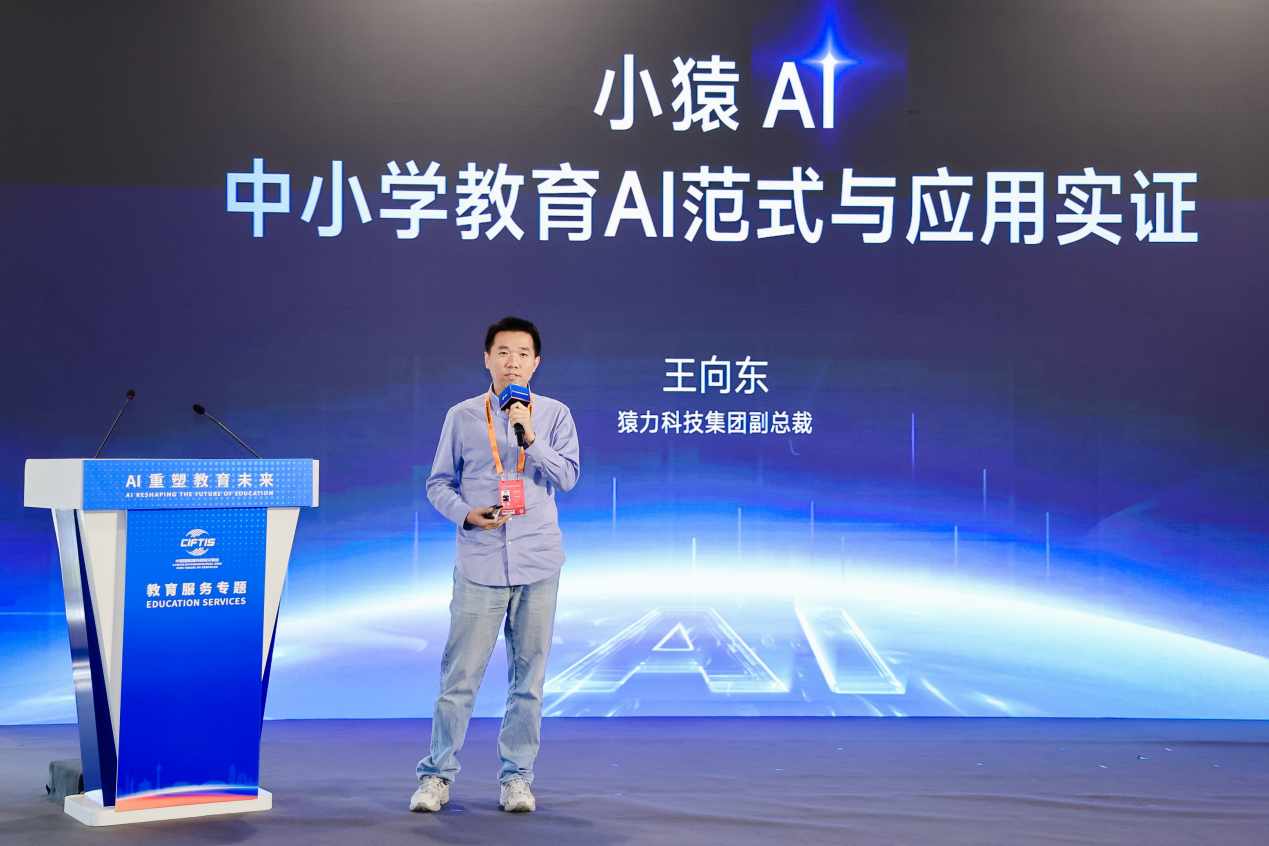
小猿AI服贸会发声:以“三维提升”破局 重塑中小学教育生态
Yang Guang Wang· 2025-09-12 09:58
Core Insights - The 2025 China International Service Trade Fair's education forum focused on "AI Reshaping the Future of Education," highlighting trends in AI-driven education consumption and technology transfer in higher education [1] - Yuanli Technology Group launched its first dedicated education AI, Xiaoyuan AI, which quickly gained market attention and was ranked first in new user downloads in the education AI sector [2] - Xiaoyuan AI's full-process learning assistance model significantly enhances learning efficiency and quality, achieving a fourfold increase in tutoring efficiency and a threefold increase in exam practice efficiency [4] Group 1: AI in Education - Xiaoyuan AI integrates a comprehensive learning support system that includes homework planning, learning diagnostics, knowledge mapping, and personalized learning suggestions [4] - The AI's ability to automate homework tasks and provide precise evaluations has transformed traditional learning methods, allowing students to save time and focus on exploring interests [4] - The AI's personalized learning approach addresses individual weaknesses and strengthens foundational knowledge, contributing to a "precision education revolution" [6] Group 2: Enhancing Core Competencies - Xiaoyuan AI extends its services to improve students' core competencies, fostering humanistic qualities and scientific spirit through various application scenarios [7] - The AI encourages exploratory learning, with 40% of users actively asking questions, primarily in the realm of general knowledge, indicating a shift towards a more engaging learning experience [7] - The "diagnosis-learning-practice" loop is a core feature of Xiaoyuan AI, systematically nurturing students' ability to learn effectively [7] Group 3: Interactive Learning Experience - Xiaoyuan AI's T4 model introduces an "AI Super-Personalized 1-on-1 Teacher" feature, enhancing the interactive learning experience with dual-screen design [8] - The AI's interactive capabilities aim to reduce the isolation often felt in traditional learning environments, promoting a more engaging and supportive educational atmosphere [8] - The company envisions that the evolving virtual teacher will provide top-tier educational guidance to students in both urban and rural settings, fostering equitable access to quality education [8]
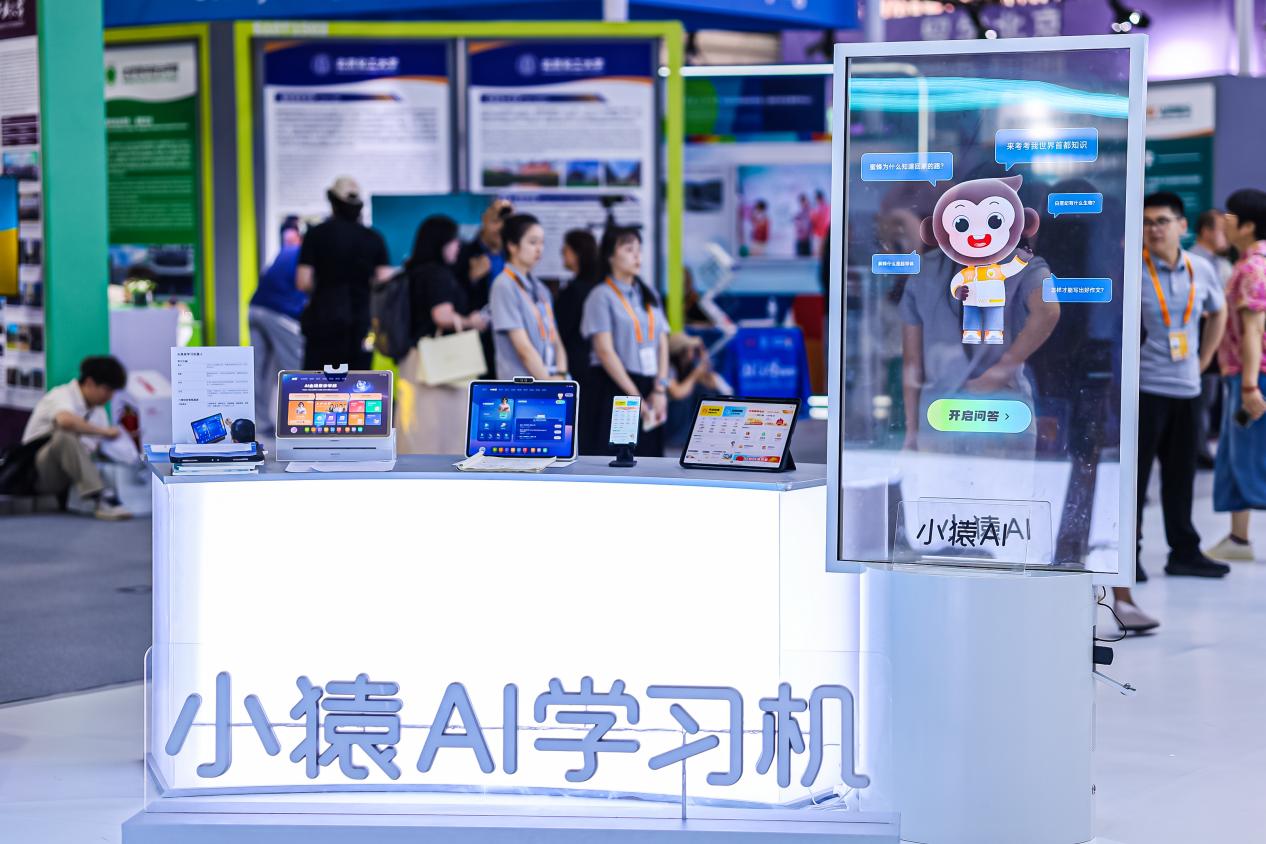
小猿全矩阵产品亮相2025服贸会 “AI超拟人1V1老师”成焦点
Zhong Guo Jing Ji Wang· 2025-09-10 11:09
Core Viewpoint - The 2025 China International Service Trade Fair opened in Beijing, showcasing advancements in education technology, particularly focusing on AI integration in educational tools [1][3]. Group 1: Event Overview - The event featured the "Intelligent Leading, Service Trade Renewed" theme, highlighting the education sector with 55 renowned institutions and enterprises [1]. - The Xiaoyuan exhibition area became a focal point, displaying a range of AI-driven educational products, including the Xiaoyuan AI Learning Machine T4 [1][3]. Group 2: Product Highlights - The Xiaoyuan AI Learning Machine T4 introduced the "AI Super Human 1V1 Teacher" feature, which mimics real teacher interactions to enhance personalized learning experiences [3][6]. - The T4's AI functionality includes real-time feedback and personalized learning paths based on student performance data, creating a closed-loop learning system [6][7]. Group 3: User Experience and Feedback - Attendees experienced the T4's interactive teaching style, which encourages student engagement through questions and guidance, resembling a real teacher's approach [6]. - The Xiaoyuan Learning Machine has achieved over 1 million units sold within 16 months, indicating strong market acceptance [9]. Group 4: Educational Impact - The Xiaoyuan Learning Machine has been piloted in 22 classes across three schools in Beijing, resulting in a 15-minute increase in daily self-study time and improved error correction rates [12]. - The product serves as a dynamic hub for data collection and feedback, optimizing the teaching and learning process through real-time adjustments based on student performance [12][10]. Group 5: Software Integration - The software product "Xiaoyuan AI" offers a comprehensive learning solution for middle and primary school students, featuring personalized tutoring and emotional support capabilities [15][16]. - The integration of AI technology aims to democratize access to quality education resources, enhancing the overall educational experience [16].
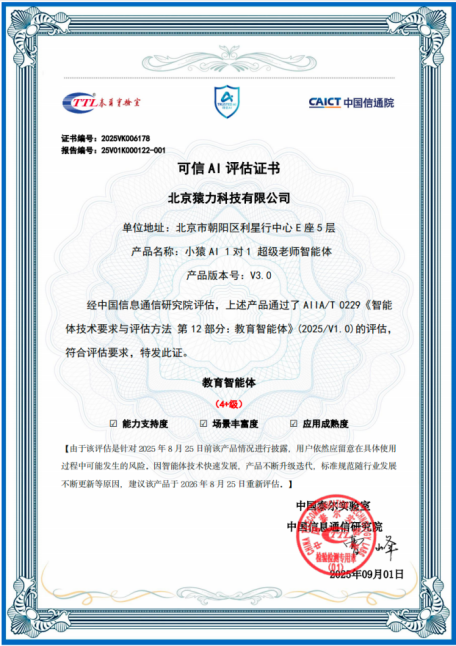
小猿AI获中国信通院教育智能体最高评级认证-财经-金融界
Jin Rong Jie· 2025-09-05 08:16
Core Viewpoint - The "Xiaoyuan AI 1-on-1 Teacher" has achieved the highest rating of 4+ in the recent evaluation organized by the China Academy of Information and Communications Technology, highlighting its technological innovation and industry leadership in the education AI sector [1]. Group 1: Evaluation and Standards - The evaluation was conducted based on the technical specifications outlined in "Intelligent Agent Technical Requirements and Evaluation Methods Part 12: Educational Intelligent Agents," establishing a scientific and systematic evaluation framework for the industry [3]. - The assessment focused on three capability domains: capability support, scenario richness, and application maturity, encompassing over 20 capability items and more than 100 detailed capability points [3]. Group 2: Features and Capabilities - Xiaoyuan AI integrates natural language processing, large models, knowledge graphs, and cognitive science principles, supporting over 100 key learning scenarios and enabling personalized learning paths based on deep analysis of learning behavior data [3]. - The emotional computing and state perception modules allow Xiaoyuan AI to adapt dynamically to students' emotions and cognitive loads, providing interactive feedback for a highly personalized learning experience [3]. Group 3: Product Integration - Xiaoyuan AI has been fully integrated into the Xiaoyuan brand's hardware and software products, including the Xiaoyuan AI App, Xiaoyuan Learning Machine, and Xiaoyuan AI Learning Machine [4]. Group 4: Learning Solutions - The Xiaoyuan AI App offers a comprehensive personalized learning solution, featuring a Q&A function that utilizes five levels of error analysis to provide 1-on-1 personalized explanations, closely mimicking professional teachers' teaching methods [6]. - The Xiaoyuan Learning Machine has been upgraded to support a "practice promotes learning" system, accommodating 322 textbook versions and a vast resource library, including 20 billion questions and 1 million exam papers [9]. Group 5: Interactive Learning Experience - The Xiaoyuan AI Learning Machine creates a "diagnose-learn-practice" closed-loop process, enhancing the personalized learning experience through emotional interaction capabilities, with the latest model featuring over 20 personalized actions and emotional expressions [11]. - The newly launched Xiaoyuan AI Learning Machine P40 aims to deeply simulate real teachers, providing professional visual explanations and highly personalized interactions to replicate real tutoring scenarios [11].