
Uber(UBER)

Search documents
优步(UBER.US)Q4营业利润创新高但盈利展望疲软 管理层拥抱“Robotaxi增长叙事”
Zhi Tong Cai Jing· 2026-02-04 14:19
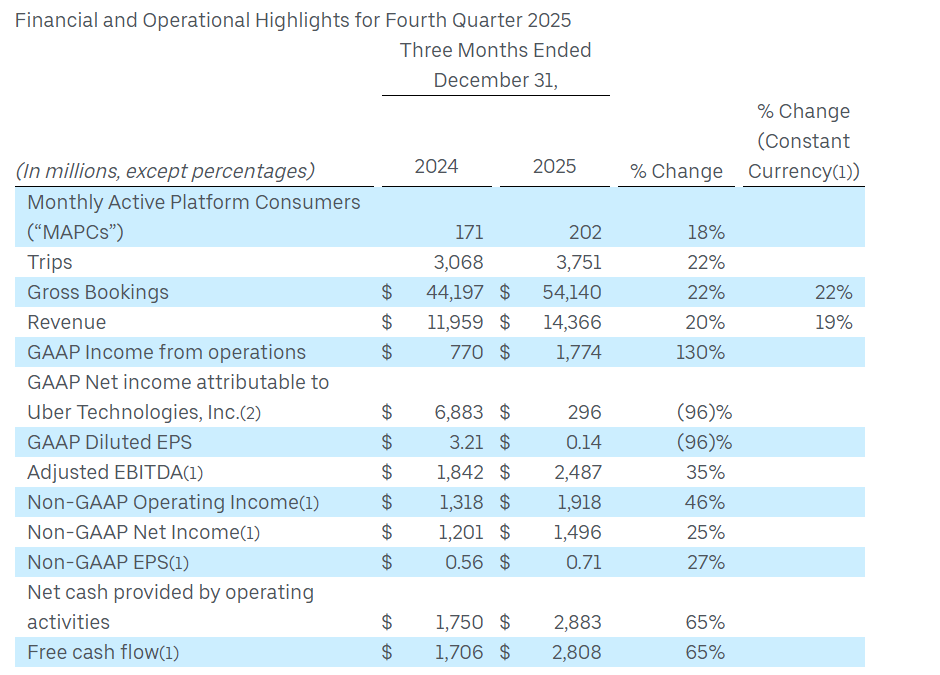
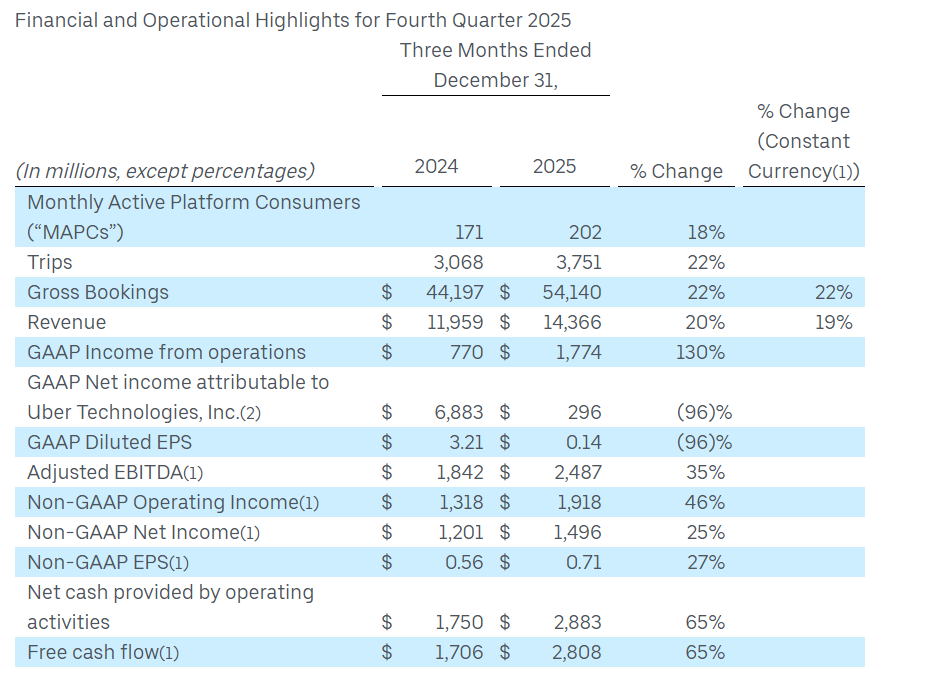
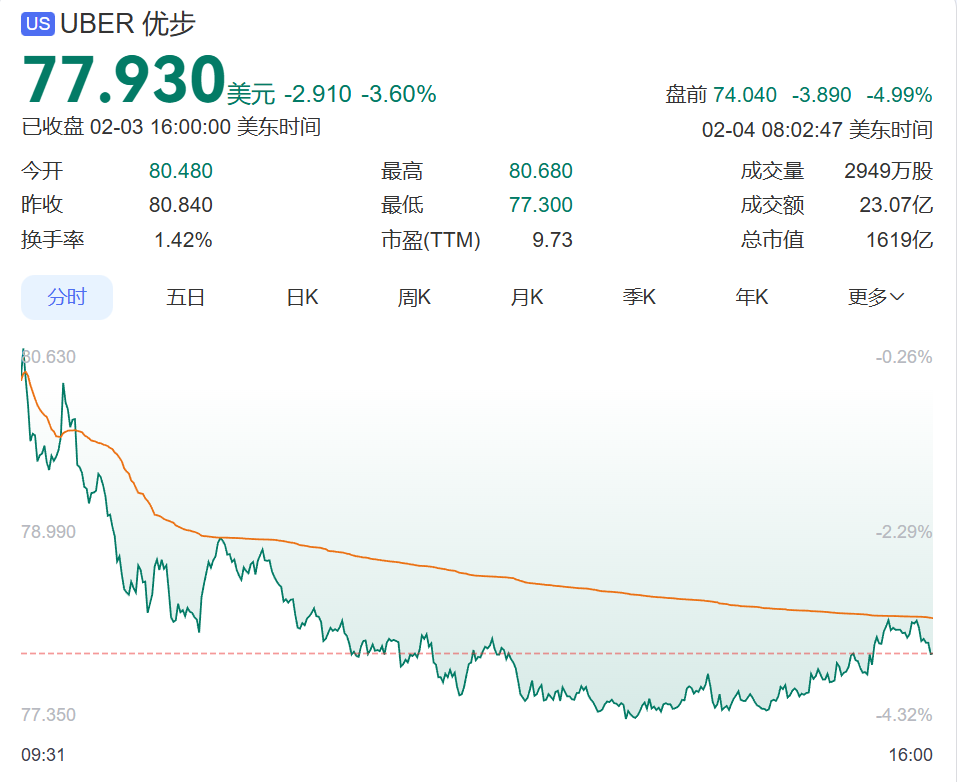
Core Viewpoint - Uber Technologies Inc. reported weak earnings guidance while announcing a new CFO who is a strong advocate for autonomous vehicles, indicating a strategic focus on Robotaxi as a key revenue driver for the future [1][4][10] Financial Performance - Uber's stock fell over 9% in pre-market trading following the disappointing earnings outlook [2] - The adjusted earnings per share for Q1 is projected to be between $0.65 and $0.72, below Wall Street's expectation of approximately $0.77 [2] - The total bookings for Q1 are expected to be between $52 billion and $53.5 billion, indicating a year-over-year growth of 17% to 21%, which is significantly higher than Wall Street's average expectations [2] - In Q4, Uber reported a record operating profit of $1.8 billion, a 130% year-over-year increase, with total revenue of approximately $14.37 billion, up 20% year-over-year, aligning with Wall Street's expectations [2] Strategic Developments - Uber has invested hundreds of millions in autonomous driving technology partners and plans to scale Robotaxi deployment on its platform [4][9] - The new CFO, Balaji Krishnamurthy, is known for supporting Uber's fully autonomous driving strategy and has defended the company's position against competitors like Waymo and Tesla [4][10] - Uber's CEO highlighted strong demand in the ridesharing market, with expectations for growth in bookings and ride volumes in the U.S. market by 2026 [5][6] Robotaxi Initiative - Uber aims to commercialize its Robotaxi strategy, planning to launch in over 10 markets by the end of the year, including Houston, Hong Kong, Madrid, and Zurich [7] - The company believes that Robotaxi can drive significant growth in the ridesharing industry and is not a zero-sum game [7][8] - Uber's partnership with Mercedes-Benz and NVIDIA to build a global Robotaxi platform signifies a major step in expanding its autonomous vehicle ecosystem [9][10]


X @TechCrunch
TechCrunch· 2026-02-04 14:19
Uber appoints new CFO as its AV plans accelerate https://t.co/vwoOwPRRYX ...
Uber appoints new CFO as its AV plans accelerate
TechCrunch· 2026-02-04 14:15
Core Insights - Uber is promoting Balaji Krishnamurthy to CFO, replacing Prashanth Mahendra-Rajah, indicating a strategic shift in financial leadership [1][7] Group 1: Leadership Changes - Balaji Krishnamurthy has been with Uber for over six years, primarily in investor relations, suggesting continuity in financial strategy [2] - Mahendra-Rajah is leaving after three years, marking a significant leadership transition [7] Group 2: Autonomous Vehicle Strategy - Krishnamurthy emphasized investment in autonomous vehicle (AV) software partners and infrastructure, indicating a focus on expanding Uber's AV operations [3] - CEO Dara Khosrowshahi highlighted the potential of AVs to unlock a multi-trillion dollar opportunity, with plans to facilitate AV trips in 15 cities by 2026 and become the largest AV trip facilitator by 2029 [4] Group 3: Financial Performance - Uber's revenue for Q4 reached $14.37 billion, a 20% increase year-over-year, driven by strong demand for food delivery services [5]
Uber(UBER) - 2025 Q4 - Earnings Call Transcript
2026-02-04 14:02
Financial Data and Key Metrics Changes - In Q4 2025, Uber achieved a gross bookings increase of 22% year-over-year, reaching an annual run rate of 15 billion trips and over 200 million monthly active users [4] - The company generated $8.7 billion in adjusted EBITDA, representing a 35% margin, and $9.8 billion in free cash flow, up 42% year-over-year [4] Business Line Data and Key Metrics Changes - The introduction of new products, such as the Moto product, has significantly contributed to user growth by attracting new segments [29] - The Reserve product has shown strong performance, particularly among suburban users seeking reliability for time-sensitive trips [30] Market Data and Key Metrics Changes - 60% of Uber's mobility gross bookings are generated internationally, indicating a strong presence outside the U.S. [23] - The company noted that growth in less dense markets is approximately 1.5-2 times faster than in major cities, contributing to overall user growth [31] Company Strategy and Development Direction - Uber is focusing on six strategic areas, including autonomous vehicles (AVs), which are seen as a multi-trillion-dollar opportunity [4][5] - The company aims to leverage its global scale and sophisticated marketplace technology to enhance its AV strategy and partnerships with various AV providers [15][41] Management's Comments on Operating Environment and Future Outlook - Management expressed confidence in the growth potential of AVs, viewing them as a net positive for the overall market rather than a competitive threat [14] - The company is optimistic about maintaining user growth momentum, with a year-over-year increase in monthly active users from 14% to 18% [32] Other Important Information - Prashanth Mahendra-Rajah will step down as CFO, with Balaji Krishnamurthy taking over the role, indicating a transition in leadership [7][10] - The company is committed to returning 50% of free cash flow to shareholders while also making strategic investments in growth opportunities [42][43] Q&A Session Summary Question: Impact of AV ramps from competitors on market share and profitability - Management views the introduction of AVs as a growth driver for markets, with bookings accelerating in cities like San Francisco and Austin [14][15] Question: Strategic priorities for maintaining user growth momentum - The strategy includes introducing new products, targeting different demographics, and expanding into less dense markets [29][30] Question: Concerns about AV technology leading to a winner-takes-most scenario - Management believes that the AV market will have multiple suppliers and that Uber's extensive network will provide a competitive advantage [38][41] Question: Capital allocation philosophy regarding free cash flow and investments - The company plans to balance reinvestments in growth with returning cash to shareholders, maintaining aggressive stock buybacks [42][43] Question: Factors driving acceleration in U.S. trips and gross bookings - Consistent pricing and insurance reforms are expected to enhance demand elasticity, contributing to growth [49][50] Question: Stages and timeline for deploying AVs on Uber's network - Initial deployments will focus on meeting consistent demand, with plans to scale as OEMs ramp production [75][76]
Uber(UBER) - 2025 Q4 - Earnings Call Transcript
2026-02-04 14:02
Financial Data and Key Metrics Changes - In Q4 2025, Uber achieved a gross bookings increase of 22% year-over-year, reaching an annual run rate of 15 billion trips and over 200 million monthly active users [4] - The company generated $8.7 billion in adjusted EBITDA, representing a 35% margin, and $9.8 billion in free cash flow, up 42% year-over-year [4] Business Line Data and Key Metrics Changes - The introduction of new products, such as the Moto product, has significantly contributed to user growth by attracting new segments [29] - The Reserve product has shown higher margins and has successfully introduced new customers, particularly in suburban areas [30] Market Data and Key Metrics Changes - 60% of Uber's mobility gross bookings are generated internationally, indicating a strong presence outside the U.S. [23] - The company noted that growth in less dense markets is approximately 1.5-2 times faster than in major cities, contributing to overall growth [31] Company Strategy and Development Direction - Uber is focusing on six strategic areas, including autonomous vehicles (AVs), which are seen as a multi-trillion-dollar opportunity [4][5] - The company aims to leverage its global scale and sophisticated marketplace technology to enhance its AV strategy and partnerships with various AV manufacturers [15][16] Management's Comments on Operating Environment and Future Outlook - Management expressed confidence in the growth potential of AVs, viewing them as a net positive for the overall market rather than a competitive threat [14] - The company is optimistic about maintaining user growth momentum, with a year-over-year increase in monthly active users from 14% to 18% [32] Other Important Information - Prashanth Mahendra-Rajah will step down as CFO, with Balaji Krishnamurthy taking over the role, indicating a transition in leadership [7][10] - The advertising business has exceeded previous growth targets, with potential for further expansion in delivery advertising [82] Q&A Session Summary Question: Impact of AVs on market share and profitability - Management views the introduction of AVs as a growth driver, with bookings in cities like San Francisco accelerating despite competition [14] Question: Strategic priorities for maintaining user growth - The strategy includes introducing new products, targeting different demographics, and expanding into less dense markets [29][30] Question: Capital return philosophy and free cash flow commitment - The company plans to maintain a 50% free cash flow return to shareholders while also investing in growth opportunities [43] Question: Factors driving acceleration in U.S. trips and gross bookings - Consistent pricing and insurance reforms are expected to enhance demand elasticity, contributing to growth [49] Question: Stages of AV deployment and scaling - Initial deployments will focus on consistent supply, with future scaling dependent on OEM production capabilities [75][76] Question: Long-term potential of delivery advertising - The advertising business is expected to grow significantly, with enterprise advertising catching up to SMBs [82]
Uber(UBER) - 2025 Q4 - Earnings Call Transcript
2026-02-04 14:00
Financial Data and Key Metrics Changes - In Q4 2025, Uber achieved a gross bookings increase of 22% year-over-year, reaching an annual run rate of 15 billion trips and over 200 million monthly active users [5][6] - The company generated $8.7 billion in adjusted EBITDA, representing a 35% margin, and $9.8 billion in free cash flow, up 42% year-over-year [5][6] - For the full year 2025, Uber maintained over 20% annual gross bookings growth for the fifth consecutive year [5] Business Line Data and Key Metrics Changes - The introduction of new products, such as the Moto product, has significantly contributed to user growth by attracting new segments [30] - The Reserve product has shown strong performance, particularly among suburban users seeking reliability for time-sensitive trips [31] - The membership program, Uber One, has grown by 55% year-over-year, enhancing customer retention and engagement [36] Market Data and Key Metrics Changes - 60% of Uber's mobility gross bookings are generated internationally, indicating a strong presence outside the U.S. [23] - Growth in less dense markets is approximately 1.5-2 times faster than in major cities, contributing to overall user growth [32] Company Strategy and Development Direction - Uber is focusing on six strategic areas, including autonomous vehicles (AVs), which are seen as a multi-trillion-dollar opportunity [5][6] - The company aims to leverage its global scale and sophisticated marketplace technology to enhance its AV strategy and partnerships with various AV manufacturers [17][42] - Uber's capital allocation strategy prioritizes reinvestment in core business opportunities while maintaining a commitment to returning 50% of free cash flow to shareholders [45][46] Management's Comments on Operating Environment and Future Outlook - Management expressed confidence in the growth potential of AVs, viewing them as a net positive for the overall market rather than a competitive threat [14][16] - The company anticipates continued user growth, with a year-end MAPC growth of 18% year-over-year, indicating strong momentum heading into 2026 [33] - Management highlighted the importance of maintaining price consistency in the U.S. market to enhance long-term demand elasticity [51] Other Important Information - Prashanth Mahendra-Rajah will step down as CFO, with Balaji Krishnamurthy taking over the role, indicating a transition in leadership [7][8] - The company is actively working on partnerships and investments in AV technology to ensure a competitive edge in the evolving mobility landscape [54][56] Q&A Session Summary Question: Impact of AVs on market share and profitability - Management views the introduction of AVs as a growth driver, with bookings in major cities accelerating despite competition [14][16] Question: Strategic priorities for maintaining user growth - The focus is on introducing new products, targeting different demographics, and expanding into less dense markets [30][32] Question: Willingness to deploy capital into AV fleets - Management is committed to investing in AV technology while ensuring profitable economics and maintaining a healthy financing ecosystem [53][56] Question: Factors driving acceleration in U.S. trips and gross bookings - Consistent pricing and a barbell strategy targeting both low-end and high-end markets are key factors for growth [51][52] Question: Stages of AV deployment and scaling - Initial focus will be on achieving consistent baseload supply from AVs, with scaling dependent on OEM production capabilities [75][76]
?优步(UBER.US)Q4营业利润创新高但盈利展望疲软 管理层拥抱“Robotaxi增长叙事”
Zhi Tong Cai Jing· 2026-02-04 13:27
Core Viewpoint - Uber reported a record high operating profit for Q4 but provided a weak earnings outlook, indicating a shift towards a focus on Robotaxi as a key growth engine for the future [1][4]. Financial Performance - In Q4, Uber achieved a GAAP operating profit of $1.8 billion, a 130% year-over-year increase, with total revenue around $14.37 billion, reflecting a 20% year-over-year growth [2]. - The adjusted earnings per share for Q1 is projected to be between $0.65 and $0.72, below Wall Street's expectation of approximately $0.77 [2]. - Total bookings for Q1 are expected to be between $52 billion and $53.5 billion, indicating a year-over-year growth of 17% to 21%, which is significantly higher than Wall Street's average expectations [2]. Management Changes - Balaji Krishnamurthy has been appointed as the new CFO, succeeding Prashanth Mahendra-Rajah, who is leaving for other opportunities [1][4]. - The management change aligns with the company's strategy to enhance its focus on autonomous driving technology and Robotaxi services [1]. Robotaxi Strategy - Uber has invested hundreds of millions in autonomous driving technology partners and plans to scale Robotaxi deployment across its global ride-hailing platform [3][6]. - The company aims to launch Robotaxi services in over ten markets by the end of the year, including Houston, Hong Kong, Madrid, and Zurich [6]. - Uber's strategy emphasizes that Robotaxi can drive significant growth in the ride-hailing industry, positioning the company as a key player in the evolving autonomous vehicle ecosystem [6][10]. Market Demand and Competitive Landscape - Demand for ride-hailing services remains strong, with total bookings in Q4 increasing by 22% to $54.1 billion, surpassing Wall Street's expectations [4]. - The company is also seeing robust growth in its delivery business, particularly during the holiday shopping season, which sets a positive growth outlook for the broader ride-hailing and delivery sectors [5]. - Uber's competitive advantage lies in its high-frequency dispatch network, dynamic pricing, and operational capabilities, differentiating it from competitors like Waymo and Tesla [9][10].
优步(UBER.US)Q4营业利润创新高但盈利展望疲软 管理层拥抱“Robotaxi增长叙事”
智通财经网· 2026-02-04 13:25
Core Viewpoint - Uber Technologies Inc. reported weak earnings guidance while announcing the appointment of Balaji Krishnamurthy as the new CFO, indicating a strategic focus on the development of Robotaxi services as a key revenue driver for the future [1][5]. Financial Performance - Uber's adjusted earnings per share (EPS) for Q1 is projected to be between $0.65 and $0.72, below Wall Street's expectation of approximately $0.77 [2]. - The total bookings for Q1 are expected to be between $52 billion and $53.5 billion, representing a year-over-year growth of 17% to 21%, which exceeds Wall Street's average expectations [2]. - In Q4, Uber reported a GAAP operating income of $1.8 billion, a 130% increase year-over-year, with total revenue of approximately $14.37 billion, up 20% year-over-year, aligning with Wall Street's expectations [2][4]. Strategic Developments - Balaji Krishnamurthy, known for his support of Uber's autonomous driving strategy, has been appointed as CFO, succeeding Prashanth Mahendra-Rajah [1][5]. - Uber has invested hundreds of millions in autonomous driving technology and plans to scale Robotaxi deployment across its platform [4][10]. - The company aims to launch Robotaxi services in over ten markets by the end of the year, including Houston, Hong Kong, Madrid, and Zurich [8][10]. Market Dynamics - Uber's CEO highlighted strong demand in the ridesharing market, with expectations for growth in trip volume and total bookings in the U.S. market by 2026 [6]. - The company reported a 22% increase in total bookings to $54.1 billion, driven by new product launches and increased subscription services [7]. - Uber's delivery business also saw significant growth during the holiday shopping season, setting records for sales [7]. Competitive Landscape - Uber's Robotaxi strategy is positioned as a key growth area, with the potential to shift the cost structure of the ridesharing market from driver-dependent to vehicle and operational costs [10][11]. - The company emphasizes its unique advantages in high-frequency dispatch networks and dynamic pricing compared to competitors like Waymo and Tesla [11].
Uber盘前一度大跌10%!Q4预订量大增难抵利润忧虑,新任CFO释放“发力 Robotaxi”信号 | 财报见闻
Hua Er Jie Jian Wen· 2026-02-04 13:18
Core Insights - Uber's Q4 earnings report shows strong growth in total bookings but raises concerns due to weak profit guidance and a significant drop in net income [1][2] Financial Performance - In Q4, Uber reported a net income of $296 million, a drastic decline of 96% year-over-year [1] - The company expects adjusted earnings per share for the current quarter to be between $0.65 and $0.72, below the analyst consensus of $0.77 [1] - Total bookings for Q4 reached $54.1 billion, a 22% year-over-year increase, surpassing analyst expectations [3] Strategic Developments - Uber appointed Balaji Krishnamurthy as the new CFO, a proponent of autonomous driving technology, signaling a strategic focus on the Robotaxi business [1][4] - The company plans to expand its Robotaxi services to new markets, including Houston, Hong Kong, Madrid, and Zurich, with a goal of launching in over 10 markets globally in the coming years [6] Market Positioning - CEO Dara Khosrowshahi highlighted a healthier pricing environment due to lower insurance costs and new product launches, which could support revenue growth and margin expansion [2] - Uber's core business remains robust, with strong performance in its delivery segment during the holiday season, capturing market share from competitors [3] Competitive Landscape - Uber refuted claims that autonomous driving technology would negatively impact its business, asserting that Robotaxi services could stimulate overall growth in the ride-hailing industry [6] - The company emphasized the advantages of human drivers in situations where autonomous vehicles may face challenges, ensuring customer experience during disruptions [6]
氪星晚报 |腾讯混元AI Infra核心技术开源;小米:辽宁营口SU7起火事故系车内遗留火源引燃周边可燃物所致
3 6 Ke· 2026-02-04 13:02
Group 1: Company Updates - Gong Youliang, the director and executive vice president of South Mining Group, plans to reduce his stake by up to 1%, amounting to 2.0172 million shares, due to personal funding needs [1] - Changan Automobile reported January sales of 134,701 units, a year-on-year decline of 51.14%, with new energy vehicle sales at 36,621 units, down 45.74% [1] - Yum China achieved fourth-quarter revenue of $2.82 billion, an 8.8% year-on-year increase, with adjusted earnings per share of $0.40, surpassing estimates [3] - Toyota plans to increase hybrid vehicle production by approximately 30% by 2028, targeting 6.7 million units, compared to a production plan of 5 million units for 2026 [4] - Panasonic announced the establishment of a Chief Artificial Intelligence Officer position to enhance AI application in customer solutions and internal operations [5] Group 2: Financing and Investments - Cloud Data Infrastructure provider "Yunqi Technology" completed a Series B financing round led by ALC Capital, with total funding exceeding 700 million yuan [6] Group 3: New Products and Innovations - Tencent's Mix Yuan AI Infra team launched an open-source high-performance LLM inference core operator library, HPC-Ops, which improved model inference performance by 30% for Mix Yuan and 17% for DeepSeek [7]


