Walmart(WMT)

Search documents
Apple downgraded, Alibaba upgraded: Wall Street's top analyst calls
Yahoo Finance· 2025-10-03 13:42
Upgrades - Rothschild & Co Redburn upgraded Coinbase (COIN) to Buy from Neutral with a price target of $417, increased from $325, expecting retail volume growth to mitigate take rate compression [2] - Wells Fargo upgraded Johnson & Johnson (JNJ) to Overweight from Equal Weight with a price target of $212, up from $170, indicating that concerns around pharmaceutical tariffs and pricing risks are largely resolved [3] - Gordon Haskett upgraded Zillow (Z) to Buy from Hold with a price target of $90, citing favorable risk/reward due to negative sentiment affecting shares [3] - Fox Advisors upgraded Instacart (CART) to Outperform from Equal-Weight, believing the 24% decline in stock price since August 11 is "oversold" due to overblown competitive concerns [3] - Erste Group upgraded Alibaba (BABA) to Buy from Hold, noting the company's strong development in artificial intelligence applications [4] Downgrades - Jefferies downgraded Apple (AAPL) to Underperform from Hold with a price target of $205.16, down from $205.82, citing excessive expectations on the replacement cycle and prospects of the iPhone 18 Fold [5] - Piper Sandler downgraded Instacart (CART) to Neutral from Overweight with a price target of $41, down from $62, due to rising competitive pressures from major players like Amazon and Walmart [5] - Wolfe Research downgraded PayPal (PYPL) to Peer Perform from Outperform, with a fair value range of $70-$80, indicating shares may be range-bound until further proof of execution is shown [5] - KeyBanc downgraded Corteva (CTVA) to Sector Weight from Overweight without a price target, following the company's announcement to separate into two public companies [5] - Goldman Sachs downgraded Bumble (BMBL) to Neutral from Buy with a price target of $7, down from $8, stating that the stock's risk/reward is more balanced at current levels [5]



X @Wu Blockchain
Wu Blockchain· 2025-10-03 12:26
Cryptocurrency Integration - OnePay (Walmart-owned fintech platform) will introduce cryptocurrency trading and custody features within its mobile banking app later this year [1] - Initially, the platform will support Bitcoin and Ethereum [1] - Users will be able to utilize cryptocurrency for Walmart purchases or to settle card debt [1]

AI Shopping Is About To Upend E-Commerce. What It Means for Amazon, Walmart, Meta, Google.
Investors· 2025-10-03 12:00
Core Insights - The emergence of "agentic commerce" powered by AI is set to transform e-commerce, offering significant investment opportunities for major players like Amazon, Google, Meta, Walmart, Shopify, and eBay [1][3][10] - OpenAI's recent announcement to enable shopping directly through ChatGPT marks a pivotal moment in the integration of AI into e-commerce [1][6][9] E-Commerce Landscape - AI shopping is not a new concept, but major retailers are increasingly focusing on AI to enhance shopping precision and speed [2][3] - The U.S. e-commerce market exceeds $1 trillion annually, highlighting the substantial financial stakes involved [3] AI Chatbots and Consumer Trust - AI chatbots are gaining traction, with a reported 4,700% increase in referrals to e-commerce product pages from AI bots year-over-year [4] - ChatGPT is central to this trend, with projections of 20 billion shopping-related messages this year [5] OpenAI's Strategic Moves - OpenAI's partnership with Etsy and Shopify to facilitate direct purchases through ChatGPT could create new revenue streams [6][7] - The launch of the Agentic Commerce Protocol aims to simplify e-commerce transactions via AI [8][9] Competitive Dynamics - The competition among tech giants like OpenAI, Google, and Amazon is intensifying as they vie for leadership in AI-driven commerce [10][11] - Amazon and Walmart are developing their own AI shopping assistants, indicating a broader trend towards agentic capabilities in retail [11][12] Financial Implications - The market for agentic commerce is projected to reach $136 billion in 2023 and could grow to $1.7 trillion by 2030, presenting new challenges for payment processors [22] - Companies like Mastercard and Visa are already adapting to this shift by launching tools focused on agentic commerce [23][24] Consumer Behavior and Adoption - Despite the advancements, consumer trust and privacy concerns remain significant hurdles for widespread adoption of AI shopping [26] - A survey indicated that 43% of U.S. consumers are uncomfortable with generative AI analyzing their personal data for shopping recommendations [26] Advertising and Revenue Streams - The rise of AI shopping could disrupt traditional advertising models, particularly for Google and Meta, as AI agents may change how consumers interact with ads [29][30] - Amazon is projected to generate $67.6 billion in advertising revenue this year, underscoring the importance of advertising in its business model [32] Market Sentiment - Despite recent stock fluctuations, analysts remain optimistic about the long-term potential of AI in e-commerce [36][37] - The ongoing investment in AI technologies by major retailers is seen as crucial for maintaining competitiveness in the evolving market landscape [38]



Walmart-backed fintech OnePay is bringing crypto to its banking app, sources say
CNBC· 2025-10-03 11:00
Core Insights - OnePay, a fintech firm majority-owned by Walmart, is expanding its offerings to include cryptocurrency trading and custody services on its mobile app [1][2] - The company aims to become a comprehensive digital finance platform, similar to international super apps like WeChat, by adding various financial services [3] Company Developments - OnePay will enable users to trade bitcoin and ether later this year, collaborating with startup Zerohash for this initiative [2] - The app currently provides a range of services including high-yield savings accounts, credit and debit cards, and buy now, pay later loans [3] - OnePay's mobile app is gaining popularity, ranking No. 5 on Apple's app store for free finance apps, surpassing larger competitors like JPMorgan Chase and Robinhood [6] Industry Context - The mainstream adoption of cryptocurrency is increasing, particularly following a shift in the U.S. government's stance under President Trump [4] - Major financial institutions, including Morgan Stanley, are beginning to offer crypto products, indicating a growing trend in the industry [4][5] - Zerohash recently raised $104 million in funding, highlighting the increasing investment in companies involved in cryptocurrency [5] Market Position - OnePay benefits from its integration with Walmart's checkout process, providing access to 150 million weekly shoppers, while also targeting a broader audience beyond Walmart customers [7]

How digital price tags could change the future of grocery shopping
CNBC· 2025-10-03 10:00
Core Insights - The adoption of electronic shelf labels is increasing in grocery stores across America, with a projected growth of the global market from $1.85 billion in 2024 to $7.54 billion by 2033 [1] - Walmart plans to implement electronic shelf labels in 2,300 stores by 2026, which will significantly reduce the time required for price updates from two days to minutes [2] - Concerns have been raised by lawmakers regarding the potential for grocery stores to implement dynamic pricing, which could lead to price increases during high demand periods [3][4] Industry Growth - The electronic shelf label industry is expected to experience significant double-digit year-over-year growth in the foreseeable future [2] - Dynamic pricing enabled by electronic shelf labels could potentially reduce food waste by up to 21% [5] Company Responses - Kroger has stated that it does not engage in surge pricing and uses electronic shelf labels to better manage inventory and lower prices on perishable items [5] - Amazon has confirmed it has no plans to utilize surge or dynamic pricing [6]


Sensory Upload: Walmart Expands Automation of Grocery Tracking
Yahoo Finance· 2025-10-03 09:30
Core Insights - Walmart is implementing tens of millions of sensors to track grocery pallets across its stores, aiming to enhance inventory management and operational efficiency [1][2] - The partnership with sensor startup Wiliot focuses on solving the challenge of real-time inventory visibility in retail [2][3] Technology and Innovation - The sensors, which utilize Bluetooth technology, are currently operational at 500 locations and will expand to approximately 4,600 Walmart stores and 40 distribution centers by the end of next year [4] - Walmart's Chief Executive Doug McMillon emphasized that AI will transform every job within the company, indicating a significant shift towards automation in supply chain management [3][4] Financial Performance - Walmart's revenue has increased by $150 billion over the past five years, while employee numbers have remained mostly flat, indicating improved operational efficiency [4] - The company's shares have risen by 12.5% in 2025, with a market value exceeding $810 billion, reflecting strong investor confidence [4] Future Outlook - Executives anticipate continued revenue growth driven by AI automation, although they expect the workforce size to remain stable for at least the next five years [4] - Walmart employs 2.1 million people, with 1.6 million in the U.S., making it the largest private employer in the country [4]
沃尔玛投资3亿美元在美国新建配送中心,提速大型商品次日达服务
Sou Hu Cai Jing· 2025-10-03 03:37
Core Insights - Walmart plans to invest $300 million in a new logistics center in North Carolina, focusing on large item distribution, enabling next-day delivery for products like patio furniture and lawnmowers [1][4] Group 1: Investment and Infrastructure - The new distribution center will cover 1.2 million square feet (approximately 111,484 square meters) and is located near Kings Mountain, expected to be operational by 2027 [4] - The center is projected to create 300 jobs, supported by a $4 million job development grant from North Carolina, contingent on Walmart meeting employment targets [4] Group 2: Strategic Importance - Walmart's Senior Vice President of U.S. Supply Chain, Karisa Sprague, stated that the new center will play a crucial role in enhancing customer service efficiency amid the ongoing growth of its e-commerce business [4] - Currently, Walmart operates 29 dedicated e-commerce distribution centers in the U.S. and plans to open its fifth "next-generation" distribution center in Stockton, California, next year to further handle online orders on the West Coast [4]
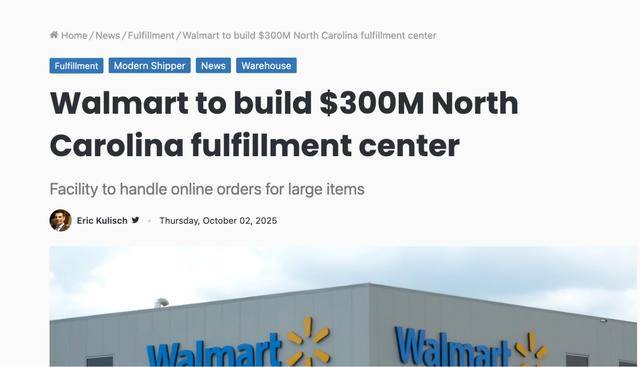
Walmart to build $300M North Carolina fulfillment center
Yahoo Finance· 2025-10-02 21:17
Walmart (WMT) is ready to build a $300 million fulfillment center in North Carolina that will focus on shipping large items such as patio furniture and lawnmowers directly to customers, as soon as the next day, North Carolina Gov. Josh Stein announced on Tuesday. The 1.2 million square-foot facility will be located in Kings Mountain, near Gastonia, and is expected to open in 2027, according to a news release from the Department of Commerce. “As our e-commerce business continues to grow, this new fulfill ...
OpenAI's Deal Machine Is in Overdrive—From CoreWeave To UiPath And Walmart
Benzinga· 2025-10-02 17:54
Core Partnerships - OpenAI's partnership with CoreWeave has expanded significantly, reflecting the high demand for compute power driven by AI adoption, with total agreements valued at approximately $22.4 billion [2][3]. - The initial agreement for computing power was signed for $11.9 billion, followed by a $4 billion agreement in May, and a further $6.5 billion deal at the end of September [2][3]. Strategic Collaborations - OpenAI and UiPath have formed a strategic partnership to integrate OpenAI's advanced AI models into UiPath's automation platform, enhancing enterprise solutions [4]. - This collaboration includes a specialized ChatGPT connector, facilitating the development and deployment of agentic automation for businesses [4]. Retail Sector Engagement - Walmart has announced a collaboration with OpenAI to implement a comprehensive AI skills program for its 2.1 million employees starting in 2026, focusing on skill-based advancement [5][6]. - The initiative aims to adapt Walmart's hiring and training processes to better align with AI-driven tools, showcasing the retailer's proactive approach to change [6]. Overall Impact - OpenAI's rapid expansion of partnerships across various sectors is driving innovation and business growth for both OpenAI and its partners [7].



Walmart Wants More Developers, and More AI Agents to Automate Their Work
WSJ· 2025-10-02 17:02
Core Viewpoint - The company is focused on hiring software engineers as it transforms its workforce to adapt to the AI era [1] Group 1 - Executives at the retail giant emphasize the importance of hiring software engineers [1] - The company is undergoing a workforce revamp to align with advancements in artificial intelligence [1]