ExxonMobil(XOM)

Search documents
US Stock Market Navigates Premarket Dips Amid Shutdown Fears and Key Economic Data
Stock Market News· 2025-09-30 10:07
Market Overview - The U.S. stock market is expected to open cautiously, with major index futures indicating a slight pullback due to concerns over a potential government shutdown and upcoming economic data releases [1][2] - September has been a positive month for major indexes, with the Nasdaq Composite gaining approximately 5.3%, the S&P 500 advancing around 3.1%, and the Dow Jones Industrial Average rising about 1.7% [3] Premarket Trading and Futures Movements - S&P 500 futures were down approximately 0.18% to 0.2%, Dow Jones Industrial Average futures declined around 0.18% to 0.23%, and Nasdaq 100 futures edged lower by about 0.16% to 0.21% [2] Corporate Earnings and Stock Movements - Nvidia (NVDA) shares rallied over 2% on Monday, settling above the $180 level, and rose 1% in premarket trading [6] - Electronic Arts (EA) surged after reports of a $55 billion going-private leveraged buyout deal, with the stock jumping 15% on Friday and climbing a further 4.5% on Monday [6] - Intel (INTC) shares were down almost 3% on Monday after a significant 20% surge last week [10] - Robinhood Markets (HOOD) saw its shares surge over 12% on Monday, closing at an all-time high [10] - Western Digital (WDC) rose 9.2% and Seagate Technology (STX) added 5.3% after analysts raised price targets due to growing demand for hard drives to support AI [10] - Coinbase Global (COIN) gained 6.8% as major cryptocurrencies moved higher [10] - Lam Research (LRCX) shares rose 3.3% after Deutsche Bank upgraded the company to a "Buy" rating [10] - Novo Nordisk (NVO) dropped 3% after receiving a downgrade to "Underweight" [10] - The energy sector was the worst-performing sector in the S&P 500 on Monday, declining 1.9% [10] Upcoming Economic Data - Key reports to be released include the Job Openings and Labor Turnover Survey (JOLTS) for August, Consumer Confidence Report for September, and Chicago Region's Business Activity Data for September [6] - The JOLTS report is expected to provide insights into labor market health, while the Consumer Confidence Report will reflect household sentiment amidst inflation concerns [6]



Exxon Mobil to cut 2,000 jobs globally amid restructuring
Yahoo Finance· 2025-09-30 10:06
Core Insights - Exxon Mobil plans to lay off 2,000 workers globally, representing about 3% to 4% of its workforce, as part of a long-term restructuring plan aimed at improving efficiency [1][2] - The company has been streamlining operations following its $60 billion acquisition of Pioneer Natural Resources in 2024, and previously announced nearly 400 job cuts in Texas [2] - The broader oil and gas industry is experiencing significant job cuts, with companies like Chevron, BP, and ConocoPhillips also announcing substantial layoffs due to weaker crude oil prices and market consolidation [3] Company-Specific Developments - Exxon Mobil's global workforce was reported to be 61,000 at the end of 2024, indicating the scale of the current layoffs [5] - The company emphasized the importance of aligning its global footprint with its operating model to enhance efficiency [2] Industry Trends - The U.S. oil and gas production sector saw a decline of 4,700 jobs in the first half of the year, reflecting ongoing challenges in the market [4] - Benchmark Brent crude futures have decreased by approximately 10.5% year-to-date, influenced by increased OPEC+ output and demand uncertainties related to U.S. trade policy [5]

Exxon chief sought security assurances for gas terminal from Mozambique president, FT reports
Reuters· 2025-09-30 04:13
Core Viewpoint - ExxonMobil's CEO Darren Woods is seeking security assurances from Mozambique's President Daniel Chapo regarding a proposed $30 billion gas terminal in Mozambique [1] Group 1 - The proposed gas terminal represents a significant investment of $30 billion by ExxonMobil in Mozambique [1] - The discussions between Woods and Chapo highlight the importance of security for the successful implementation of the gas project [1]

Exxon Mobil (XOM) Stock Falls Amid Market Uptick: What Investors Need to Know
ZACKS· 2025-09-29 22:46
Company Performance - Exxon Mobil (XOM) closed at $114.10, reflecting a -2.67% change from the previous day, underperforming the S&P 500's daily gain of 0.26% [1] - Over the past month, Exxon Mobil's stock has increased by 2.56%, which is lower than the Oils-Energy sector's gain of 4.06% and the S&P 500's gain of 2.87% [1] Earnings Projections - The upcoming EPS for Exxon Mobil is projected at $1.73, indicating a 9.90% decline compared to the same quarter last year [2] - The Zacks Consensus Estimate for revenue is $87.06 billion, down 3.28% from the previous year [2] Annual Forecast - For the entire year, the Zacks Consensus Estimates predict earnings of $6.7 per share and revenue of $332.87 billion, representing changes of -13.99% and -4.78% respectively compared to the previous year [3] - Recent adjustments to analyst estimates for Exxon Mobil reflect evolving short-term business trends, with positive revisions indicating analyst optimism [3][4] Valuation Metrics - Exxon Mobil is currently trading at a Forward P/E ratio of 17.5, which is a premium compared to its industry's Forward P/E of 10.95 [6] - The company has a PEG ratio of 2.13, while the average PEG ratio for the Oil and Gas - Integrated - International industry is 1.86 [6] Industry Ranking - The Oil and Gas - Integrated - International industry holds a Zacks Industry Rank of 86, placing it in the top 35% of over 250 industries [7] - The Zacks Industry Rank measures the strength of individual industry groups, with the top 50% rated industries outperforming the bottom half by a factor of 2 to 1 [7]
ExxonMobil's Advantaged Assets: A Hedge Against Oil Price Volatility?
ZACKS· 2025-09-29 14:45
Core Insights - Exxon Mobil Corporation (XOM) is well-positioned to manage commodity price volatility due to its low-cost, high-return assets in the Permian Basin and Guyana, which support profitable operations even in challenging price environments [1][4] Production and Cost Structure - Over 50% of ExxonMobil's oil and gas production is derived from high-return, advantaged assets, which have low breakeven costs, allowing the company to maintain stable performance and generate sustainable cash flows even when oil prices are low [2][9] - The company aims to reduce its breakeven costs to $30 per barrel by 2030 [2] - ExxonMobil plans to increase Permian production from approximately 1.6 million barrels of oil equivalent (Boe) to 2.3 million Boe by 2030, and aims to achieve a production capacity of 1.7 million Boe from its eight offshore developments in the Stabroek block in Guyana by 2030 [3][9] Competitive Landscape - Other industry players like ConocoPhillips and EOG Resources also maintain a low-cost production profile, with strong asset bases in U.S. shale basins, enabling them to remain profitable during low oil price periods [5][6][7] Valuation and Market Performance - ExxonMobil's shares have decreased by 1.4% over the past six months, compared to a 2.1% decline in the broader industry [8] - The company trades at a trailing 12-month enterprise value to EBITDA (EV/EBITDA) of 7.52X, which is above the industry average of 4.62X [11] - The Zacks Consensus Estimate for ExxonMobil's 2025 earnings has been revised upward recently, indicating positive market sentiment [12]

“特不靠谱”?他的产业棋局,正在一个个落地成金!
Ge Long Hui· 2025-09-29 12:28
Group 1 - The article highlights the effectiveness of Trump's industrial policies, which were initially met with skepticism, but have since shown significant results in various sectors [1][14]. - The manufacturing sector has seen a return to the U.S. due to Trump's policies, with Intel and Boeing benefiting from government support and contracts [3][4]. - The U.S. steel industry has experienced a resurgence, with domestic steel prices rising and companies like U.S. Steel expanding operations due to protective tariffs and infrastructure demands [4][27]. Group 2 - Trump's focus on strategic sectors such as defense and critical resources has evolved into a systematic approach, with companies like MP Materials and Palantir positioned as key beneficiaries [6][7]. - MP Materials has transformed into a leading U.S. rare earth supplier with significant government backing, highlighting the importance of resource security [7][8]. - The nuclear energy sector has also gained traction, with companies like Centrus Energy and NuScale receiving substantial government support, leading to stock price increases [8][20][22]. Group 3 - In the energy sector, Trump's policies have led to increased domestic oil and gas production, benefiting companies like ExxonMobil and Pioneer Natural Resources through regulatory rollbacks [11][30][31]. - The infrastructure sector has seen a positive impact from Trump's $1 trillion infrastructure plan, with companies like Lowe's and Commercial Metals experiencing significant revenue growth [12][29][34]. - The article emphasizes the importance of understanding the long-term implications of Trump's policies on various industries, suggesting that companies closely aligned with these strategies are likely to thrive [15][35].


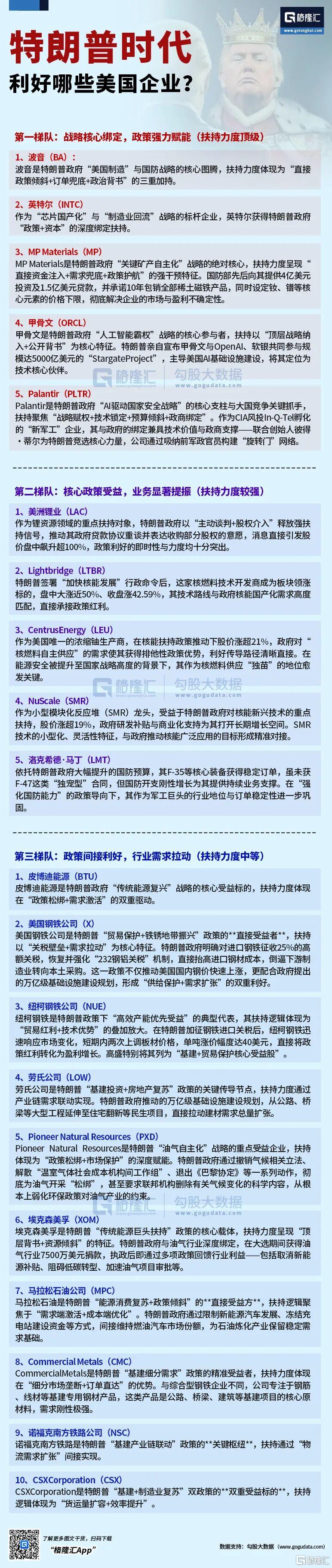
“特不靠谱”?他的产业棋局,正在一个个落地成金!
格隆汇APP· 2025-09-29 11:11
Core Viewpoint - The article emphasizes that Trump's industrial policies, once dismissed as mere rhetoric, have proven effective in reshaping the U.S. industrial landscape, creating significant investment opportunities in various sectors [2][10]. Group 1: Manufacturing and Defense - Trump's pressure on companies like Carrier and Intel to bring manufacturing back to the U.S. was initially ridiculed, but it has led to substantial investments and job creation in the semiconductor industry, with Intel's Arizona factory ramping up production [3][4]. - Boeing has secured hundreds of billions in contracts, demonstrating the effectiveness of Trump's defense policies and the importance of domestic manufacturing [4]. - The U.S. steel industry has benefited from tariffs on imported steel, with domestic steel prices rising and companies like U.S. Steel expanding operations, creating thousands of jobs [4][10]. Group 2: Strategic Resource Independence - The article highlights the rise of MP Materials as a key player in the rare earths sector, supported by government investments and contracts, showcasing the shift towards resource independence [5][6]. - The nuclear energy sector has seen significant growth, with companies like Centrus Energy and NuScale receiving government support, leading to stock price increases and project advancements [6][7]. - Palantir has experienced a dramatic increase in market value, reflecting its central role in the government's AI-driven national security strategy [7][10]. Group 3: Energy and Infrastructure - Trump's policies aimed at traditional energy have led to increased domestic oil production, with companies like ExxonMobil and Pioneer Natural Resources benefiting from regulatory rollbacks and increased market share [8][9]. - The infrastructure sector has seen a positive impact from Trump's $1 trillion infrastructure plan, with companies like Lowe's and Commercial Metals reporting significant revenue growth due to increased demand for construction materials [9][10]. Group 4: Key Beneficiary Companies - Palantir is identified as a core beneficiary of the AI-driven national security strategy, with strong government ties and significant budget allocations [13]. - MP Materials, Lightbridge, and Centrus Energy are highlighted as key players in the critical minerals and nuclear sectors, benefiting from government support and policy initiatives [14][15][16]. - U.S. Steel and Nucor Steel are recognized for their direct benefits from trade protection policies and increased domestic demand for steel [19][21].


These 3 Energy Stocks Have Turned Oil Pumps Into Money Printing Machines
Yahoo Finance· 2025-09-29 10:02
Group 1: ExxonMobil - ExxonMobil generated $11.5 billion in cash flow from operations during Q2, totaling $24.5 billion year-to-date, and is on track to produce nearly $50 billion in cash this year, down from $55 billion in 2024 due to lower oil and gas prices [3][4] - The company plans to invest $140 billion into major projects and its Permian Basin development program through 2030, which is expected to add another $30 billion to its annual cash flow, positioning Exxon to produce about $165 billion in cumulative surplus free cash during that period [4] - Exxon returned $18.4 billion in cash to investors in the first half of the year, including $8.6 billion in dividends and $9.8 billion in share repurchases, and expects to continue increasing its dividend and repurchase $20 billion of its stock annually in 2025 and 2026 [5] Group 2: Chevron - Chevron generated $8.6 billion in cash flow from operations and $4.9 billion of free cash flow in Q2, returning $5.5 billion to shareholders through dividends and share repurchases, marking the 13th consecutive quarter of returning at least $5 billion [6][9] - The company anticipates a larger free cash flow next year, expecting an additional $12.5 billion from completed expansion projects and the acquisition of Hess [7][8] - Chevron has increased its dividend for 38 consecutive years and plans to repurchase between $10 billion and $20 billion of its stock annually [9]

All It Takes Is $28,000 Invested in These 2 High-Yield Dividend Stocks and 1 ETF to Help Generate Over $1,000 in Passive Income Per Year
The Motley Fool· 2025-09-28 10:45
Core Insights - Generating dividend income from stocks is an effective strategy for passive income while remaining invested in the market, especially when the S&P 500 is experiencing significant returns [1][2] Group 1: Dividend Stocks - Investing $28,000 in equal parts of ExxonMobil, Whirlpool, and the Vanguard Utilities ETF can yield at least $1,000 in annual dividend income [3] - ExxonMobil has a strong history of dividend growth, having raised its payout for 42 consecutive years, with a current forward yield of 3.4% [5][6] - The company maintains a conservative payout ratio of 68% over the past five years, ensuring financial health while rewarding shareholders [7] Group 2: Whirlpool - The recent sell-off of Whirlpool stock following a Federal Reserve rate cut presents a buying opportunity, as lower rates typically benefit the company [10] - Whirlpool's competitive positioning is expected to improve due to tariffs on Asian competitors, which will favor domestic producers [12][13] - The stock offers a 4.7% dividend yield, making it attractive for both income-seeking and speculative investors [13] Group 3: Utilities Sector - The utility sector is currently outperforming the S&P 500, driven by steady cash flow and increasing power demands, particularly due to AI [14][21] - AI's demand for power is creating opportunities for utility companies, especially those with off-grid solutions [18][21] - The Vanguard Utilities ETF offers a low expense ratio of 0.09% and a 2.8% yield, making it a simple way to invest in the growing demand for power [22]

Exxon Mobil And Visa Among 16 Companies To Announce Annual Increases In October
Seeking Alpha· 2025-09-27 12:45
Group 1 - The article emphasizes the effectiveness of buying dividend growth stocks and reinvesting dividends as a strategy for long-term wealth growth [1] - The author has experience with various investment vehicles including stocks, options, ETFs, treasury notes, and mutual funds [1] - The blog HarvestingDividends.com focuses on providing information about S&P Dividend Aristocrats and other dividend growth stocks [1]