
Axis Bank

Search documents
Personal loan interest rates: Top 7 banks charge these rates in December 2025
MINT· 2025-12-01 09:35
Before you decide to raise a personal loan, it is recommended to compare the interest rates charged by different banks. These rates tend to change from time to time.-Notably, even a small difference of 50 basis points in interest rates on personal loans can lead to huge savings for investors over a period of time. For instance, a ₹10 lakh loan for 5 years can lead to savings of ₹14,711 when the interest is 9.5% (instead of 10%). The savings amount to ₹29,422 when the loan amount is ₹20 lakh with all other v ...


Capital Gains Account Scheme Deposits: Old rules, new updates
BusinessLine· 2025-11-29 14:41
Investing in properties is among the most preferred options across age groups in India. It is also common for holders of old or ancestral properties to sell their residence and use the proceeds to buy an apartment or a villa in gated communities. Many would also want to use the money to construct their own property. The sharp appreciation in real estate assets has given many the affordability to deploy the gains for moving to newer acquired residences.However, on the operational front it is not always easy ...

Active banking funds fail to capitalise on PSU rally: Value Research data
Rediff· 2025-11-29 09:22
Core Insights - Sectoral funds focused on public sector banks (PSBs) have outperformed other domestic mutual fund categories, achieving nearly a 28% rise in the Nifty PSU Bank index over the past six months [1][3] - Active banking and financial services funds have lagged behind, with median returns of only 9.2% during the same period, primarily due to their heavy investment in private sector lenders [3][4] Investment Composition - Most active banking and financial services (BFSI) funds allocate over 50% of their investments to the top 4-5 private sector banks, which dominate the banking sector's profit pool [4][6] - HDFC Bank, ICICI Bank, Axis Bank, and Kotak Mahindra Bank collectively account for 66% of the Nifty Financial Services index, while State Bank of India (SBI) is the only PSB with over 5% weight in the index [4][5] Performance Analysis - Despite the flexibility of active funds to build independent portfolios, their performance is still benchmarked against indices, leading to a performance gap with PSB indices [5][6] - Direct plans of BFSI schemes have generally outperformed the Nifty Financial Services total return index, which increased by 7.17% in the last six months [5] Market Outlook - Experts suggest that the performance gap between PSU and private sector banks may narrow in the near term, with private banks expected to outperform in the medium term due to their superior deposit franchises and operational efficiencies [7][8] - The rally in PSU banks may have peaked, with a potential sector rotation anticipated in 2026, as the Nifty PSU Bank index appears overextended after a multi-year rally [9]

无惧关税影响,印度三季度经济增长8.2%超预期
Hua Er Jie Jian Wen· 2025-11-28 13:02
印度经济在美国高额关税的阴影下展现出超预期韧性。 数据公布后,印度10年期国债收益率上涨4个基点至6.50%。不过多位专家警告,随着与美国的贸易谈 判悬而未决以及节日消费刺激效应减退,经济增长势头可能在未来几个季度放缓。 制造业和服务业驱动增长 数据显示,除消费外,强劲的经济表现主要由制造业部门主导,该部门同比增长9.1%。政府发布的声 明称,金融、房地产和专业服务在7月至9月期间"保持了可观的增长率",达到10.2%。 印度名义GDP——未剔除通胀或通缩因素——在9月当季增长8.7%,略低于前一季度的8.8%。上一季度 7.8%的实际增速曾因较低的平减指数而意外提振,平减指数衡量通胀如何影响总产出价值。 私人消费在本季度出现显著跳升,这主要归功于政府的刺激措施。据Axis Bank首席经济学家Neelkanth Mishra表示,9月季度的国内消费在商品服务税计划削减前"有所抑制",为后续反弹蓄积了动能。 10月份需求急剧回升,汽车和黄金销售创下纪录,商品服务税削减和此前个人所得税税率下调提升了民 众可支配收入。 面对美国8月生效的50%关税冲击,印度政府迅速推出应对措施。政府于9月22日宣布全面削减商品服 ...
Stock markets end flat in highly volatile trade
Rediff· 2025-11-28 11:53
Market Performance - Benchmark stock indices Sensex and Nifty closed almost unchanged in a highly volatile trade as investors remained cautious ahead of key macroeconomic data announcements [1] - The 30-share BSE Sensex slipped by 13.71 points or 0.02 percent to settle at 85,706.67, while the 50-share NSE Nifty skidded 12.60 points or 0.05 percent to 26,202.95 [2][3] - During the trading session, Sensex hit a high of 85,969.89 and a low of 85,577.82, gyrating 392.07 points [3] Investor Activity - Fresh foreign fund outflows and muted global market trends contributed to the rangebound nature of the stock markets [3] - Foreign Institutional Investors (FIIs) offloaded equities worth Rs 1,255.20 crore, while Domestic Institutional Investors (DIIs) bought stocks worth Rs 3,940.87 crore [5] Sector Performance - Among Sensex firms, Power Grid, Eternal, Bharti Airtel, Axis Bank, and Infosys were the biggest laggards [4] - Major gainers included Mahindra & Mahindra, Sun Pharma, Kotak Mahindra Bank, and State Bank of India [4] Global Market Trends - In Asian markets, South Korea's Kospi and Hong Kong's Hang Seng index settled lower, while Japan's Nikkei 225 index and Shanghai's SSE Composite index ended in positive territory [4] - Brent crude, the global oil benchmark, increased by 0.25 percent to $63.50 per barrel [5]

Sensex jumps 1,022.50 points; Nifty inches near record high
Rediff· 2025-11-26 11:38
Market Performance - The benchmark Sensex rebounded by 1,022.50 points or 1.21% to settle at 85,609.51, while Nifty increased by 320.50 points or 1.24% to end at 26,205.30, just 10 points shy of its all-time high [3][4] - In intra-day trade, Nifty surged 330.35 points or 1.27% to reach 26,215.15 [4] Investor Sentiment - Growing expectations of a US Federal Reserve rate cut in December, supported by recent US economic data indicating softening demand and cooling inflation, bolstered investor sentiment [7][10] - Increasing optimism regarding a potential truce between Russia and Ukraine also enhanced risk appetite among investors [9][10] Sector Performance - Market participation was broad-based, with metals, energy, and IT sectors leading the gains, while mid-cap and small-cap indices advanced over 1% [5][6] - Major gainers among Sensex firms included Bajaj Finserv, Bajaj Finance, Tata Steel, Reliance Industries, Sun Pharma, Tata Motors Passenger Vehicles, Axis Bank, and Infosys, while Bharti Airtel and Asian Paints were laggards [4][6] Foreign and Domestic Investment - Foreign Institutional Investors purchased equities worth ₹785.32 crore, while Domestic Institutional Investors bought stocks worth ₹3,912.47 crore [8] - The overall market sentiment improved globally, driven by expectations of a US Federal Reserve rate cut and a weaker dollar [8]

Prabhudas Lilladher hikes Nifty's 12-month target to 29,094 on 5 tailwinds. Picks HAL, ICICI and 16 more stocks to buy
The Economic Times· 2025-11-26 11:14
Core Viewpoint - Prabhudas Lilladher (PL) remains bullish on large-cap stocks, selecting 11 stocks to buy, while also identifying 7 mid and small-cap stocks, totaling 18 preferred picks [1][12]. Market Performance - Nifty has shown resilience over the past three months, trading at 26,175 with a gain of 290 points, needing to cover 90 points to surpass its lifetime high of 26,277 [2][14]. - The ongoing rally is attributed to strong corporate performance in 2QFY26, with sales, EBIDTA, and PAT growth of 8.1%, 16.3%, and 16.4% respectively, alongside an EPS upgrade for Nifty [3][14]. Economic Drivers - Economic momentum is expected to be driven by domestic demand, influenced by several factors: 1. Income tax rate cuts benefiting over 80% of individual taxpayers [6][14]. 2. Anticipated 100 basis points rate cut by the RBI to stimulate growth [6][7]. 3. Healthy rural incomes supported by a strong monsoon and robust harvests [9][14]. 4. Low inflation rates, with CPI at 1.7% for September and projected at 1% for the December quarter, enhancing real purchasing power [10][14]. 5. GST rationalization contributing to demand revival [11][14]. Banking Sector Outlook - Improvement in bank performance is expected, with Net Interest Margins (NIMs) having bottomed out and credit growth recovering from 9% to a projected 11-13% in the second half of the year [8][14]. - Benefits from lower interest rates are anticipated to reflect in liability repricing from 3Q26, with potential for an additional 25 basis points rate cut in FY26 [8][14]. Stock Recommendations - Preferred large-cap stocks include ITC, Larsen & Toubro (L&T), Mahindra & Mahindra (M&M), and others [12][14]. - Broader market picks include Ajanta Pharma, Fine Organic Industries, and Voltamp Transformers [12][14]. Government Capex Concerns - There is a potential cool-off in government capital expenditure, which has increased significantly since COVID, with a 40% rise in 1H capex possibly leading to a 10% year-over-year decline in 2H26 unless the government exceeds its capex allocation [12][14].

Sensex, Nifty jump 1% on global optimism, banks and metals lead broad market rally
BusinessLine· 2025-11-26 07:03
Market Overview - Domestic benchmark indices experienced a rally driven by strong global cues and improved investor sentiment, primarily due to rising expectations of a US Federal Reserve rate cut, which has enhanced risk appetite globally [1] - The Sensex rose by 850.49 points (1.01%) to 85,437.50, while the Nifty 50 increased by 272.40 points (1.05%) to 26,157.20, reflecting a mix of short-covering, sector rotation, and supportive technicals [2] Sector Performance - All sectoral indices showed positive movement, with banking and metal stocks leading the gains, while IT, realty, media, and oil & gas sectors also posted increases of over 1% [3][4] - The Nifty Bank index reached a record high of 59,515.30 during the session [3] Stock Performance - Top gainers in the Nifty 50 included JSW Steel, Adani Ports, HDFC Life, Bajaj Finance, Trent, and Bajaj Finserv, while Bharti Airtel was the only stock in negative territory [5] - Heavyweight stocks such as Reliance, MCX, Axis Bank, Canara Bank, and SBI reached their 52-week highs, indicating strong bullish activity [6] Midcap and Smallcap Indices - The midcap index saw gains led by HUDCO, SAIL, Paytm, Dixon Tech, and Suzlon, which rose by 3-4%, while some stocks like M&M Financial and Coromandel International faced declines [7] - In the smallcap segment, Natco Pharma and Reliance Power surged by 6-7%, while other stocks like MRPL and CreditAccess experienced declines of 1-3% [7]


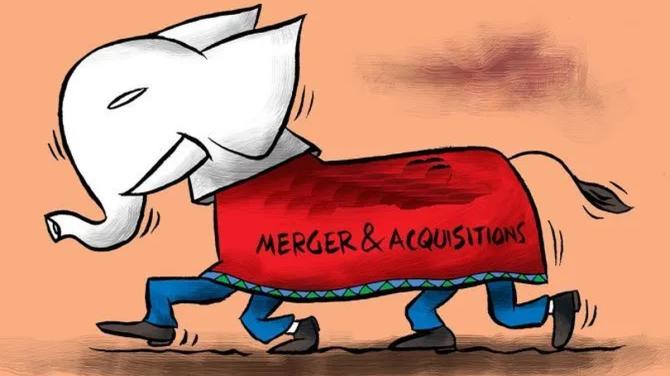
M&A financing the new frontier for banks, but RBI's watching
Rediff· 2025-11-26 06:39
Core Viewpoint - The Reserve Bank of India's cautious proposals on M&A funding for banks aim to balance risk management with the growing opportunities in the M&A space, which is expected to exceed $100 billion annually in India [4][5][16]. Group 1: M&A Market Dynamics - Domestic banks are now entering the M&A advisory space, traditionally dominated by foreign banks and shadow banks, indicating a shift in the competitive landscape [4][5]. - The aggregate acquisition finance exposure for banks is capped at 10% of their Tier-I capital, and financing can only cover up to 70% of the acquisition value [5][6][14]. - The net worth of the banking sector was over ₹27 trillion, allowing for available funds exceeding $30 billion for M&A financing under the proposed regulations [16]. Group 2: Regulatory Framework - The draft regulations propose a fixed debt-to-equity (D/E) ratio of 3:1, which some industry experts argue may not adequately reflect sector-specific nuances [8][13]. - There is a call for more flexibility in underwriting judgments based on individual deal characteristics rather than strict regulatory limits [9][12]. - The proposed regulations signal a cautious approach from the RBI, reflecting concerns about market risks and the need for robust governance in M&A transactions [12][22]. Group 3: Industry Perspectives - Industry leaders express a desire for more liberal financing norms to facilitate M&A activities, while also acknowledging the need for improved governance and oversight within banks [22][23]. - The potential for partnerships between state-run banks and established financial institutions is highlighted as a way to enhance M&A capabilities [19][21]. - Compensation structures for M&A professionals are expected to be significant, reflecting the specialized nature of the business and the competitive landscape for talent [18][20].
India spends big with credit cards in ecommerce, fest tango
The Economic Times· 2025-11-24 19:41
Core Insights - The festive season saw a significant boost in consumption due to GST rationalization, with credit card spending rising 19.6% year-on-year in October to ₹2.14 lakh crore, driven by strong e-commerce sales and festive purchases [8][6] - However, new credit card additions have slowed, with a drop to 6.27 lakh in October from 10.76 lakh in September, indicating a potential tapering off of festive momentum [8][7] - Private banks have strengthened their dominance in the credit card market, increasing their market share from 70.8% to 77.7%, while the share of other lenders has decreased from 29.2% to 22.3% [6][8] Credit Card Market Trends - New credit card originations have fallen 42% over eight quarters, from 76 lakh in Q2 FY24 to 44 lakh in Q2 FY26, highlighting a calibrated slowdown in acquisition [3][4] - Major issuers reported declines in net monthly additions, with HDFC Bank experiencing a 44% month-on-month decline, SBI Card down 26%, ICICI Bank down 46%, and Axis Bank down 25% [8][7] - The credit card market in India is highly consolidated, with the top four banks accounting for approximately 71% of all outstanding credit cards, around 77% of transaction volumes, and about 75% of transaction value [8][7] Customer Behavior and Asset Quality - New cards issued remain metro-centric, with private banks targeting higher-value customers, while asset quality pressures persist, with a portfolio-at-risk in the 31-180-day bucket at 4.1% [7][6] - The new-to-credit share has remained stable, indicating a maturing customer base, and there is a strategic shift towards driving higher spends from existing customers amid elevated delinquency concerns [7][6]