
LVMH

Search documents
新华财经晚报:2025年中国GDP跨越140万亿元关口
Xin Hua Cai Jing· 2026-01-19 15:21
Domestic News - In 2025, China's GDP is projected to reach 140,187.9 billion yuan, reflecting a growth of 5.0% year-on-year at constant prices. The primary industry is expected to contribute 93.3 billion yuan with a growth of 3.9%, the secondary industry 499.7 billion yuan with a growth of 4.5%, and the tertiary industry 808.9 billion yuan with a growth of 5.4% [1] - Fixed asset investment (excluding rural households) is forecasted to be 485.2 billion yuan, a decrease of 3.8% compared to the previous year. Excluding real estate development investment, the decline is 0.5%. Per capita disposable income is expected to be 43,377 yuan, with a nominal growth of 5.0% and an actual growth of 5.0% after adjusting for price factors. The total retail sales of consumer goods are projected to be 501.2 billion yuan, reflecting a growth of 3.7% [1] Real Estate Market - In December 2025, the sales prices of commercial residential properties in 70 large and medium-sized cities showed an overall month-on-month decline, with first-tier cities experiencing a 0.3% decrease in new residential property prices and a 0.9% decrease in second-hand residential property prices. Year-on-year, new residential property prices in first-tier cities fell by 1.7%, while second-hand prices dropped by 7.0% [2] International News - The international prices of gold and silver reached historical highs due to the U.S. government's imposition of tariffs on certain European countries. Gold prices exceeded $4,690 per ounce, and silver prices surpassed $94 per ounce [4] - European automotive stocks plummeted following President Trump's threat to impose tariffs on eight European countries, with significant declines in major manufacturers such as Mercedes-Benz (down 6.7%), BMW (down 7%), and Volkswagen (down 5.4%). Luxury goods stocks also fell, with LVMH down nearly 4% and Richemont down over 3% [4]


David Ponzo Named Deputy CEO at Tiffany & Co.
Yahoo Finance· 2026-01-19 13:30
Core Viewpoint - Tiffany & Co. has appointed David Ponzo as deputy chief executive officer, a role that expands his responsibilities to shape the brand's strategic priorities and oversee various commercial functions [1][2]. Group 1: Appointment and Role - David Ponzo takes over the duties of former chief commercial officer Gavin Haig, who retired in 2025 [2]. - In his new role, Ponzo will lead Tiffany's worldwide retail and corporate commercial organization, overseeing retail zones, client relations, digital and omnichannel strategies, and global servicing [2]. - He will also manage the jewelry and high jewelry product divisions and the newly created strategic business development function [2]. Group 2: Background and Experience - Ponzo joins Tiffany & Co. from Louis Vuitton, where he served as chief commercial officer for five years, focusing on local clientele and high-end product categories [3]. - His previous roles include president and CEO of Louis Vuitton Japan and senior leadership positions at Swatch Group and Omega in Asia [3]. Group 3: Management Strategy - The appointment aligns with a broader management fortification strategy at parent company LVMH, which has seen similar deputy CEO role additions at other brands like Louis Vuitton, Dior, and Bulgari [5]. - This strategy emphasizes promoting talent from within the company [5].
Here are the European exporters most exposed if Trump’s Greenland tariffs kick in
CNBC· 2026-01-19 10:53
Tariff Threats and Economic Impact - U.S. President Donald Trump has announced plans to impose 10% tariffs on several European countries, escalating to 25% by June 1, as part of a strategy to acquire Greenland [2] - European political leaders are preparing for emergency talks to discuss potential retaliatory measures and broader economic policies in response to the tariffs [3] Affected Sectors Automotive - The automotive sector is highly vulnerable to the proposed tariffs due to globalized supply chains and reliance on North American manufacturing [4] - Major European car manufacturers, including Volkswagen, BMW, and Mercedes-Benz, experienced stock declines of over 2.5% following the announcement [5] - The tariffs are expected to negatively impact Germany's economic outlook, which is heavily reliant on the automotive industry [7][8] Luxury Goods - Luxury stocks, previously insulated from trade tensions, are now facing potential declines due to the tariffs, particularly affecting French companies like LVMH and Kering [9] - Shares of LVMH and Kering fell approximately 3.5% and 2.6%, respectively, following the tariff threats [10] Pharmaceuticals - The pharmaceutical sector could see significant repercussions, as it represents the EU's largest export to the U.S., with exports valued at €84.4 billion ($98.1 billion) in the first three quarters of the previous year [11] - Major pharmaceutical companies, including Novo Nordisk, Roche, and Sanofi, experienced slight declines in stock prices due to the tariff threats [12] Energy - The energy sector may be indirectly affected by the tariffs, with concerns over weaker global demand and lower crude prices impacting stock performance [13] - Energy stocks like Equinor, TotalEnergies, Shell, and BP saw declines ranging from 1% to 3.4% following the announcement [14] Broader Economic Implications - Analysts predict that the tariffs will have a widespread impact across various sectors, affecting oil prices, commodity prices, equity markets, and debt markets [16]


LVMH在德国Tradegate平台下跌4.4%
Mei Ri Jing Ji Xin Wen· 2026-01-19 06:55
每经AI快讯,1月19日,LVMH在德国Tradegate平台下跌4.4%。 ...
可选消费W03周度趋势解析:美联储独立性和未来货币政策稳定性的担忧和要求设置信用卡利率上限,本周海外消费集体下挫-20260118
Haitong Securities International· 2026-01-18 14:35
Investment Rating - The report assigns an "Outperform" rating to multiple companies including Nike, Midea Group, JD Group, and Anta Sports, among others [1]. Core Insights - Concerns regarding the independence of the Federal Reserve and future monetary policy stability have led to a collective decline in overseas consumer sectors [4][11]. - The snack sector has shown resilience, outperforming the MSCI China index, while other sectors such as luxury goods and overseas sportswear have faced significant declines [4][11]. - The report highlights that most sectors are currently undervalued compared to their historical averages, indicating potential investment opportunities [9][15]. Sector Performance Summary - **Snack Sector**: Increased by 1.7%, with Wei Long's revenue guidance for 2026 projected to grow over 15% due to innovative products and channel expansion [6][14]. - **Jewelry Sector**: Rose by 1.6%, driven by Chow Tai Fook's strong operational performance expectations for FY26Q3 [6][14]. - **Overseas Cosmetics**: Gained 1.1%, with E.L.F Beauty's sales growth exceeding previous guidance [6][14]. - **Domestic Sportswear**: Increased by 1.5%, with Li Ning's revenue meeting expectations and a positive outlook for net profit margins [8][14]. - **Pet Sector**: Grew by 0.3%, with strong annual growth despite a slight decline in December [8][14]. - **Gambling Sector**: Slight decline of 0.1%, with Galaxy Entertainment showing resilience as a preferred investment choice [8][14]. - **Domestic Cosmetics**: Decreased by 0.3%, with expectations for recovery in 2026 [8][14]. - **Retail Sector**: Fell by 1.5%, with Target's positive leadership changes noted [8][14]. - **Luxury Goods**: Declined by 2.9%, impacted by market concerns over credit risks following Saks Global's bankruptcy [8][14]. - **Overseas Sportswear**: Experienced a significant drop of 4.0%, with major brands like Nike and Adidas facing declines [8][14]. - **Credit Card Sector**: Decreased by 5.1%, influenced by proposed caps on credit card interest rates [8][14]. Valuation Analysis - The report indicates that the expected PE ratios for various sectors in 2025 are below their historical averages, suggesting potential undervaluation: - Overseas Sportswear: 30.4x (57% of historical average) - Domestic Sportswear: 13.5x (71% of historical average) - Jewelry: 22.8x (43% of historical average) - Luxury Goods: 27.4x (49% of historical average) - Gambling: 16.2x (26% of historical average) - Overseas Cosmetics: 41.0x (61% of historical average) - Domestic Cosmetics: 27.3x (51% of historical average) - Pet Sector: 36.9x (50% of historical average) - Snack Sector: 29.8x (72% of historical average) - Retail: 29.9x (54% of historical average) - US Hotels: 34.8x (21% of historical average) - Credit Cards: 28.3x (54% of historical average) [9][15].
诺和诺德美股股价暴涨,公司减肥口服药在美开局稳健
Feng Huang Wang· 2026-01-16 23:32
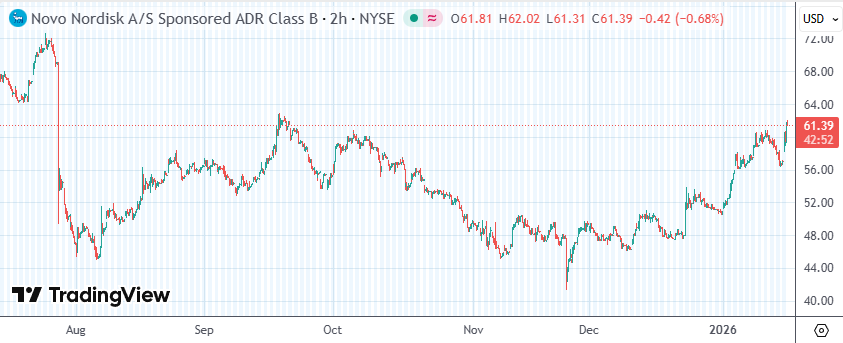
Group 1 - Novo Nordisk's stock surged by 8% on January 16, reaching a peak of $62.02, the highest level since September of the previous year, with a market capitalization of $273.5 billion [1] - The early prescription data for Novo Nordisk's newly launched oral GLP-1 medication for obesity shows promising results, with approximately 3,100 prescriptions in the first week [3] - Comparatively, Eli Lilly's injectable weight loss drug Zepbound garnered about 1,900 prescriptions in its first full week post-launch, indicating a strong start for Novo Nordisk's oral medication [3] Group 2 - Analysts caution that more data is needed to fully assess the early demand for the Wegovy oral medication [4] - The direct sales channel is expected to have significant potential for promoting the oral medication, and analysts are eager to see its complete performance [5] - The weight loss and diabetes medication market is experiencing rapid growth, with Eli Lilly holding a significant market share and preparing to launch its own oral obesity medication [6] Group 3 - The demand landscape may change in the coming months with the anticipated market entry of Eli Lilly's oral drug orforglipron [7] - Although Novo Nordisk currently has a first-mover advantage, its peptide-based medication has dietary restrictions that may affect user acceptance [7] - In contrast, Eli Lilly's drug is a small molecule compound, which does not have the same dietary limitations [8]
Major European Markets Close Slightly Weak
RTTNews· 2026-01-16 18:40
Market Overview - Major European markets closed lower due to geopolitical tensions and uncertainty surrounding French budget negotiations, with investors taking profits from recent gains [1][2] - The pan-European Stoxx 600 edged down 0.03%, with the U.K.'s FTSE 100 down 0.04%, Germany's DAX down 0.22%, and France's CAC 40 down 0.65% [3] Company Performance - In the UK market, BAE Systems, Natwest Group, Smiths Group, Schroders, National Grid, Standard Chartered, British Land Company, and The Sage Group gained between 1.4% to 2.3% [4] - Conversely, Pearson, Metlen Energy & Metals, Entain, Antofagasta, Endeavour Mining, Glencore, Anglo American Plc., and Pershing Square Holdings lost between 2% to 4% [4] - Daimler Truck Holding reported a decline in 2025 sales, contributing to its stock decline [5] - Siemens Energy saw a significant increase of over 5%, while Zalando, RWE, and Fresenius Medical Care gained between 1.5% to 1.7% [6] Notable Transactions - Kloeckner & Co shares soared over 28% following Worthington Steel's announcement of a $2.4 billion acquisition of the German steel processor [6] French Market Insights - In the French market, Kering and Essilor closed down by 4.7% and 4%, respectively, while LVMH, Stellantis, TP, and Renault lost between 2.7% to 3.1% [6][7]

What Went Wrong At Saks Global?
Seeking Alpha· 2026-01-15 12:30
Company Overview - Saks Global, the luxury retailer behind brands like Saks Fifth Avenue, Neiman Marcus, and Bergdorf Goodman, has filed for Chapter 11 bankruptcy due to difficulties in paying debts amid financial challenges [4] - The company has secured $1.75 billion in committed capital to support its restructuring efforts [4] Market Context - The luxury retail market experienced a surge post-pandemic, but inflation and rising interest rates have restricted the customer base to ultra-wealthy consumers [4] - Major fashion houses are increasingly bypassing traditional retailers by establishing their own boutiques and online platforms, which has intensified competition for Saks Global [4] Strategic Moves - Hudson's Bay, the Canadian owner of Saks, made a significant move by acquiring Neiman Marcus for $2.7 billion to consolidate the luxury market under Saks Global [5] - The integration of Neiman Marcus into Saks Global faced challenges, including funding issues and limited growth potential due to customer overlap [5] Competitive Landscape - Bloomingdale's, owned by Macy's, reported its best sales growth in three years by maintaining a strong balance sheet and pivoting to smaller stores with curated inventory [5] - Nordstrom has successfully maintained supplier relationships and improved cash flow through its off-price division, Nordstrom Rack, while also going private to focus on long-term strategies [5] Creditors and Stakeholders - Key creditors of Saks Global include luxury brands Kering and LVMH, while equity shareholders include Amazon, Salesforce, and G-III Apparel [6]

Can Saks’ new CEO repair the damage done to the luxury retailer by years of being treated as a ‘financial plaything’?
Yahoo Finance· 2026-01-15 08:00
For the second time in his career, luxury executive Geoffroy van Raemdonck has been tasked with fixing an iconic department store company brought low by financial engineering. In 2018, he was hired to fix Neiman Marcus Group, which was struggling to to keep up with shifting consumer trends and unprofitable under the weight of heavy debt from years of private equity ownership. This time, the job is twice as big. On Tuesday, Van Raemdonck was appointed CEO of Saks Global, the same day as the luxury departm ...
Factbox-What Saks Global's bankruptcy filing reveals about its assets, creditors, financing
Yahoo Finance· 2026-01-14 13:32
Jan 14 (Reuters) - High-end department store conglomerate Saks Global filed for bankruptcy protection late on Tuesday, barely a year after a deal that aimed to create a luxury powerhouse. One of the largest retail collapses since the pandemic, the development casts uncertainty over the future of U.S. luxury fashion. Here are some key details of Saks' Chapter 11 court filing listed below: ASSETS AND LIABILITIES: Saks Global listed its estimated assets and liabilities in the range of $1 billion to $1 ...