
京东方

Search documents
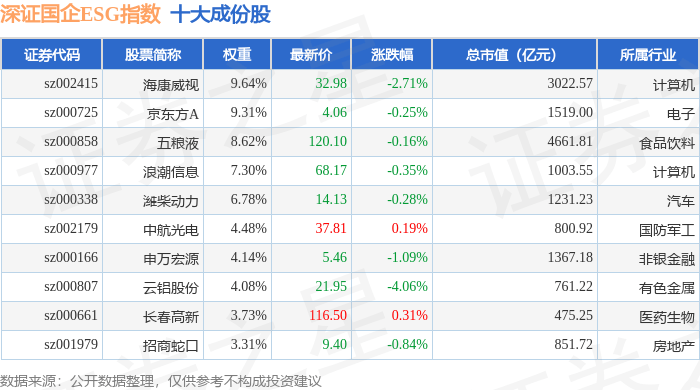
10月28日深证国企ESG(970055)指数跌0.5%,成份股云铝股份(000807)领跌
Sou Hu Cai Jing· 2025-10-28 12:22
Core Points - The Shenzhen State-owned Enterprise ESG Index (970055) closed at 1406.55 points, down 0.5%, with a trading volume of 38.737 billion yuan and a turnover rate of 1.15% [1] - Among the index constituents, 20 stocks rose while 29 stocks fell, with Zhongtung High-tech leading the gainers at a 10.02% increase, and Yun Aluminum leading the decliners with a 4.06% drop [1] Index Constituents Summary - The top ten constituents of the Shenzhen State-owned Enterprise ESG Index are as follows: - Hikvision (sz002415): Weight 9.64%, Latest Price 32.98, Change -2.71%, Market Cap 302.257 billion yuan, Industry: Computer [1] - BOE Technology Group (sz000725): Weight 9.31%, Latest Price 4.06, Change -0.25%, Market Cap 151.9 billion yuan, Industry: Electronics [1] - Wrigley (sz000858): Weight 8.62%, Latest Price 120.10, Change -0.16%, Market Cap 466.181 billion yuan, Industry: Food & Beverage [1] - Inspur Information (sz000977): Weight 7.30%, Latest Price 68.17, Change -0.35%, Market Cap 100.355 billion yuan, Industry: Computer [1] - Weichai Power (sz000338): Weight 6.78%, Latest Price 14.13, Change -0.28%, Market Cap 123.123 billion yuan, Industry: Automotive [1] - AVIC Optoelectronics (sz002179): Weight 4.48%, Latest Price 37.81, Change 0.19%, Market Cap 80.092 billion yuan, Industry: Defense [1] - Shenwan Hongyuan (sz000166): Weight 4.14%, Latest Price 5.46, Change -1.09%, Market Cap 136.718 billion yuan, Industry: Non-banking Financial [1] - Yun Aluminum (sz000807): Weight 4.08%, Latest Price 21.95, Change -4.06%, Market Cap 76.122 billion yuan, Industry: Non-ferrous Metals [1] - Changchun High-tech (sz000661): Weight 3.73%, Latest Price 116.50, Change 0.31%, Market Cap 47.525 billion yuan, Industry: Pharmaceuticals [1] - China Merchants Shekou (sz001979): Weight 3.31%, Latest Price 9.40, Change -0.84%, Market Cap 85.172 billion yuan, Industry: Real Estate [1] Capital Flow Analysis - The index constituents experienced a net outflow of 989 million yuan from institutional investors, while retail investors saw a net inflow of 1.076 billion yuan [1] - The detailed capital flow for selected stocks includes: - Zhongtung High-tech: Net inflow from institutions 509 million yuan, net outflow from retail -239 million yuan [2] - China National Materials: Net inflow from institutions 179 million yuan, net outflow from retail -176 million yuan [2] - Changchun High-tech: Net inflow from institutions 27.645 million yuan, net outflow from retail -130.24 million yuan [2]


西安奕材首秀盘中暴涨360%,京东方创始人王东升再布资本“棋局”
Huan Qiu Lao Hu Cai Jing· 2025-10-28 12:21
Core Insights - Xi'an Yicai successfully listed on the Shanghai Stock Exchange's Sci-Tech Innovation Board on October 28, with its stock price soaring by 361.48% at the opening and closing at a 198.72% increase, reaching a market capitalization of 104 billion yuan [1][3] - The company is recognized as the largest 12-inch silicon wafer manufacturer in mainland China and the sixth globally, based on average monthly shipment volume and production capacity by the end of 2024 [3][4] - Xi'an Yicai is the first company to successfully go public on the Sci-Tech Innovation Board under the new "eight measures" policy while still being unprofitable [1][4] Company Overview - Xi'an Yicai's IPO price was set at 8.62 yuan per share, with a total issuance of 53.78 million shares, raising approximately 4.636 billion yuan, making it the second-largest IPO of the year [3] - The company's main business focuses on the research, production, and sales of 12-inch silicon wafers, with a projected production capacity of 710,000 wafers per month by the end of 2024 [3][4] - The first manufacturing base is located in Xi'an, with the first factory reaching production capacity in 2023 and a second factory expected to commence production in 2024 [3] Financial Performance - Xi'an Yicai has shown rapid revenue growth but has not yet achieved profitability, with revenues of 1.055 billion yuan in 2022, projected to reach 2.121 billion yuan in 2024 [4] - The company reported a net loss of 4.12 billion yuan in 2022, with cumulative losses of approximately 2.216 billion yuan over three and a half years [4] - For the first three quarters of 2025, revenue is expected to be between 1.930 billion and 2.029 billion yuan, reflecting a year-on-year growth of 34.61% to 41.51% [4] Leadership and Background - Wang Dongsheng, known as the "father of China's semiconductor display industry," is a key figure behind Xi'an Yicai's rapid rise, having previously founded BOE Technology Group [1][5] - After retiring from BOE in 2019, Wang initiated a second entrepreneurial venture with the establishment of Xi'an Yicai and other subsidiaries under the Yiswei Group [5][6] - Wang currently holds approximately 3.65% of Xi'an Yicai's shares, valued at around 3.796 billion yuan [7] Investment and Support - Xi'an Yicai has attracted significant investment, with over 60 venture capital and private equity firms backing the company since its inception [9] - The company has completed multiple financing rounds, including a 3 billion yuan Series B round in July 2021 and a nearly 4 billion yuan Series C round in December 2022 [9] - Notably, the Shaanxi Integrated Circuit Fund has been a crucial early investor, supporting the construction of Xi'an Yicai's first factory [10]
新益昌:公司积极推进产业结构升级战略
Zheng Quan Ri Bao Wang· 2025-10-28 10:40
Core Viewpoint - The company is actively promoting an industrial structure upgrade strategy, focusing on core areas such as semiconductor and new display packaging technology [1] Group 1: Company Strategy - The company is concentrating resources on semiconductor and new display packaging technology [1] - The company is recognized as a leading domestic enterprise that has developed intelligent manufacturing equipment for Mini LED production [1] Group 2: Industry Position - The technical indicators of the company's related equipment are at the industry-leading level [1] - The company has received recognition from major industry players including BOE, TCL, Samsung, Zhouming Technology, Leyard, and Huike [1] Group 3: Future Outlook - The company advises stakeholders to pay attention to its upcoming regular reports for specific operational details in the third quarter [1]

面向未来打造超高清视听高质量发展的“北京样本”
Bei Jing Ri Bao Ke Hu Duan· 2025-10-28 10:24
Core Insights - The National Radio and Television Administration has designated 2025 as the "Year of Ultra-High Definition Development," with Beijing leading the implementation of the Ultra-High Definition Audio-Visual Pioneer Action Plan, which has been included in the "Top Ten Major Events for National Cultural Center Construction in 2024" [1] Group 1: Policy and Initiatives - Beijing has launched the Ultra-High Definition Audio-Visual Pioneer Action Plan, aiming to establish an international first-class digital audio-visual production center, supported by over ten policy documents to clarify development paths and directions [3] - The city has set up the first national fund to support the development of the ultra-high definition audio-visual industry, providing funding for 159 quality projects in 2024, with a total of 1.45 billion yuan allocated, leveraging nearly 5 billion yuan in social investment and generating over 30 billion yuan in economic benefits [3] Group 2: Industry Progress - The total revenue from broadcasting and online audio-visual services in Beijing reached 287.33 billion yuan in the first half of 2025, marking an 11.41% year-on-year increase and accounting for 41.74% of the national total [3] - The number of licensed broadcasting program production entities in Beijing has reached 17,701, representing one-third of the national total, with significant advancements in ultra-high definition content production [5] Group 3: Technological and Application Developments - A "chip-screen-end-cloud" innovation matrix has formed, with companies like BOE and New Outer continuously advancing technology, resulting in 162 technological achievements and the mass production of the sixth-generation semiconductor display devices [6] - The application scenarios for "Ultra-High Definition+" are expanding across various fields, including culture, education, and performing arts, with notable projects like the 13K3D digital experience space and live transmissions of top performances to over 80,000 audiences nationwide [6] Group 4: Future Plans - The city aims to enhance its competitive edge in innovation, focusing on breakthroughs in key technologies such as video compression coding, and plans to have over 65% of new programs on major online platforms be ultra-high definition by 2027 [7] - Future initiatives will include creating a vibrant talent hub and establishing Beijing as a key global center for collaboration and development in the ultra-high definition audio-visual industry [7]
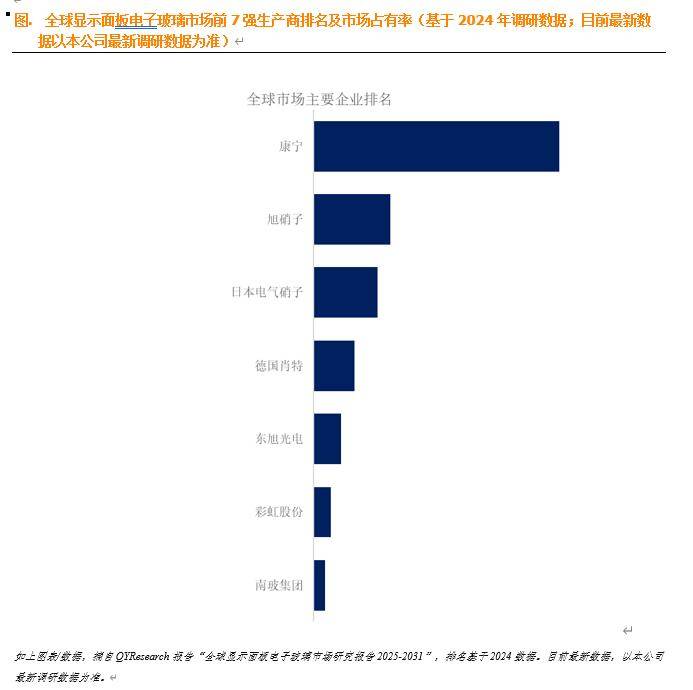
全球市场显示面板电子玻璃市场份额预测
Sou Hu Cai Jing· 2025-10-28 09:11
Core Insights - The display panel electronic glass market is projected to exceed $20.527 billion by 2031, with a stable CAGR of 4.7% from 2024 to 2031, driven by the upgrade of consumer electronics and the acceleration of emerging display technologies [1][5] Market Overview - The global display panel electronic glass industry is highly concentrated, with the top three companies holding approximately 84.6% of the market share in 2024, including Corning, Asahi Glass, and NEG [5] Industry Structure - The supply chain of the display panel electronic glass industry is tightly integrated, with significant differences in technical requirements and value distribution across various stages [6] - The upstream focuses on high-purity materials, while the midstream involves critical manufacturing processes requiring high precision and quality control [6][7] Application and Demand - The downstream applications include a diverse customer base, with glass substrates accounting for over 60% of the market share, followed by cover glass at around 30% [7] - Demand in the high-end market is driven by the need for precision and strength, while the mid-low end market emphasizes cost control and stable supply [7][8] Policy Environment - Various countries have included the display industry in strategic emerging industries, promoting development through supportive policies, particularly in China, Korea, and Japan [8] Future Opportunities - Future growth opportunities in the display panel electronic glass industry will focus on the proliferation of high-end display technologies and the expansion of application scenarios, such as automotive displays and smart home devices [8]

Q3’25 国内TFT-LCD面板厂平均稼动率高于预期,Q4'25 预计低于80%
CINNO Research· 2025-10-28 08:29
Core Insights - The average utilization rate of domestic TFT-LCD panel manufacturers in China for Q3 2025 exceeded expectations, while the forecast for Q4 2025 is expected to be below 80% [2]. Group 1: Production Capacity - The latest production capacity lists for China's G4.5 to G6 LCD panel production lines are provided [3]. - The latest production capacity lists for China's G8.5 to G11 LCD panel production lines are included [3]. Group 2: Utilization Rates - The average utilization rate statistics for China's LCD production lines in Q3 2025 are detailed [3]. - The utilization rate statistics for LTPS LCD panel production lines in Q3 2025 are presented [3]. - The utilization rate statistics for BOE (京东方) LCD panel production lines in Q3 2025 are reported [3]. - The utilization rate statistics for CSOT (华星光电) LCD panel production lines in Q3 2025 are included [3]. - The utilization rate statistics for TM (天马) LCD panel production lines in Q3 2025 are provided [3]. - The utilization rate statistics for HK C (惠科) LCD panel production lines in Q3 2025 are detailed [3]. - The utilization rate statistics for CHOT (咸阳彩虹) LCD panel production lines in Q3 2025 are included [3]. Group 3: Future Predictions - The forecast for global and domestic LCD panel manufacturers' utilization rates for Q4 2025 is discussed [3].
年产2000万片,福建这个液晶显示屏项目主体封顶
WitsView睿智显示· 2025-10-28 07:51
Core Viewpoint - The construction of a liquid crystal display (LCD) and capacitive touch screen manufacturing base is progressing rapidly, with all three main buildings having been topped out. The project aims to enhance the regional electronic information industry's comprehensive supporting capabilities and promote the development of the upstream and downstream industrial chains [2][3]. Group 1: Project Overview - The LCD and capacitive touch screen manufacturing base covers an area of 22.9 acres, with a total construction area of approximately 50,000 square meters. It will consist of two factory buildings and one auxiliary building [3]. - The project will feature three production lines for LCDs and touch screens, 20 automatic PIN production lines, 20 COG module production lines, 10 backlight production lines, and SMT binding and assembly lines, with an expected annual production capacity of 20 million LCDs [3]. Group 2: Project Timeline and Impact - The project has officially entered the masonry construction phase, with plans to increase investment and complete all structural tasks by the end of the year, aiming for successful completion inspection by July next year [3]. - Once fully operational, the project is expected to significantly enhance the region's electronic information industry and stimulate the gathering of related industrial chains [3]. Group 3: Export Performance - In the first eight months of this year, Fujian Province's flat panel display module exports reached 15.01 billion yuan, representing a year-on-year increase of 14.7% [5]. - Notably, exports to ASEAN amounted to 5.08 billion yuan, up 34.9%, with Vietnam and Thailand seeing exports of 3.09 billion yuan and 1.5 billion yuan, reflecting year-on-year growth of 57.8% and 9%, respectively [5]. - Exports to Latin America reached 2.71 billion yuan, a significant year-on-year increase of 90.6%, with exports to Mexico alone totaling 2.04 billion yuan, marking a remarkable growth of 111.1% [5].

全球四条8.6代OLED线投产时间预测出炉
WitsView睿智显示· 2025-10-28 07:51
Core Viewpoint - The global IT OLED panel market is entering a phase of diverse investment plans, with major players like Samsung Display, BOE, Visionox, and TCL Huaxing launching their 8.6-generation OLED production lines, indicating a competitive landscape ahead [2][5][6][7][9]. Group 1: Samsung Display - Samsung Display initiated its 8.6-generation line investment in 2023, utilizing traditional FMM evaporation technology and planning to incorporate Tandem OLED processes to enhance screen longevity. The equipment installation is complete, and products are expected to be introduced in the new MacBook Pro series by Apple in 2026, with mass production anticipated in Q2 2026 [5]. Group 2: BOE - Following Samsung, BOE announced its 8.6-generation OLED line investment by the end of 2023, also employing FMM evaporation technology and Tandem OLED configurations. Equipment installation is set to be completed gradually starting from Q2 2025, with production expected to commence in the first half of 2026 [6]. Group 3: Visionox - Visionox is entering the FMM-free camp with its self-developed ViP (Visionox Intelligent Pixelization) technology, which promises higher pixel density and aperture ratio compared to traditional FMM. The company plans to establish its 8.6-generation OLED line by Q2 2024, aiming for completion of the facility by Q4 2025 and volume production to start in Q1 2027 [7]. Group 4: TCL Huaxing - TCL Huaxing is adopting inkjet printing (IJP) technology, which simplifies the process compared to traditional FMM and theoretically reduces material waste by about 30%. Following the groundbreaking ceremony for its 8.6-generation OLED line, TCL Huaxing targets volume production by Q4 2027 [9]. Group 5: Market Dynamics - The investment plans for both FMM and non-FMM generation lines are proliferating, indicating a competitive environment in the IT OLED panel supply chain. The FMM camp benefits from established customer relationships and production experience, while the non-FMM camp, despite facing challenges like lower yield rates and material development, has the potential to catch up due to high market interest [9].




【会议预告】TCL华星 陈麟:发挥技术创新优势,赋能MLED价值提升
WitsView睿智显示· 2025-10-28 07:51
Core Viewpoint - The article highlights the upcoming 2025 Self-Luminous Display Industry Seminar organized by TrendForce's LEDinside and Display divisions, focusing on technological innovations in MLED (Mini LED) to enhance value [2][3]. Group 1: Event Details - The seminar is scheduled for October 30, 2025, from 8:30 AM to 5:00 PM at JW Marriott Hotel in Shenzhen, Futian District [10]. - The event aims to gather industry experts for in-depth discussions and to align on future directions in the display technology sector [7]. Group 2: Speaker Information - Chen Lin, the LED Display R&D Director at TCL Huaxing, will present on leveraging technological innovation to enhance MLED value [3][6]. - Chen Lin has extensive experience in the LED display industry since 2007 and has focused on Mini LED direct display technology and reliability since 2017 [6]. Group 3: Supporting Organizations - The seminar is supported by various industry players, including Abyen, BOE, and TCL Huaxing, among others [11].

TrendForce:IT OLED面板大世代竞争升温 FMM阵营领跑、FMM-free阵营加速推进
智通财经网· 2025-10-28 06:24
Group 1 - The global IT OLED panel investment landscape is entering a phase of diversification, with both FMM and non-FMM camps planning significant investments in large-generation production lines [1] - The FMM camp benefits from strong customer relationships and production experience, while the non-FMM camp, including technologies like ViP and IJP, faces challenges such as low yield rates and material development [1] - Samsung Display Corporation (SDC) is a market leader, having initiated the 8.6-generation OLED production line investment using traditional FMM deposition processes [2] Group 2 - SDC plans to introduce Tandem OLED processes to enhance screen longevity, with products expected to be integrated into the new MacBook Pro series by 2026 [2] - BOE has also announced its 8.6-generation OLED production line investment, adopting FMM deposition and Tandem OLED technology, with production expected to commence in the first half of 2026 [2] - Visionox is developing its 8.6-generation OLED production line using its proprietary ViP technology, aiming for mass production to start in Q1 2027 [3] Group 3 - TCL CSOT is utilizing inkjet printing (IJP) technology for its 8.6-generation OLED production line, which is expected to reduce material waste by approximately 30% [3] - TCL CSOT's production line is targeted to begin mass production in Q4 2027 following the recent groundbreaking ceremony [3]