
OPPO

Search documents
IDC:三季度中国智能手机出货量约6840万台,同比下降0.6%
Bei Jing Shang Bao· 2025-10-15 01:32
北京商报讯(记者 陶凤 王天逸)10月15日,IDC发布中国季度手机市场跟踪报告显示,2025年第三季 度中国智能手机出货量约6840万台,同比下降0.6%,延续下降趋势。 从厂商表现来看,前五大智能手机厂商中,vivo以11.8百万台的出货量、17.3%的市场份额位居第一, 但出货量同比下降7.8%;苹果出货量10.8百万台,市场份额15.8%,出货量同比增长0.6%;华为出货量 10.4百万台,市场份额15.2%,出货量同比下降1.0%;小米出货量10.0百万台,市场份额14.7%,出货量 同比下降1.7%;OPPO和荣耀并列第五,OPPO出货量9.9百万台,市场份额14.5%,出货量同比增长 0.4%;荣耀出货量9.8百万台,市场份额14.4%,出货量同比下降2.1%。此外,其他品牌出货量5.6百万 台,市场份额8.2%,出货量同比增长21.5%。 IDC表示,该季度属于传统手机销售淡季,新品发布数量较少,且"国补"政策收紧,消费者消费更趋理 性。随着9月中下旬各品牌大量年度旗舰新品提前集中上市,市场表现或于下季度初期有所改善,但即 便后续有"双十一"大促,也难以大幅激发消费需求。未来厂商竞争将更激烈, ...
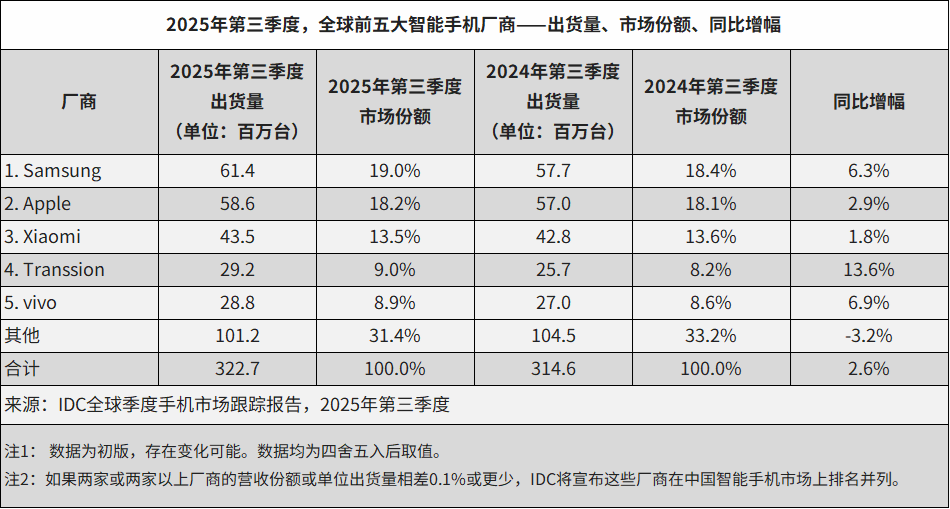
IDC:三季度全球智能手机出货量达3.227亿部 同比增长2.6%
Zhi Tong Cai Jing· 2025-10-14 23:20
Core Insights - The global smartphone market is experiencing a recovery, with Q3 2025 shipments reaching 322.7 million units, a 2.6% year-on-year increase driven by high-end market demand and innovative AI smartphones [1][2][3] Market Performance - Samsung and Apple are leading the high-end market, with Samsung shipping 61.4 million units (19.0% market share) and Apple 58.6 million units (18.2% market share) in Q3 2025, both showing significant year-on-year growth [4] - Xiaomi, Transsion, and vivo also reported notable growth, with Xiaomi shipping 43.5 million units (13.5% market share) and Transsion achieving a 13.6% year-on-year increase [4][3] Regional Insights - In China, the smartphone market saw a slight decline, with total shipments of 68.4 million units in Q3 2025, down 0.6% year-on-year, attributed to seasonal sales trends and tightening government subsidies [5] - Vivo led the Chinese market with 11.8 million units (17.3% market share), while Apple and Huawei followed closely [5] Future Outlook - IDC maintains an optimistic outlook for the smartphone market in 2025, expecting continued growth driven by strong promotional activities and a diverse product lineup from major manufacturers [3][2]





价格战背后是手持影像市场突围战
Mei Ri Shang Bao· 2025-10-14 23:13
Core Insights - DJI has initiated a price reduction campaign for its products, including the Osmo Pocket 3, which has seen a price drop of 900 yuan, leading to significant consumer reactions and discussions about price protection rights [1][2][3] - Despite DJI's claim that this is a routine promotional activity, the company is facing declining market share and increasing competition in the handheld imaging market [1][4] Market Reaction - The price drop has led to a surge in sales, with products like the Osmo Mobile 6 and Osmo Pocket 3 topping sales charts on platforms like JD and Tmall [2][3] - Consumers have expressed mixed feelings, with some feeling "betrayed" by the rapid price drop shortly after their purchases, while others have seized the opportunity to buy at lower prices [2][3] Sales Channels - Increased foot traffic has been reported in DJI's physical stores, although there are discrepancies in after-sales service between online and offline channels [3] - DJI's customer service has clarified that all purchases from official stores come with a 7-day price protection policy, with options for returns and re-purchases within 30 days [3] Competitive Landscape - DJI's market position is under pressure, with its share dropping from 19.1% to 13.2% as competitors like Insta360 gain ground, increasing their share from 28.4% to 35.6% [4] - The entry of smartphone manufacturers into the handheld gimbal market poses a significant threat, as they can leverage existing resources and offer seamless integration with mobile devices [5] Strategic Implications - The price reduction is seen as a dual strategy: clearing inventory ahead of the anticipated launch of the Osmo Pocket 4 and countering competition from brands like Insta360 [4] - Analysts suggest that DJI must address its ecological shortcomings, either by developing its own software ecosystem or collaborating with smartphone manufacturers to remain competitive in the evolving market [5]
中国拒接美国电话原因找到了!外贸稳得很,加关税威胁毫无效果
Sou Hu Cai Jing· 2025-10-14 19:28
Group 1 - China's tightening of rare earth export controls has led to a significant escalation in international dynamics, with the U.S. attempting to communicate with China but failing to establish a dialogue [1] - The U.S. President's strong reactions indicate the credibility of the situation, reflecting his frustration with China's non-responsive stance [3] - Despite the U.S. imposing high tariffs on Chinese imports, China's exports have shown resilience, achieving growth against the odds [8][11] Group 2 - China's exports to ASEAN and the EU have been particularly strong, compensating for declines in exports to the U.S. due to tariffs [10] - Emerging markets, especially Africa, present substantial opportunities for Chinese products, with Chinese brands dominating the smartphone market [10] - The dual strategy of rare earth export controls and robust foreign trade resilience provides China with a significant buffer against U.S. trade pressures [11]

当手机卷成相机 vivo、OPPO对标增距镜
Bei Jing Shang Bao· 2025-10-14 15:47
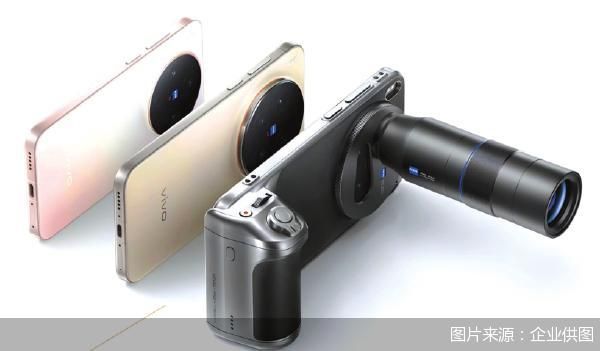
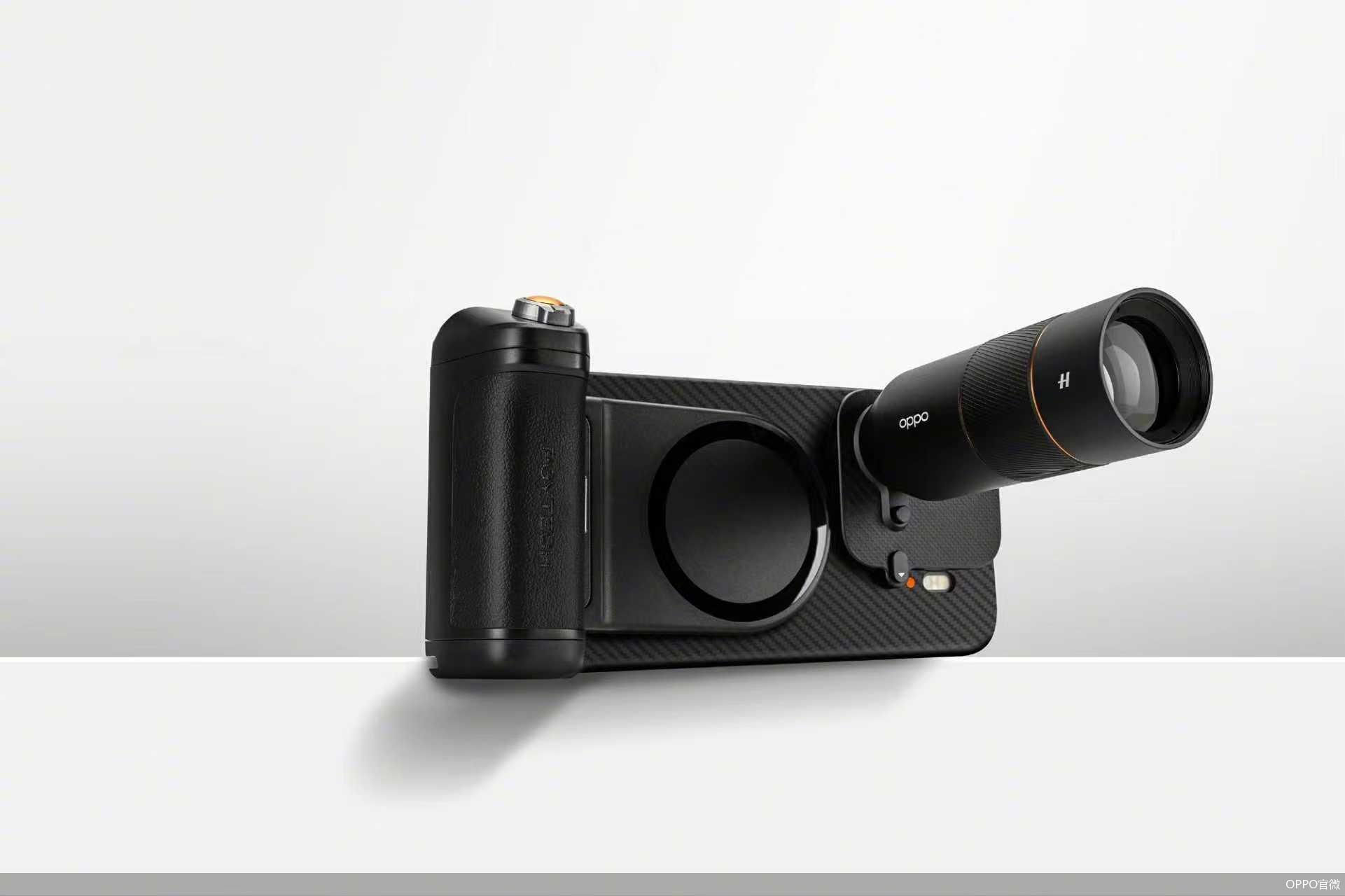
Core Viewpoint - The smartphone industry is witnessing a shift towards external camera accessories, with major players like vivo and OPPO launching innovative products that blur the lines between smartphones and traditional cameras [1][9][10]. Group 1: Product Launches and Innovations - vivo has introduced the X300 series, featuring an external telephoto lens that enhances photography capabilities, marking its second attempt at offering such a photography kit [1][6]. - OPPO plans to unveil the "Hasselblad Professional Imaging Kit" alongside its Find X9 series on October 16, which also includes a similar external telephoto lens [1][10]. - The trend of integrating external lenses into smartphones is gaining traction, moving from niche to mainstream as companies like vivo and OPPO continue to innovate [3][6]. Group 2: Historical Context and Market Attempts - The concept of external smartphone lenses is not new, with Sony being an early pioneer in 2013 with its QX series, but initial attempts faced technical limitations that hindered widespread adoption [3][4]. - Other companies, including OPPO and Motorola, have also experimented with external lenses, but high prices and subpar user experiences led to limited market acceptance [4][6]. - Recent advancements in technology and design have allowed major players to revisit this concept, leading to products that are now considered market-ready [6][10]. Group 3: Market Dynamics and Consumer Preferences - The competition in the smartphone market is intensifying, with companies seeking differentiation through enhanced camera capabilities, as evidenced by the collaboration with professional camera brands [9][10]. - Data from IDC indicates that while the overall smartphone market is expected to grow, there is a notable divergence in performance among leading brands, with some experiencing declines in market share [10][11]. - The demand for higher-quality imaging among consumers is driving smartphone manufacturers to focus on camera technology as a key selling point in a saturated market [9][10].
vivo、OPPO“大炮对轰”:手机为何卷成相机?
Bei Jing Shang Bao· 2025-10-14 14:48
Core Viewpoint - The smartphone industry is witnessing a shift towards external camera accessories, with major players like vivo and OPPO launching new products that blur the lines between smartphones and traditional cameras [3][5][15]. Group 1: Product Launches - vivo officially launched the X300 series on October 13, with the base model starting at 4399 yuan and the Pro version at 5299 yuan, including a 1499 yuan professional imaging handle with a 2.35x telephoto lens [3][4]. - OPPO announced the release of the Find X9 series on October 16, which will also feature a similar external telephoto lens accessory [4][5]. Group 2: Market Trends - The introduction of external camera accessories is becoming mainstream, moving beyond niche products that previously failed due to technical limitations and high costs [7][11]. - The smartphone market is experiencing intense competition, with IDC forecasting a total shipment of approximately 286 million units in 2024, reflecting a 5.6% year-on-year growth [15]. Group 3: Consumer Perception - Consumers are increasingly viewing smartphones and cameras as interchangeable, with the demand for higher quality images driving the adoption of external accessories [5][12]. - The collaboration between smartphone manufacturers and established camera brands like Leica and Hasselblad is becoming a key differentiator in the high-end market [15][17]. Group 4: Competitive Landscape - The competitive landscape is intensifying, with vivo leading the market with a 17.2% share and a 10.3% year-on-year growth, while Huawei follows closely with a 16.6% share and a significant 50.1% growth [15][16]. - The market is entering a phase of stock competition, where companies must find compelling selling points to attract consumers amidst high levels of product similarity [17][18].
eSIM手机来了!
证券时报· 2025-10-14 12:41
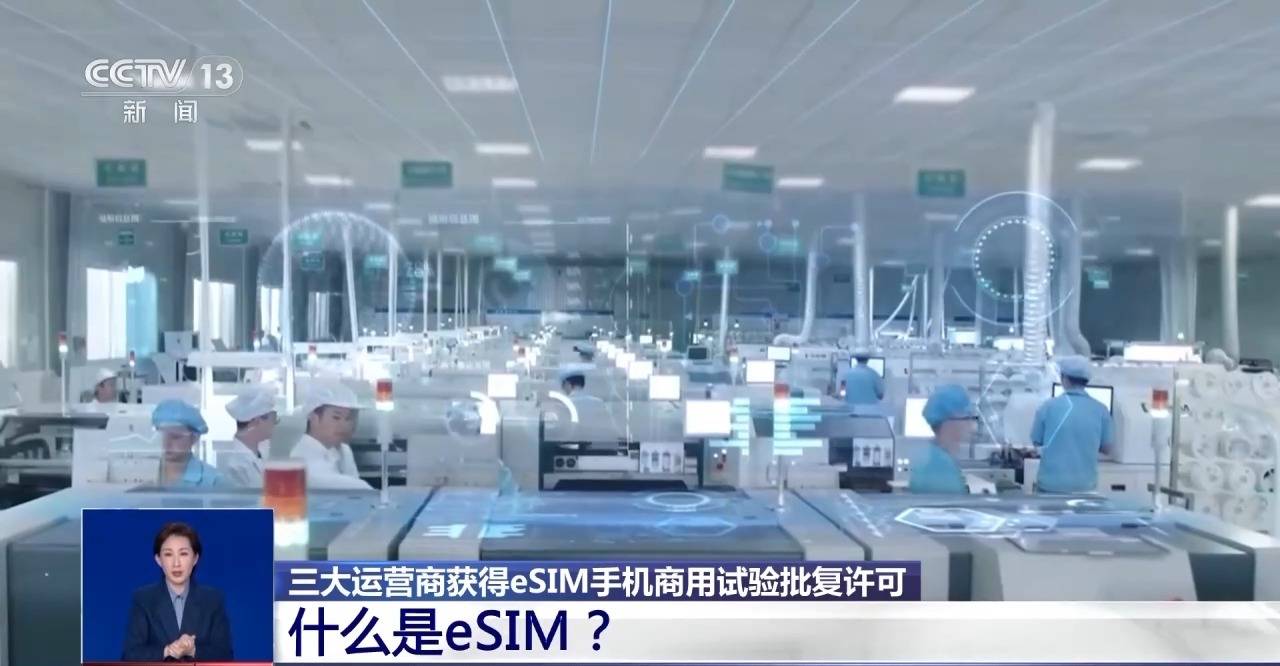
Core Viewpoint - The recent approval of eSIM technology by China's three major telecom operators marks a significant step towards the commercialization of eSIM mobile services in the smartphone sector, transitioning from traditional SIM cards to electronic SIM cards [1][4][7]. Group 1: eSIM Technology Overview - eSIM is a virtual electronic SIM card that replaces physical SIM cards, allowing users to activate mobile services without inserting a physical card [6]. - The integration of eSIM within devices eliminates the need for a SIM card slot, enabling thinner devices and providing more internal space for other components [6]. Group 2: Operators' Support and Services - China Unicom, China Mobile, and China Telecom have all received approval to conduct commercial trials for eSIM services, although online processing is currently not available [4][5]. - China Unicom has adapted 75 devices for eSIM, serving millions of users, while China Mobile plans to support a full range of eSIM products across various device types [11]. Group 3: Benefits of eSIM - eSIM technology addresses issues associated with traditional SIM cards, such as damage and the need for physical replacements, enhancing reliability [10][12]. - The use of eSIM facilitates easier switching to local carriers when traveling, eliminating the need for roaming services or purchasing local SIM cards [12].




以后手机不用插卡了? 三大运营商获eSIM手机商用试验批复许可
Yang Shi Xin Wen· 2025-10-14 12:29
Core Points - eSIM technology has become a hot topic recently, with major Chinese telecom operators receiving approval for commercial trials [1][3] - eSIM allows users to activate mobile services without a physical SIM card, enabling thinner devices and more internal space [2] - The approval marks a new phase for eSIM technology in mobile phones, following its previous applications in IoT and wearables [2] Industry Developments - China Unicom, China Mobile, and China Telecom have all announced the approval for eSIM mobile service trials as of October 13 [3] - China Unicom has adapted 75 devices, serving millions of users, while China Mobile plans to support a full range of eSIM products across various devices [3] - China Telecom has confirmed the launch of eSIM mobile services across 31 provinces in China [3] Device Compatibility - Supported eSIM devices include models from Apple, Huawei, and OPPO, which will be available for sale soon [4]
eSIM暂不开放线上办理,需到营业厅办理开通
Yang Shi Xin Wen Ke Hu Duan· 2025-10-14 12:21
Core Viewpoint - The recent approval of eSIM technology for mobile phones by China's three major telecom operators marks a significant step towards commercial deployment in the mobile sector, transitioning from previous applications in IoT and smart wearables [1][4][6]. Group 1: eSIM Technology Overview - eSIM technology replaces physical SIM cards with electronic data files, allowing users to activate mobile services without inserting a physical card, leading to thinner devices and increased internal space [2]. - The approval for eSIM mobile services indicates a new phase of commercial use in the mobile sector, following prior applications in IoT and smart wearables [4]. Group 2: Telecom Operators' Developments - China Unicom, China Mobile, and China Telecom have received approval for eSIM mobile service trials, with China Unicom reporting compatibility with 75 devices and a user base exceeding several million [6]. - China Mobile plans to offer a full range of eSIM products, extending beyond mobile phones to include smartwatches, tablets, and in-car devices [6]. - China Telecom has confirmed the launch of eSIM mobile services across 31 provinces and regions in China [6]. Group 3: User Access and Device Compatibility - During the trial period, users must visit physical stores to activate eSIM services, as online processing is not yet available [4][6]. - Supported eSIM devices include models from Apple, Huawei, and OPPO, which will be available for sale soon [9].
eSIM暂不开放线上办理 需到营业厅办理开通
Xin Lang Cai Jing· 2025-10-14 12:18
Core Points - China Unicom, China Mobile, and China Telecom have officially received approval to conduct commercial trials for eSIM mobile services as of October 13 [1] - During the trial period, the three companies will not offer online processing; users must visit physical stores to activate eSIM services [1] - Supported eSIM devices include models from Apple, Huawei, and OPPO, which will be gradually available for sale [1]