Samsung

Search documents
Apple and Samsung smartphone growth to take hit from tariff uncertainty: Counterpoint Research
CNBC· 2025-06-04 11:35
Core Viewpoint - Counterpoint Research has significantly reduced its global smartphone shipment growth forecast for 2025 due to uncertainties surrounding U.S. tariff policies, now projecting a growth of 1.9% year-on-year, down from 4.2% previously [1][2]. Group 1: Apple and Samsung Shipment Forecasts - Apple's shipment growth is now expected to be 2.5% year-on-year in 2025, a decrease from the earlier forecast of 4% [2]. - Samsung's shipments are anticipated to experience no growth in 2025, a revision from the previously projected 1.7% increase [2]. - The revisions are attributed not only to tariff uncertainties but also to weakened demand in North America, Europe, and parts of Asia [3]. Group 2: Factors Influencing Apple’s Shipment Growth - The downgraded shipment growth for Apple is primarily driven by the iPhone 16 series and a trend of emerging market customers purchasing more expensive phones [3]. - Apple has increased its shipments to the U.S. from India, where it has been boosting production of its iPhones, in response to tariff concerns [4]. Group 3: Market Dynamics and Competitors - Huawei is highlighted as a positive outlier, with an expected shipment growth of 11% year-on-year in 2025, benefiting from easing sourcing bottlenecks and a rebound in sales in China [5][6]. - The Chinese tech giant's recovery is attributed to advancements in semiconductor technology for its devices, which have revitalized its market position [6].


Silicon Motion Technology Corporation (SIMO) 2025 Conference Transcript
2025-06-03 18:40
Summary of Silicon Motion Technology Corporation (SIMO) Conference Call Company Overview - **Company**: Silicon Motion Technology Corporation (SIMO) - **Industry**: Memory chip industry, specifically focusing on NAND flash memory Key Points Long-Term Growth Catalysts - NAND flash memory is critical for various applications, including smartphones, PCs, enterprise, automotive, and industrial sectors, leading to increased memory demand and performance requirements [2][3] - The expansion and improvement of NAND memory generations create opportunities for SIMO to deliver solutions that enhance performance and density, thus expanding Total Addressable Market (TAM) and Serviceable Available Market (SAM) [3] Near-Term Outlook - Despite geopolitical uncertainties and tariffs, SIMO expects growth in the second quarter due to new projects ramping up, including PCIe 5 for client SSDs [4][5] - Customer conversations indicate that the demand in the second quarter is genuine and not merely a pull-in demand [6] Market Share and Competitive Position - SIMO has seen a significant increase in market share for client SSDs, growing from over 25% to over 30% last year, with a target of achieving over 40% in the coming years [9][10] - The company is positioned to capture over 50% market share in the high-end PCIe 5 controller segment, which has historically been dominated by flash makers developing in-house solutions [10][11] Business Model and Outsourcing Trends - The increasing complexity and cost of developing new controllers have led flash makers to outsource their controller needs, presenting an opportunity for SIMO to gain market share [17][18] - SIMO is the only merchant supplier that collaborates with all flash makers, allowing it to capture a disproportionate share of the market [18][21] Automotive Sector Growth - The automotive sector currently accounts for over 5% of SIMO's revenue, with expectations to exceed 10% in the next few years due to the increasing number of memory components required in vehicles [31][32] - SIMO is engaged with various automotive manufacturers, providing solutions for infotainment, ADAS, and other memory-intensive applications [33][34] Data Center and AI Opportunities - SIMO is providing boot drives for NVIDIA's BlueField 3 GPUs, which is expected to open up further opportunities in the enterprise SSD market [36][37] - The Montitan enterprise SSD, supporting high densities, is anticipated to contribute 5% to 10% of total revenue by 2026-2027 [37][45] Macro and Industry Uncertainties - The company has not observed significant impacts from U.S. tariffs, with overall expectations for PC and smartphone growth remaining stable [46][49] - Inventory levels are reported to be normal, reflecting end market demand [49] Shareholder Returns and Capital Allocation - SIMO has consistently prioritized dividends, increasing from $0.60 to $2 per ADS over the past decade, and has allocated approximately half of its free cash flow to share repurchases [55][56] - The company is also exploring M&A opportunities to enhance its technology offerings [57] R&D and Talent Acquisition - SIMO has been increasing its headcount to drive development in new technologies, including six-nanometer solutions for PCIe 5 and UFS 4 [60] Legal Matters - Ongoing arbitration in Singapore is expected to convene in October, with a resolution anticipated by the end of the year [50][52] Conclusion - SIMO is well-positioned for growth in the memory chip industry, with strong market share gains, a robust pipeline of projects, and strategic focus on high-growth sectors such as automotive and data centers. The company remains vigilant in managing macroeconomic uncertainties while continuing to prioritize shareholder returns and innovation.

Navitas Semiconductor (NVTS) 2025 Conference Transcript
2025-06-03 13:30
Summary of Navitas Semiconductor (NVTS) Conference Call Company Overview - **Company**: Navitas Semiconductor - **Industry**: Power Semiconductors - **Key Materials**: Gallium Nitride (GaN) and Silicon Carbide (SiC) Core Insights and Arguments 1. **Market Position**: Navitas is a leading supplier of next-generation power solutions, focusing on GaN and SiC technologies, which are more efficient than traditional silicon-based semiconductors [2][4][6] 2. **Market Size**: The silicon carbide market is valued at approximately $3 billion to $4 billion, while GaN is a newer market with significant growth potential [6][8] 3. **Applications**: Navitas is expanding its applications from mobile chargers to data centers, electric vehicles (EVs), and solar inverters [6][12] 4. **AI Impact**: The rise of AI is creating a demand for high-power semiconductors, as AI processors require significantly more power than traditional CPUs [8][10] 5. **Data Center Evolution**: The shift from 12-volt to 48-volt and now to 800-volt data centers is crucial for efficiency, reducing power distribution losses by a factor of 16 when moving to higher voltages [14][17] 6. **Collaboration with NVIDIA**: Navitas is collaborating with NVIDIA to develop next-generation data centers that will utilize their GaN and SiC technologies [12][29] 7. **Revenue Growth**: The company anticipates significant revenue growth in 2026 and 2027 as it ramps up production for data centers and other applications [11][22] Additional Important Points 1. **Technological Advantage**: Navitas has integrated driver and control circuitry directly into GaN chips, which is a significant competitive advantage [26][46] 2. **Patent Portfolio**: The company holds over 200 patents related to GaN technology, enhancing its market position [46] 3. **Market Trends**: The transition to higher voltage systems is not unique to Navitas; it is a broader industry trend that all hyperscalers are adopting [36][38] 4. **Potential for Modules**: There is potential for Navitas to expand into power modules, which could significantly increase their market content [42][43] 5. **Competitive Landscape**: Infineon is identified as a major competitor, but Navitas has established a collaborative relationship through a cross-licensing agreement [48][50] 6. **Future of Power Semiconductors**: The need for high-voltage solutions will continue to grow as the global energy grid upgrades, with silicon carbide being the preferred material for high-voltage applications [56][58] This summary encapsulates the key points discussed during the Navitas Semiconductor conference call, highlighting the company's strategic direction, market opportunities, and technological advancements.


Judge in Google antitrust trial presses DOJ on AI's role in future competition
New York Post· 2025-05-30 16:54
Core Points - The judge in the antitrust case against Google is questioning the potential for new search engine competitors to emerge in the context of rising artificial intelligence technologies [1][2] - The Department of Justice (DOJ) is advocating for significant remedies, including the divestment of Google's Chrome browser and restrictions on its use of AI tools to maintain market dominance [5][6] - Google argues that the DOJ's proposals are excessive and could harm national security, while also highlighting competition from other AI-driven platforms [7][8] Group 1: Judge's Inquiry - Judge Amit Mehta is exploring the impact of AI on search engine competition, questioning whether new entrants can emerge in the current landscape [1][2] - The DOJ emphasizes that generative AI represents a new access point for search, necessitating remedies that address future technologies [4] Group 2: DOJ's Proposals - The DOJ has requested that Google divest its Chrome browser and restrict its AI capabilities to prevent further entrenchment of its monopoly [5][6] - Additional proposals include prohibiting Google from paying companies to be the default search engine and requiring data sharing with competitors [6] Group 3: Google's Defense - Google contends that the DOJ's remedies exceed the scope of the initial ruling and could disrupt its platforms [7] - The company points to intense competition from AI platforms like OpenAI's offerings, arguing that the industry is rapidly evolving [8] - Google has made changes to its exclusivity agreements with carriers and smartphone manufacturers to address AI-related concerns [9]


每周观察| 3Q25NAND Flash价格有望上涨;1Q25NAND Flash前五大厂商营收;Micro LED应用场景拓展
TrendForce集邦· 2025-05-30 04:04
Group 1: Enterprise SSD Market - The demand for enterprise SSDs is expected to grow significantly by Q3 2025, driven by increased AI investments from major cloud service providers (CSPs) [1] - With low finished product inventory levels, the enterprise SSD market is anticipated to shift towards a supply shortage, supporting a price increase of approximately 10% [1] Group 2: NAND Flash Market Performance - In Q1 2025, the combined revenue of the top five NAND Flash manufacturers reached $12.02 billion, reflecting a nearly 24% quarter-over-quarter decline [3] - The average selling price (ASP) of NAND Flash products decreased by 15%, and shipment volumes fell by 7% due to inventory pressures and declining end-user demand [3] - Samsung, SK Group, Micron, Kioxia, and Sandisk are the top five NAND Flash brands, with respective revenues of $4.2 billion, $2.19 billion, $2.03 billion, $1.92 billion, and $1.70 billion in Q1 2025 [4] Group 3: Micro LED Market Outlook - The Micro LED technology is focusing on two key areas: optimizing manufacturing costs through improved design and production processes, and exploring unique niche markets [5] - The market value of Micro LED display applications is projected to reach $740 million by 2029, with a compound annual growth rate (CAGR) of 93% from 2024 to 2029 [5]

制造业中的生成性人工智能:首席信息官在企业范围内实施的完整指南
Hexaware· 2025-05-30 00:45
Investment Rating - The report emphasizes the transformative potential of Generative AI (GenAI) in manufacturing, suggesting a strong investment opportunity for organizations willing to adopt and scale this technology. Core Insights - Generative AI is positioned as a game-changer in manufacturing, akin to the impact of Google on information access, enabling organizations to innovate in product design, optimize operations, and enhance customer experiences [3][14][31]. - The report outlines a structured approach for organizations to transition from pilot projects to enterprise-wide implementation of GenAI, focusing on identifying high-value use cases and ensuring organizational readiness [19][24][29]. Summary by Sections Introduction - The manufacturing sector is at a pivotal moment with GenAI, which can fundamentally change how products are designed, built, and delivered [5][12]. How Generative AI Can Revolutionize Manufacturing - GenAI offers tools to streamline operations, predict supply chain disruptions, and reduce costs, thus enhancing agility and innovation in manufacturing [8][9][10]. Why Generative AI is Manufacturing's "Google Moment" - Companies like BMW and Samsung are already leveraging GenAI for significant operational improvements, showcasing its potential for transformative impact [15][16]. Creating Organizational Readiness for Generative AI Adoption - Organizations must assess their Business Value Potential and Implementation Feasibility to effectively adopt GenAI solutions [19][20][21][22]. From Potential to Performance: The GenAI Playbook - A clear roadmap is essential for scaling GenAI, starting with easy wins and progressing to transformational changes [24][25][27][29]. The Promise of Generative AI in Manufacturing - GenAI is reshaping product design, enhancing core production processes, and optimizing supply chains, leading to increased efficiency and innovation [31][32][46][58]. The Path to Scalable AI: Overcoming Challenges - Organizations face challenges such as cost management and the need for iterative deployment, which can be addressed through proactive risk management and strategic planning [71][73]. Final Reflections: Leadership That Drives Transformation - Effective implementation of GenAI can lead to a 20% reduction in time-to-market and a 5-10% decrease in overall R&D costs, highlighting its tangible benefits for manufacturing leaders [75][76].
Counterpoint Research:2025年Q1中东和非洲智能手机出货量同比增长7%
智通财经网· 2025-05-29 03:17
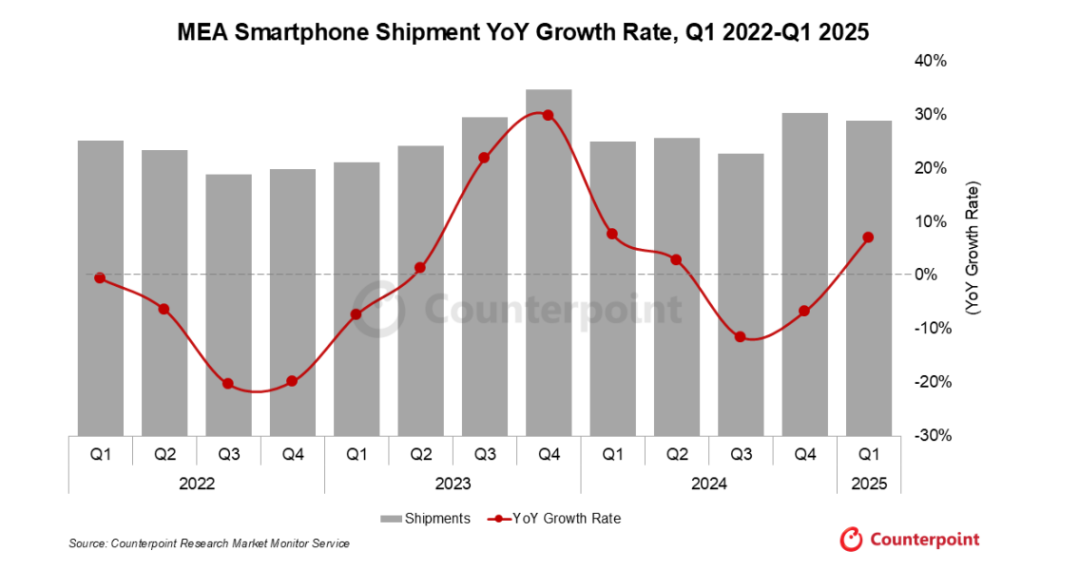
Core Insights - The smartphone shipment volume in the Middle East and Africa is expected to grow by 7% year-on-year in Q1 2025, marking the first positive growth after two consecutive quarters of decline [1] - Strong demand during Ramadan and Easter, expanded device supply, and moderate inflation have driven consumer spending in the region [1] Market Dynamics - The smartphone market in the Middle East and Africa is entering an adjustment phase in 2024, with brands focusing on clearing old inventory and reducing new product launches, leading to a decrease in active brands [6] - Despite the adjustment, the market is expected to see a strong recovery in early 2025 due to improved supply and the release of pent-up demand, particularly for budget models under $100 [6] - High-end smartphones priced above $800 continue to show robust growth, indicating a persistent trend towards premiumization [6] 5G Adoption - The 5G adoption rate in the region has slightly increased, reaching a market share of 33% in Q1 2025, with brands like Samsung, Xiaomi, and HONOR leading the growth in the $400 to $499 price segment [6] - The reduction in 5G component costs and significant investments from African operators, along with government digitalization efforts, have contributed to the proliferation of 4G and 5G infrastructure [6] Display Technology - The penetration rate of OLED displays reached 42% in Q1 2025, driven by consumer demand for vibrant colors, better contrast, and energy efficiency [7] - Smartphones with screens larger than 6.5 inches are increasingly popular, as users prefer high-resolution displays for enhanced viewing experiences [7] Brand Performance - Samsung maintained its market leadership with a 15% year-on-year increase in shipments, streamlining its product offerings from 103 to 76 models to focus on higher quality [12] - Transsion holds a 32% market share in the region, up from 29% last year, with TECNO achieving a 31% growth rate due to strong promotions in the mid-range market [12] - Xiaomi's shipments decreased by 2%, but its LTE smartphones saw a 27% year-on-year growth, primarily in the low-end market [13] - Apple experienced a 4% increase in shipments, with its market share rising to 6%, driven by the strong performance of the new iPhone 16e in price-sensitive markets [13]

2025年Q1中东非洲智能手机出货量增长7%:节日促销成关键驱动力
Counterpoint Research· 2025-05-29 02:32
Core Viewpoint - The smartphone market in the Middle East and Africa is experiencing a recovery with a 7% year-on-year growth in Q1 2025, driven by strong holiday demand, improved supply, and moderate inflation [1][4]. Market Dynamics - In 2024, the smartphone market in the region is expected to enter an adjustment phase as brands focus on clearing old inventory and reducing new product launches, leading to a decrease in active brands [2]. - The recovery in early 2025 is attributed to supply improvements and the release of pent-up demand, particularly for budget models priced under $100 [2][4]. Smartphone Shipment Growth - The growth in smartphone shipments is primarily seen in the low-end market, which is the fastest-growing segment due to increased competition [4]. - The penetration rates for 5G and OLED technologies reached 33% and 42%, respectively, supported by network deployments and the introduction of popular large-screen Android devices [4][5]. Brand Performance - Samsung maintained its market leadership with a 15% year-on-year increase in shipments, focusing on fewer, higher-quality models [9]. - Transsion holds a 32% market share, up from 29% the previous year, with TECNO leading in the mid-range market due to strong promotions [9]. - Xiaomi's shipments decreased by 2%, but its LTE smartphones saw a 27% increase, indicating a competitive push in the low-end market [10]. - Apple experienced a 4% increase in shipments, driven by the launch of the iPhone 16e, which performed well in price-sensitive markets [10].

Sonos (SONO) Conference Transcript
2025-05-28 20:30
Sonos (SONO) Conference Call Summary - May 28, 2025 Company Overview - **Company**: Sonos (SONO) - **Industry**: Consumer Electronics / Audio Products Key Points and Arguments Recovery and Performance Metrics - Sonos is recovering from previous app issues, with core metrics around reliability and performance now exceeding those of the predecessor app version [5][6] - Focus on improving the core experience, which is essential for customer retention and repurchases [6][7] - A recent promotion to existing customers yielded a better take rate than a similar promotion conducted a year prior to the app launch, indicating positive recovery trends [10][11] Financial Guidance and Market Position - The company anticipates a choppy year-over-year comparison due to the launch of new products last year, but expects growth in Q4 [12][13] - Sonos is restructuring to be more scalable and efficient, reducing headcount while reorganizing teams to streamline operations [14][15] Tariff Mitigation Strategies - Sonos has shifted production away from China, primarily to Vietnam and Malaysia, to mitigate tariff impacts [16][17] - The company is adopting a flexible pricing strategy to manage tariff costs while maximizing gross profit dollars rather than focusing solely on gross margin percentages [19][40] Leadership Transition - An active CEO search is underway, with the interim CEO, Tom, effectively managing the transformation and recovery efforts [22][23] - The search process is expected to take about six months, with five months already completed [24] Product Innovation and Market Competition - Sonos aims to maintain a steady cadence of product launches, focusing on core experience improvements while exploring new innovations [27][30] - The company ranks fourth in patent power, indicating a strong foundation for future innovations [30] - Sonos acknowledges competition from emerging brands and is focused on articulating its unique value propositions to customers [33][35] Cash Management and Shareholder Returns - Sonos has paused stock buybacks to preserve cash for operational flexibility amid tariff uncertainties, but plans to resume buybacks once conditions stabilize [36][37] Geographic Expansion - The company is actively pursuing geographic expansion, particularly in APAC markets, which are showing double-digit growth potential [38][39] - This expansion strategy aims to diversify revenue sources and tap into high-income customer segments in regions like the Middle East [39] Additional Important Insights - Sonos is committed to a disciplined approach in R&D investments, ensuring alignment with revenue projections to avoid overextending resources [31][32] - The company is leveraging its existing product lines to capture demand in new markets without necessarily launching new products [39][41]

EVERHOME SUITES CONTINUES TO GROW ITS NATIONAL FOOTPRINT WITH NINE NEW OPENINGS AND GROUNDBREAKINGS ACROSS TEXAS, ARIZONA, OREGON, AND OHIO
Prnewswire· 2025-05-28 14:08
Core Insights - The Everhome Suites brand is experiencing strong developer interest and demand for midscale extended stay accommodations across various states, indicating a positive market trend for this segment [1][2] - The collaboration between Choice Hotels and Highside Companies is focused on launching new properties that cater to specific market needs, enhancing the brand's operational model and guest experience [2] Development Overview - Everhome Suites is expanding its footprint with several new openings and constructions in Texas, Arizona, Oregon, and Ohio, targeting strategic locations to meet diverse traveler needs [4][5][7][8] - The properties are designed to support various demographics, including military, medical, and corporate travelers, with amenities that cater to long-term stays [4][5][8] Property Details - In Texas, multiple Everhome Suites locations are set to open between February 2025 and June 2025, with properties in Bastrop, Waco, Brownsville, El Paso, and Amarillo, each strategically located near key employers and attractions [5] - The Everhome Suites in Yuma, Arizona, is scheduled to open in July 2025, focusing on military and medical travelers due to its proximity to MCAS Yuma and Yuma Regional Medical Center [4] - The Salem, Oregon location is expected to open in Q3 2026, expanding the brand's presence in the Pacific Northwest and serving local healthcare and government sectors [7] - In Ohio, a new property in Dayton is set to break ground in June 2025, positioned to attract highway travelers and military personnel due to its location near major transport routes and facilities [8] Brand Features - Everhome Suites offers apartment-style suites with fully equipped kitchens, spa-like bathrooms, and modern amenities designed for extended stays, including fitness centers and self-service marketplaces [10] - The brand emphasizes a "Closer to Home" experience, allowing guests to maintain their routines while traveling [10] Company Background - Choice Hotels International is one of the largest lodging franchisors globally, with over 7,500 hotels and a diverse portfolio of 22 brands, catering to various traveler needs [11] - Highside Companies, founded in 2019, is a real estate firm with nearly $1 billion in active projects, focusing on investment and development solutions across multiple asset classes [12]