
Samsung

Search documents
ASML vs. AMAT: Which Semiconductor Equipment Stock Is the Better Buy?
ZACKS· 2025-04-04 13:45
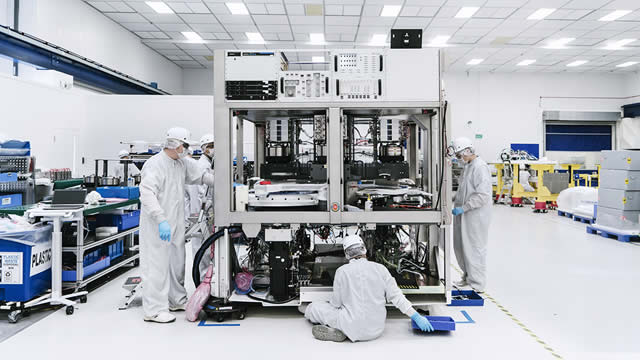
Core Viewpoint - ASML Holding and Applied Materials are key players in the semiconductor supply chain, with ASML holding a dominant position in EUV lithography and Applied Materials providing a broad range of semiconductor fabrication equipment [1][2]. Group 1: ASML Holding - ASML Holding has a near-monopoly on extreme ultraviolet (EUV) lithography, crucial for producing advanced semiconductors [3][4]. - The company is investing in next-generation technologies like High-NA EUV, which are essential for smaller semiconductor nodes [5]. - In Q4 2024, ASML reported a 24% increase in revenues and a 30% increase in earnings year-over-year, with a record backlog of €36 billion indicating strong future revenue visibility [6]. - ASML's revenue growth guidance for Q1 2025 is 46.5%, and for the full year 2025, it is 15% [6]. - Geopolitical risks, particularly export restrictions to China, pose challenges, as China accounted for approximately 41% of ASML's lithography shipments in 2024 [7]. Group 2: Applied Materials - Applied Materials is the largest supplier of semiconductor fabrication equipment, with a strong position in AI-driven semiconductor technology [8]. - In fiscal 2024, revenues from advanced semiconductor nodes exceeded $2.5 billion, with expectations to double in fiscal 2025 [9]. - In Q1 fiscal 2025, Applied Materials reported a 7% increase in revenues and a 12% increase in non-GAAP EPS [9]. - The company faces challenges from U.S. export restrictions to China, which are expected to reduce fiscal 2025 revenues by $400 million [10]. - A slowdown in the ICAPS segment could negatively impact Applied Materials' overall performance [11]. Group 3: Price Performance and Valuation - Year-to-date, ASML shares have decreased by 10.1%, while Applied Materials shares have declined by 16.7% [13]. - ASML is trading at a forward earnings multiple of 23.56X, below its three-year median of 30.04X, while Applied Materials has a forward sales multiple of 14.13X, significantly lower than its median of 18.14X [14]. - ASML's valuations reflect high growth expectations and improving profitability, suggesting that its premium may be justified if execution is sustained [15]. Group 4: Estimates Comparison - The Zacks Consensus Estimate for ASML's 2025 sales and EPS implies year-over-year growth of 12.4% and 21.9%, respectively [18]. - For Applied Materials, the estimates for fiscal 2025 sales and EPS imply a year-over-year increase of 6% and 8.2%, respectively, with recent downward revisions [20]. Conclusion - ASML Holding has a stronger growth profile and a monopoly in EUV technology, making it a more compelling long-term investment compared to Applied Materials, which faces more uncertain growth prospects [21].


Will VZ Stock Benefit From a Three-Year Price Lock Guarantee?
ZACKS· 2025-04-04 13:40
Core Viewpoint - Verizon Communications Inc. has introduced a three-year price lock guarantee for its myPlan and myHome network plans, aiming to attract new customers and retain existing ones in a challenging economic environment [1][17]. Group 1: Customer-Centric Initiatives - The price lock guarantee ensures that core monthly plan prices for calling, data, and texting will remain unchanged for three years, excluding taxes and fees [1]. - Verizon offers a free phone from major brands like Apple, Google, or Samsung with any myPlan enrollment when users trade in any phone, along with free home internet routers for myHome plans [2]. - Customers can enjoy free satellite text messaging services on qualifying devices and save over 40% on popular subscription services like Netflix and Disney+ [2][3]. Group 2: 5G and Infrastructure Development - Verizon is experiencing significant adoption of 5G and fixed wireless broadband, supported by premium unlimited plans and a mix-and-match pricing strategy [4]. - The company is focused on enhancing its 5G network through massive spectrum holdings, deep fiber resources, and deploying small cells [3][5]. - High capital expenditures are being made to support the launch and build-out of the 5G Ultra Wideband network and significant fiber assets [9][10]. Group 3: Strategic Partnerships - Verizon is exploring a partnership with Banco Santander to enhance customer satisfaction, which may lead to increased customer additions [6][7]. - Santander aims to leverage Verizon's customer base to develop its technology platform for consumer banking in the U.S. [7]. Group 4: Financial Performance and Market Position - Verizon's stock has gained 8.3% over the past year, lagging behind competitors like AT&T and T-Mobile, which have seen gains of 64.2% and 66.3%, respectively [12]. - Earnings estimates for Verizon for 2025 and 2026 have declined by 0.2% and 0.4%, indicating bearish sentiment towards the stock [16]. - The company's wireline division is facing challenges with persistent losses in access lines due to competitive pressures [8][11].

Here's How Tariffs Could Affect This Industry Giant. Should Investors Be Worried?
The Motley Fool· 2025-04-03 14:23
Core Viewpoint - President Trump's new tariff plan, announced on April 2, includes updated tariffs on over 180 countries, with rates ranging from 10% to over 90%, impacting U.S. companies that rely on imports, particularly large tech firms [1] Company-Specific Analysis - Nvidia, a leading GPU producer, is significantly affected by the new tariffs, especially since it relies heavily on imports from Taiwan and China, which now face reciprocal tariffs of 32% and 34% respectively [2][3] - While semiconductors, crucial for Nvidia's GPUs and AI chips, are mostly exempt from the tariffs, the company still faces a 25% tariff on aluminum and steel used in its data center hardware, increasing costs from $1,000 to $1,250 for certain items [3][4] - Nvidia's revenue and net income have seen impressive growth due to rising demand for its products, but the new tariffs are expected to negatively impact earnings and profit margins in the short term [5][6] - The company has the option to pass increased costs onto customers, but this could risk losing price-sensitive customers amid recession fears, potentially harming Nvidia in the long run [7] - Despite the challenges posed by the tariffs, Nvidia is financially well-prepared with over $43 billion in cash and short-term investments, providing flexibility to navigate current conditions [8] - Nvidia's key partner, Taiwan Semiconductor Manufacturing, plans to increase U.S. operations, which may mitigate tariff impacts over time, and anticipated growth in AI could help offset immediate financial challenges [9] - For investors concerned about short-term stock performance, dollar-cost averaging is suggested as a strategy to manage volatility while maintaining confidence in Nvidia's long-term potential [10][11]


《GenAI的内存解决方案》系列综合报告
Counterpoint Research· 2025-04-03 02:59
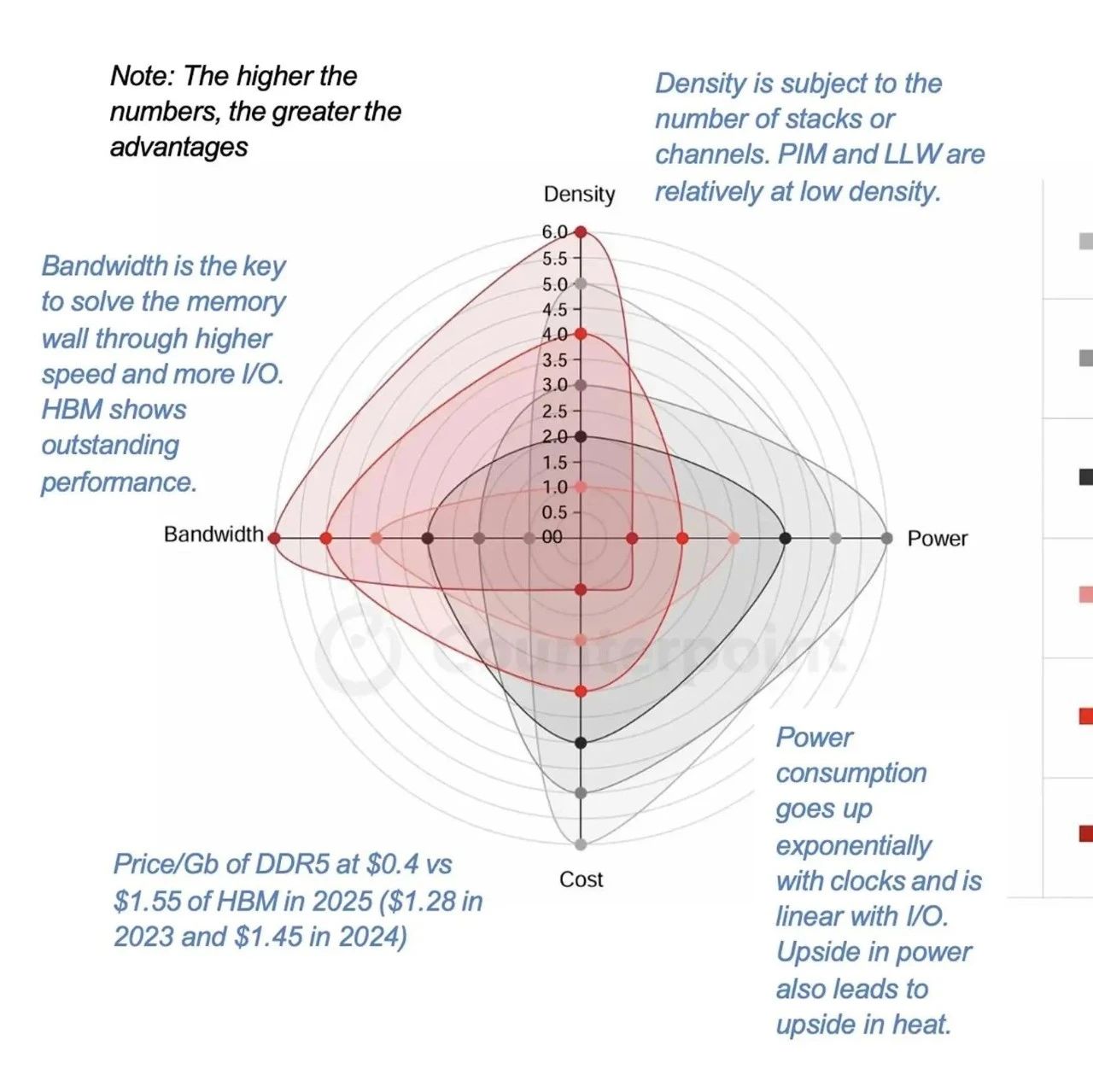
GenAI的内存解决方案 第 1 部分:能力的变化 所需能力 GenAI 应用需要高速、高带宽且低延迟的内存,以便实时处理海量数据。在需要实时决策和 预测的推理环节,数据的快速访问就显得尤为关键。 GenAI内存解决方案第 2 部分:HBM的竞争态势 内存设计的挑战与解决方案以及内存技术的最新趋势正在塑造高性能计算的未来及其竞争 格局。 竞争态势 技术革新: 具有传统接口的动态随机存取存储器(DRAM)在带宽和延迟方 面 存在局限,因此像高带宽内存(HBM)这类利用硅通孔(TSV)堆叠 DRAM 的 技术,就成为满足这些性能需求的关键解决方案。与内存设计相关的挑战与应 对办法,以及内存技术的新兴趋势,正塑造着高性能计算的未来与竞争格局。 优化策略: 未来,像3D-IC和(或)CoWoS等封装技术的进步,将在智能手 机、PC 等不同领域得到应用。智能手机受空间和成本限制,人们会尝试多种办 法,在不增加成本与空间占用的前提下,降低延迟、减少能耗。 应变准备 : 目前仍不清楚到 2030 年哪些类型的GenAI模型和应用会流行,以 及具体数量是多少。因此,支持架构层面的进步并构建生态系统,以便能够应 对任何变化,将 ...


《GenAI的内存解决方案》系列综合报告
Counterpoint Research· 2025-04-03 02:59
Group 1: Core Insights - GenAI applications require high-speed, high-bandwidth, and low-latency memory for real-time data processing, making fast data access critical for decision-making and predictions [2] - The competition landscape in memory technology is evolving, with challenges in memory design and emerging trends shaping the future of high-performance computing [4][6] - Custom HBM (High Bandwidth Memory) is becoming essential for AI systems, with significant growth expected as companies like NVIDIA, Amazon, and Microsoft drive its development [26][28] Group 2: Competitive Landscape - Samsung is lagging in HBM due to conservative actions in advanced testing and packaging, focusing too much on cost while failing to meet customer demands for heat dissipation and power consumption [7] - SK Hynix is leading the market by addressing NVIDIA's power and thermal constraints through innovative memory unit designs and backend processing [7][8] - Micron is entering the HBM market later than competitors, planning to launch HBM3e by 2025, while adopting proven bonding equipment and internal voltage conversion technologies [7][8] Group 3: China's Influence - China's influence in the storage market is expected to grow, depending on the new demand environment shaped by GenAI, technological changes, and U.S.-China policies [9] - By 2024, China's DRAM manufacturer CXMT is projected to account for 13% of global capacity, 6% of shipments, and 3.7% of revenue, with potential growth to match Micron's capacity by 2025 [12] - The Chinese semiconductor industry is working towards domestic supply chains for HBM and DRAM, but faces challenges due to U.S. regulations on advanced equipment [12][18] Group 4: Smartphone Integration - The integration of GenAI with smartphones is a significant development, requiring transformative memory solutions and altering the competitive landscape [11] - Samsung plans to improve HBM3e by Q1 2025, potentially increasing its HBM shipment from 8-9 billion gigabits to 11-12 billion gigabits [11] - China aims for domestic production of HBM3 by 2025, with a focus on self-sufficiency in GPU manufacturing and related technologies [11] Group 5: Future Trends and Innovations - The future of memory solutions will focus on balancing bandwidth, capacity, power consumption, and cost, with ARM's recent strategic adjustments influencing configurations [22] - Innovations like Processing In Memory (PIM) and Wide I/O are expected to enhance performance in high-end smartphones and other applications, although their adoption timelines vary [15][22] - The custom HBM market is projected to grow significantly, with estimates suggesting it could account for 30-40% of the overall HBM market by 2030 [29]
比亚迪电子:Auto+AI to drive earnings growth-20250402
信达国际· 2025-04-02 14:23
Investment Rating - The report maintains a "BUY" rating for BYD Electronic with a target price of HKD 48.84, representing a potential upside of 22.6% from the current price of HKD 39.85 [6][17]. Core Insights - BYD Electronic's FY24 results showed a revenue growth of 36.4% to RMB 177.3 billion, while net profit increased by 5.5% to RMB 4,265 million, although net profit was approximately 6% below consensus due to lower than expected gross margin and higher costs [1][16]. - The company is expected to benefit from the increasing demand for generative AI smartphones, which is projected to drive a new replacement cycle in the smartphone market starting in 2024 [5][16]. - BYD Electronic's automotive intelligent segment revenue surged by 45.5% YoY to RMB 20.5 billion, indicating strong growth potential in the automotive sector [13][16]. Summary by Sections Financial Performance - FY24 revenue reached RMB 177.3 billion, up 36.4% YoY, while net profit was RMB 4,265 million, a 5.5% increase YoY [1][21]. - Gross margin decreased by 1.1 percentage points YoY to 6.9%, below the consensus estimate of 7.6% [1][16]. Business Segments - The assembly and components segments experienced significant growth, with assembly service revenue increasing by 26% YoY and components revenue soaring 1.6x YoY to approximately RMB 35.6 billion [3][12]. - The IoT segment faced challenges, with revenue slipping YoY due to pressures in the energy storage business [2][11]. Market Trends - The global smartphone shipment grew approximately 2.4% YoY in 4Q24, with a notable 37% QoQ increase in shipments from US clients due to new flagship launches [1][3]. - Generative AI smartphones are expected to account for a significant portion of total smartphone shipments, with projections of 234 million units in 2024 and a CAGR of 100% from 2023 to 2027 [5][16]. Future Outlook - BYD Electronic anticipates continued revenue growth in the IoT and automotive segments, projecting revenue to exceed RMB 50 billion and RMB 65 billion by FY25E and FY26E, respectively [15][16]. - The company is focusing on diversifying its business strategy, which is expected to enhance sales and earnings visibility in the long run [16][17].
Intel's new CEO acknowledges the company fell behind and he wants customers to be 'brutally honest'
Business Insider· 2025-04-01 05:19
Intel's new CEO said the company had fallen short of expectations recently and asked for customer feedback in his first public appearance since taking over the chip giant. "We had been too slow to adapt and to meet your needs," Lip-Bu Tan said about customers on Monday at an Intel event in Las Vegas. "You deserve better, and we need to improve, and we will. Please be brutally honest with us." The keynote was Tan's first since taking over as CEO on March 18. Tan walked the audience through his upbringing in ...

Zepp Health(ZEPP) - 2024 Q4 - Earnings Call Transcript
2025-03-27 23:05
Financial Data and Key Metrics Changes - Overall sales in Q4 2024 rose by more than 40% quarter over quarter, aligning with guidance [10] - Gross margin for the year 2024 reached 39% compared to 26.2% for the full year 2023 [10][40] - Cash on hand at the end of 2024 was $112 million, providing ample runway for investments [11] Business Line Data and Key Metrics Changes - The successful launch of the T-Rex 3 significantly boosted market demand and sales growth [12] - The T-Rex 3 is noted for its durability, battery life, and AI integration, establishing a strong position in the market [13] - The upcoming Amazfit Active 2 and Bip 6 series are expected to expand market reach and drive sales growth [16] Market Data and Key Metrics Changes - Global smartwatch sales fell by 7% in 2024, with Apple shipments declining by 19% [31] - Sales in China grew from 19% to 25% of the market, marking a significant shift [31] - The Indian market saw a decline from 30% to 23% due to quality issues with ultra-cheap devices [32] Company Strategy and Development Direction - The company is focusing on a brand transition to a high-margin business model and enhancing global marketing [9] - The strategy includes launching one to two new products each quarter in 2025 to drive demand [37][122] - Partnerships with athletes and organizations like HYROX are aimed at increasing brand visibility and market share [20][21] Management's Comments on Operating Environment and Future Outlook - Management expressed confidence in the long-term growth trajectory despite macroeconomic challenges [27] - The company anticipates a recovery in the global market driven by AI features and health data [34] - The outlook for Q1 2025 includes expected revenue growth of 14% to 29% year over year [55] Other Important Information - The company is committed to a share repurchase program in 2025, reflecting confidence in long-term value [28] - Inventory levels were reported at $57 million, the lowest since 2018, indicating strong inventory management [52] - The company has successfully refinanced short-term debts into long-term instruments, improving financial stability [53] Q&A Session Summary Question: Impact of new tariffs on smartwatch imports - Management indicated minimal impact due to proactive supply chain management and dual sourcing strategies [30][61] Question: Percentage of manufacturing outside China - Approximately 20% to 25% of the overall portfolio is manufactured outside China [63] Question: Impairment loss details - The impairment loss was due to investments in upstream and downstream technology companies that did not perform as expected [66][70] Question: Shift in demand towards lower-priced players - Management noted that while the market declined, there are bright spots in the outdoor and sports smartwatch segments, with strong performance from brands like Garmin [75][80] Question: Long-term strategy and vision - The company is diversifying its product portfolio and exploring B2B opportunities while focusing on building a global health ecosystem [90][91] Question: Relationship with Xiaomi - The relationship remains strong, but the company is transitioning to focus on self-branded products for profitability [96][100] Question: Stock liquidity concerns - Management acknowledged the illiquidity of the stock and emphasized ongoing buyback programs and growth strategies to improve market perception [106][110] Question: New product roadmap for 2025 - The company plans to launch multiple new products across different price segments, which is expected to drive revenue growth [118][122]

Counterpoint:2024 年“印度制造”智能手机出货量同比增长6%
智通财经网· 2025-03-27 08:49
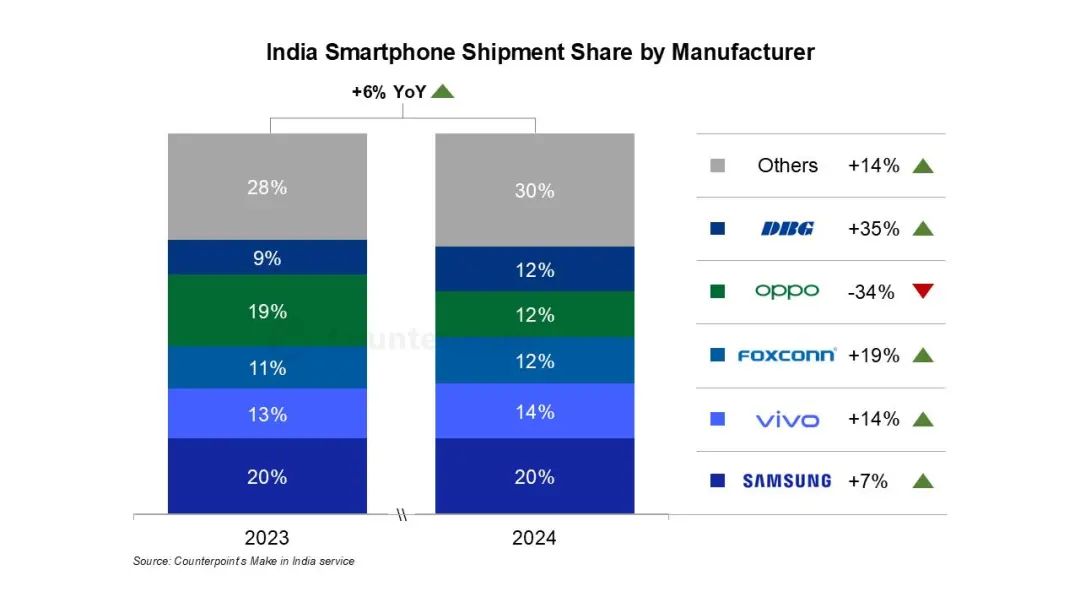
Core Insights - The "Make in India" initiative is projected to see a 6% year-on-year growth in smartphone shipments in 2024, driven primarily by the export growth of Apple and Samsung, which together account for approximately 94% of India's smartphone exports [1][5] - The Indian government's Production-Linked Incentive (PLI) policy is encouraging global manufacturers to establish or expand production bases in India, contributing to local manufacturing growth [1][5] Manufacturer Performance - Samsung is expected to maintain its leading position in India's electronics manufacturing sector, with a 7% year-on-year increase in shipments driven by export growth [6] - Vivo ranks second with a 14% year-on-year growth, achieving a market share of 14%, largely due to the expansion of offline retail channels and distribution networks [6] - Foxconn, supported by Apple, anticipates a 19% year-on-year increase in manufacturing volume, with plans to establish smartphone display module assembly operations to enhance local manufacturing capabilities [6] - Tata Electronics is the fastest-growing manufacturer in 2024, with a 107% year-on-year increase, attributed to strong shipments of iPhone 15 and iPhone 16, alongside the establishment of semiconductor manufacturing facilities [6] - OPPO's manufacturing ranking has dropped to fourth place, with a 34% year-on-year decline in shipments due to intense market competition and increased reliance on contract manufacturing [6] - DBG has achieved double-digit growth in 2024 due to collaborations with Xiaomi and realme [6] Overall Market Dynamics - Dixon leads the overall mobile device market, including smartphones and feature phones, with strong shipment performance driven by Transsion's brands and Motorola [7] - In the smartphone sector, Dixon has experienced a 39% year-on-year growth, supported by new partnerships with Transsion and realme [7]

2024 年,“印度制造”智能手机出货量同比增长 6% ,出口创历史新高
Counterpoint Research· 2025-03-27 03:49
根据 Counterpoint 的 《印度制造服务报告》, 2024 年"印度制造"智能手机出货量同比增长 6% ,主 要受到 Apple 和 Samsung 出口增长的推动。 Apple 和 Samsung 两大品牌合计占印度智能手机出口 量的约 94% 。 2024 年,Samsung 继续保持印度智能手机制造商的头部地位,其智能手机出货量取得 7 % 的 同比增长,这得益于其出口量同比增长 13 %。 Foxconn Hon Hai在印度的出货量同比增长 19% ,主要受 iPhone 14 、iPhone 15 和 iPhone 13 机 型出货量增长的带动。 Tata Electronics(原纬创)是 2024 年印度增长最快的智能手机制造商,同比增长 107% ,其中 iPhone 15 和 iPhone 16 机型贡献了主要出货量。 在整个手机市场(包括智能手机和功能机)中,Dixon 成为 2024 年印度最大的制造商。 受政府推动以及品牌加速供应链多元化的影响,预计 2025 年"印度制造"智能手机的出货量将 实现两位数增长。 数据来源:Counterpoint "印度制造"服务 分析师观 ...