
润达医疗

Search documents
医药商业板块盘初上扬,人民同泰涨停
Mei Ri Jing Ji Xin Wen· 2025-11-10 01:52
Group 1 - The pharmaceutical commercial sector experienced an initial rise on November 10, with notable stocks such as Renmin Tongtai hitting the daily limit increase [1] - Other companies that followed the upward trend include Hefei China, Huaren Health, Rundat Medical, Saili Medical, and Shuyupingmin [1]

AI 医疗板块11月6日跌1.53%,卫宁健康领跌,主力资金净流出5.47亿元
Sou Hu Cai Jing· 2025-11-06 09:28
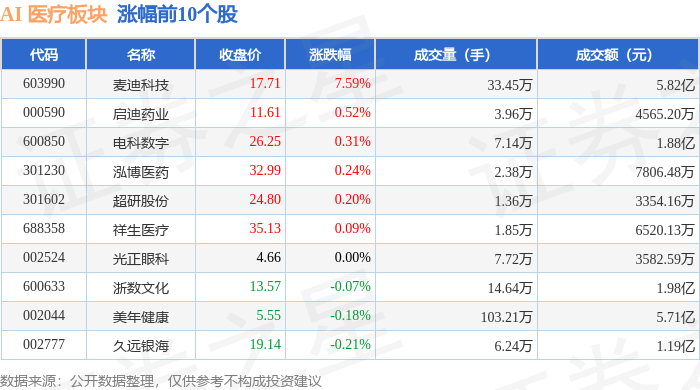
Core Insights - The AI healthcare sector experienced a decline of 1.53% on November 6, with Weining Health leading the drop [1][2] - The Shanghai Composite Index closed at 4007.76, up 0.97%, while the Shenzhen Component Index closed at 13452.42, up 1.73% [1] AI Healthcare Sector Performance - Major stocks in the AI healthcare sector showed mixed results, with notable gainers and losers [1][2] - Madi Technology (603990) saw a significant increase of 7.59%, closing at 17.71, with a trading volume of 334,500 shares and a turnover of 582 million yuan [1] - Weining Health (300253) led the decline with a drop of 10.38%, closing at 8.20, with a trading volume of 1,704,800 shares and a turnover of 1.428 billion yuan [2] Capital Flow Analysis - The AI healthcare sector experienced a net outflow of 547 million yuan from institutional investors, while retail investors saw a net inflow of 364 million yuan [2][3] - Madi Technology had a net inflow of 83.697 million yuan from institutional investors, but also saw significant outflows from retail investors [3] - The overall capital flow indicates a cautious sentiment among institutional investors while retail investors are more active in the sector [2][3]


医药商业板块11月6日跌0.52%,人民同泰领跌,主力资金净流出4.67亿元
Zheng Xing Xing Ye Ri Bao· 2025-11-06 08:51
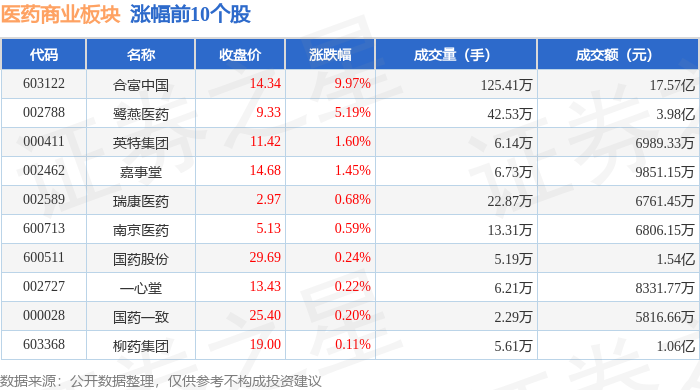
Core Insights - The pharmaceutical commercial sector experienced a decline of 0.52% on November 6, with Renmin Tongtai leading the drop [1] - The Shanghai Composite Index closed at 4007.76, up 0.97%, while the Shenzhen Component Index closed at 13452.42, up 1.73% [1] Stock Performance - The top-performing stock was HeFu China (603122), which closed at 14.34, up 9.97% with a trading volume of 1.2541 million shares and a transaction value of 1.757 billion [1] - Other notable gainers included Yinghe Shiyao (002788) at 9.33, up 5.19%, and Yingche Dong (002462) at 14.68, up 1.45% [1] - Conversely, Renmin Tongtai (600829) saw a significant drop of 9.98%, closing at 65.6 with a trading volume of 521,700 shares and a transaction value of 500 million [2] Capital Flow - The pharmaceutical commercial sector experienced a net outflow of 467 million from institutional investors, while retail investors saw a net inflow of 408 million [2] - The overall capital flow indicates that while institutional investors withdrew funds, retail investors were actively buying into the sector [2] Individual Stock Capital Flow - Notable net inflows from retail investors were observed in stocks like Yifeng Pharmacy (603939) with a retail net inflow of 412.67 million, while institutional investors had a net inflow of 287.47 million in Nanjing Pharmaceutical (600713) [3] - Conversely, stocks like Luyuan Pharmaceutical (002788) and Jia Shitang (002462) experienced net outflows from both institutional and retail investors [3]


AI医疗行业研究报告:AI医疗前景广阔,政策助推应用落地
Guoyuan Securities· 2025-11-05 09:40
Investment Rating - The report recommends a "First Time Buy" rating for the AI healthcare industry [6] Core Insights - The AI healthcare industry is experiencing robust growth, with the market size in China expected to increase from 97.3 billion yuan in 2023 to 159.8 billion yuan by 2028, representing a compound annual growth rate (CAGR) of 10.5% from 2022 to 2028 [2][28] - The industry is supported by various government policies aimed at accelerating the implementation of AI technologies in healthcare settings [3][37] - Different application scenarios within AI healthcare exhibit varying levels of maturity, with medical imaging and drug development showing rapid growth [4][32] Summary by Sections 1. AI Technology Development in Healthcare - AI healthcare refers to the use of advanced technologies such as machine learning, natural language processing, and computer vision to analyze complex medical data, assisting clinical decision-making and optimizing treatment processes [12] - The core technologies in AI healthcare include medical imaging analysis, natural language processing, drug development, and intelligent health management [14][18] 2. Market Size and Growth - The AI healthcare market in China was valued at 97.3 billion yuan in 2023 and is projected to reach 159.8 billion yuan by 2028, with a CAGR of 10.5% [28] - The AI medical imaging market is expected to grow significantly, with a projected size of approximately 74.5 billion yuan in 2024, reflecting a year-on-year growth of 160.5% [32] - The AI drug development market is anticipated to grow from 410 million yuan in 2023 to 5.86 billion yuan by 2028, with a CAGR of 68.5% [33] 3. Policy Support - The Chinese government has introduced multiple policies to support the development of AI in healthcare, including guidelines for AI applications in medical institutions [3][37] - Key policies include the "Artificial Intelligence + Action Plan" and the "Guidelines for the Pricing of AI-Assisted Diagnostic Services" [37] 4. Application Scenarios - AI healthcare applications can be categorized into pre-treatment, during treatment, and post-treatment stages, covering health promotion, disease prevention, diagnosis, treatment, rehabilitation, and chronic disease management [15][19] - The maturity of AI applications varies significantly across different scenarios, with medical imaging analysis being one of the most mature areas [22][24] 5. Key Companies in the Industry - **Weining Health**: Focuses on providing integrated solutions for healthcare information systems and has developed a medical AI model, WiNGPT, enhancing its service capabilities [50][51] - **Chuangye Huikang**: Specializes in healthcare information technology and has developed a comprehensive solution system for clinical decision support and electronic medical records [54][55] - **Yidu Technology**: Offers an AI-driven platform, YiduCore, that supports various healthcare sectors, including public health and clinical research [60][61] - **Donghua Software**: Develops AI solutions for healthcare, focusing on intelligent decision support systems and electronic medical record generation [65][66]
医药商业板块11月4日跌0.5%,百洋医药领跌,主力资金净流入3234.11万元
Zheng Xing Xing Ye Ri Bao· 2025-11-04 08:45
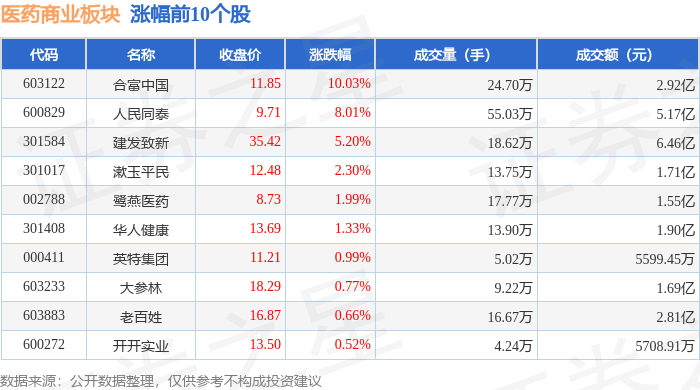
Market Overview - The pharmaceutical commercial sector declined by 0.5% on November 4, with Baiyang Pharmaceutical leading the drop [1] - The Shanghai Composite Index closed at 3960.19, down 0.41%, while the Shenzhen Component Index closed at 13175.22, down 1.71% [1] Stock Performance - Notable gainers included: - HeFu China (603122) with a closing price of 11.85, up 10.03% [1] - Renmin Tongtai (600829) at 9.71, up 8.01% [1] - Jianfa Zhixin (301584) at 35.42, up 5.20% [1] - Baiyang Pharmaceutical (301015) saw a significant decline, closing at 25.62, down 6.09% [2] - Other notable decliners included: - Yifeng Pharmacy (603939) at 23.76, down 3.22% [2] - Saili Medical (603716) at 24.78, down 3.17% [2] Capital Flow - The pharmaceutical commercial sector experienced a net inflow of 32.34 million yuan from institutional investors, while retail investors saw a net outflow of 41.10 million yuan [2] - The capital flow for key stocks showed: - Renmin Tongtai had a net inflow of 63.04 million yuan from institutional investors [3] - Yifeng Pharmacy experienced a net outflow of 32.44 million yuan from retail investors [3]


润达医疗:无逾期担保
Zheng Quan Ri Bao Wang· 2025-11-03 13:11
Core Viewpoint - RunDa Medical (603108) announced that as of the disclosure date, the total external guarantees provided by the company and its subsidiaries amount to 512,100,000 yuan, with no overdue guarantees reported [1] Summary by Category Total Guarantees - The total external guarantees provided by the company and its subsidiaries is 512,100,000 yuan [1] - Among this, the company provided guarantees of 422,100,000 yuan to its subsidiaries, while the subsidiaries provided counter-guarantees of 90,000,000 yuan for the company's bond issuance [1] Actual Guarantee Balance - The actual guarantee balance that has occurred is 321,759,900 yuan, which represents 73.89% of the company's audited net assets as of December 31, 2024 [1] - There are no overdue guarantees reported by the company [1] Related Party Transactions - The company does not provide guarantees to its controlling shareholders, actual controllers, or their related parties [1]
润达医疗(603108) - 关于上月为子公司担保的进展情况公告
2025-11-03 08:45
| 证券代码:603108 | 证券简称:润达医疗 | 公告编号:临 2025-056 | | --- | --- | --- | | 转债代码:113588 | 转债简称:润达转债 | | 上海润达医疗科技股份有限公司 关于上月为子公司担保的进展情况公告 | 资产负债率为 | 70%以上的全资及控股子公司 | | | | | --- | --- | --- | --- | --- | | 担保对 | 被担保人名称 | | 杭州润达医疗管理有限公司 | | | | 本次担保金额 | 万元 16,280 | | | | | 实际为其提供的担保余额 | 161,490.05 万元 | | | | 象一 | 是否在前期预计额度内 | 是 □否 | | □不适用:_________ | | | 本次担保是否有反担保 | □是 否 | | □不适用:_________ | | 担保对 | 被担保人名称 | 公司 | 润达医疗供应链管理(杭州)有限 | | | | 本次担保金额 | 万元 1,000 | | | | 象二 | 实际为其提供的担保余额 | 4,880 万元 | | | | | 是否在前期预计额度内 | ...
润达医疗20251031
2025-11-03 02:36
Summary of Runda Medical's Conference Call Company Overview - **Company**: Runda Medical - **Industry**: Healthcare, specifically focusing on medical testing and AI-driven healthcare solutions Key Points Financial Performance - For the first three quarters of 2025, Runda Medical reported a revenue of **5.268 billion** yuan, a decrease of **14.7%** year-on-year [3] - The net profit attributable to shareholders was **-163 million** yuan, primarily due to the impact of price reductions from centralized procurement policies starting in 2024, which limited hospital client development [3] - Gross margin decreased by **4.12 percentage points** year-on-year, attributed to fixed employee costs and unchanged service quality despite product price reductions [3] AI Business Development - Runda Medical's information technology revenue reached **127 million** yuan, growing by approximately **30%** year-on-year, making it the fastest-growing segment [4] - The company has developed over **20 AI intelligent systems** covering hospital research, clinical management, and patient services, providing digital solutions to around **150 hospitals** [2][5] - A strategic partnership with Huawei aims to enhance digital transformation in hospitals, with plans to accelerate resource allocation for more hospital clients [2][4] Market Challenges and Strategies - The centralized procurement policy has created significant revenue and profit pressure since Q3 2024, leading the company to adjust its business structure and focus on high-margin projects [6] - Runda Medical anticipates a gradual recovery in performance as testing prices stabilize and testing volumes increase, alongside new testing projects entering clinical and insurance directories [6] Order and Client Engagement - The company has accumulated interest from approximately **hundreds of hospitals** for AI solutions, with potential orders valued at around **1 billion** yuan [8] - Currently, **100+ hospitals** have implemented AI solutions, primarily large hospitals with strong capabilities [8] - The decision-making process for clients is lengthy due to high hardware costs, with a typical conversion from interest to revenue taking **six months to a year** [8] Future Outlook - Runda Medical is optimistic about the recovery of the industry and its main business, expecting to return to normal growth trajectories as the healthcare environment stabilizes [22] - The company plans to enhance its AI product offerings and commercialize them effectively, targeting over **10,000** secondary hospitals in China [17][18] - The collaboration with Huawei is not exclusive, as other companies are also involved, but Runda Medical focuses on diverse applications and rich functionality [19] International Expansion - Runda Medical has made progress in international markets, with ongoing discussions in Latin America and engagements in the UAE and Egypt [9] Collaboration with Insurance Companies - The company has launched a health management app in collaboration with Tianjin Taixin Hospital and China Life Insurance, focusing on specialized disease management [14] Accounts Receivable Situation - The company has a low bad debt risk due to its client base of large hospitals, but extended payment periods have affected profit margins [15] - The proportion of accounts receivable over two years has increased by over **10 percentage points** from 2024 to 2025, impacting current profits [15] Conclusion - Runda Medical is navigating a challenging healthcare policy environment while investing in AI technology and digital solutions to enhance its service offerings and market position. The company is focused on recovery and growth through strategic partnerships and innovative product development.
润达医疗的前世今生:2025年三季度营收52.68亿行业排17,净利润-1.26亿敬陪末座
Xin Lang Zheng Quan· 2025-10-31 15:55
Core Viewpoint - RunDa Medical is a leading provider of in vitro diagnostic services in China, established in 1999 and listed on the Shanghai Stock Exchange in 2015, offering comprehensive support to medical laboratories [1] Financial Performance - For Q3 2025, RunDa Medical reported revenue of 5.268 billion yuan, ranking 17th among 24 companies in the industry, significantly lower than the top company Shanghai Pharmaceuticals at 215.072 billion yuan and the industry average of 29.222 billion yuan [2] - The company recorded a net profit of -126 million yuan, placing it at the bottom of the industry rankings, with the industry leader Shanghai Pharmaceuticals achieving a net profit of 5.986 billion yuan [2] Financial Ratios - As of Q3 2025, RunDa Medical's debt-to-asset ratio was 61.60%, slightly lower than the previous year's 61.66% but above the industry average of 59.74% [3] - The gross profit margin for Q3 2025 was 21.52%, down from 25.64% year-on-year, yet still higher than the industry average of 13.11% [3] Shareholder Information - As of September 30, 2025, the number of A-share shareholders decreased by 1.05% to 64,800, while the average number of circulating A-shares held per shareholder increased by 1.06% to 9,317.14 [5] - Among the top ten circulating shareholders, notable changes included a decrease in holdings by the Southern CSI 1000 ETF and the entry of Hong Kong Central Clearing Limited as a new shareholder [5] Business Highlights - The company is actively optimizing its business structure, with the number of clients increasing to 448 [5] - RunDa Medical's industrial segment has made significant progress in overseas markets, with core products receiving FDA 510K certification [5] - The company is deepening its AI strategy, with medical information technology revenue growing by 40.73% year-on-year [5] - Forecasts for revenue from 2025 to 2027 are 8.085 billion, 8.703 billion, and 9.456 billion yuan, with net profits projected at 199 million, 238 million, and 275 million yuan respectively [5][6]

10.62亿主力资金净流入,猴痘概念涨3.20%
Zheng Quan Shi Bao Wang· 2025-10-31 09:58
Core Insights - The monkeypox concept stock increased by 3.20%, ranking 10th among concept sectors, with 69 stocks rising, including notable gainers like Zhongsheng Pharmaceutical and HeFu China, which hit the daily limit [1][2] - The sector saw a net inflow of 1.062 billion yuan, with 46 stocks receiving inflows, and five stocks attracting over 50 million yuan each, led by Zhongsheng Pharmaceutical with a net inflow of 305 million yuan [2][3] Stock Performance - Top gainers in the monkeypox sector included: - Zhongsheng Pharmaceutical: +10.02% with a turnover rate of 10.14% and a net inflow of 304.73 million yuan [3][4] - Asia-Pacific Pharmaceutical: +9.99% with a turnover rate of 21.34% and a net inflow of 258.69 million yuan [3][4] - Other notable performers included Yipin Hong (+9.94%) and Toukeng Life (+8.81%) [1][4] - Decliners in the sector included: - Kefu Medical: -4.35% - *ST Suwu: -1.98% - Jianfeng Group: -1.81% [1][6] Fund Flow Analysis - The top three stocks by net inflow ratio were: - Asia-Pacific Pharmaceutical: 21.24% - Zhongsheng Pharmaceutical: 20.95% - Hainan Hai Pharmaceutical: 16.73% [3][4] - The overall fund flow into the monkeypox concept was significant, indicating strong investor interest [2][3]


