
Blue Owl Capital Inc.

Search documents
美股迎关键考验周:美联储主席候选人搅动债市,AI“淘金热”切换赛道,科技股面临“守卫更迭”
智通财经网· 2025-12-15 01:33
Market Overview - The stock market experienced a decline last Friday, with the Nasdaq Composite Index dropping approximately 1.7%, while the Dow Jones Industrial Average and the S&P 500 Index fell by 0.5% and 1% respectively [1] - This week, the Nasdaq Index is down about 1.5%, while the Dow Jones Index has risen over 1%. The S&P 500 Index decreased by 0.6% but closed at a historical high on Thursday [1] Federal Reserve and Leadership Speculation - The Federal Open Market Committee (FOMC) recently lowered interest rates by 25 basis points, marking the third rate cut of 2025 and the most contentious decision of the year, with three members dissenting [2] - Market attention is shifting towards potential candidates to succeed Jerome Powell as Fed Chair, with Kevin Hassett and Kevin Walsh being prominent names. As of last Friday, Hassett had a 73% probability of being nominated, while Walsh's chances increased to 39% after a recent report [2][3] Corporate Earnings and Market Sentiment - Major companies such as Micron, Accenture, Nike, FedEx, and Darden Restaurants are set to report their quarterly earnings this week, which will be closely monitored by investors [1] - Oracle's stock fell over 10% after announcing that AI-related costs would exceed expectations, while Broadcom's earnings report indicated profit pressures, leading to an 11% drop in its stock [5] AI Investment Trends - The recent surge in debt issuance by large companies, particularly in the investment-grade bond market, has reached $75 billion in September and October, significantly higher than the pre-pandemic average of $37 billion per year [5] - Analysts suggest that the next major beneficiaries of AI technology may not be chip manufacturers or large-scale companies, but rather businesses that implement this technology to enhance growth and productivity [5]


ROSEN, A LONGSTANDING LAW FIRM, Encourages Blue Owl Capital Inc. Investors to Secure Counsel Before Important Deadline in Securities Class Action - OWL
TMX Newsfile· 2025-12-14 14:00
Core Viewpoint - Rosen Law Firm is reminding investors who purchased Blue Owl Capital Inc. securities between February 6, 2025, and November 16, 2025, about the upcoming lead plaintiff deadline on February 2, 2026, for a class action lawsuit [1]. Group 1: Class Action Details - Investors who bought Blue Owl securities during the specified Class Period may be eligible for compensation without incurring out-of-pocket fees through a contingency fee arrangement [2]. - A class action lawsuit has already been filed, and interested parties can join by contacting Rosen Law Firm [3][6]. - To serve as lead plaintiff, individuals must file a motion with the Court by February 2, 2026 [3]. Group 2: Case Allegations - The lawsuit alleges that during the Class Period, Blue Owl made false or misleading statements and failed to disclose significant issues, including pressure on its asset base from BDC redemptions and undisclosed liquidity problems [5]. - It is claimed that Blue Owl was likely to limit or halt redemptions of certain BDCs, and the defendants downplayed the severity of these issues, leading to materially misleading positive statements about the company's business and prospects [5].




Finance of America Announces $2.5 Billion Strategic Partnership with Funds Managed by Blue Owl to Expand FOA's Home Equity Lending
Businesswire· 2025-12-11 22:19
Core Insights - Finance of America Companies Inc. has announced the expansion of a $2.5 billion strategic partnership with Blue Owl Capital to enhance product innovation and distribution for the growing retirement demographic in the U.S. [1] Company Overview - Finance of America is a leading provider of home equity-based financing solutions tailored for modern retirement needs [1]. - Blue Owl Capital is recognized as a prominent alternative asset manager [1]. Strategic Partnership Details - The partnership aims to accelerate the development and distribution of financial products specifically designed for the fast-growing retirement demographic in the nation [1]. - The total value of the partnership is set at $2.5 billion, indicating a significant commitment to innovation in this sector [1].


Blackstone, Apollo, and Blue Owl are all in on data center bets — but there's one thing making them wary
Business Insider· 2025-12-11 17:14
Core Insights - Concerns about an AI bubble are rising, yet major private investors remain optimistic about their investments in data centers and AI technology [1][2] Investment Sentiment - Blackstone's President Jon Gray highlighted that data centers are the firm's biggest moneymaker, while Ares CEO Michael Arougheti noted that international data center investments are exceeding expectations and enhancing revenue forecasts [2] - Blue Owl co-CEO Doug Ostrover expressed strong confidence in data center investments, indicating a positive outlook for continued investment growth [2] Demand and Supply Dynamics - Apollo CEO Marc Rowan emphasized the global demand for data center capacity, stating that major users require more compute resources, but supply is constrained by natural, energy, and regulatory limits [3][4] - Ostrover pointed out an unprecedented supply-demand imbalance in the market, with demand accelerating while supply remains stagnant [4] Risk Considerations - Rowan discussed the risks associated with lease renewals for data centers, indicating a preference for lease-up risk over renewal risk, as the future of energy and compute usage remains uncertain [5] - The variability in energy usage projections for 2030 raises concerns about the reliability of long-term investments in data centers [5] Lease Quality and Investment Strategy - Blackstone focuses on long-term lease data centers, only commencing construction with a 15-plus year lease from large market cap companies, thereby mitigating risk [6] - Blue Owl's strategy includes securing favorable leases with high-quality tenants, transitioning from traditional tenants to major tech companies like Microsoft and Google, which enhances investment security [9][10] Financial Returns - Blue Owl's triple-net-lease business model, where tenants cover taxes, insurance, and maintenance, has historically yielded over 20% returns, and the firm expects similar terms with top-tier tenants [8][9] - Even in scenarios where facilities may have no residual value at the end of their lives, Ostrover believes returns can still be achieved, indicating a robust investment strategy [10]



ROSEN, A RANKED AND LEADING LAW FIRM, Encourages Blue Owl Capital Inc. Investors to Secure Counsel Before Important Deadline in Securities Class Action – OWL
Globenewswire· 2025-12-10 00:54
Core Viewpoint - A class action lawsuit has been filed against Blue Owl Capital Inc. for misleading statements regarding its financial health and liquidity issues during the specified Class Period from February 6, 2025, to November 16, 2025 [1][5]. Group 1: Lawsuit Details - The lawsuit claims that Blue Owl made false or misleading statements and failed to disclose significant pressures on its asset base due to business development companies (BDC) redemptions, leading to undisclosed liquidity issues [5]. - It is alleged that Blue Owl was likely to limit or halt redemptions of certain BDCs, and that the defendants downplayed the severity of the negative impacts, resulting in materially misleading statements about the company's business and prospects [5]. Group 2: Investor Information - Investors who purchased Blue Owl securities during the Class Period may be entitled to compensation without any out-of-pocket fees through a contingency fee arrangement [2]. - To participate in the class action, investors can visit the provided link or contact the law firm for more information [3][6]. Group 3: Law Firm Credentials - The Rosen Law Firm has a strong track record in securities class actions, having achieved significant settlements, including the largest securities class action settlement against a Chinese company [4]. - The firm has consistently ranked highly in securities class action settlements and has recovered hundreds of millions of dollars for investors, with over $438 million secured in 2019 alone [4].

BLUE OWL ALERT: Bragar Eagel & Squire, P.C. Announces that a Class Action Lawsuit Has Been Filed Against Blue Owl Capital, Inc. and Encourages Investors to Contact the Firm
Globenewswire· 2025-12-06 14:25
Core Viewpoint - A class action lawsuit has been filed against Blue Owl Capital, Inc. for allegedly making materially false and misleading statements regarding its business operations and financial health during the specified class period from February 6, 2025, to November 16, 2025 [2][3]. Allegation Details - The lawsuit claims that Blue Owl failed to disclose significant pressures on its asset base due to Business Development Company (BDC) redemptions [3]. - It is alleged that the company faced undisclosed liquidity issues as a result of these pressures [3]. - The complaint suggests that Blue Owl was likely to limit or halt redemptions of certain BDCs, which was not communicated to investors [3]. - Positive statements made by the company regarding its business and prospects are claimed to be materially misleading and lacking a reasonable basis [3]. Next Steps - Investors who purchased Blue Owl shares and suffered losses are encouraged to contact the law firm for more information and to discuss their rights [4]. - There is no cost or obligation for investors to inquire about their claims [4]. About the Law Firm - Bragar Eagel & Squire, P.C. is a nationally recognized law firm that represents individual and institutional investors in various types of litigation, including securities and commercial cases [5]. - The firm operates nationwide and has offices in New York, South Carolina, and California [5].


X @Bloomberg
Bloomberg· 2025-12-03 18:24
Blue Owl pulled a plan to merge a smaller fund into the listed Blue Owl Capital last month, with management expressing frustration that the BDC was trading at a steep discount to the value of its portfolio. https://t.co/hhzI9yyfeb ...
Should Investors Buy Spectrum Brands as Callodine Capital Keeps Adding to its Largest Position?
The Motley Fool· 2025-12-02 18:16
Company Overview - Spectrum Brands is a diversified consumer products company with a global footprint and a portfolio of well-established brands, focusing on essential products for households and pets [5] - The company generates revenue primarily through product sales to retailers, e-commerce platforms, wholesalers, and distributors on a global scale [7] - Spectrum Brands offers branded consumer products across home appliances, personal care, pet care, and home and garden categories, with leading brands such as Black & Decker, Remington, IAMS, and Spectracide [7] Financial Performance - As of September 30, 2025, Spectrum Brands reported a revenue of $2.81 billion and a net income of $99.90 million [4] - The company's dividend yield stands at 3.27% [4] - The stock price as of December 1, 2025, was $57.44, reflecting a 38% decline over the past year and underperforming the S&P 500 by 51 percentage points [3][4] Investment Insights - Callodine Capital has increased its investment in Spectrum Brands by 360,898 shares, raising its total holding to 1,714,955 shares valued at $90.09 million, which accounts for 7.89% of Callodine's assets under management [2][3] - The stock's price-to-sales ratio of 0.5 is the lowest since the 2020 crash, indicating a potential value opportunity [9] - Spectrum Brands is currently trading at 12 times forward earnings, and the company has been actively buying back shares, having repurchased nearly half of its outstanding shares after selling its hardware and home improvement business for $4.1 billion in 2023 [10][11] Strategic Positioning - The company emphasizes brand strength and multi-channel distribution, enabling it to reach a broad customer base and adapt to shifting consumer preferences [8] - Spectrum Brands is currently considering a divestiture of its home and personal goods unit, aiming to replicate the success of its previous sale [11]


资本视角聊聊万亿大基建钱从哪儿来,以及电力破局的六条路径
3 6 Ke· 2025-11-26 07:51
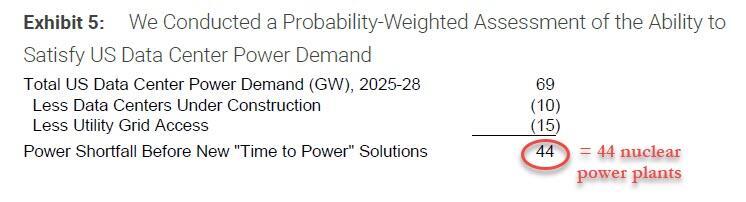
Core Insights - The core issue facing the AI infrastructure in the U.S. is a significant power shortage, with a projected gap of 44 GW by 2028, equivalent to the output of 44 nuclear power plants [1][3] - The construction cost for each additional 1 GW of data center capacity is approximately $50 billion, leading to discussions about a potential AI investment bubble [1][3] - The transition of cryptocurrency miners to AI data centers could potentially provide up to 15 GW of power within the next 18-24 months [3][4] Power Shortage Solutions - The first conventional method to address the power shortage is the transition of Bitcoin miners to AI data centers, which could release 15 GW of power [3][4] - Nuclear power is considered a long-term solution, with significant construction timelines, making it unfeasible for immediate needs [5][7] - Natural gas is another option, but supply chain constraints for gas turbines limit its short-term viability [8][9] - Fuel cell storage and solar plus storage solutions are also discussed, but they are not expected to resolve the immediate power shortage [10][11] Financing AI Infrastructure - The financing for AI infrastructure is a critical concern, with companies like CoreWeave facing significant debt levels and high-interest rates [22][25] - Investment-grade bonds and high-yield bonds are potential financing avenues, with estimates suggesting that the investment-grade market could address $1.5 trillion in financing needs over the next five years [39][40] - Asset-backed securities (ABS) and collateralized debt obligations (CDOs) are proposed as methods to package and sell future cash flows from data centers to investors [28][30] Market Dynamics and Competition - NVIDIA is positioned as a central player in the GPU market, with its partnerships with companies like OpenAI reinforcing its market dominance [41][42] - The competitive landscape is influenced by the need for AI companies to invest heavily in infrastructure to avoid being left behind, creating a "herd mentality" among major players [45][46] - The potential for over-investment exists, but current discussions suggest that the industry is still in the early stages of leveraging debt for expansion [47][48] Transition of Cryptocurrency Miners - The transition of cryptocurrency miners to AI data centers is seen as a viable solution, with early movers like CoreWeave benefiting from their strategic positioning [52]




11 Investment Must Reads for This Week (Nov. 25, 2025)
Yahoo Finance· 2025-11-25 17:03
Group 1 - Oddball funds, which are not tied to traditional stock and bond markets, offer high diversification potential but may also create investor anxiety due to their idiosyncratic nature [1] - UBS has lowered the minimum asset threshold for its Consolidated Advisory Program and alternative investments-dedicated CAP Select offering, expanding eligibility for alternative-friendly advisory programs [2] - Financial advisors are increasingly utilizing model portfolios for their scalability in portfolio management, whether built in-house or outsourced [3] Group 2 - The AI boom has led to a decline in the quality of investments as investors chase high returns, raising concerns about the neglect of balance sheets [4] - The anticipated influx of new cryptocurrency-focused ETFs due to eased US regulations is expected to create more accessible and liquid investment options in the crypto space [5] - Over 1,300 active ETFs have launched in 2024, with lower fees and greater tax efficiency being key advantages over traditional mutual funds [6] Group 3 - BlackRock's private credit CLO has failed to meet performance tests, leading to management fee waivers and a need for corrective measures to protect safer securities [7] - Clarion Partners Real Estate Income Fund is transitioning to an interval fund structure to enhance liquidity for shareholders, marking a significant change under the Investment Company Act of 1940 [8] - The misfire at Blue Owl highlights the importance of proration in semiliquid funds, allowing managers to handle less liquid assets without facing large redemption pressures [9] Group 4 - The IMF has raised concerns regarding the rapid growth of private credit investments and the emergence of new private rating agencies, which could impact the quality of investment-grade classifications [10] - The growth of retail funds is creating new risks for general partners (GPs), necessitating preparations for potential industry-wide effects such as shifting allocations and liquidity stress [11]