Arthrosi

Search documents
卖掉痛风创新药,一品红靠什么支撑股价?
Guo Ji Jin Rong Bao· 2025-12-16 12:45
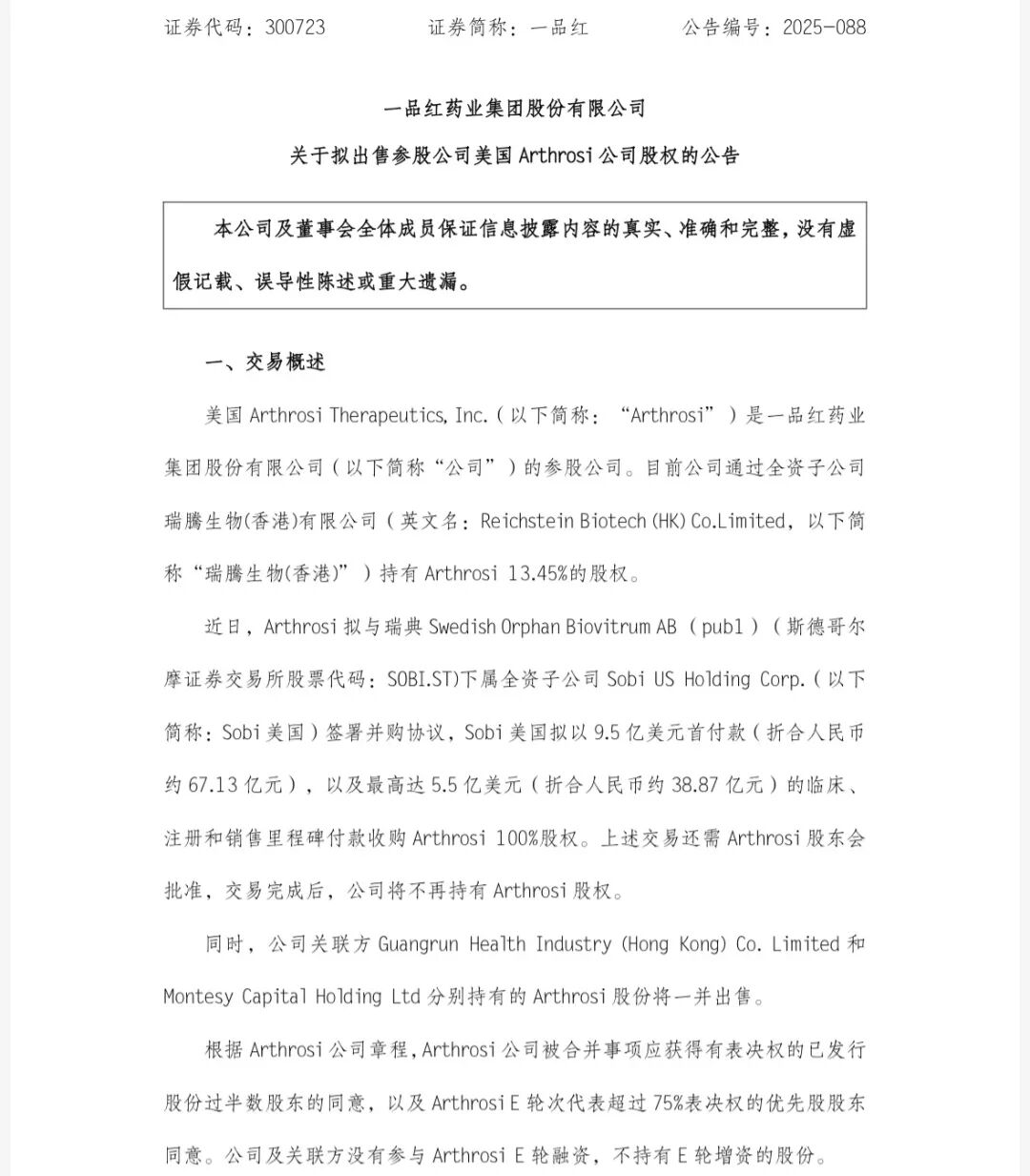
Core Viewpoint - Yipinhong (300723) announced the sale of its 13.45% stake in the US company Arthrosi to Swedish rare disease giant SOBI for a total value of approximately $1.5 billion (about 10.6 billion RMB), which includes an upfront payment of $950 million (about 6.71 billion RMB) and potential milestone payments of up to $550 million [1][3]. Group 1: Company Overview - Yipinhong was established in 2002 and listed on the Shenzhen Stock Exchange in November 2017, focusing on the entire pharmaceutical industry chain, primarily in pediatric and chronic disease medications [4]. - As of the end of 2024, the company holds 193 drug registration approvals, including 82 national medical insurance varieties and 39 ongoing research projects [4]. Group 2: Financial Performance - Following the announcement of the stake sale, Yipinhong's stock price fell sharply, prompting the company to announce a share buyback plan of 100 million to 200 million RMB at a price not exceeding 70 RMB per share [5]. - The company's revenue from 2021 to 2024 was 2.199 billion RMB, 2.280 billion RMB, 2.505 billion RMB, and 1.45 billion RMB, respectively, with net profits declining from 293 million RMB in 2021 to a loss of 567 million RMB in 2024 [7]. Group 3: Regulatory Issues - In July 2024, Yipinhong's subsidiary was found to have violated bidding regulations in a national drug procurement process, resulting in the cancellation of its qualification and a return of 266 million RMB in medical insurance funds [8]. Group 4: Product Development and Competition - The drug AR882, which Yipinhong retains exclusive rights to in China, is currently undergoing critical phase III clinical trials and has received FDA fast track designation [10]. - However, AR882 faces competition from other URAT1 inhibitors, including Japan's Lesinurad, which has been approved in China and is set to enter the market in 2025 [11].


利空突袭,5倍创新药牛股大幅杀跌,股价腰斩
Xin Lang Cai Jing· 2025-12-16 10:49
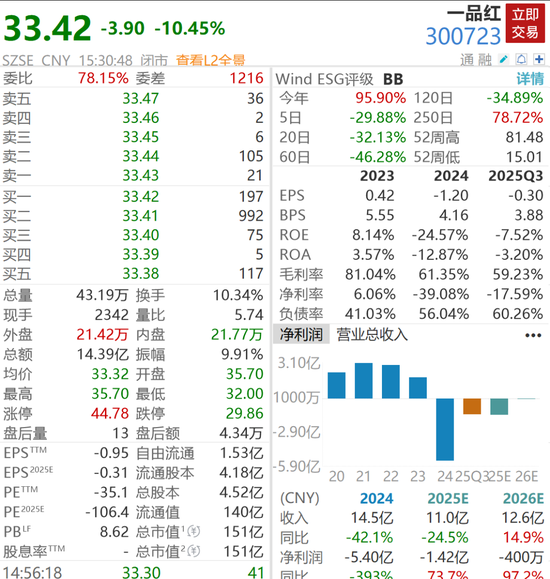
Core Viewpoint - The stock price of Yipin Hong has experienced a dramatic decline, dropping to a six-month low of 33.42 CNY per share, with a market capitalization of approximately 15 billion CNY, following a series of sell-offs triggered by a perceived negative market reaction to a recent acquisition announcement [1][12]. Company Performance - Yipin Hong's stock price fell by 20% on December 15 and continued to decline by over 10% on December 16, marking a significant downturn from a previous high where the stock had increased by over 500% from September of the previous year to July of this year [1][12][14]. - The company announced a share buyback plan of 100 million to 200 million CNY, with a maximum buyback price of 70.00 CNY per share, to be funded by its own and self-raised funds within three months [3][15]. Acquisition Announcement - Yipin Hong's recent acquisition of its U.S. partner Arthrosi by Sobi for 950 million USD upfront and up to 550 million USD in milestone payments has been interpreted negatively by the market, despite the conventional view that such acquisitions are beneficial [4][5][15]. - Concerns from investors include the acquisition price being lower than expected, leading to doubts about the commercialization prospects of the core drug AR882 [5][16]. Financial Outlook - The company is projected to incur a net loss of 472 million to 679 million CNY in 2024, a stark contrast to a profit of 185 million CNY in the previous year, indicating significant financial pressure [16]. - Yipin Hong faces additional challenges, including asset impairment and cash flow pressures, with expected non-recurring losses impacting cash flow by approximately 295 million CNY [16][18]. Industry Context - The pharmaceutical sector is undergoing a shift in valuation logic, moving away from relying solely on innovation concepts for premium valuations to a focus on pipeline progress, commercialization capabilities, and performance realization [19][20]. - The market is increasingly demanding higher profitability from pharmaceutical companies, particularly in light of ongoing policy changes aimed at cost reduction and efficiency in the industry [19][21]. Long-term Prospects - Yipin Hong's future growth will depend on the successful clinical progress of its drug pipeline, particularly AR882, and the ability of its new manufacturing base to achieve breakeven [19][20]. - The valuation of Yipin Hong may shift from a research-focused pharmaceutical company to an innovative drug core manufacturer if it can establish stable cash flows through its global supply rights [22].
利空突袭,5倍创新药牛股大幅杀跌,股价腰斩
21世纪经济报道· 2025-12-16 10:42
Core Viewpoint - The stock of Yipin Hong has experienced significant volatility, with a dramatic decline in price following a series of sell-offs, reflecting investor concerns over its recent acquisition and financial outlook [1][7][11]. Group 1: Stock Performance - On December 15, Yipin Hong's stock price fell sharply, hitting the 20% limit down within half an hour of trading, and continued to decline over the next day, closing at 33.42 CNY per share, with a market capitalization of approximately 15 billion CNY [1][2]. - The stock had previously surged over 500% from late September to July but has since halved in value, with year-to-date gains now below 100% [2][7]. Group 2: Acquisition Announcement - On December 14, Yipin Hong announced that its associated company, Arthrosi, would be acquired by Sobi for a total of 9.5 billion USD upfront and up to 5.5 billion USD in milestone payments, which raised concerns among investors [6][7]. - Investors expressed worries that the acquisition price was below expectations, leading to doubts about the commercial prospects of Yipin Hong's core drug, AR882 [7][8]. Group 3: Financial Outlook - Yipin Hong projected a net loss of 472 million to 679 million CNY for 2024, a stark contrast to a profit of 185 million CNY in the previous year, indicating significant financial pressure [7][9]. - The company faces additional challenges, including asset impairment and cash flow pressures, with expected non-recurring losses impacting its financial stability [7][9]. Group 4: Market Sentiment and Valuation Changes - The market's reaction indicates a shift in valuation logic within the pharmaceutical sector, moving away from relying solely on innovation concepts to a focus on pipeline progress, commercialization capabilities, and earnings realization [11][12]. - The average price-to-sales ratio for unprofitable biotech companies has dropped from 30 times to 8-12 times, reflecting a market that is increasingly intolerant of unclear profit paths [12][13]. Group 5: Long-term Prospects - Despite short-term pressures, Yipin Hong's innovation strategy aligns with supportive policies for new drugs, which could benefit the company in the long run if it successfully navigates current challenges [9][12]. - The future valuation of Yipin Hong will depend on the successful commercialization of its drug pipeline and the ability to generate stable cash flows from its global supply rights [13].

创新药押注下业绩阵痛 :一品红9.5亿美元并购利好却引抛售
2 1 Shi Ji Jing Ji Bao Dao· 2025-12-16 06:33
Core Viewpoint - The stock price of Yipinhong experienced a dramatic drop of 20% following the announcement of a merger involving its associated company, Arthrosi, which raised concerns about the valuation logic in the pharmaceutical sector and the survival of innovative drug companies [1][4]. Group 1: Stock Price Movement - On December 15, Yipinhong's stock opened significantly lower, hitting the 20% limit down within half an hour, closing at 37.32 yuan per share, with a market capitalization dropping below 17 billion yuan [1]. - Following the merger announcement, the stock continued to show a decline, with a drop of over 10% observed in early trading on December 16 [3]. Group 2: Merger Announcement and Market Reaction - The merger announcement revealed that Arthrosi would be acquired by Sobi for an upfront payment of $950 million and potential milestone payments of up to $550 million, which raised doubts about the expected valuation of the deal [4]. - Investors expressed concerns regarding the acquisition price being lower than anticipated, leading to skepticism about the commercialization prospects of the core drug AR882 [4][5]. Group 3: Financial Performance and Projections - Yipinhong projected a net loss of 472 million to 679 million yuan for 2024, a significant decline from a profit of 185 million yuan in the previous year, indicating short-term performance challenges [4]. - The company is also facing cash flow pressures due to required payments for medical insurance refunds and asset impairment provisions totaling approximately 110.26 million yuan [4]. Group 4: Innovation and R&D Focus - Yipinhong is focusing on innovative drugs in the "children's medicine + chronic disease medicine" sectors, with R&D expenses expected to exceed 22% of revenue in 2024 [6]. - The core pipeline drug AR882 has entered Phase III clinical trials and has received FDA fast track designation, indicating its potential as a significant product in the gout treatment market [6]. Group 5: Industry Valuation Changes - The stock price movement reflects a shift in the valuation logic of the pharmaceutical sector, where investors are now prioritizing the certainty of pipeline progress, commercialization ability, and performance realization over mere innovation concepts [9]. - The market is demanding higher profitability from pharmaceutical companies, with a notable decline in the average price-to-sales ratio for biotech firms, indicating a lower tolerance for unclear profitability paths [10]. Group 6: Long-term Outlook and Valuation - Despite short-term pressures, long-term policies favor innovative drug companies, with initiatives aimed at expediting clinical trial reviews and including innovative drugs in medical insurance coverage [7]. - The valuation of Yipinhong may shift from a research-focused model to a core manufacturer of innovative drugs if it can establish stable cash flows through its global supply rights [11].
创新药概念再度走低 诺诚健华跌超5% 下半年来医药BD交易短暂真空
Zhi Tong Cai Jing· 2025-12-16 03:18
值得关注的是,A股创新药大牛股一品红(300723)昨日意外跌停,今早再跌超13%。该公司参股的美 国Arthrosi公司收到收购要约,交易总金额最高可达15亿美元。有分析称,一品红的交易可能改变了一 些市场预期。此前市场预期的这个标的是按现在的收购价进行BD,但现在是直接卖出。而此前,股价 上涨太多,并且反应的是BD,现在预期走弱,故而股价跌停。 创新药概念股再度走低,截至发稿,诺诚健华(09969)跌5.09%,报12.86港元;石药集团(01093)跌 3.99%,报7.21港元;信达生物(01801)跌3.36%,报79港元。 中邮证券指出,下半年以来,国内的BD出海交易虽有短暂真空,但仍在持续,Q4以来亦诞生了多个 MNC为合作方的交易。该行认为,海外MNC的购买行为系对国内创新药公司创新研发的实力的背书认 可。进一步看,该行认为系中国创新药产业链能力、管线数量和质量、研发效率在全球的强大竞争优势 催生出的结果,坚定看好长期的产业趋势。 ...

4000万美元投资收益挡不住日内近15%股价跳水,维亚生物当前价值几何?
Zhi Tong Cai Jing· 2025-12-15 12:36
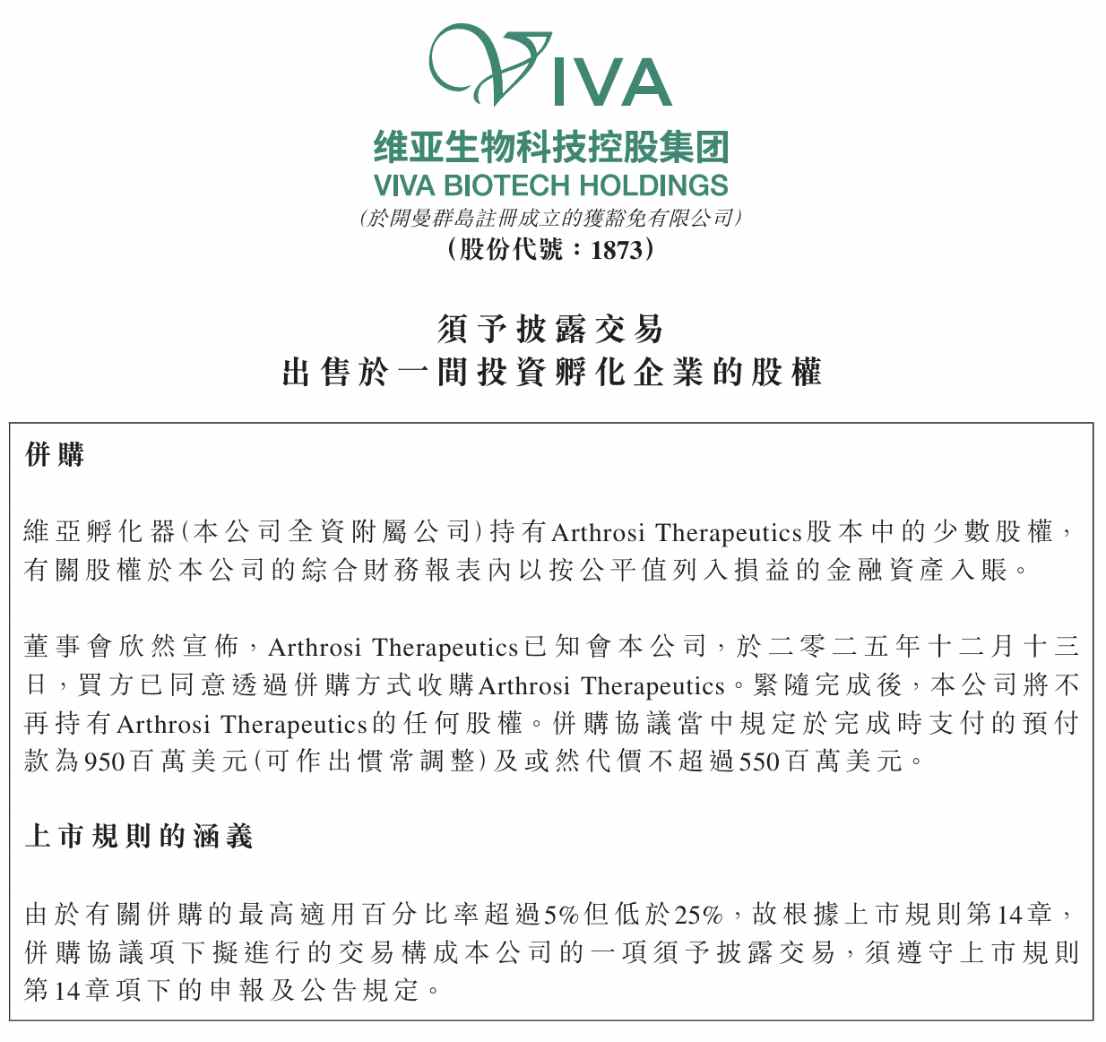
Group 1: Acquisition Announcement - Via Biotechnology (01873) announced that Swedish Orphan Biovitrum AB (Sobi) has reached an acquisition agreement for Arthrosi, with a total transaction value of up to $1.5 billion, including $950 million upfront and up to $550 million in regulatory and commercial milestone payments, expected to be completed in the first half of 2026 [1] - Via Biotechnology anticipates a maximum investment return of approximately $40 million from this transaction, contingent on subsequent regulatory approvals and commercialization milestones [6] Group 2: Stock Performance - Following the announcement, Via Biotechnology's stock opened high on December 15, reaching a peak of HKD 2.21, a 13.92% increase, but the market sentiment quickly reversed, leading to a significant drop in stock price later in the day [6] - The stock has been in a downward trend for two months, with a peak of HKD 3.27 on October 8, followed by a decline to a low of HKD 1.80 on November 24, representing a maximum drop of 44.95% [7] - The stock's trading volume during the recent price increases was significantly higher than during previous periods, indicating a "volume-price rise" characteristic, but the October rally showed signs of weakness with declining trading volumes [8][9] Group 3: Market Sentiment and Valuation - The stock's profit-taking behavior has been observed, with the proportion of profitable shares dropping from 100% on October 8 to 24.69% by December 12, while the average cost remains at HKD 2.30 [11] - The current market sentiment reflects a cautious approach towards AI investments, with a shift from enthusiasm to prudence, impacting Via Biotechnology as an AI concept stock [13] - Despite recent declines, Via Biotechnology's price-to-sales (PS) ratio is currently at 2.05, significantly lower than the industry average of 8.66, suggesting that the company may be undervalued [18] Group 4: Business Model and Financial Performance - Via Biotechnology has been actively investing in and incubating high-potential biotech startups through an "Equity for Service" model, exchanging early drug development services for equity stakes, with 93 companies incubated and 18 achieving partial or full exits [15] - The company's AI-driven drug development services are becoming a significant revenue driver, with AI-related orders accounting for 12% of new signed orders [14] - For the first half of 2025, the company reported revenues of RMB 832 million, a 15.27% decrease year-on-year, while net profit attributable to shareholders increased by 4.28% to RMB 122 million, with a gross margin of 40.8% [14]
4000万美元投资收益挡不住日内近15%股价跳水,维亚生物(01873)当前价值几何?
智通财经网· 2025-12-15 12:32
Core Viewpoint - Via Biotechnology (01873) announced a $1.5 billion acquisition agreement with Swedish Orphan Biovitrum AB (Sobi) for Arthrosi, with an upfront payment of $950 million and up to $550 million in regulatory and commercial milestone payments, expected to close in the first half of 2026 [1] Group 1: Financial Impact and Stock Performance - Via Biotechnology anticipates a maximum investment return of approximately $40 million from the transaction, contingent on regulatory approvals and commercialization milestones [6] - Following the announcement, Via Biotechnology's stock opened at a high of HKD 2.21, reflecting a 13.92% increase, but the stock price later declined, indicating market volatility [6][10] - The stock has experienced a significant decline of 44.95% since reaching a high of HKD 3.27 on October 8, with a minimum price of HKD 1.8 on November 24 [6][10] Group 2: Market Sentiment and Trading Volume - The recent stock price increase was characterized by a "volume-price rise" pattern, with daily trading volumes exceeding 20 million shares during the price increase phase [7] - However, the October rally showed signs of weakness, with declining trading volumes, indicating a lack of market confidence and leading to subsequent price drops [7][8] - The proportion of profitable shares held by investors decreased from 100% on October 8 to 24.69% by December 12, suggesting a shift in market sentiment [10] Group 3: AI and Business Model Developments - Via Biotechnology has been integrating AI into its drug development services, with AI-related orders now accounting for 12% of new signed orders, reflecting a growing trend [13] - The company has adopted an "Equity for Service" model, investing in high-potential biotech startups in exchange for equity, which has resulted in significant returns and a robust product pipeline [14] - As of the first half of 2025, Via Biotechnology has invested in 93 companies, with 18 achieving partial or full exits, and a total of 228 product pipelines, indicating a strong growth trajectory [14] Group 4: Valuation and Investment Considerations - After two months of declining stock prices, Via Biotechnology's price-to-sales (PS) ratio stands at 2.05, significantly below the industry average of 8.66, suggesting it is undervalued [17] - The company’s fundamentals are improving, and the current valuation presents an opportunity for investors to consider [17]
一品红战略布局收获验证:痛风新药中国权益与全球供应权价值凸显
Zheng Quan Ri Bao· 2025-12-15 07:45
Core Viewpoint - Yipinhong Pharmaceutical Group Co., Ltd. has strategically retained key rights in the acquisition of the innovative gout drug AR882, ensuring long-term benefits and market control in Greater China [2][3] Group 1: Company Strategy - Yipinhong holds 100% market rights for AR882 in Greater China, including Hong Kong, Macau, and Taiwan, regardless of the acquisition's outcome [2][3] - The company has secured priority rights to supply AR882 globally, allowing it to participate in the international supply chain and share in product sales revenue [3] Group 2: Product Development - AR882, a next-generation URAT1 inhibitor, is currently in critical Phase III clinical trials targeting patients with limited treatment options for gout, particularly those with tophi [2] - The large population of hyperuricemia and gout patients in China presents significant market potential for AR882 [3] Group 3: Market Positioning - Yipinhong's dual-track strategy combines domestic market leadership with international supply chain involvement, enhancing its position in the gout treatment sector [3] - The company's proactive rights arrangement ensures ongoing participation and future revenue sharing from this important innovative drug [3]
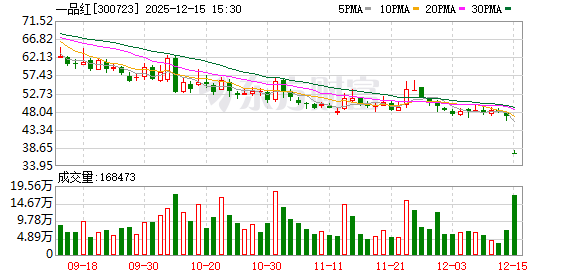
突然崩了!5倍大牛股一品红20%封死跌停,创新药集体回调
Zheng Quan Shi Bao Wang· 2025-12-15 05:18
Company Summary - Yipinhong (300723) experienced a sudden 20% drop in stock price despite a favorable announcement regarding its product Qinxiangqing oral solution being approved as a national second-level protected traditional Chinese medicine [1][3] - The company’s stake in the US company Arthrosi received a buyout offer with a total transaction value of up to $1.5 billion (approximately 10.6 billion RMB), but the market's expectations shifted from a business development (BD) perspective to a direct sale, leading to a decline in stock price [1][2] - Yipinhong's stock had previously surged over 500% from September last year to July this year, but has since halved in value, indicating a potential market correction [2] Industry Summary - The overall performance of the innovative drug sector was negatively impacted, with the Hong Kong innovative drug index dropping over 2% and several companies experiencing declines of more than 5% [4] - The innovative drug business development (BD) transactions in China have seen explosive growth this year, with projections suggesting that by the end of 2025, the transaction volume will exceed $100 billion, accounting for nearly 50% of global transactions [4] - The Chinese innovative drug market is expected to grow from approximately 819.8 billion RMB in 2020 to 1.14 trillion RMB by 2024, with a compound annual growth rate of 8.53%, and is projected to surpass 1.22 trillion RMB by 2025 [5]

20%封死跌停!5倍大牛股,突发!
券商中国· 2025-12-15 04:22
Core Viewpoint - Yipin Hong (一品红) experienced a sudden 20% drop in stock price despite a favorable announcement regarding its product Qinxiang Qingjie Oral Liquid being approved as a national second-level protected traditional Chinese medicine [1][5]. Group 1: Company Developments - Yipin Hong's stock price fell to the limit down after a significant rise of over 500% from September last year to July this year, indicating a market correction following excessive valuation [3][4]. - The company announced that its stake in the U.S. company Arthrosi was subject to a buyout offer totaling up to $1.5 billion (approximately ¥10.6 billion), which analysts believe reflects a shift in market expectations regarding business development (BD) transactions [1][3]. - Despite the approval of Qinxiang Qingjie Oral Liquid, which is expected to enhance its market competitiveness in pediatric medicine, this positive news did not mitigate the negative market reaction [5]. Group 2: Market Impact - The decline in Yipin Hong's stock negatively affected the overall performance of the innovative drug sector, with the Hong Kong innovative drug index dropping over 2% and several companies experiencing declines of more than 5% [7]. - Analysts suggest that the recent transaction involving Yipin Hong may alter market expectations, highlighting a potential shift in how BD transactions are perceived in the industry [7]. - The innovative drug market in China is projected to grow significantly, with estimates suggesting a market size increase from approximately ¥819.8 billion in 2020 to over ¥1.22 trillion by 2025, driven by supportive policies and an expanding drug approval system [8].