
Seagen

Search documents
Pfizer (NYSE:PFE) FY Conference Transcript
2026-01-12 18:47
Pfizer FY Conference Summary Company Overview - **Company**: Pfizer (NYSE:PFE) - **Date of Conference**: January 12, 2026 Key Financial Performance - **2025 Performance**: Achieved good financial results with three consecutive earnings beats in both revenue and profitability [4] - **Cost Reduction**: Successfully reduced operational expenses by $5.6 billion between 2024 and 2025 [4] - **COVID Revenue Decline**: COVID-related revenues decreased from approximately $11 billion in 2024 to an expected $6.5 billion in 2025, indicating a significant decline in relevance for the business [5] Strategic Focus for 2026 - **Key Transactions**: Focus on maximizing value from three major acquisitions: Seagen, Biohaven (Nurtec), and Metsera, which account for 80% of investments [6][7] - **R&D Milestones**: Emphasis on delivering critical R&D milestones with a rich pipeline of catalysts expected in 2026 [7] - **Post-2028 Growth**: Preparing for a loss of exclusivity (LOE) period from 2026 to 2028, aiming for industry-leading growth post-2028 [7] - **AI Integration**: Plans to scale AI across the organization to enhance efficiency and cost management [8] Anticipated Catalysts - **Regulatory Approvals**: Expecting two approvals for Padcev, which will significantly increase the addressable patient population from 19,000 to an additional 22,000 [9] - **Data Readouts**: Key upcoming data readouts include Elrexfio for multiple myeloma, Litfullo for vitiligo, and Lyme disease vaccine trials [10][12] - **Metsera Portfolio**: Anticipating significant data releases from Metsera, particularly regarding its monthly dosing program and ultra-long-acting GLP-1 [12][13] Market Insights - **Obesity Market Growth**: The obesity market is projected to grow to $150 billion by 2030, with Pfizer positioning itself competitively through the Metsera acquisition [25][26] - **Differentiated Products**: Emphasis on developing a differentiated portfolio with long-acting formulations and strong marketing capabilities to capture market share [27][28] Financial Guidance - **2026 Revenue Projections**: Guidance for approximately $61 billion in revenue for 2026, including a $1.5 billion reduction from COVID revenues [18] - **Long-term Growth**: Expecting double-digit growth from new product introductions to offset LOEs, with a modest decline projected in 2027 and 2028 [21] Competitive Landscape - **Market Positioning**: Pfizer's competitive strategy includes leveraging its commercial capabilities and differentiated product offerings to compete against major players like Lilly and Novo [28] - **Oncology Pipeline**: Significant focus on oncology assets, including SV for lung cancer and CDK4 for breast cancer, with promising phase 2 data [31][35] Policy and Regulatory Environment - **MFN Policy Impact**: The recent deal regarding the Most Favored Nation (MFN) policy is expected to positively impact international sales and pricing strategies [40][41] - **Investment in Innovation**: Commitment to increasing R&D investments and maintaining dividends while exploring business development opportunities [44] Conclusion - Pfizer is strategically positioned to navigate the upcoming LOE period while focusing on innovation and market expansion, particularly in the obesity and oncology sectors. The company aims to leverage its acquisitions and R&D capabilities to drive future growth and maintain a competitive edge in the pharmaceutical industry.

HER2 ADC缩圈,国内玩家Live or Die?
3 6 Ke· 2026-01-12 04:26
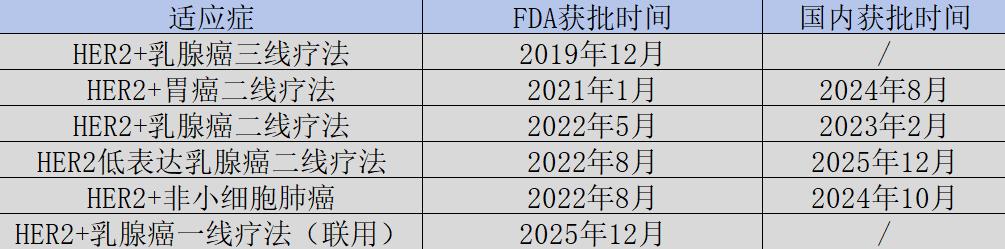
Core Viewpoint - Enhertu (DS-8201) has evolved into a "complete entity" with the recent approval for first-line therapy in HER2+ breast cancer, marking significant progress from its initial approval as a third-line therapy in December 2019 to its current status [1][2] Group 1: Enhertu's Progression - Enhertu's journey includes approvals for HER2+ breast cancer in third-line therapy (December 2019), second-line therapy (January 2021), and now first-line therapy [2] - The first-line therapy approval is in combination with pertuzumab, with expectations for single-agent approval in the future [2] Group 2: Competitive Landscape - The HER2 ADC breast cancer market is approaching a critical phase, with companies like Rongchang Biopharma, Kelun-Biotech, and BaiLi Tianheng adopting various strategies to compete [3][6] - Rongchang Biopharma has focused on differentiated strategies, avoiding direct competition in breast cancer and targeting unmet clinical needs in other indications like gastric cancer [4][6] - Kelun-Biotech has actively pursued HER2+ breast cancer, achieving approval for its product A166 as the first domestic ADC for second-line therapy, leveraging a strategy of gradual advancement [7][9] Group 3: Strategic Approaches - BaiLi Tianheng aims to create a competitive product against Enhertu, with its T-Bren ADC targeting both HER2+ breast cancer and non-small cell lung cancer (NSCLC) [11][14] - HengRui Medicine adopts a multi-cancer strategy, focusing on various indications beyond breast cancer, with its SHR-A1811 ADC already approved for HER2-mutated NSCLC [16][17] Group 4: Differentiated Strategies - Lepu Biopharma's strategy centers on combining its ADC with PD-1 therapies, positioning its products as complementary rather than direct competitors [18][20] - In contrast, YingEn Biopharma has established a global strategy, securing a partnership with BioNTech for its DB-1303 ADC, focusing on unmet needs in endometrial cancer [22][24] Group 5: Future Outlook - The competitive landscape in the HER2 ADC market is intensifying, with companies employing diverse strategies to carve out their niches [26] - The future success in this sector may hinge on the depth of differentiated strategies and the ability to commercialize effectively, rather than solely on product efficacy [26]



美股异动 | 传获默沙东洽谈收购 Revolution Medicines(RVMD.US)盘前续涨近15%
智通财经网· 2026-01-09 14:20
Core Viewpoint - Revolution Medicines (RVMD.US) has seen a significant pre-market increase of nearly 15%, following a cumulative rise of 35% over the past two trading days, amid reports of potential acquisition discussions with Merck (MRK.US) [1] Group 1: Acquisition Talks - Merck is reportedly in discussions to acquire Revolution Medicines, with the proposed transaction price estimated between $28 billion and $32 billion [1] - If the acquisition is finalized, it would mark one of the largest pharmaceutical industry deals since Pfizer (PFE.US) acquired Seagen for $43 billion at the end of 2023 [1] Group 2: Other Acquisition Interest - AbbVie (ABBV.US) was also reported to be in "deep" negotiations to acquire Revolution Medicines, with a potential valuation exceeding $20 billion for the company, which currently has no products on the market [1] - However, AbbVie later clarified that it is not in negotiations to acquire Revolution Medicines [1]


美股异动丨Revolution盘前大涨15% 传获默沙东洽谈收购
Ge Long Hui· 2026-01-09 09:49
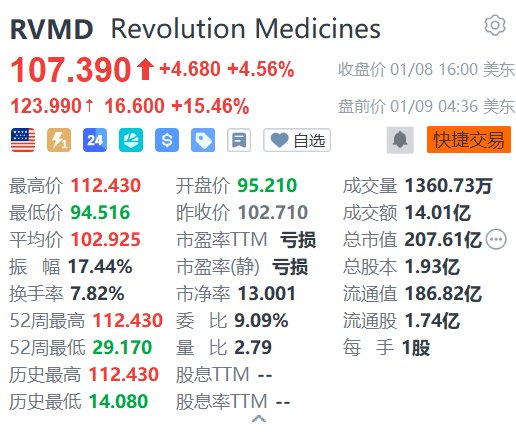
Core Viewpoint - Revolution Medicines (RVMD.US) shares surged 15.46% to $123.99 in pre-market trading following reports that Merck is in discussions to acquire the company for a price between $28 billion and $32 billion, potentially marking one of the largest pharmaceutical deals since Pfizer's $43 billion acquisition of Seagen at the end of 2023 [1]. Group 1: Company Performance - The closing price of Revolution Medicines on January 8 was $107.39, reflecting an increase of 4.56% [1]. - The pre-market price on January 9 reached $123.99, with a notable increase of $16.60 [1]. - The stock experienced a trading volume of 13.6073 million shares, with a total market capitalization of $20.761 billion [1]. Group 2: Market Metrics - The stock's highest price during the session was $112.43, while the lowest was $94.516 [1]. - The average price recorded was $102.925, with a price-to-earnings ratio indicating a loss [1]. - The stock's 52-week high was $112.43, and the 52-week low was $29.17 [1].
美股异动|Revolution Medicines夜盘涨超13%,传获默沙东以至多320亿美元报价洽购
Ge Long Hui· 2026-01-09 01:24
专注癌症药物研发的生物科技公司Revolution Medicines(RVMD.US)夜盘涨超13%,报121.5美元。消息 面上,据英国《金融时报》引述知情人士称,默沙东正就收购Revolution Medicines进行磋商。报道称, 交易作价或介乎280亿至320亿美元,若最终落实,将成为自2023年底辉瑞以430亿美元收购Seagen以 来,规模最大的药业并购之一。此前艾伯维否认正在洽谈收购Revolution Medicines。 ...
2 Predictions for Pfizer in 2026
Yahoo Finance· 2026-01-02 21:50
Core Viewpoint - Pfizer is facing challenges but has made strategic moves that could lead to a turnaround by 2026, particularly in oncology and weight management markets [1] Group 1: Progress in Oncology - Pfizer has a strong historical presence in oncology and has made significant investments, including the $43 billion acquisition of Seagen, to enhance its pipeline of cancer therapies [2] - The company has licensed a promising cancer medicine, PF-08634404, from 3SBio and is accelerating its development with multiple studies, including late-stage clinical trials [3] - Positive developments in oncology could significantly impact Pfizer's stock, especially if PF-4404 competes effectively against leading cancer drugs like Keytruda [5] Group 2: Weight Management Market - The weight management market is gaining attention and is expected to grow significantly, with Pfizer developing several anti-obesity candidates [6] - One candidate, PF-07976016, is an oral GLP-1 medicine currently in phase 2 studies, while MET-097i has recently completed phase 2 trials successfully [8] - Pfizer's efforts in the weight-loss market may take longer to materialize, but they are indicative of the company's recovery strategy [7]
Better Buy in 2026: Pfizer or Eli Lilly?
Yahoo Finance· 2025-12-18 17:05
Core Viewpoint - Eli Lilly has significantly outperformed Pfizer in stock performance, with a nearly 200% increase in 2023, while Pfizer has seen a decline of nearly 50% [1]. Growth Potential - Eli Lilly is focusing on GLP-1 drugs and expanding manufacturing capabilities, with a $6 billion investment in a new plant in Alabama to produce orforglipron [5]. - Pfizer has pursued acquisitions to enhance its pipeline, including a $43 billion acquisition of Seagen and a recent $7 billion deal for Metsera, aimed at obesity treatments [6]. - Eli Lilly is viewed as having a clearer growth path compared to Pfizer, which may take longer to realize the benefits of its acquisitions [7]. Financial Strength - Eli Lilly expects sales of approximately $63 billion in 2024, a 40% increase from $45 billion in the previous year, driven by strong demand for its GLP-1 drugs [8]. - Eli Lilly maintains a profit margin of around 31%, indicating robust net income growth alongside revenue increases [9]. - Pfizer is currently struggling to grow sales, and its acquisitions have not yet yielded significant financial benefits [8].

Pfizer's modest 2026 outlook shows its big investments will take time to pay off
CNBC· 2025-12-16 15:12
Core Viewpoint - Pfizer is forecasting modest guidance for 2026 as it focuses on long-term investments in its pipeline to mitigate declining sales from Covid products and older drugs [1] Group 1: Financial Outlook - Pfizer expects adjusted profit for 2026 to be between $2.80 and $3 per share, slightly below analysts' consensus estimate of $3.05 per share [3] - Revenue is projected to be between $59.5 billion and $62.5 billion, which is largely flat compared to the 2025 sales guidance of $62 billion [4] - The company anticipates a decline of approximately $1.5 billion in sales from Covid vaccine and antiviral pill Paxlovid, projecting 2026 sales from these products to be around $5 billion [4] Group 2: Market Challenges - Pfizer is facing a projected $1.5 billion year-over-year drop in sales due to certain products losing market exclusivity, with increased competition impacting blockbuster drugs like Prevnar [5] - Patent expirations are expected to significantly affect revenues, with an estimated $17 billion impacted by expirations occurring primarily in 2026 and 2028 [6] Group 3: Strategic Investments - The company has made significant acquisitions, including a $10 billion deal for Metsera and a $43 billion acquisition of Seagen, to build new revenue streams [2] - However, the benefits from these investments are still distant, as Metsera's pipeline consists of drugs in early-stage development [3] Group 4: Cost Management - Pfizer has exceeded its cost-saving goals for 2025 and is targeting over $7 billion in cost cuts by 2027, expecting to deliver most of these savings by next year [8] - The guidance reflects costs associated with recent acquisitions, including Metsera [7] Group 5: Regulatory Environment - The company is navigating changes in U.S. vaccine policy, which has introduced uncertainty, particularly under Health and Human Services Secretary Robert F. Kennedy Jr. [9] - Pfizer's CEO stated that comments from the FDA regarding vaccines do not merit concern and will not alter the company's long-term investment strategy [10] Group 6: Pricing Strategy - Pfizer has entered a drug pricing deal that includes selling existing drugs to Medicaid patients at the lowest price offered in other developed nations, which will lead to price and margin compression in 2026 [11]
辉瑞(PFE.US)艰难求增长:预测明年营收将持平,频寻收购热门药物
智通财经网· 2025-12-16 13:29
Core Viewpoint - Pfizer (PFE.US) is facing stagnant sales growth as it attempts to revamp its drug portfolio through costly acquisitions, with projected revenues for 2026 expected to be between $59.5 billion and $62.5 billion, aligning with Wall Street expectations [1] Group 1: Financial Projections - Pfizer anticipates minimal to no sales growth for the upcoming year, with expected sales of $62 billion for the current year, consistent with previous guidance [1] - The company forecasts adjusted earnings per share for next year to be between $2.80 and $3.00 [1] - Revenue from COVID-related products is projected to decline by approximately $1.5 billion to $5 billion next year [1] Group 2: Cost-Cutting Measures - Pfizer plans to implement significant cost-cutting measures, aiming to save over $7 billion by 2027, with most savings expected to be realized in the coming year [1] - The company intends to reinvest $500 million of the savings into research and development [2] Group 3: Acquisitions and Competition - Pfizer has recently acquired Metsera for $10 billion to enhance its drug pipeline in the obesity treatment sector, although the drugs are still in early development stages [2] - The company is also facing increased competition for key products like the pneumonia vaccine Prevnar and the heart disease treatment Vyndaqel [2] - Previous acquisitions, including a $43 billion deal for cancer drug maker Seagen, have not yet yielded sufficient success, with analysts predicting flat or declining sales at least until 2031 [3]
Pfizer's Cancer Drugs Deliver Growth Amid Competitive Pressure
ZACKS· 2025-12-02 16:26
Core Insights - Pfizer is a leading player in the oncology sector with a strong portfolio of approved cancer medicines and a promising pipeline focusing on various modalities [1] - The acquisition of Seagen in 2023 has enhanced Pfizer's oncology position by adding four antibody-drug conjugates (ADCs) that have significantly contributed to revenues [2] Revenue Performance - Oncology sales account for approximately 28% of Pfizer's total revenues, with a year-to-date growth of 7% driven by key drugs [3][10] - Specific revenue figures include Xtandi at $578 million (up 3%), Lorbrena at $268 million (up 28%), and Braftovi/Mektovi at $202 million (up 17%) [4] - The newly launched drug Elrexfio generated $85 million in sales, while Ibrance saw a decline of 5% to $1.06 billion [4] Pipeline and Future Prospects - Pfizer is advancing its oncology pipeline with several candidates in late-stage development, including atirmociclib and sigvotatug vedotin, and expects to have eight or more blockbuster oncology medicines by 2030 [6][7] - The company has also entered the oncology biosimilars market, generating $315 million in revenues, reflecting a 10% year-over-year increase [5] Competitive Landscape - Major competitors in the oncology space include AstraZeneca, Merck, and Bristol-Myers, with AstraZeneca's oncology sales comprising around 43% of its total revenues and growing by 16% [8] - Merck's Keytruda alone accounts for over 50% of its pharmaceutical sales, with reported sales of $23.3 billion, up 8% [9] - Bristol-Myers' Opdivo accounts for about 20% of its total revenues, with sales rising 8% to $7.54 billion [11] Valuation and Market Position - Pfizer's stock has declined by 4.7% this year, contrasting with a 17.8% increase in the industry [12] - The company's shares are trading at a price/earnings ratio of 8.02, lower than the industry average of 17.26 and its own 5-year mean of 10.44, indicating attractive valuation [13] - The Zacks Consensus Estimate for 2025 earnings has increased from $3.06 to $3.14 per share over the past month [15]
