
君实生物

Search documents
君实生物:股东熊俊累计增持10万股公司股份
Ge Long Hui· 2026-01-09 10:04
截至本公告披露日,熊俊先生通过上海证券交易所系统以集中竞价方式累计增持公司A股股份10万股, 约占公司总股本的0.01%,累计成交总额为人民币383.84万元。本次增持计划尚未实施完毕,熊俊先生 将继续按照相关增持计划,在增持计划实施期间内择机增持公司股份。 格隆汇1月9日丨君实生物(688180.SH)公布,公司控股股东、实际控制人之一兼董事长熊俊先生拟自 2025年4月12日起12个月内,通过上海证券交易所交易系统与香港联合交易所有限公司允许的方式(包括 但不限于集中竞价和大宗交易等方式)增持公司A股股份及H股股份,合计增持金额不低于人民币1亿 元,其中A股增持金额不低于人民币5000万元。 ...
君实生物(688180) - 君实生物关于控股股东、实际控制人之一兼董事长增持股份进展公告
2026-01-09 09:32
本公司董事会、全体董事及相关股东保证本公告内容不存在任何虚假记载、 误导性陈述或者重大遗漏,并对其内容的真实性、准确性和完整性依法承担法律 责任。 证券代码:688180 证券简称:君实生物 公告编号:临 2026-001 上海君实生物医药科技股份有限公司 关于控股股东、实际控制人之一兼董事长 增持股份进展公告 重要内容提示: 上海君实生物医药科技股份有限公司(以下简称"公司")控股股东、 实际控制人之一兼董事长熊俊先生拟自 2025 年 4 月 12 日起 12 个月内,通过上 海证券交易所交易系统与香港联合交易所有限公司允许的方式(包括但不限于集 中竞价和大宗交易等方式)增持公司 A 股股份及 H 股股份,合计增持金额不低 于人民币 1 亿元,其中 A 股增持金额不低于人民币 5,000 万元。 截至本公告披露日,熊俊先生通过上海证券交易所系统以集中竞价方式 累计增持公司 A 股股份 100,000 股,约占公司总股本的 0.01%,累计成交总额为 人民币 383.84 万元。本次增持计划尚未实施完毕,熊俊先生将继续按照相关增 持计划,在增持计划实施期间内择机增持公司股份。 本次增持计划可能存在因资本市场 ...
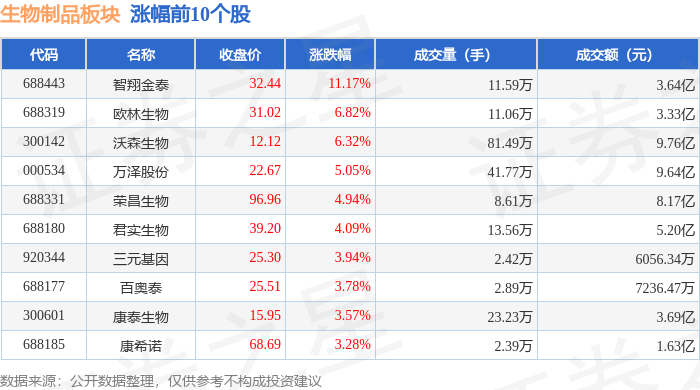
生物制品板块1月9日涨1.73%,智翔金泰领涨,主力资金净流入1.44亿元
Zheng Xing Xing Ye Ri Bao· 2026-01-09 08:54
Group 1 - The biopharmaceutical sector increased by 1.73% on January 9, with Zhixiang Jintai leading the gains [1] - The Shanghai Composite Index closed at 4120.43, up 0.92%, while the Shenzhen Component Index closed at 14120.15, up 1.15% [1] - Key stocks in the biopharmaceutical sector showed significant price increases, with Zhixiang Jintai rising by 11.17% to a closing price of 32.44 [1] Group 2 - The biopharmaceutical sector experienced a net inflow of 144 million yuan from institutional investors, while retail investors saw a net inflow of 90.72 million yuan [2] - Major stocks like Wozhen Bio and Wanze Co. had notable net inflows from institutional investors, with Wozhen Bio seeing 108 million yuan [3] - Retail investors showed a net outflow in several stocks, indicating a mixed sentiment in the market [3]


君实生物涨4.09%,成交额5.20亿元,近3日主力净流入7324.69万
Xin Lang Cai Jing· 2026-01-09 07:33
Core Viewpoint - Junshi Biosciences is positioned as a leading innovative pharmaceutical company with a complete industry chain capability from drug discovery to commercialization, focusing on first-in-class and best-in-class drug development [2] Group 1: Company Overview - Junshi Biosciences was established on December 27, 2012, and went public on July 15, 2020, specializing in the research and commercialization of monoclonal antibody drugs and other therapeutic proteins [7] - The company's main revenue sources include drug sales (90.67%), technology licensing (8.74%), and technical services (0.59%) [7] - As of September 30, 2023, Junshi Biosciences reported a revenue of 1.806 billion yuan, a year-on-year increase of 42.06%, and a net profit attributable to shareholders of -596 million yuan, a year-on-year increase of 35.72% [8] Group 2: Product Development and Pipeline - The company has developed a significant product portfolio, including the first domestically approved PD-1 monoclonal antibody, Toripalimab, which has received approval for 11 indications in mainland China and is also approved in multiple countries including the US and EU [2] - Junshi Biosciences is also developing Tifcemalimab, the world's first anti-BTLA monoclonal antibody entering clinical development, with ongoing Phase III trials and several combination studies with Toripalimab [2] - The company is collaborating with various research institutions to develop a monkeypox recombinant protein vaccine, currently in preclinical development [3] Group 3: Market Activity - On January 9, 2024, Junshi Biosciences' stock rose by 4.09%, with a trading volume of 520 million yuan and a market capitalization of 40.246 billion yuan [1] - The stock has seen a net inflow of 42.43 million yuan from major investors, indicating a mixed trend in investor sentiment [4][5] - The average trading cost of the stock is 39.88 yuan, with the current price approaching a resistance level of 39.67 yuan, suggesting potential for upward movement if this level is surpassed [6]
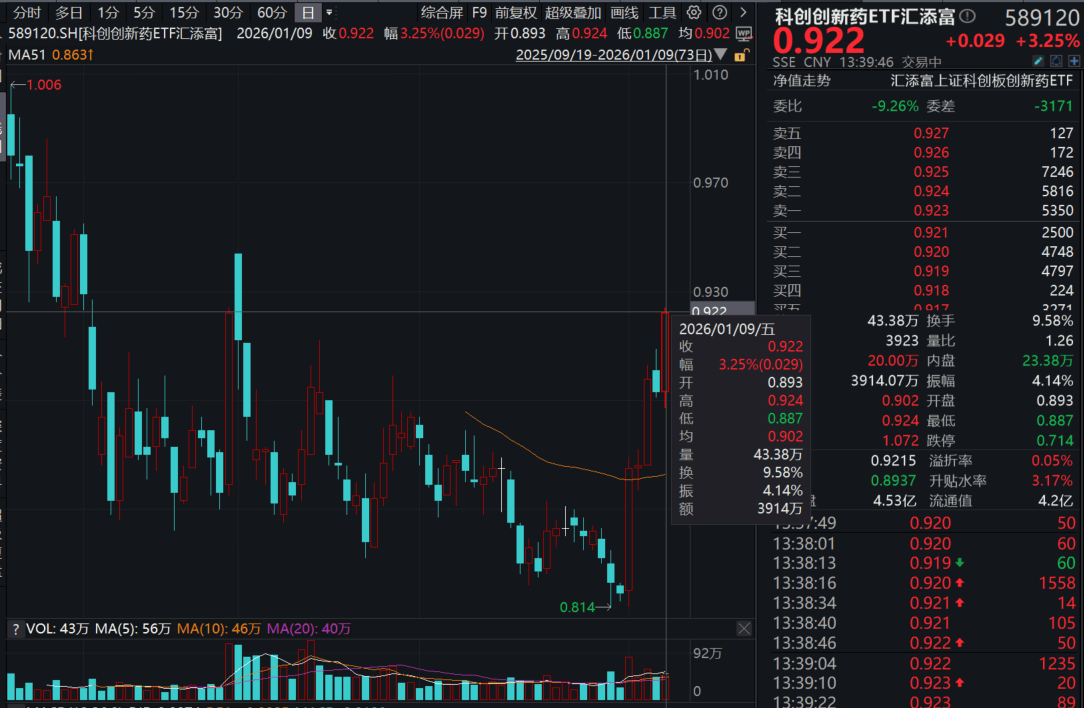
创新药午后蹿升!骨髓瘤注射液获上市审批,智翔金泰大涨超8%,科创创新药ETF汇添富(589120)涨超3%,强势反包!创新药2026投资前瞻来了
Sou Hu Cai Jing· 2026-01-09 06:05
Core Viewpoint - The A-share market is experiencing a significant upward trend, with the Shanghai Composite Index returning to 4100 points for the first time in 10 years, driven by a strong performance in the innovative pharmaceutical sector, particularly the Sci-Tech Innovation Drug ETF Huatai (589120) which rose over 3% [1] Group 1: Market Performance - The Sci-Tech Innovation Drug ETF Huatai (589120) saw most of its constituent stocks surge, with notable increases such as Yuekang Pharmaceutical up over 10%, Zhixiang Jintai up over 8%, and Micron Biologics up over 6% [3] - The top ten constituent stocks of the ETF include major players in the pharmaceutical sector, with BeiGene (688235) rising by 1.77% and Aier Eye Hospital (688578) increasing by 2.18% [3] Group 2: Regulatory Support - A national drug supervision conference held from January 6 to 7 emphasized the need to actively support the pharmaceutical industry in enhancing quality and efficiency, alongside comprehensive reforms in drug regulation [4] Group 3: Innovation and Drug Approvals - Innovation remains a key theme in the Sci-Tech Innovation Drug sector, with recent announcements including Zhixiang Jintai's conditional listing application for a dual-antibody drug and Micron Biologics receiving approval for clinical trials of a new drug for pancreatic cancer [5] - BeiGene announced the conditional approval of its new BCL2 inhibitor, providing new treatment options for patients with chronic lymphocytic leukemia [6] - Rongchang Biologics is seeking breakthrough therapy designation for a new indication of its drug, which would mark a significant regulatory achievement for domestic ADC products [7] Group 4: Future Outlook - The Pacific Securities report anticipates that by 2026, the innovative drug sector will benefit from enhanced international capabilities and supportive industry policies, leading to increased market confidence and investment [8] - The report highlights that the average deal value for innovative drugs purchased from China by top multinational corporations is significantly higher than those from overseas, indicating a growing recognition of the value of Chinese innovative drugs in the global market [9]



中国创新药BD交易创新高,浦东核心枢纽如何炼成?丨出海观察
2 1 Shi Ji Jing Ji Bao Dao· 2026-01-07 12:30
Core Insights - The Chinese innovative pharmaceutical industry is undergoing a historic transformation, shifting from "fast followers" to "original creators" supported by solid data and market performance [1] - By 2025, the total value of innovative drug licensing transactions in China is expected to exceed $130 billion, with over 150 transactions, marking a historical high [1] - Shanghai's Pudong district is becoming a key hub for the global market, with significant achievements in CAR-T products and first-class new drugs [1] Industry Overview - China's pharmaceutical industry ranks second globally, with approximately 30% of innovative drugs in development worldwide [1] - The industry is entering a critical phase characterized by "innovation realization + global layout" [1] Company Developments - Chinese innovative drug companies are leveraging speed and cost-effectiveness to gain a competitive edge in the global market [3] - Companies like Maiwei Biotech and Jinsai Pharmaceutical are forming significant overseas business development (BD) partnerships, enhancing China's global competitiveness [3][4] - Maiwei Biotech has accelerated its BD efforts, securing exclusive licensing agreements for innovative therapies, including a $1 billion potential deal with Aditum Bio [4][5] Market Trends - By 2025, Pudong is expected to have approved four CAR-T products, accounting for 30% of the global total, and seven first-class new drugs, representing 14% of the national total [1] - The commercial sales of innovative drugs in Pudong are projected to exceed 11.6 billion yuan in 2024, with several new drugs achieving over 1 billion yuan in annual sales [10] Strategic Initiatives - Companies are focusing on building comprehensive global capabilities covering research, registration, and sales to transition from "licensing out" to "commercialization abroad" [10] - Jinsai Pharmaceutical has established local teams in the U.S. and Europe to manage clinical trials and seek collaboration opportunities [8] Innovation and Collaboration - The future of innovative drugs lies in international markets, with companies emphasizing deep understanding of disease biology as a core competitive advantage [5] - Companies are forming cooperative committees with BD partners to ensure project progress through information sharing and resource collaboration [5] Ecosystem Support - The rise of China's innovative drug industry is attributed to years of policy guidance, technological accumulation, and capital cultivation [23] - The unique industrial atmosphere, talent pool, and complete industrial chain in Zhangjiang are seen as core advantages for local companies [23][24] - Pudong's talent policies and supportive platforms are facilitating the rapid gathering of global talent resources [23] Future Outlook - The next 3-5 years are expected to see continued emphasis on internationalization and globalization among Chinese biopharmaceutical companies [14] - Companies are increasingly focusing on source innovation and high-quality BD potential to meet global market demands and achieve high valuations [17]


中国创新药BD交易创新高,浦东核心枢纽如何炼成?丨出海观察
21世纪经济报道· 2026-01-07 12:09
Core Viewpoint - The Chinese innovative pharmaceutical industry is undergoing a historic transformation, shifting from "fast followers" to "original creators," supported by solid data and market performance [1]. Group 1: Industry Overview - China's pharmaceutical industry is the second largest globally, with innovative drugs accounting for approximately 30% of global research [1]. - By 2025, the total value of innovative drug licensing transactions in China is expected to exceed $130 billion, with over 150 transactions, marking historical highs [1]. - The increase in competitiveness and cost-effectiveness of Chinese pharmaceutical assets is driving the industry into a critical phase of "innovation realization + global layout" [1]. Group 2: Regional Development - Shanghai's Pudong district is becoming a core hub for the global market connection of China's biopharmaceutical industry, with significant achievements in innovative drug approvals and business development transactions [1]. - By 2025, Pudong has approved 4 CAR-T products (30% of the global total) and 7 Class 1 new drugs (14% of the national total), with business development transaction amounts reaching $20.4 billion (14% of the global total) [1]. Group 3: Competitive Advantages - Chinese innovative pharmaceutical companies are gaining a competitive edge in the global market due to their speed and cost-effectiveness, being able to advance drug discovery 2-3 times faster and recruit clinical trial patients 2-5 times faster than international counterparts [3]. - The cost per patient for clinical trials in China is only half that of Europe and the US [3]. Group 4: Business Development Collaborations - Companies like Maiwei Biopharma and Jinsai Pharmaceutical are forming significant overseas business development collaborations, enhancing China's global competitiveness in innovative drugs [3][5]. - Maiwei Biopharma has accelerated its business development efforts, securing exclusive licensing agreements for innovative therapies within months of initial meetings [3][4]. Group 5: Full-Chain Layout - A number of innovative pharmaceutical companies are rapidly constructing comprehensive overseas layouts covering research, registration, and sales, transitioning from "licensing out" to "commercialization abroad" [9]. - By 2024, Pudong is expected to have over 20 innovative drugs achieving commercial sales, with total sales exceeding 11.6 billion yuan [9]. Group 6: Source Innovation - The market consensus is that only companies with source innovation capabilities, quality business development potential, and global layout abilities can effectively meet global market demands and achieve high valuations [16]. - Companies like Jinfang Pharmaceutical are focusing on unique therapeutic areas and avoiding following trends, which positions them favorably in the global market [17]. Group 7: Industry Ecosystem - The rise of China's innovative pharmaceutical industry is attributed to years of policy guidance, technological accumulation, and capital cultivation, leading to a critical growth inflection point [21]. - The unique industrial atmosphere, quality talent pool, and complete industrial chain in Zhangjiang are considered core advantages for companies operating in the region [21][22]. Group 8: Future Outlook - The Pudong district is set to enhance its support for the biopharmaceutical industry, aiming to become a global hub for innovative drug launches and scientific entrepreneurship [23]. - The ongoing development of a differentiated industrial linkage pattern is expected to further support the growth of the life sciences industry in the region [23]. Group 9: Conclusion - The path of globalization for Chinese innovative drugs is deepening, supported by core industrial hubs like Pudong and the continuous upgrading of companies' innovation and internationalization capabilities [24].

君实生物:公司董事长熊俊先生的增持计划尚未实施完毕
Zheng Quan Ri Bao Wang· 2026-01-07 11:11
证券日报网讯1月7日,君实生物在互动平台回答投资者提问时表示,截至本回复日,公司董事长熊俊先 生的增持计划尚未实施完毕,熊俊先生将在增持计划实施期间内择机增持公司股份。 ...
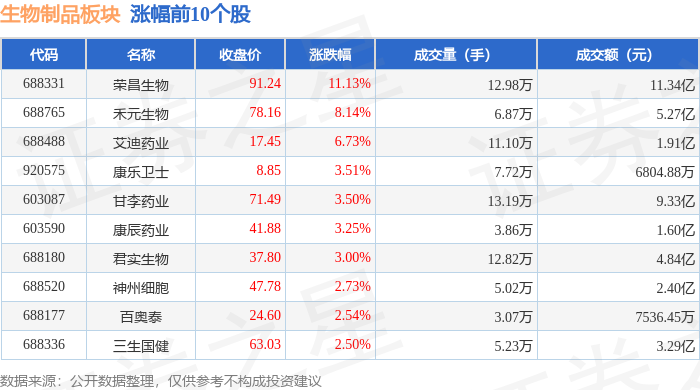
生物制品板块1月7日涨0.61%,荣昌生物领涨,主力资金净流入1.58亿元
Zheng Xing Xing Ye Ri Bao· 2026-01-07 08:58
Core Insights - The biopharmaceutical sector experienced a rise of 0.61% on January 7, with Rongchang Biopharmaceutical leading the gains [1] - The Shanghai Composite Index closed at 4085.77, up 0.05%, while the Shenzhen Component Index closed at 14030.56, up 0.06% [1] Stock Performance - Rongchang Biopharmaceutical (688331) closed at 91.24, with a significant increase of 11.13%, and a trading volume of 129,800 shares, amounting to 1.134 billion yuan [1] - Other notable performers included Buyuan Biopharmaceutical (688765) with a closing price of 78.16, up 8.14%, and Aidi Pharmaceutical (688488) at 17.45, up 6.73% [1] - The overall trading volume and turnover for the biopharmaceutical sector indicated strong investor interest, with Rongchang Biopharmaceutical leading in both metrics [1] Capital Flow - The biopharmaceutical sector saw a net inflow of 158 million yuan from institutional investors, while retail investors experienced a net outflow of 163 million yuan [2] - The data indicates a mixed sentiment among different investor types, with institutional investors showing confidence in the sector [2][3] Individual Stock Capital Flow - Rongchang Biopharmaceutical had a net inflow of 128 million yuan from institutional investors, while retail investors showed a net outflow of approximately 50 million yuan [3] - Other companies like Ganli Pharmaceutical (603087) and Junshi Biosciences (688180) also experienced net inflows from institutional investors, indicating a trend of institutional support for select stocks within the sector [3]
君实生物股价连续3天上涨累计涨幅10.71%
Xin Lang Cai Jing· 2026-01-07 07:09
Group 1 - The core viewpoint of the news is that Junshi Biosciences has seen a significant stock price increase, with a 10.71% rise over the past three days, closing at 37.82 CNY per share [1] - Junshi Biosciences is primarily engaged in the research and commercialization of monoclonal antibody drugs, with 90.67% of its revenue coming from drug sales [1] - The company was founded on December 27, 2012, and went public on July 15, 2020, with a current market capitalization of 38.829 billion CNY [1] Group 2 - Tianzhi Fund has a significant holding in Junshi Biosciences, with its Tianzhi New Consumption Mixed Fund (350008) holding 18,100 shares, representing 4.75% of the fund's net value [2] - The Tianzhi New Consumption Mixed Fund has generated a floating profit of approximately 66,200 CNY during the three-day stock price increase [2] - The fund was established on August 4, 2011, and has a current scale of 15.7711 million CNY, with a year-to-date return of 5.18% [2]