中国软件

Search documents
AI PC概念下跌4.54%,13股主力资金净流出超亿元
Zheng Quan Shi Bao Wang· 2025-10-17 10:09
Core Viewpoint - The AI PC concept sector experienced a significant decline of 4.54% as of the market close on October 17, with major stocks like Siquan New Materials, Tongfu Microelectronics, and Taijia Co., Ltd. leading the losses, while only two stocks, Wentai Technology and China Software, saw gains of 4.28% and 0.21% respectively [1]. Market Performance - The AI PC concept sector ranked among the top decliners, with a net outflow of 3.884 billion yuan from main funds, affecting 39 stocks, of which 13 saw outflows exceeding 100 million yuan [2]. - The top three stocks with the highest net outflows were Tongfu Microelectronics (net outflow of 682.76 million yuan), Lingyi Technology (577.00 million yuan), and Shenghong Technology (312.87 million yuan) [2][3]. Stock Performance - The stocks within the AI PC concept that experienced the largest declines included: - Tongfu Microelectronics: -9.46% - Lingyi Technology: -6.49% - Siquan New Materials: -12.36% [3]. - Conversely, the stocks with net inflows included Wentai Technology (net inflow of 201.57 million yuan), China Software (18.86 million yuan), and Xinghuan Technology (0.78 million yuan) [4].


自主可控系列:鸿蒙和国产操作系统
2025-10-16 15:11
Summary of the Conference Call on Domestic Operating Systems and Hongmeng Industry Overview - The importance of domestic operating systems is increasingly recognized due to concerns over reliance on foreign systems, particularly after the 2008 Microsoft black screen incident, which highlighted potential threats to national industry and economic security [1][2] - The domestic operating system market has historically been dominated by Windows and Mac OS, with a market share as high as 95%. However, the market share of these foreign systems is gradually declining due to the promotion of domestic alternatives through the Xinchuang (Information Technology Application Innovation) initiative [2] Core Insights and Arguments - Huawei's Hongmeng operating system employs a "dual-track" strategy: the "pure blood" version focuses on Huawei's own closed ecosystem, while the open-source version aims to compete with Android by fostering an ecosystem with industry partners [1][5] - As of August 2025, Huawei invests over 10,000 personnel and hundreds of billions of RMB annually in R&D for Hongmeng, with over 130 million lines of code developed to achieve complete independence from Android [1][9] - The open-source Hongmeng, donated to the OpenAtom Open Source Foundation, has become a recognized and robust open-source operating system ecosystem in China, attracting numerous software and hardware developers [1][10] Development Stages of Domestic Operating Systems - The development of domestic operating systems can be categorized into five stages: 1. **Initial Development (1960s-70s)**: Early systems like 1,507 were developed for specific applications. 2. **Linux Introduction (1990s)**: The introduction of open-source Linux aimed to break Microsoft's monopoly. 3. **Growth Phase (Early 2000s)**: Government support for domestic Linux and procurement initiatives began. 4. **Diverse Development (Post-2000)**: Major companies, including Google and Apple, entered the market, prompting local firms to develop their own systems. 5. **Current Phase (Post-2018)**: The US-China trade war accelerated the development of domestic systems, with Hongmeng leading the charge [4] Competitive Landscape - Besides Huawei, several companies are actively developing domestic operating systems, including: - China Software's Qilin Software, focusing on government and key industries. - Chengmai Technology's Tongxin Software and Qilin Xinan, which are targeting server markets and specific industry applications [6] Future Prospects - The future of domestic operating systems appears promising, with significant growth potential driven by external environmental changes and policy support. Both pure blood and open-source Hongmeng are expected to perform well in policy-level markets, consumer markets, and vertical industries, creating investment opportunities [3][13]
中国软件企业出海正当时 四大要素构建出海核心竞争力
Zhong Guo Jin Rong Xin Xi Wang· 2025-10-16 13:41
Core Insights - The report by Bain & Company and Amazon Web Services highlights the growing trend of Chinese software companies expanding globally, particularly in sectors like SaaS, AI applications, e-commerce, social media, and fintech [1][2] - Chinese software firms are leveraging local digital innovation, a rich developer community, and partnerships with leading global tech companies to enhance their innovation capabilities and business practices [1] - The global AI hardware and software market is projected to reach between $780 billion and $990 billion by 2027, with an average growth rate of 40% to 55%, presenting significant opportunities for Chinese enterprises [1] Market Opportunities - North America remains a key focus area for e-commerce and social media, while emerging markets in Southeast Asia, the Middle East, Africa, and Latin America show strong growth potential [1] - The report emphasizes the importance of understanding differentiated local market needs and learning from established international tech companies to succeed in global markets [2] Key Success Factors - The report identifies four critical success factors for Chinese software companies in their global expansion: strategic planning, deep understanding of local markets, leveraging mature systems from leading global tech firms, and seizing AI opportunities [2] - Companies are advised to choose "high compatibility" bases, develop comprehensive market and service strategies, identify risks and challenges, and enhance their overall capabilities [2] Tactical Recommendations - Actionable insights include focusing on security compliance, stability, cost management, and capitalizing on generative AI opportunities as essential tactical elements for successful international operations [2][3] - The increasing importance of AI responsibility, security compliance, and business resilience is highlighted, with a notable rise in privacy laws globally [3] Collaboration and Support - Bain & Company and Amazon Web Services are collaborating to assist companies in achieving technological and business transformations related to generative AI [3] - Amazon Web Services has supported numerous Chinese software companies in their rapid growth and overseas expansion, positioning itself as a key enabler for their globalization efforts [3]
董事会主席陈宇红增持中国软件国际100万股 每股作价约5.81港元

Zhi Tong Cai Jing· 2025-10-16 11:22
Group 1 - The chairman of the board, Chen Yuhong, increased his stake in China Software International (00354) by purchasing 1 million shares at a price of 5.8125 HKD per share, totaling 5.8125 million HKD [1] - Following the purchase, the total number of shares held by Chen Yuhong is approximately 320 million, representing a holding percentage of 11.71% [1]
董事会主席陈宇红增持中国软件国际(00354)100万股 每股作价约5.81港元
智通财经网· 2025-10-16 11:20
Group 1 - The chairman of the board, Chen Yuhong, increased his stake in China Software International (00354) by purchasing 1 million shares at a price of HKD 5.8125 per share, totaling HKD 5.8125 million [1] - Following the purchase, the total number of shares held by Chen Yuhong is approximately 320 million, representing a new ownership percentage of 11.71% [1]
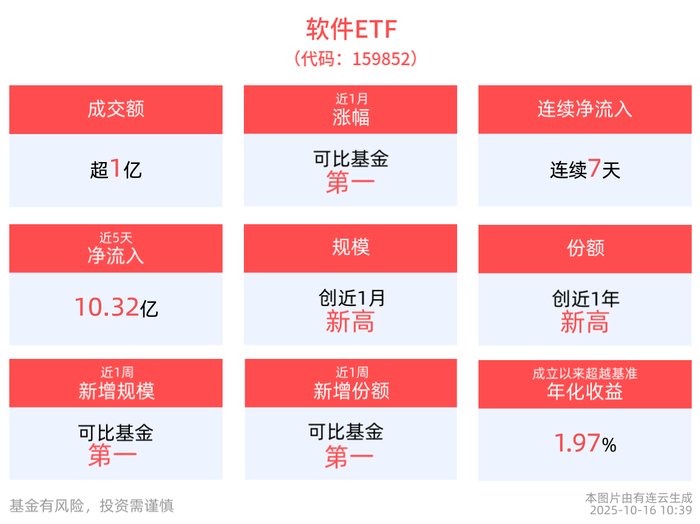
国产软件行业迎来重要发展机遇,软件ETF(159852)近7天获得连续资金净流入超11亿元
Xin Lang Cai Jing· 2025-10-16 03:29
Core Viewpoint - The software industry in China is experiencing significant development opportunities, supported by positive government policies aimed at promoting technological innovation and industry upgrades [4] Group 1: Market Performance - As of October 16, 2025, the CSI Software Service Index has decreased by 1.51%, with major stocks like China Software, Runhe Software, and Kingsoft Office leading the decline [1] - The Software ETF (159852) has seen a trading volume turnover of 3.12% and a transaction value of 181 million yuan, reaching a new high of 5.872 billion yuan in total assets [3] - The Software ETF has achieved a net inflow of 1.113 billion yuan over the past week, with a single-day peak inflow of 507 million yuan [3] Group 2: Fund Performance - The Software ETF has recorded a net value increase of 21.92% over the past three years, with the highest monthly return since inception being 39.35% [3] - The longest consecutive monthly gain for the Software ETF is three months, with a maximum increase of 69.40% and an average monthly return of 10.06% [3] Group 3: Key Stocks and Weightings - The top ten weighted stocks in the CSI Software Service Index account for 62.41% of the index, with iFlytek, Tonghuashun, and Kingsoft Office being the most significant contributors [3] - The performance of key stocks includes iFlytek down by 1.45%, Kingsoft Office down by 2.38%, and Runhe Software down by 2.89% [6] Group 4: Industry Outlook - The Chinese government has emphasized support for emerging industries, particularly in the technology innovation sector, as part of the 14th Five-Year Plan [4] - Analysts from China Galaxy Securities suggest that the domestic software industry is entering a critical phase of localization, with expected benefits in areas such as EDA, industrial software, operating systems, databases, and cybersecurity [4]
中国软件国际(00354.HK):获主要股东陈宇红增持100万股
Ge Long Hui· 2025-10-15 14:34
Core Viewpoint - China Software International (00354.HK) announced that its major shareholder, Chairman and Executive Director Chen Yuhong, purchased a total of 1 million shares of the company's ordinary stock on October 15, 2025, at an average price of approximately HKD 5.8125 per share, totaling around HKD 5.8125 million [1] Summary by Relevant Sections - **Share Purchase Details** - Chen Yuhong acquired 1 million shares at an average price of HKD 5.8125 per share, amounting to a total investment of approximately HKD 5.8125 million [1] - The shares purchased represent about 0.04% of the total issued shares of the company as of the announcement date [1] - **Post-Purchase Shareholding** - Following the acquisition, Chen Yuhong holds 320 million shares, which corresponds to approximately 11.71% of the total issued shares of the company as of the announcement date [1]
中国软件国际获主要股东陈宇红增持合共100万股
Zhi Tong Cai Jing· 2025-10-15 14:19
Core Viewpoint - China Software International (00354) announced that its major shareholder, Dr. Chen Yuhong, purchased a total of 1 million ordinary shares in the open market at an average price of approximately HKD 5.8125 per share, totaling around HKD 5.8125 million [1] Summary by Relevant Sections - **Share Purchase Details** - Dr. Chen acquired 1 million shares at an average price of HKD 5.8125 per share, amounting to HKD 5.8125 million [1] - The total number of shares acquired represents approximately 0.04% of the company's total issued shares as of the announcement date [1] - **Post-Purchase Holdings** - Following the acquisition, Dr. Chen holds a total of 319,988,861 shares, which is about 11.71% of the company's total issued shares as of the announcement date [1]
中国软件国际(00354)获主要股东陈宇红增持合共100万股
智通财经网· 2025-10-15 14:14
Core Viewpoint - China Software International (00354) announced that its major shareholder, Dr. Chen Yuhong, purchased a total of 1 million ordinary shares in the open market at an average price of approximately HKD 5.8125 per share, totaling around HKD 5.8125 million [1] Summary by Relevant Sections - **Share Purchase Details** - Dr. Chen acquired 1 million shares at an average price of HKD 5.8125 per share, amounting to HKD 5.8125 million [1] - The shares purchased represent approximately 0.04% of the total issued shares of the company as of the announcement date [1] - **Post-Purchase Shareholding** - Following the acquisition, Dr. Chen holds a total of 319,988,861 shares, which is about 11.71% of the total issued shares of the company as of the announcement date [1]
国产软件概念爆发,信创ETF基金(562030)上探1.8%!机构:美国拟对关键软件出口管制,国产替代加速突围
Xin Lang Ji Jin· 2025-10-15 02:45
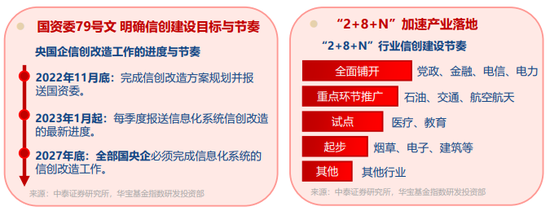
Core Viewpoint - The announcement by Trump to impose a 100% tariff on China and export controls on key software has significant implications for the domestic software industry, particularly in the context of China's push for self-reliance in technology and the development of the "信创" (Xinchuang) industry [1][6]. Group 1: Industry Developments - The adjustment in the format of the Ministry of Commerce's announcement signifies a major breakthrough in the strategy for domestic office software replacement, marking a milestone for the Xinchuang industry [1]. - The Xinchuang industry is progressing steadily with a "2+8+N" rhythm, transitioning from policy-driven to a dual-driven approach of policy and market [1]. - The market scale of the Xinchuang industry is expected to grow at rates of 17.84% and 26.82% in 2025 and 2026, respectively, with the market surpassing 2.6 trillion yuan by 2026 [1]. Group 2: Market Performance - The domestic software concept saw a surge on October 15, with the Xinchuang ETF fund (562030) rising by 1.81%, indicating strong market interest [3]. - The ETF has attracted a total of 13.16 million yuan in inflows over the past three days, reflecting investor confidence in the sector [3]. - Key stocks within the ETF, such as 格尔软件 (Geer Software) and 华大九天 (Hua Da Jiu Tian), experienced significant gains, with some reaching their daily limit [3]. Group 3: Investment Logic - The Xinchuang industry is supported by four key investment logics: geopolitical tensions necessitating self-reliance, increased local government procurement, technological breakthroughs by domestic firms, and the critical timing for procurement standards [6]. - The data security sector, represented by the big data industry ETF (516700), is also gaining traction, with a focus on data centers and cloud computing [7].