
软件即服务(SaaS)

Search documents
MongoDB Stock Down Over 25% After Guidance Whiff
Schaeffers Investment Research· 2026-03-03 15:02
Core Insights - MongoDB Inc (NASDAQ:MDB) has experienced a significant decline of 25%, trading at $236.42, following a first-quarter profit forecast that fell below estimates, overshadowing an adjusted fourth-quarter earnings and revenue beat [1] - The negative impact of MongoDB's guidance has also affected peers Okta (OKTA) and Snowflake (SNOW), which saw declines of 3% and 4.7% respectively [1] Analyst Reactions - A total of 18 analysts have reduced their price targets for MongoDB, with the lowest target set by Soctiabank at $275, down from $415, indicating a shift in market sentiment [2] - Despite this, 30 out of 39 brokerages continue to maintain "strong buy" ratings, with no "sell" ratings currently on record [2] Stock Performance Metrics - MongoDB's stock is trading at its lowest level since a 38.3% post-earnings bull gap on August 27, and is now below its year-over-year breakeven level [2] - The stock has a 14-Day Relative Strength Index (RSI) of 26, indicating it is deep in "oversold" territory [2] Options Market Activity - Prior to the earnings event, options traders were betting bearishly, as evidenced by a 50-day put/call volume ratio of 1.19, which is higher than 90% of readings from the past year [3] - In contrast, there has been a surge in call options trading today, with over 18,000 calls exchanged, which is 11 times the average intraday volume [4] - The March 330 call has emerged as the most popular standard contract, with new positions being opened at the weekly 3/6 300-strike call [4]



阿波罗高管警告:私募股权软件投资"多车连环相撞",行业面临估值重置
Sou Hu Cai Jing· 2026-02-20 21:23
Core Viewpoint - The private equity industry is facing a reckoning due to the disruptive impact of artificial intelligence on software investments, as highlighted by Apollo Global Management's partner David Sambur [1][3]. Group 1: Industry Insights - Apollo Global Management manages approximately $938 billion in assets and has expressed concerns about the industry's failure to recognize the transformative effects of AI on the software sector [1]. - Sambur noted that signs of impending trouble were evident as early as 2022, particularly following the launch of ChatGPT by OpenAI and the rising interest rates, which have contributed to the current challenges [3]. - The private equity sector invested a record $348 billion in the Software as a Service (SaaS) space in 2021, raising questions about the concentration of investments and potential risks associated with groupthink [3]. Group 2: Current Market Conditions - Many software investments made during the pandemic are nearing the end of their traditional holding periods, creating uncertainty about whether these assets can be exited at favorable prices, which may impact fundraising and deal-making in the private equity sector [3]. - Sambur emphasized the need for the industry to prepare for a "much-needed valuation reset" [3]. Group 3: Apollo's Position - Apollo has disclosed a "zero exposure" to the software sector within its private equity business, with overall exposure to the sector being less than 2% [4]. - Despite this cautious stance, Apollo's stock has declined by over 14% this year [4]. - From 2015 to 2025, private equity buyers have acquired over 1,900 software companies, with total transaction values exceeding $440 billion [4]. Group 4: Other Firms' Responses - Other notable merger and acquisition firms, such as Thoma Bravo and Vista Equity Partners, have been meeting with investors to reassure them about their limited or manageable exposure to the software sector [5].

"软件-PE"死亡循环的中心,美国PE三巨头持续重挫,KKR和Blue Owl电话会承认财务挑战
硬AI· 2026-02-06 06:44
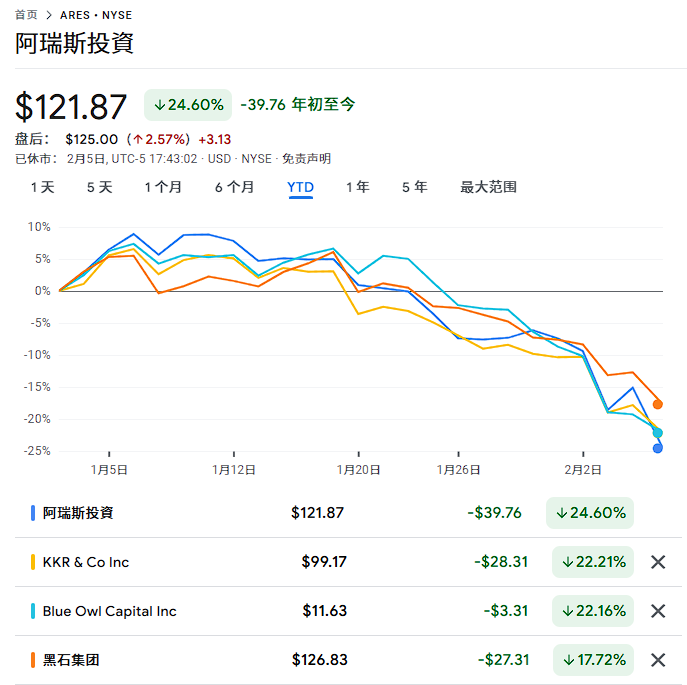
Core Viewpoint - Concerns over AI disrupting the software industry have led to a slowdown in financing, delayed exits, and increased redemption pressures for U.S. private equity giants [2][3] Group 1: Financial Outlook and Performance - KKR and Blue Owl warned about their financial outlook for 2026, with KKR indicating potential delays in asset sales that could reduce cash flow and earnings [3][9] - Blue Owl reported a rise in redemption requests, leading to a significant slowdown in expected fee growth, projecting only "moderate" growth compared to approximately 20% in 2025 [3][10] - Ares, KKR, and Blue Owl saw their stock prices drop significantly, with Ares falling over 11% and KKR down 5.5%, reflecting a cumulative decline of over 15% for these firms this year [4] Group 2: Market Dynamics and Risks - The stability logic of Software as a Service (SaaS) assets is collapsing due to rising risks associated with AI replacing coding and data analysis functions, leading to an increase in non-performing loans [6][14] - The private equity sector is considering delaying asset sales, which could impact their ability to generate performance fees and slow overall asset growth due to investor withdrawals [7][9] - The private credit market is experiencing a dual "unwinding" process, with the lending logic to software companies collapsing and the attractiveness of private credit diminishing as public market yields rise [14][15] Group 3: Management Responses and Strategies - Executives from KKR, Ares, and Blue Owl addressed concerns about their exposure to software company loans, with Blue Owl's CEO asserting that significant losses are not anticipated [12] - KKR's co-CEO mentioned that the firm has been preparing for AI-related disruptions and has sold off vulnerable companies, indicating a low level of anxiety about current market conditions [12] - Ares disclosed that software accounts for 9% of its private credit management assets, with negligible non-performing loans, maintaining that AI risks have not altered their growth outlook [12]

"软件-PE"死亡循环的中心,美国PE三巨头持续重挫,KKR和Blue Owl电话会承认财务挑战
Hua Er Jie Jian Wen· 2026-02-06 01:03
Core Insights - The private equity (PE) industry is facing significant challenges due to a slowdown in fundraising, delayed asset exits, and increased redemption pressures, particularly in the software sector, which has been a core area for investment over the past decade [1][4][10] - Major players like KKR and Blue Owl have issued warnings regarding their financial outlook for 2026, indicating potential delays in asset sales and reduced cash flow [1][5] - The stock prices of leading PE firms have dropped significantly, with Ares falling over 11%, KKR down 5.5%, and Blue Owl down 3.8%, reflecting investor concerns about growth prospects [1][5] Group 1: Market Dynamics - The fundamental market logic has shifted, with the Software as a Service (SaaS) sector, previously favored for its stable recurring revenue, now facing instability due to the rise of AI technologies [3][4] - Over the past four weeks, more than $17.7 billion in loans to tech companies have fallen to non-performing levels, prompting private equity firms to reconsider asset sales [4][11] Group 2: Financial Performance and Projections - KKR's CFO warned that if market conditions worsen, asset sales may be delayed, impacting future profits, although he remains optimistic about the company's long-term prospects [5][8] - Blue Owl's CFO indicated that rising redemption requests would lead to only "moderate" fee growth in 2026, a significant slowdown from previous ambitious targets [5][6] Group 3: Company Responses and Strategies - Executives from KKR, Ares, and Blue Owl faced intense questioning regarding their exposure to software loans and the potential for increased default rates due to AI risks [7][8] - Blue Owl's CEO dismissed concerns about widespread obsolescence in software companies, asserting that their loan portfolio is unlikely to experience a surge in defaults [7][8] - Ares reported that its software-related loans have minimal defaults, and its growth outlook remains unchanged despite AI risks [8][9] Group 4: Broader Implications for Private Credit - The private credit market is undergoing a dual "unwinding" process, with significant pressure on asset valuations and potential tightening of credit conditions as software equity valuations plummet [10][11] - The appeal of private credit is diminishing as public market yields rise, making the promised liquidity premium less attractive [13]
彭博:美国软件业贷款坏账激增,一场“软件-PE”死亡循环正上演
美股IPO· 2026-02-05 04:02
Core Viewpoint - The article discusses a significant credit crisis in the U.S. software industry, driven by concerns over AI disrupting traditional software business models, leading to a surge in non-performing loans and a potential "death spiral" in private credit markets [1][2][4]. Group 1: Credit Crisis in the Software Industry - Over the past four weeks, more than $17.7 billion in tech company loans have fallen into non-performing status, with the total non-performing debt in the tech sector soaring to approximately $46.9 billion, the highest level since October 2022 [2][3]. - The crisis, referred to as the "SaaS apocalypse," is particularly affecting the Software as a Service (SaaS) sector, which is seen as vulnerable due to AI's potential to replace traditional software functions [2][4]. - Notable companies facing difficulties include FinThrive and Perforce Software, both backed by private equity firm Clearlake Capital, indicating a broader trend of distress in the software sector [2][3]. Group 2: Impact on Private Credit Markets - The private credit market is experiencing dual shocks: the collapse of lending logic to software companies and a decline in the attractiveness of private credit itself [5][7]. - Approximately 14% of the leveraged loan market is exposed to the tech sector, with this figure rising to 20% in private credit, highlighting the significant risk to these markets [2][6]. - The appeal of private credit is diminishing as public market yields rise, making the promised "liquidity premium" less attractive, especially in light of increasing default risks [7][8]. Group 3: Formation of a "Death Spiral" - The current market environment is characterized by panic selling, with a lack of signs of stabilization, leading to a dangerous feedback loop where falling software valuations pressure private credit institutions to tighten lending conditions [8]. - As software companies continue to trade at distressed levels, their access to traditional debt markets becomes increasingly difficult, exacerbating their financial challenges [8].

美国软件业贷款坏账激增,一场“软件-PE”死亡循环正上演
Hua Er Jie Jian Wen· 2026-02-05 00:55
Core Insights - The U.S. software industry is facing a credit crisis triggered by concerns over AI disrupting traditional software business models [1][2] - The crisis, referred to as the "SaaS apocalypse," has led to a significant increase in bad debt within the tech sector, reaching approximately $46.9 billion, the highest level since October 2022 [1] - The impact of this crisis is spreading from the stock market to the private credit sector, with a notable percentage of leveraged loans exposed to the tech industry [1][3] Group 1: Debt Deterioration - Over the past four weeks, $17.7 billion in tech company loans have fallen into bad debt, primarily within the Software as a Service (SaaS) sector [2] - Bad loans are defined as those yielding more than 10 percentage points above the benchmark Secured Overnight Financing Rate (SOFR) [2] - Many software company loans are nearing distress levels, with specific examples including Dayforce and Calabrio, which are approaching crisis thresholds [2] Group 2: Private Credit Market Challenges - The software industry's troubles are transmitting shockwaves to the private credit market, with alternative lenders' stock prices plummeting in tandem with software companies [3] - Analysts indicate that software represents one of the largest industry exposures for Business Development Companies (BDCs), potentially higher than reported due to misclassification of loans [3] - The logic behind lending to software companies has collapsed, as the predictability of subscription revenue is now questioned due to the risk of obsolescence [3][4] Group 3: Market Dynamics - The appeal of private credit is diminishing as public market yields rise, making the promised "liquidity premium" less attractive [4] - The current market environment is characterized by panic selling, with no signs of stabilization, leading to a "death spiral" for software companies [5] - A dangerous feedback loop is forming, where falling software equity valuations pressure private credit institutions to reassess their balance sheets, tightening credit conditions further [5]
泡沫隐忧与稳健标的:2026年科技股走势前瞻
Xin Lang Cai Jing· 2025-12-19 16:20
Core Insights - 2025 is expected to be a pivotal year for investors, with the expansion of the artificial intelligence (AI) trend and increasing market concerns about potential bubbles in tech stocks and the disruptive impact of AI technology [1][9] - Despite strong stock price increases for tech giants like Alphabet and Nvidia, sectors such as memory chips and hard drives are emerging as superior investment opportunities [1][8] - The sustainability of massive investments in AI computing power and the ability to generate reasonable returns are under unprecedented scrutiny as the US stock market enters its fourth year of a bull run [9] New Cloud Service Providers' Anxiety - New cloud service providers focused on AI-customized services are expected to be market focal points in 2025, but by 2026, they may become indicators of AI bubble risks [2][10] - OpenAI's ongoing inability to achieve profitability raises doubts about its capacity to fulfill substantial spending commitments, including a $300 billion cloud computing agreement with Oracle [2][10] - Oracle's stock has dropped over 45% since peaking in September, primarily due to risks associated with OpenAI, although it saw a 6% increase following news of a TikTok acquisition [2][10] Decline of New Cloud Service Providers - CoreWeave's market value has shrunk by about two-thirds since its peak in June, while Nebius Group's stock has fallen over 42% from its October high [3][11] Undervalued "Traditional Tech" - Investors are discovering new investment avenues by following the flow of hundreds of billions in capital expenditures in the AI sector, with companies like SanDisk, Western Digital, and Seagate leading the S&P 500 annual gainers [4][12] - The trend of increasing capital expenditures is expected to continue into 2026, with more investors focusing on undervalued software stocks [4][12] - The emergence of investment highlights in edge technology is noted, as a complete ecosystem around AI infrastructure is gradually forming [4][12] Software Sector's Struggles - Despite attractive valuations, software stocks have not effectively attracted investors, particularly SaaS companies, which have faced significant declines due to fears of being disrupted by AI [5][12] - The introduction of AI tools like ChatGPT and Google's Gemini is eroding market demand and pricing power for traditional software products [5][12] - Analysts indicate that AI poses an existential competitive threat to certain software companies, with the battle for dominance among AI chatbots and intelligent agents becoming a core industry battleground [5][13] Continued Weakness in Software Sector - The decline in the software sector may persist into 2026, with some analysts suggesting that the current downturn has been excessive, as SaaS companies are trading at a 30% to 40% discount to their fundamental value [14] Strong Performers: High Valuation Stocks Reaching New Highs - Concerns that high valuation stocks would stagnate in 2025 have proven unfounded, as companies like Palantir have seen stock price increases despite high P/E ratios exceeding 200 [6][15] - Palantir's stock ranks eighth in the S&P 500 with a nearly 150% increase, and analysts expect a 43% revenue surge in 2026 [6][15] - Tesla, despite facing valuation controversies and challenges, has reached historical highs, driven by investor confidence in its future prospects [6][15] Outlook for 2026 - The overall landscape of the tech industry in 2026 is expected to resemble that of the previous year, with high valuations but real growth opportunities [7][16] - The ability of companies to deliver on performance promises will be crucial for driving stock prices higher, as market expectations are already elevated [7][16]


瑞穗前瞻软件行业Q3财报季:云服务与AI需求强劲 有望交出超预期“答卷”
Zhi Tong Cai Jing· 2025-10-20 06:27
Group 1 - The core viewpoint of the articles indicates that the U.S. software industry is expected to achieve better-than-expected growth in Q3, driven by strong performance in public cloud, consumer data, and the continued adoption of artificial intelligence [1][2] - Mizuho's analyst team, led by Gregg Moskowitz, reported robust survey results for Q3, highlighting good demand in cybersecurity and resilience in the Software as a Service (SaaS) sector, with some improvement in specific sub-segments [1] - The strongest performing software companies identified by Mizuho include Microsoft, Datadog, Palo Alto Networks, and CyberArk, all receiving "outperform" ratings with target price increases [1] Group 2 - Mizuho expects Atlassian to deliver solid performance, with a current target price of $235 and an "outperform" rating [2] - The anticipated median revenue growth for the industry in Q3 is approximately 3% quarter-over-quarter and 18% year-over-year, slightly lower than the strong growth rates of the past two quarters [2] - Mizuho's survey results for Microsoft Azure are optimistic, predicting a year-over-year growth rate exceeding the company's guidance of approximately 37% [2]

中国软件企业出海正当时 四大要素构建出海核心竞争力
Zhong Guo Jin Rong Xin Xi Wang· 2025-10-16 13:41
Core Insights - The report by Bain & Company and Amazon Web Services highlights the growing trend of Chinese software companies expanding globally, particularly in sectors like SaaS, AI applications, e-commerce, social media, and fintech [1][2] - Chinese software firms are leveraging local digital innovation, a rich developer community, and partnerships with leading global tech companies to enhance their innovation capabilities and business practices [1] - The global AI hardware and software market is projected to reach between $780 billion and $990 billion by 2027, with an average growth rate of 40% to 55%, presenting significant opportunities for Chinese enterprises [1] Market Opportunities - North America remains a key focus area for e-commerce and social media, while emerging markets in Southeast Asia, the Middle East, Africa, and Latin America show strong growth potential [1] - The report emphasizes the importance of understanding differentiated local market needs and learning from established international tech companies to succeed in global markets [2] Key Success Factors - The report identifies four critical success factors for Chinese software companies in their global expansion: strategic planning, deep understanding of local markets, leveraging mature systems from leading global tech firms, and seizing AI opportunities [2] - Companies are advised to choose "high compatibility" bases, develop comprehensive market and service strategies, identify risks and challenges, and enhance their overall capabilities [2] Tactical Recommendations - Actionable insights include focusing on security compliance, stability, cost management, and capitalizing on generative AI opportunities as essential tactical elements for successful international operations [2][3] - The increasing importance of AI responsibility, security compliance, and business resilience is highlighted, with a notable rise in privacy laws globally [3] Collaboration and Support - Bain & Company and Amazon Web Services are collaborating to assist companies in achieving technological and business transformations related to generative AI [3] - Amazon Web Services has supported numerous Chinese software companies in their rapid growth and overseas expansion, positioning itself as a key enabler for their globalization efforts [3]

高盛:全球股市回报率将趋温和 科技板块之外投资机遇涌现
Zhi Tong Cai Jing· 2025-09-19 07:28
Group 1: Market Outlook - High valuations, rising interest rates, inflation, and slowing global trade expansion are contributing to potentially lower absolute returns in the stock market compared to past structural bull markets [1][2] - The U.S. stock market is particularly concentrated in a few large tech companies, which may pose risks for investors due to limited diversification opportunities [2][3] Group 2: Interest Rates Impact - Rising long-term bond yields, driven by higher inflation expectations and increased government debt levels, suggest that future stock market returns may be lower compared to previous bull markets characterized by declining interest rates [3] Group 3: Global Trade Dynamics - The trend of globalization is reversing, with increased tariffs and weakened economic integration slowing global trade growth, making specialization more important for competitiveness [4] - Investors should focus on countries and companies that can dominate in export markets, particularly in the service sector, to mitigate competition from China's manufacturing [4] Group 4: Artificial Intelligence Influence - The development of artificial intelligence (AI) is expected to disrupt existing business models while enhancing productivity and creating new products and services [5] - Investment opportunities are likely to expand beyond the tech sector, with potential growth in areas such as software as a service (SaaS) and AI infrastructure [5][6] Group 5: Infrastructure and Capital Expenditure - There is a growing importance of physical assets and infrastructure, with a shift towards investing in sectors that require significant capital investment, alongside strong growth opportunities in technology [6] - The integration of virtual and physical worlds is leading to a new cycle of capital expenditure, driven by trends such as increased defense spending and decarbonization [6]
