星网宇达

Search documents
航天装备板块10月9日涨1.4%,星网宇达领涨,主力资金净流出7586.83万元
Zheng Xing Xing Ye Ri Bao· 2025-10-09 09:00
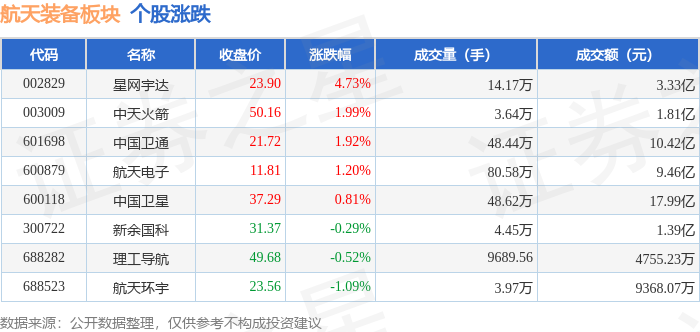
Core Insights - The aerospace equipment sector experienced a 1.4% increase on October 9, with Xingwang Yuda leading the gains [1] - The Shanghai Composite Index closed at 3933.97, up 1.32%, while the Shenzhen Component Index closed at 13725.56, up 1.47% [1] Sector Performance - Xingwang Yuda (002829) closed at 23.90, with a rise of 4.73% and a trading volume of 141,700 shares, totaling a transaction value of 333 million yuan [1] - Zhongtian Rocket (003009) closed at 50.16, up 1.99%, with a trading volume of 36,400 shares and a transaction value of 181 million yuan [1] - China Aerospace (601698) closed at 21.72, increasing by 1.92%, with a trading volume of 484,400 shares and a transaction value of 1.042 billion yuan [1] - Aerospace Electronics (600879) closed at 11.81, up 1.20%, with a trading volume of 805,800 shares and a transaction value of 946 million yuan [1] - China Satellite (600118) closed at 37.29, with a slight increase of 0.81%, trading 486,200 shares for a total of 1.799 billion yuan [1] - Xinyu Guoke (300722) closed at 31.37, down 0.29%, with a trading volume of 44,500 shares and a transaction value of 139 million yuan [1] - Ligong Navigation (688282) closed at 49.68, down 0.52%, with a trading volume of 9,689 shares and a transaction value of 47.55 million yuan [1] - Aerospace Huaiyu (688523) closed at 23.56, down 1.09%, with a trading volume of 39,700 shares and a transaction value of 93.68 million yuan [1] Capital Flow - The aerospace equipment sector saw a net outflow of 75.87 million yuan from institutional investors, while retail investors contributed a net inflow of 90.11 million yuan [1]







星网宇达股价涨5.04%,华夏基金旗下1只基金位居十大流通股东,持有345.12万股浮盈赚取396.89万元
Xin Lang Cai Jing· 2025-10-09 05:29
Group 1 - The core point of the news is that Xingwang Yuda's stock price increased by 5.04% to 23.97 CNY per share, with a trading volume of 1.93 billion CNY and a turnover rate of 5.69%, resulting in a total market capitalization of 4.981 billion CNY [1] - Xingwang Yuda, established on May 20, 2005, and listed on December 13, 2016, specializes in inertial technology development and applications, focusing on inertial navigation, measurement, and stabilization products for various sectors including aerospace, marine, and telecommunications [1] - The company's revenue composition includes 45.41% from unmanned systems, 35.18% from information perception, 16.91% from satellite communication, and 2.49% from other sources [1] Group 2 - Among the top ten circulating shareholders of Xingwang Yuda, Huaxia Fund's Huaxia Industry Prosperity Mixed A (003567) entered the list in the second quarter, holding 3.4512 million shares, which accounts for 2.36% of the circulating shares, with an estimated floating profit of approximately 3.9689 million CNY [2] - Huaxia Industry Prosperity Mixed A was established on February 4, 2017, with a latest scale of 7.261 billion CNY, achieving a year-to-date return of 59.07% and a one-year return of 71.16% [2] - The fund manager of Huaxia Industry Prosperity Mixed A is Zhong Shuai, who has a cumulative tenure of 5 years and 75 days, with the fund's total asset scale at 8.253 billion CNY and a best return of 185.39% during his tenure [3]
航天装备板块9月30日涨2.65%,航天电子领涨,主力资金净流入1.82亿元
Zheng Xing Xing Ye Ri Bao· 2025-09-30 08:51
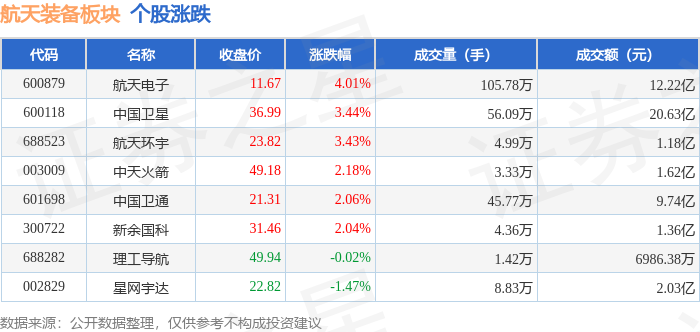
Group 1 - The aerospace equipment sector increased by 2.65% on September 30, with aerospace electronics leading the gains [1] - The Shanghai Composite Index closed at 3882.78, up 0.52%, while the Shenzhen Component Index closed at 13526.51, up 0.35% [1] - Major stocks in the aerospace equipment sector showed varied performance, with Aerospace Electronics (600879) rising by 4.01% to a closing price of 11.67 [1] Group 2 - The net inflow of main funds in the aerospace equipment sector was 182 million yuan, while retail investors saw a net outflow of 241 million yuan [1] - Aerospace Electronics had a main fund net outflow of 22.38 million yuan, but retail investors contributed a net inflow of 27.89 million yuan [2] - China Satellite (600118) experienced a significant main fund net inflow of 216 million yuan, indicating strong institutional interest [2]


三型舰载机完成起降训练,美方再提航发谈判筹码
CAITONG SECURITIES· 2025-09-29 13:39
Core Insights - The defense and military industry index experienced a decline of -0.42% over the past week, ranking 13th out of 31 in the Shenwan primary industry classification [5][9] - Over the past month, the index fell by -9.03%, ranking last at 31st out of 31 [5][10] - In the past year, the index has increased by 40.43%, ranking 10th out of 31 [5][15] - The current PE-TTM for the defense and military industry is 84.84, which is at the 77.44th percentile compared to the past decade [5][15][16] Industry and Stock Performance Review Industry Performance - The defense and military industry index's performance over the past week, month, and year shows significant fluctuations, with a notable annual increase [5][9][15] - The industry is currently facing a high valuation level, with the PE-TTM at a historical relative high [5][15] Stock Performance - Top-performing stocks in the defense and military sector over the past week include: - Xingwang Yuda (11.84%) - Aerospace Electronics (7.76%) - Sichuan Chuangxin (4.77%) [5][20] - Conversely, the worst-performing stocks include: - Jinxin Nuo (-5.70%) - Torch Electronics (-5.75%) - Hongyuan Electronics (-5.88%) [5][20] Funding Data Tracking - The total transaction volume for the defense and military industry reached 257 billion yuan this week, representing an 88.28% increase year-on-year but a decrease of 8.22% week-on-week [5][34] - The military ETF fund shares increased by 2.12% compared to last week and 82.40% compared to last year [5][37] Industry News - The successful training of three types of carrier-based aircraft on the Fujian ship marks a significant milestone for China's naval capabilities [5][46] - The U.S. has indicated that aircraft engines and components may become important bargaining chips in negotiations with China, highlighting the strategic importance of the aviation industry [5][45] Investment Recommendations - Suggested investment focuses include: - Aviation engines: Companies like Wanzhe Co., Parker New Materials, and others [5][46] - Military trade: Companies such as Hongdu Aviation and others [5][46] - Commercial aerospace: Companies like Aerospace Power and others [5][46] - Aircraft carrier supply chain: Companies such as Guorui Technology and others [5][46] - Military AI: Companies like Guanshang Technology and others [5][46]
航天装备板块9月29日涨1.63%,理工导航领涨,主力资金净流出4467.34万元
Zheng Xing Xing Ye Ri Bao· 2025-09-29 08:45
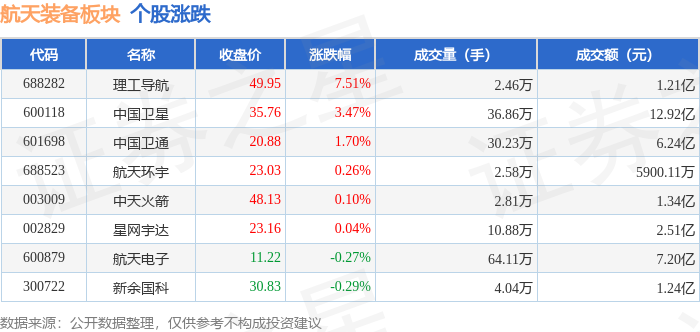
Market Performance - The aerospace equipment sector increased by 1.63% on September 29, with leading gains from LIGONG Navigation, which rose by 7.51% to a closing price of 49.95 [1] - The Shanghai Composite Index closed at 3862.53, up 0.9%, while the Shenzhen Component Index closed at 13479.43, up 2.05% [1] Stock Performance - Key stocks in the aerospace equipment sector showed varied performance, with China Satellite up 3.47% and China Telecom up 1.70%, while Aerospace Electronics and New Meeting Guoke experienced slight declines of -0.27% and -0.29% respectively [1] - The trading volume and turnover for LIGONG Navigation reached 24,600 hands and 121 million yuan, respectively [1] Capital Flow - The aerospace equipment sector experienced a net outflow of 44.67 million yuan from institutional investors and 46.71 million yuan from retail investors, while individual investors saw a net inflow of 91.38 million yuan [1] - Detailed capital flow data indicates that China Satellite had a net inflow of 12.92 billion yuan from institutional investors, while LIGONG Navigation had a net inflow of 10.50 million yuan [2]
低空行业周报(9月第4周):2025深圳低空经济展览会本周召开,产业进展持续推动中-20250928
Huafu Securities· 2025-09-28 09:04
Investment Rating - The industry rating is "Outperform the Market" [6][54]. Core Insights - The low-altitude economy sector is currently experiencing a period of stagnation, with expectations for a rebound driven by industry catalysts and supportive policies [4][29]. - The focus for the low-altitude industry this year is on infrastructure development and the implementation of drone applications, which are seen as essential for the sector's growth [5][30]. - The market is awaiting significant policy support and advancements in the industry, with local governments actively working on practical measures such as airspace planning and low-altitude flight management [4][29]. Summary by Sections Market Review - The Wind Low Altitude Economy Index decreased by 0.55% this week, ranking 164 out of 338, underperforming the market as the Shanghai Composite Index rose by 0.21% [3][13]. - The top five gainers in the A-share and Hong Kong stock markets included: Kaizhong Co. (up 15.44%), Xingwang Yuda (up 11.84%), Shencheng Transportation (up 10.13%), Aerospace Nanhua (up 5.99%), and Zongheng Co. (up 5.78%) [3][16]. Industry Dynamics - Recent developments include strategic partnerships and policy announcements aimed at fostering the low-altitude economy, such as the signing of a cooperation agreement between Hefei City and a helicopter company, and the release of support policies for low-altitude economic development in Shanghai [33][36]. - The Guangdong low-altitude economy has reached a scale of over 100 billion, with more than 15,000 related enterprises, accounting for over 30% of the national low-altitude economy industry chain [37]. Investment Strategy - The report suggests focusing on infrastructure companies such as Les Information and Suzhou Planning, as well as drone-related companies like Jifeng Technology and Henghe Precision [6][32]. - The low-altitude industry is seen as having the potential for a rebound, with the right conditions and catalysts expected to drive growth in the coming months [4][29].





研判2025!中国导航吊舱行业相关概述、产业链、发展现状、竞争格局及未来趋势:军民需求双轮发力,导航吊舱行业市场规模有望达到5.51亿元[图]
Chan Ye Xin Xi Wang· 2025-09-28 01:20
Core Viewpoint - The navigation pod industry in China is rapidly developing due to government support and increasing demand in both military and civilian sectors, with market size projected to reach 5.07 billion yuan in 2024, an 8.8% year-on-year increase [1][4]. Industry Overview - The navigation pod is a payload device installed on aircraft, used for collecting optical signals, and can be categorized into various types including navigation pods, targeting pods, and electronic intelligence pods [3]. - The components of navigation pods include terrain-following radar, forward-looking infrared systems, and other essential parts for operational functionality [3]. Industry Chain - The upstream of the navigation pod industry includes components like radar and infrared sensors, while the midstream focuses on manufacturing, and the downstream applications span military and civilian uses [4]. Current Industry Status - The global navigation pod market is maturing, with a compound annual growth rate of 4.9% from 2016 to 2024, expected to reach 1.11 billion dollars in 2025 [4]. - In China, the navigation pod market is supported by stable military spending and the growth of the UAV market, leading to increased demand [4]. Competitive Landscape - The global market is competitive, with leading positions held by American companies like Lockheed Martin and Raytheon, while Chinese companies are catching up in mid to low-end products [5][6]. - Key players in the Chinese market include North Optical Electric Co., Ltd., Beijing Star Net Yuda Technology Co., Ltd., and others [5][6]. Development Trends - The integration of AI, big data, and IoT technologies is expected to drive the evolution of navigation pods towards smarter and more connected systems [7]. - Demand in the military sector is anticipated to grow, particularly for UAVs, while civilian applications in environmental monitoring and disaster response will also expand [8]. - The competitive landscape is becoming more diversified, with state-owned enterprises maintaining a stronghold in high-end military products, while private tech companies are emerging in the civilian market [10].

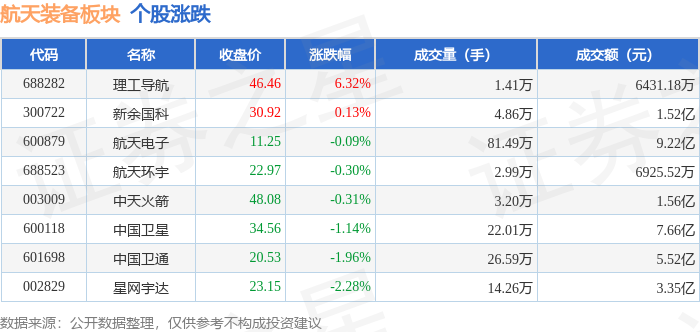
航天装备板块9月26日跌1.09%,星网宇达领跌,主力资金净流出7030.52万元
Zheng Xing Xing Ye Ri Bao· 2025-09-26 08:48
Market Overview - The aerospace equipment sector experienced a decline of 1.09% on September 26, with Xingwang Yuda leading the drop [1] - The Shanghai Composite Index closed at 3828.11, down 0.65%, while the Shenzhen Component Index closed at 13209.0, down 1.76% [1] Stock Performance - The following stocks in the aerospace equipment sector showed notable performance: - Ligong Navigation (688282) increased by 6.32% to a closing price of 46.46 [1] - Xinyu Guoke (300722) rose slightly by 0.13% to 30.92 [1] - Aerospace Electronics (600879) decreased by 0.09% to 11.25 [1] - Xingwang Yuda (002829) fell by 2.28% to 23.15 [1] Capital Flow - The aerospace equipment sector saw a net outflow of 70.31 million yuan from institutional investors, while retail investors had a net inflow of 70.93 million yuan [1] - Detailed capital flow for specific stocks includes: - Aerospace Electronics (600879) had a net inflow of 36.69 million yuan from institutional investors [2] - Ligong Navigation (688282) saw a net inflow of 9.98 million yuan from institutional investors [2] - Xingwang Yuda (002829) experienced a significant net outflow of 38.21 million yuan from institutional investors [2] - China Satellite (600118) had a net inflow of 8.95 million yuan from institutional investors [2]
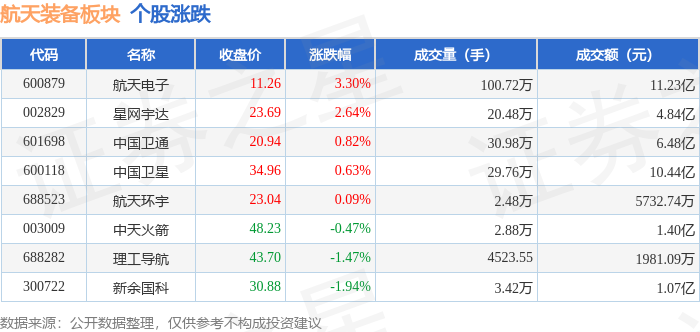
航天装备板块9月25日涨1.05%,航天电子领涨,主力资金净流入1.71亿元
Zheng Xing Xing Ye Ri Bao· 2025-09-25 08:44
Core Insights - The aerospace equipment sector experienced a 1.05% increase on September 25, with Aerospace Electronics leading the gains [1] - The Shanghai Composite Index closed at 3853.3, down 0.01%, while the Shenzhen Component Index closed at 13445.9, up 0.67% [1] Sector Performance - Aerospace Electronics (600879) closed at 11.26, up 3.30% with a trading volume of 1,007,200 shares and a turnover of 1.123 billion yuan [1] - StarNet Yuda (002829) closed at 23.69, up 2.64% with a trading volume of 204,800 shares and a turnover of 484 million yuan [1] - China Satellite (601698) closed at 20.94, up 0.82% with a trading volume of 309,800 shares and a turnover of 648 million yuan [1] - China Inner Star (600118) closed at 34.96, up 0.63% with a trading volume of 129,760 shares and a turnover of 1.044 billion yuan [1] - Aerospace Huaiyu (688523) closed at 23.04, up 0.09% with a trading volume of 24,800 shares and a turnover of 57.3274 million yuan [1] - Zhongtian Rocket (003009) closed at 48.23, down 0.47% with a trading volume of 28,800 shares and a turnover of 140 million yuan [1] - Ligong Navigation (688282) closed at 43.70, down 1.47% with a trading volume of 4,523 shares and a turnover of 1.98109 million yuan [1] - Xinyu Guoke (300722) closed at 30.88, down 1.94% with a trading volume of 34,200 shares and a turnover of 107 million yuan [1] Capital Flow - The aerospace equipment sector saw a net inflow of 171 million yuan from institutional investors, while retail investors experienced a net outflow of 193 million yuan [1] - The detailed capital flow for key stocks indicates varying levels of net inflow and outflow among institutional and retail investors [2]
航天装备板块9月24日跌0.98%,中天火箭领跌,主力资金净流出1.64亿元
Zheng Xing Xing Ye Ri Bao· 2025-09-24 08:46
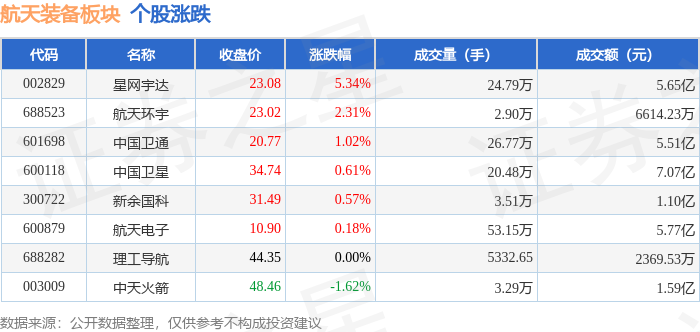
Market Overview - The aerospace equipment sector experienced a decline of 0.98% on September 24, with Zhongtian Rocket leading the losses [1] - The Shanghai Composite Index closed at 3853.64, up 0.83%, while the Shenzhen Component Index closed at 13356.14, up 1.8% [1] Individual Stock Performance - StarNet Yuda (002829) closed at 23.08, up 5.34% with a trading volume of 247,900 shares and a turnover of 565 million yuan [1] - Aerospace Huanyu (688523) closed at 23.02, up 2.31% with a trading volume of 29,000 shares and a turnover of 6.614 million yuan [1] - China Satellite (600118) closed at 34.74, up 0.61% with a trading volume of 204,800 shares and a turnover of 707 million yuan [1] - Zhongtian Rocket (003009) closed at 48.46, down 1.62% with a trading volume of 32,900 shares and a turnover of 159 million yuan [1] Fund Flow Analysis - The aerospace equipment sector saw a net outflow of 164 million yuan from institutional investors, while retail investors had a net inflow of 172 million yuan [1] - The detailed fund flow for individual stocks indicates that: - Aerospace Electronics (600879) had a net outflow of 67.0864 million yuan from institutional investors [2] - Zhongtian Rocket (003009) experienced a net outflow of 19.4786 million yuan from institutional investors but a net inflow of 29.0393 million yuan from retail investors [2] - StarNet Yuda (002829) had a net outflow of 5.4626 million yuan from institutional investors but a net inflow of 16.3072 million yuan from retail investors [2]