
郑州银行

Search documents
银行研思录25:银行股息率排名与中期分红进度梳理-20251114
CMS· 2025-11-14 03:02
Investment Rating - The report does not explicitly state an investment rating for the banking sector, but it provides detailed insights into dividend yields and distribution processes, which can inform investment decisions. Core Insights - The report outlines the latest dividend yields and mid-term dividend processes for A and H shares of listed banks, emphasizing the importance of accurately calculating dynamic dividend yields to avoid discrepancies across periods [1][2]. - It details the two processes for mid-term dividends following the 2023 revision of the regulatory guidelines, highlighting the conventional and simplified processes for implementing mid-term dividends [2]. - The report provides a comprehensive overview of key dates related to dividend distribution for both A and H shares, including the importance of purchasing shares before the ex-dividend date to qualify for dividends [3][4]. Summary by Sections Dynamic Dividend Yield Calculation - A simplified yet accurate method for calculating dynamic dividend yield is introduced, defined as "rolling 12-month EPS * cash dividend rate / share price," which helps avoid issues related to overlapping or missing annual and mid-term dividends [1]. - The report calculates the cash dividend rate using a standardized approach across different banks, resulting in a clear comparison of dividend yields as of November 13, 2025 [1]. Mid-Term Dividend Processes - The report explains the two processes for mid-term dividends: the conventional process requiring shareholder approval and a simplified process allowing for quicker implementation [2]. - The simplified process is designed to enhance flexibility for companies in distributing mid-term dividends, thereby improving shareholder returns [2]. Dividend Distribution Key Dates - For A shares, investors must purchase shares before the ex-dividend date to receive dividends on the same day, while H shares typically see a delay of about one month for dividend payments [3][4]. - The report outlines the differences in the dividend distribution timeline between A and H shares, emphasizing the need for investors to be aware of these timelines to maximize their returns [3][4]. Mid-Term Dividend Progress - As of November 13, 2025, 31 A-share banks have confirmed mid-term dividends, while 11 H-share banks have also confirmed their dividend distributions [9][11]. - The report categorizes banks based on their dividend status, detailing those that have implemented dividends, those that are pending, and those that have opted not to distribute dividends [9][10][11]. - It highlights that the end of 2025 and early 2026 is expected to be a peak period for mid-term dividend distributions, suggesting potential investment opportunities for dividend-seeking investors [11].






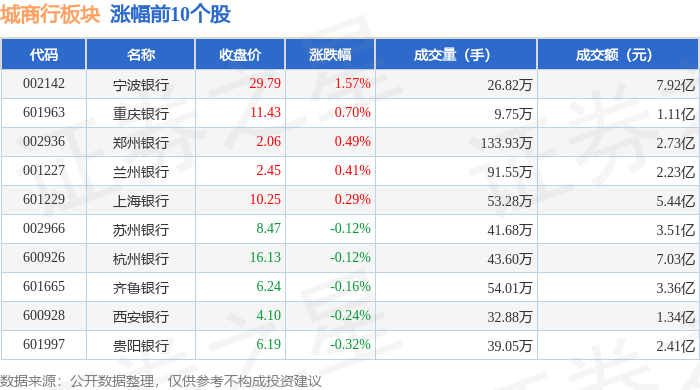
城商行板块11月13日跌0.02%,长沙银行领跌,主力资金净流出6796.93万元
Zheng Xing Xing Ye Ri Bao· 2025-11-13 08:45
Core Points - The city commercial bank sector experienced a slight decline of 0.02% on November 13, with Changsha Bank leading the drop [1] - The Shanghai Composite Index closed at 4029.5, up 0.73%, while the Shenzhen Component Index closed at 13476.52, up 1.78% [1] Summary by Category Stock Performance - Ningbo Bank (002142) closed at 29.79, with an increase of 1.57% and a trading volume of 268,200 shares, totaling a transaction value of 792 million yuan [1] - Chongqing Bank (601963) closed at 11.43, up 0.70%, with a trading volume of 97,500 shares, totaling 111 million yuan [1] - Zhengzhou Bank (002936) closed at 2.06, up 0.49%, with a trading volume of 1,339,300 shares, totaling 273 million yuan [1] - Other banks such as Lanzhou Bank, Shanghai Bank, and Suzhou Bank showed minor fluctuations in their stock prices, with varying trading volumes and values [1] Capital Flow - The city commercial bank sector saw a net outflow of 67.9693 million yuan from main funds, while retail funds experienced a net outflow of 99.3293 million yuan [3] - Conversely, speculative funds recorded a net inflow of 166.7 million yuan [3]





240只港股获南向资金大比例持有
Zheng Quan Shi Bao Wang· 2025-11-13 01:44
Core Insights - The overall shareholding ratio of southbound funds in Hong Kong Stock Connect stocks is 19.26%, with 240 stocks having a shareholding ratio exceeding 20% [1] - Southbound funds hold a total of 4,864.84 million shares, accounting for 19.26% of the total share capital of the stocks, with a market value of 64,209.67 billion HKD, representing 14.59% of the total market value [1] - The highest shareholding ratio by southbound funds is in China Telecom (601728) at 72.09%, followed by Green Power (601330) at 69.31% and COSCO Shipping Energy (600026) at 68.55% [1] Group 1: Shareholding Distribution - 240 stocks have a shareholding ratio of over 20%, 130 stocks between 10% and 20%, 96 stocks between 5% and 10%, 82 stocks between 1% and 5%, and 19 stocks below 1% [1] - Among the stocks with over 20% shareholding by southbound funds, 128 are AH concept stocks, making up 53.33% of that group [1] Group 2: Industry Concentration - Stocks with a shareholding ratio exceeding 20% are primarily concentrated in the healthcare, industrial, and financial sectors, with 56, 35, and 34 stocks respectively [2] - The table lists several stocks with high southbound fund holdings, including China Telecom (72.09%), Green Power (69.31%), and COSCO Shipping Energy (68.55%) [2][3]
银行直售房,没那么吓人
Ge Long Hui· 2025-11-12 10:55
Core Insights - The recent surge in banks selling properties has raised concerns about the accumulation of non-performing assets within the banking sector [1][2][4] - Data indicates that the number of properties listed for sale by various rural credit systems is substantial, with Guangdong, Sichuan, and other provinces showing significant figures [1][2][6] - Despite the high number of properties being sold, they represent a small fraction of the overall housing inventory in major cities like Guangzhou, Shenzhen, and Chengdu [6][11][9] Summary by Sections Property Sales Data - Since August 2024, the Guangdong rural credit system has listed 12,386 properties for sale, while the Sichuan rural credit system has listed 24,821 properties since November 2024 [1] - Other provinces such as Liaoning, Guizhou, Jilin, and Fujian have also contributed to the total number of properties being sold [1] Market Reaction - The market has reacted with surprise, speculating that banks may be facing a significant amount of non-performing assets [2][4] - The perception is that the properties being sold are just the tip of the iceberg, indicating a larger issue with banks needing to liquidate assets [2] Non-Performing Loans and Asset Management - The sale of properties is often linked to borrowers' inability to repay loans, leading banks to reclaim and sell these assets [3] - The current data suggests that the number of properties being sold is relatively small compared to the total inventory of second-hand homes available in the market [6][11] Trends in Non-Performing Loan Rates - The overall non-performing loan rates for listed banks have been declining since 2020, indicating that banks have been effectively managing and disposing of non-performing assets [12][13] - As of November 2025, the non-performing loan rates for various banks show a downward trend compared to previous years, with many banks reporting lower rates than in 2020 [12][13] Industry Restructuring - The banking sector has undergone significant reforms and consolidations, with over 300 rural banks being merged or restructured in 2025 alone [15] - Major banks have also participated in these consolidations, indicating a strategic move to strengthen their positions and manage non-performing assets more effectively [15] Asset Disposal Efforts - Banks have been actively disposing of non-performing assets, with significant amounts being processed each year [18][20] - In 2025, banks disposed of 1.5 trillion yuan in non-performing assets, reflecting a proactive approach to managing risk [20] - The rural commercial banks have seen the highest non-performing loan rates but have also experienced the most significant reductions in these rates over the years [21][22]

城商行板块11月12日涨0.05%,长沙银行领涨,主力资金净流入2.2亿元
Zheng Xing Xing Ye Ri Bao· 2025-11-12 08:49
Core Insights - The city commercial bank sector experienced a slight increase of 0.05% on November 12, with Changsha Bank leading the gains [1] - The Shanghai Composite Index closed at 4000.14, down 0.07%, while the Shenzhen Component Index closed at 13240.62, down 0.36% [1] Stock Performance - Changsha Bank (601577) closed at 10.08, up 0.90% with a trading volume of 199,800 shares and a transaction value of 201 million yuan [1] - Shanghai Bank (601229) closed at 10.22, up 0.89% with a trading volume of 597,100 shares and a transaction value of 611 million yuan [1] - Other notable performances include: - Lanzhou Bank (001227) at 2.44, up 0.41% - Jiangsu Bank (616009) at 11.13, up 0.27% - Beijing Bank (601169) at 5.73, up 0.17% [1] Capital Flow - The city commercial bank sector saw a net inflow of 220 million yuan from main funds, while retail investors experienced a net outflow of 200 million yuan [2] - Key capital flows include: - Jiangsu Bank (600919) with a net inflow of 10.4 million yuan from main funds [2] - Beijing Bank (601169) with a net inflow of 62.5 million yuan from main funds [2] - Shanghai Bank (601229) with a net inflow of 58.5 million yuan from main funds [2]


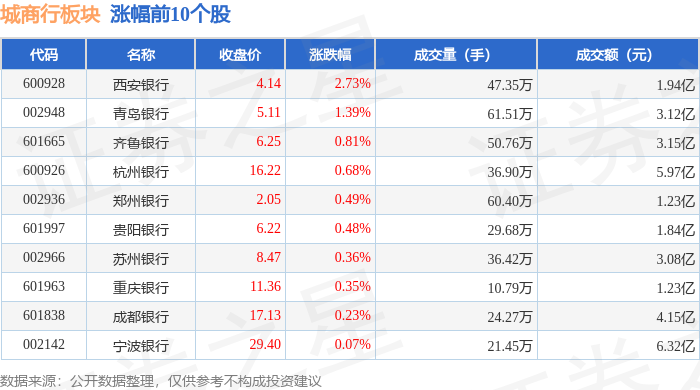
城商行板块11月11日跌0%,上海银行领跌,主力资金净流入2.41亿元
Zheng Xing Xing Ye Ri Bao· 2025-11-11 08:46
Market Overview - The city commercial bank sector experienced a slight decline of 0.0% on November 11, with Shanghai Bank leading the drop [1] - The Shanghai Composite Index closed at 4002.76, down 0.39%, while the Shenzhen Component Index closed at 13289.0, down 1.03% [1] Individual Bank Performance - Xi'an Bank saw the highest increase in share price, closing at 4.14 with a rise of 2.73% [1] - Qingdao Bank and Qilu Bank also reported positive performance, with increases of 1.39% and 0.81% respectively [1] - Shanghai Bank, on the other hand, closed at 10.13, down 0.98%, indicating a significant decline in its stock price [2] Trading Volume and Capital Flow - The city commercial bank sector recorded a net inflow of 241 million yuan from institutional investors, while retail investors saw a net outflow of 290 million yuan [2] - Jiangsu Bank attracted the highest net inflow from institutional investors at 113 million yuan, representing 11.75% of its trading volume [3] - In contrast, Zhengzhou Bank experienced a net outflow of 421,280 yuan from institutional investors, indicating a negative sentiment towards its stock [3]

一日两家,“村改支”提速
中国基金报· 2025-11-11 05:20
Group 1 - The core viewpoint of the article highlights the recent acquisitions and restructuring of village banks by major banks in China, specifically mentioning the actions taken by SPDB and Zhengzhou Bank [2][3]. - SPDB has received approval to acquire Zhejiang Pingyang SPDB Village Bank and establish a new branch, SPDB Wenzhou Pingyang Branch, while also absorbing its assets, liabilities, and employees [2][3]. - Zhengzhou Bank plans to acquire the remaining 49% of shares in Xun County Zhengyin Village Bank and will merge it into its operations, leading to the dissolution of the village bank [3]. Group 2 - The reform of village banks is accelerating, with data from the National Financial Regulatory Administration indicating that as of August 15, 100 village banks have completed mergers and restructuring, surpassing the total of 94 exits for the entire year of 2024 [4]. - Analysts suggest that the absorption and restructuring of village banks into branches enhance service capabilities and risk resistance for the banks, while also allowing the parent banks to expand their operational scope in areas where they lack existing branches [4].

浦发银行及郑州银行同日披露吸收旗下村镇银行并改设分支机构
Zhong Guo Ji Jin Bao· 2025-11-11 05:10
Core Points - SPDB (Shanghai Pudong Development Bank) and Zhengzhou Bank have announced the acquisition and restructuring of their respective village banks into branch institutions, indicating a trend towards consolidation in the rural banking sector [2][3] - The National Financial Regulatory Administration has approved these acquisitions, emphasizing compliance with legal regulations during the process [2] - The restructuring aims to enhance service capabilities and risk management for the parent banks while expanding their operational scope in rural areas [3] Group 1: SPDB's Acquisition - SPDB has received approval to acquire Zhejiang Pingyang Pudong Village Bank and establish a new branch, SPDB Wenzhou Pingyang Branch, taking over its assets, liabilities, and operations [2] - This marks the second village bank restructuring initiative by SPDB in recent months, following a similar acquisition in Dalian [2] Group 2: Zhengzhou Bank's Acquisition - Zhengzhou Bank plans to acquire the remaining 49% of shares in Xun County Zhengyin Village Bank and will merge it into its operations, leading to the dissolution of the village bank [3] - Xun County Zhengyin Village Bank was established in November 2017 with a registered capital of 100 million yuan, and Zhengzhou Bank previously held a 51% stake [3] Group 3: Industry Trends - As of August 15, 2023, 100 village banks have completed mergers and restructurings, surpassing the total of 94 exits projected for the entire year of 2024 [3] - Analysts suggest that the consolidation of village banks into branch institutions will improve service capabilities and broaden the business scope for the parent banks, especially in areas lacking existing branches [3]

一日两家,“村改支”提速
Zhong Guo Ji Jin Bao· 2025-11-11 05:09
Core Insights - SPDB and Zhengzhou Bank announced the acquisition of their respective village banks and the establishment of branch institutions, indicating a trend towards consolidation in the rural banking sector [1][2] - The National Financial Regulatory Administration has approved these acquisitions, emphasizing compliance with legal regulations [1] - The reform of village banks is accelerating, with over 100 village banks having completed mergers and restructurings by mid-August, surpassing the total number of exits for the entire year of 2024 [2] SPDB Acquisition - SPDB has acquired Zhejiang Pingyang Pudong Village Bank and will establish the Wenzhou Pingyang Branch, taking over its assets, liabilities, and employees [1] - This is the second "village-to-branch" project initiated by SPDB this year, following the acquisition of Dalian Ganjingzi Pudong Village Bank [1] Zhengzhou Bank Acquisition - Zhengzhou Bank plans to acquire the remaining 49% of shares in Xun County Zhengyin Village Bank and will merge it into a branch institution [2] - The merger will result in the dissolution of Xun County Zhengyin Village Bank, with all rights and obligations transferred to Zhengzhou Bank [2] Industry Trends - The ongoing consolidation of village banks is aimed at enhancing service capabilities and risk resilience in rural areas [2] - The transformation of village banks into branches allows parent banks to expand their operational scope, particularly in regions lacking existing branches [2]
郑州银行(06196) - 海外监管公告 - 郑州银行股份有限公司股东会议事规则及郑州银行股份有限公...
2025-11-10 22:58
香 港 交 易 及 結 算 所 有 限 公 司 及 香 港 聯 合 交 易 所 有 限 公 司 對 本 公 告 的 內 容 概 不 負 責, 對 其 準 確 性 或 完 整 性 亦 不 發 表 任 何 聲 明,並 明 確 表 示 概 不 會 就 本 公 告 全 部 或 任 何 部 分 內 容 而 產 生 或 因 倚 賴 該 等 內 容 而 引 致 的 任 何 損 失 承 擔 任 何 責 任。 Bank of Zhengzhou Co., Ltd.* 鄭州銀行股份有限公司 * (於中華人民共和國註冊成立的股份有限公司) (H股股份代號:6196) 海外監管公告 本 公 告 由 鄭 州 銀 行 股 份 有 限 公 司(「本 行」)根 據 香 港 聯 合 交 易 所 有 限 公 司證券上市規則第13.10B條 作 出。 以 下 為 本 行 於 深 圳 證 券 交 易 所 網 站 發 佈 之《鄭 州 銀 行 股 份 有 限 公 司 股 東 會 議 事 規 則》《鄭 州 銀 行 股 份 有 限 公 司 董 事 會 議 事 規 則》,僅 供 參 閱。 承董事會命 鄭州銀行股份有限公司* 趙 飛 董事長 中國河南省鄭州市 ...