
村镇银行改革

Search documents
再现13.08%反对票!村镇银行合并潮股东分歧显现 多家上市银行收购议案遭显著反对
Mei Ri Jing Ji Xin Wen· 2026-01-23 14:18
Group 1 - The core viewpoint of the articles highlights the increasing shareholder dissent during the merger and acquisition processes of rural banks, indicating a trend towards more market-driven governance mechanisms in the banking sector [1][2][3] - The recent merger of Suzhou Rural Commercial Bank with Zhangjiagang Yurun Rural Bank was approved with a 13.08% dissenting vote, reflecting growing concerns among shareholders regarding the governance and decision-making processes in banking [1][2] - Similar patterns were observed in previous cases, such as Guiyang Bank and Guangzhou Rural Commercial Bank, where significant dissenting votes were recorded, suggesting a broader trend of shareholder activism in the banking sector [1][4] Group 2 - Financial data of Zhangjiagang Yurun Rural Bank shows total assets of 537 million yuan and a net profit of 20.33 million yuan, with a low non-performing loan ratio of 0.73% and a high provision coverage ratio of 930.51% [2] - The dissent among shareholders is attributed to concerns over the rationality of merger pricing and the diverse interests of different shareholder groups, particularly between management's focus on long-term growth and minority shareholders' emphasis on short-term returns [3][5] - The integration of rural banks involves complex valuation and risk management issues, with capital adequacy, cultural integration, and strategic alignment being critical factors for successful mergers [7][8]
村镇银行改革首度引入信托,能否复制推广?
Xin Lang Cai Jing· 2026-01-22 12:28
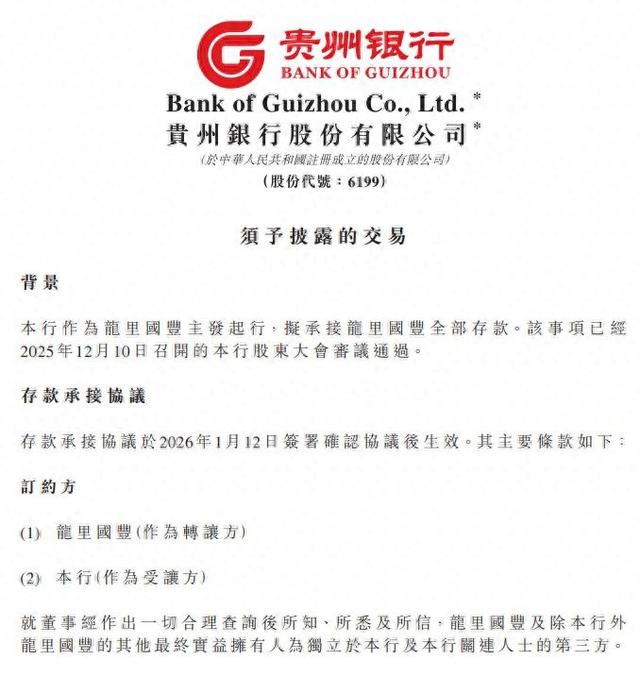
Core Viewpoint - The introduction of a trust structure as an "intermediate layer" in the reform of village banks represents a significant innovation, focusing on the "isolation of asset confirmation and delivery" and the "non-cash disposal of risk assets" [1][12][18]. Summary by Sections Transaction Details - Guizhou Bank announced a deposit assumption agreement with Longli Guofeng Village Bank, where Guizhou Bank will assume debts and related rights amounting to a total of 1.913 billion yuan, with a final consideration of 1.849 billion yuan [3][13]. - The agreement will take effect on January 12, 2026, and all deposits will be assumed by Guizhou Bank starting January 9, 2026 [15][16]. Trust Structure Innovation - The model allows Guizhou Bank to avoid cash acquisition of the village bank's equity or assets, instead creating a trust plan that exchanges deposit debts for future credit asset income rights [2][14]. - This trust plan is a first in the banking sector, typically seen in corporate bankruptcy restructuring, enhancing restructuring efficiency [2][14]. Regulatory and Compliance Considerations - Experts have raised concerns about regulatory arbitrage risks, particularly regarding whether this model could be seen as using trust channels to "off-balance" bad assets [2][14]. - The model is seen as a potential solution to the capital adequacy pressures faced by small and medium-sized banks, which have lower capital adequacy ratios compared to larger banks [18][19]. Market Implications - The trust structure aims to address three major pain points in the reform of small banks: alleviating capital pressure, improving bad asset disposal efficiency, and avoiding complex equity negotiations [18][19]. - The model's applicability is considered limited, requiring specific conditions such as clear asset ownership and stable cash flow from credit assets [21][22]. Future Outlook - The new model is viewed as a valuable intermediate path for institutions needing urgent risk isolation without direct acquisition, although traditional restructuring methods remain necessary for severely deteriorated assets [22][23]. - The conditions for successful implementation of this model are seen as maturing, with regulatory support and the evolving ecosystem for trust tools [23].
村镇银行改革现新解法,贵州银行缘何借信托承接逾19亿元存款?
Mei Ri Jing Ji Xin Wen· 2026-01-16 11:42
Core Viewpoint - Guizhou Bank is set to assume all deposit liabilities of Longli Guofeng Village Bank, totaling 19.13 billion yuan, through a trust plan instead of cash payment, marking an innovative approach in village bank reforms [1][3][5]. Group 1: Transaction Details - The deposit assumption agreement will take effect on January 12, 2026, with a total principal and interest amount of 19.13 billion yuan, and a net consideration of 18.49 billion yuan after deducting related rights [1][2][5]. - The transaction involves Guizhou Bank receiving trust beneficiary shares in exchange for the debt it assumes, which is a rare method in village bank reforms [1][3][4]. Group 2: Strategic Implications - This approach is based on market-oriented and legal principles, aiming to protect the rights of all parties involved and maintain local financial stability [1][5][18]. - The trust structure allows for risk isolation, ensuring the safety of the trust beneficiary rights and optimizing liquidity, which aids in a smooth exit for the institution [6][8][18]. Group 3: Broader Context - Guizhou Bank is also consolidating several other village banks, having completed the acquisition of Tongren Fengyuan Village Bank in 2025 and planning to absorb three more banks pending regulatory approval [2][19][20]. - The bank's actions align with the ongoing nationwide reform of village banks, where over 200 banks have exited the market in the past year, with absorption and restructuring becoming mainstream [4][15].
19亿存款“寄身”信托,贵州银行旗下村镇银行现另类改革
券商中国· 2026-01-15 03:56
Core Viewpoint - Guizhou Bank is set to take over all deposits from Longli Guofeng Rural Bank through a unique asset-backed trust plan, marking a significant reform in rural banking practices in China [1][2][8]. Group 1: Deposit Transfer Agreement - Guizhou Bank will assume a total deposit liability of RMB 19.13 billion from Longli Guofeng Rural Bank, with a final transfer price of RMB 18.49 billion after accounting for related rights [5]. - The agreement will take effect on January 12, 2026, following the signing of the deposit transfer contract [1][4]. - The transfer will not involve immediate cash payment; instead, it will utilize an asset income right trust plan [2][4]. Group 2: Unique Payment Structure - The payment for the deposit transfer will be made through trust benefits derived from the asset income rights of Longli Guofeng Rural Bank, rather than direct cash [8][9]. - This structure allows Guizhou Bank to manage cash flow effectively while ensuring the protection of depositors' rights [9]. - The trust plan is designed to isolate risks and enhance the security of deposits, ensuring that Guizhou Bank's future earnings remain independent from Longli Guofeng's other debts [9]. Group 3: Business Adjustments - Starting January 9, 2026, all deposits will be managed by Guizhou Bank, which will also handle the repayment obligations [12]. - Longli Guofeng Rural Bank will cease to issue new loans, with existing loans managed by Guizhou Bank, but customers must continue to fulfill their repayment obligations to Longli Guofeng [12]. - The announcement emphasizes "business adjustments" rather than terms like "dissolution" or "exit," indicating a strategic approach to the transition [12].


村镇银行改革新模式,贵州银行借道信托承接逾19亿存款
Guan Cha Zhe Wang· 2026-01-14 04:33
Core Viewpoint - The recent reform of village banks in China has introduced a new model, exemplified by Guizhou Bank's acquisition of all deposits from Longli Guofeng Village Bank through an innovative trust benefit rights payment method, marking a significant step in the reform process [1][4]. Group 1: Transaction Details - Guizhou Bank has officially assumed all deposits amounting to 1.913 billion yuan from Longli Guofeng Village Bank, with the actual consideration for the transaction set at 1.849 billion yuan after accounting for related rights [1]. - The transaction utilizes a rare payment model where Longli Guofeng Village Bank entrusts its asset income rights to a trust plan, allowing Guizhou Bank to acquire corresponding trust beneficiary shares as payment, effectively isolating risks and alleviating cash flow pressure [4]. Group 2: Loan Management - Longli Guofeng Village Bank will cease new loan operations from January 9, 2026, while existing loans will be managed by Guizhou Bank, ensuring that borrowers continue to fulfill their repayment obligations under original agreements [5]. Group 3: Regulatory Approval and Future Operations - The reform has completed all compliance approvals, with Guizhou Bank's shareholders approving the relevant plans on December 10, 2025, and the regulatory authority granting approval for the dissolution of Longli Guofeng Village Bank on January 8, 2026 [7]. - Customers can begin conducting business at corresponding Guizhou Bank branches from January 12, 2026, as the original branches of Longli Guofeng Village Bank transition to Guizhou Bank [7]. Group 4: Company Background and Financial Performance - Guizhou Bank, established in September 2012, was formed through the merger of several local banks and was listed on the Hong Kong Stock Exchange in December 2019. It holds a 25.36% stake in Longli Guofeng Village Bank [7][8]. - As of September 2025, Guizhou Bank reported total assets of 615.629 billion yuan, with a capital adequacy ratio of 14.31%, meeting regulatory requirements [8]. - For the first three quarters of the previous year, Guizhou Bank's revenue was approximately 8.746 billion yuan, with a net profit of about 3.105 billion yuan, although year-on-year growth rates were not disclosed [9].
洞察2025|超230家完成“变身”!村镇银行“有序重构”关键之年
Bei Jing Shang Bao· 2025-12-24 13:21
Core Insights - The transformation of rural banks in China has shifted from passive risk management to proactive strategic restructuring, with over 230 rural banks undergoing mergers, acquisitions, and reorganizations since 2025 [1][3][7] - The integration process involves multiple stakeholders, including state-owned banks, joint-stock banks, and local financial institutions, creating a multi-layered reform ecosystem [1][3][6] - The year 2026 is anticipated to be critical for enhancing the quality of services and risk management in the newly integrated rural banks, focusing on deep integration of risk control and financial services [1][10][13] Group 1: Industry Transformation - Since their inception in 2006, rural banks have expanded rapidly, exceeding 1,600 in number, but have faced challenges such as deteriorating asset quality and governance issues [1][7] - The regulatory environment has evolved, leading to a shift from a focus on reducing the number of institutions to enhancing the quality and efficiency of services provided by the remaining banks [7][9] - The integration of rural banks is seen as a vital step in the structural reform of financial supply, aiming to strengthen the foundation of inclusive rural finance [1][10] Group 2: Stakeholder Involvement - State-owned banks have begun to actively participate in the restructuring of rural banks, with significant acquisitions and transformations, such as the Industrial and Commercial Bank of China acquiring Chongqing Bishi Bank [3][4] - Joint-stock banks are also accelerating their integration efforts, focusing on regional strategies to optimize their service networks and enhance financial resource allocation [5][6] - Local financial institutions are expanding their reach by absorbing rural banks from different regions, thereby broadening their service capabilities [6][8] Group 3: Future Outlook - The year 2026 is expected to be a pivotal year for the quality enhancement of integrated rural banks, with a focus on achieving a seamless transition in operations and maintaining customer relationships [10][11] - Challenges include ensuring effective personnel placement and integrating existing business operations without service disruptions [11][12] - The ongoing consolidation may lead to a higher concentration in the industry, with weaker banks potentially being acquired or exiting the market [13]

浦发银行收购泽州村镇银行“变身”四支行,村镇银行改革路径渐明
Guan Cha Zhe Wang· 2025-11-19 13:34
Core Viewpoint - The acquisition of Zezhou Pudong Rural Bank by Shanghai Pudong Development Bank (SPDB) represents a strategic move to enhance operational efficiency and risk management while ensuring continuity of financial services in the region [1][2]. Group 1: Acquisition Details - The National Financial Supervision Administration approved SPDB's acquisition of Zezhou Pudong Rural Bank, allowing the establishment of four new branches in Jin Cheng [1]. - The acquisition involves the transfer of assets, liabilities, business operations, and employees from Zezhou Pudong Rural Bank to SPDB, facilitating a smooth transition [1]. Group 2: Strategic Implications for SPDB - This acquisition allows SPDB to integrate the previously independent rural bank into its network, enhancing its service reach into core rural areas and improving market penetration [2]. - The transition from "initiating management" to "direct operation" strengthens SPDB's control and execution capabilities in the region [2]. - By absorbing existing assets and operations, SPDB ensures a seamless customer relationship transition and continuity of operational expertise, representing a cost-effective market expansion strategy [2]. Group 3: Industry Context - The acquisition reflects a broader trend in the financial industry where smaller, struggling rural banks are being restructured through market-driven approaches to mitigate risks and enhance overall industry health [2].

一日两家,“村改支”提速
中国基金报· 2025-11-11 05:20
Group 1 - The core viewpoint of the article highlights the recent acquisitions and restructuring of village banks by major banks in China, specifically mentioning the actions taken by SPDB and Zhengzhou Bank [2][3]. - SPDB has received approval to acquire Zhejiang Pingyang SPDB Village Bank and establish a new branch, SPDB Wenzhou Pingyang Branch, while also absorbing its assets, liabilities, and employees [2][3]. - Zhengzhou Bank plans to acquire the remaining 49% of shares in Xun County Zhengyin Village Bank and will merge it into its operations, leading to the dissolution of the village bank [3]. Group 2 - The reform of village banks is accelerating, with data from the National Financial Regulatory Administration indicating that as of August 15, 100 village banks have completed mergers and restructuring, surpassing the total of 94 exits for the entire year of 2024 [4]. - Analysts suggest that the absorption and restructuring of village banks into branches enhance service capabilities and risk resistance for the banks, while also allowing the parent banks to expand their operational scope in areas where they lack existing branches [4].
浦发银行及郑州银行同日披露吸收旗下村镇银行并改设分支机构
Zhong Guo Ji Jin Bao· 2025-11-11 05:10
Core Points - SPDB (Shanghai Pudong Development Bank) and Zhengzhou Bank have announced the acquisition and restructuring of their respective village banks into branch institutions, indicating a trend towards consolidation in the rural banking sector [2][3] - The National Financial Regulatory Administration has approved these acquisitions, emphasizing compliance with legal regulations during the process [2] - The restructuring aims to enhance service capabilities and risk management for the parent banks while expanding their operational scope in rural areas [3] Group 1: SPDB's Acquisition - SPDB has received approval to acquire Zhejiang Pingyang Pudong Village Bank and establish a new branch, SPDB Wenzhou Pingyang Branch, taking over its assets, liabilities, and operations [2] - This marks the second village bank restructuring initiative by SPDB in recent months, following a similar acquisition in Dalian [2] Group 2: Zhengzhou Bank's Acquisition - Zhengzhou Bank plans to acquire the remaining 49% of shares in Xun County Zhengyin Village Bank and will merge it into its operations, leading to the dissolution of the village bank [3] - Xun County Zhengyin Village Bank was established in November 2017 with a registered capital of 100 million yuan, and Zhengzhou Bank previously held a 51% stake [3] Group 3: Industry Trends - As of August 15, 2023, 100 village banks have completed mergers and restructurings, surpassing the total of 94 exits projected for the entire year of 2024 [3] - Analysts suggest that the consolidation of village banks into branch institutions will improve service capabilities and broaden the business scope for the parent banks, especially in areas lacking existing branches [3]

一日两家,“村改支”提速
Zhong Guo Ji Jin Bao· 2025-11-11 05:09
Core Insights - SPDB and Zhengzhou Bank announced the acquisition of their respective village banks and the establishment of branch institutions, indicating a trend towards consolidation in the rural banking sector [1][2] - The National Financial Regulatory Administration has approved these acquisitions, emphasizing compliance with legal regulations [1] - The reform of village banks is accelerating, with over 100 village banks having completed mergers and restructurings by mid-August, surpassing the total number of exits for the entire year of 2024 [2] SPDB Acquisition - SPDB has acquired Zhejiang Pingyang Pudong Village Bank and will establish the Wenzhou Pingyang Branch, taking over its assets, liabilities, and employees [1] - This is the second "village-to-branch" project initiated by SPDB this year, following the acquisition of Dalian Ganjingzi Pudong Village Bank [1] Zhengzhou Bank Acquisition - Zhengzhou Bank plans to acquire the remaining 49% of shares in Xun County Zhengyin Village Bank and will merge it into a branch institution [2] - The merger will result in the dissolution of Xun County Zhengyin Village Bank, with all rights and obligations transferred to Zhengzhou Bank [2] Industry Trends - The ongoing consolidation of village banks is aimed at enhancing service capabilities and risk resilience in rural areas [2] - The transformation of village banks into branches allows parent banks to expand their operational scope, particularly in regions lacking existing branches [2]