
Stripe

Search documents
X @CoinGecko
CoinGecko· 2025-12-23 06:00
Market Trend - The stablecoin market is projected to reach $2 trillion in the near future [1] Company Focus - Stripe is interested in entering the stablecoin market [1] - The report focuses on @Tempo and its aim to facilitate institutional-grade stablecoin payments [1]
Public market investors are missing out on some of the growth of private companies: ACME's Hany Nada
Youtube· 2025-12-22 13:19
Core Viewpoint - The IPO market is reopening, potentially providing liquidity relief to limited partners who have faced challenges over the past decade due to companies remaining private for extended periods [1][2]. Group 1: Current IPO Landscape - The trend of companies staying private for longer has been notable, with many firms not returning capital to limited partners effectively over the last decade [2]. - The influx of capital into the private equity market has led to the creation of mega funds that can invest substantial amounts into small private companies, making it less appealing for these companies to go public [3][4]. Group 2: Implications of Staying Private - Companies that remain private may experience better quality when they eventually go public, but public market investors miss out on significant growth that typically occurs between years five and ten of a company's lifecycle [5][6]. - The delay in going public can result in slower growth rates for companies when they finally enter the public market, which can affect investor returns [5][6]. Group 3: Regulatory Environment - The current regulatory burden is seen as a significant barrier for small companies considering an IPO, with the requirements having increased to the point where only companies with substantial revenues can go public [8][9]. - The Dodd-Frank Act is identified as a detrimental factor for the IPO market, particularly for small private companies, suggesting that many regulations should be reconsidered or removed to facilitate easier access to public markets [9]. Group 4: Market Dynamics - There is a fundamental mismatch between the short-term focus of public markets and the long-term perspective of private investors, which complicates the transition for companies from private to public [12]. - The need for reduced scrutiny and regulatory requirements for small companies is emphasized as a way to encourage more firms to consider going public [13].


前特朗普政府官员在Meta董事会任职仅8个月后辞职
Jin Rong Jie· 2025-12-22 02:29
Core Viewpoint - Dina Powell McCormick has resigned from the board of Meta, with her resignation effective immediately, although the reason for her departure is not disclosed [1] Group 1 - The resignation of McCormick was filed with the U.S. Securities and Exchange Commission (SEC) [1] - Meta currently has no plans to replace McCormick on the board [1] - McCormick is considering continuing her collaboration with Meta in a strategic advisory role, but no specific decision has been made yet [1] Group 2 - McCormick joined the Meta board in April alongside Patrick Collison, co-founder and CEO of Stripe [1]

Robinhood's Vlad Tenev Addresses Bernie Sanders' AI Concerns: Says This Is Why We Need To Give 'Retail Investors Exposure To Private AI Companies'
Yahoo Finance· 2025-12-21 21:32
Core Viewpoint - Robinhood's CEO, Vlad Tenev, emphasizes the need for retail investors to gain exposure to private AI companies to address economic exclusion concerns and mitigate backlash against AI advancements [1][3]. Group 1: Political Backlash and Economic Exclusion - Tenev addresses the political concerns raised by Sen. Bernie Sanders regarding the societal impact of AI data centers, linking these fears to a growing sense of economic exclusion among everyday Americans [1][2]. - He argues that the public's anxiety about AI taking jobs without providing benefits is a significant factor driving resistance to AI development [3][4]. Group 2: Retail Investor Access to AI - Robinhood plans to launch a new fund through its subsidiary, Robinhood Ventures, aimed at allowing retail investors to invest in a concentrated portfolio of leading private AI companies [5]. - Tenev highlights the importance of giving retail investors a stake in AI companies to transform them into supporters of AI technology, contrasting this with the crypto industry's success in engaging retail investors [3][6]. Group 3: Tokenization of Private Shares - Beyond AI, Robinhood advocates for the tokenization of private company shares to enhance retail access to high-growth firms like SpaceX and Stripe, which are currently inaccessible to most individual investors [6]. - Tenev notes that while the technology for tokenization is available, comprehensive securities legislation is necessary to overcome existing barriers that exclude over 80% of the public from investing [6].

X @Token Terminal 📊
Token Terminal 📊· 2025-12-20 20:33
New Asset Listing - USDH listed on HyperliquidX by Native Markets [1] - USDH is backed 1:1 by US Treasuries, cash, and cash equivalents, implying 100% backing [1] Team Background - Native Markets team includes alumni from Uniswap, BlackRock, Stripe, Circle, and Ramp, suggesting strong industry expertise [1]
Pantera 合伙人:加密 VC 回归专业和理性,下一个投资风口在哪?
Xin Lang Cai Jing· 2025-12-20 08:56
Group 1: Current State of Crypto Investment - Pantera Capital partners discussed the current state of crypto investment, highlighting a record total funding of $34 billion this year, while transaction numbers have decreased by nearly half compared to 2021 and 2022 [1][2] - The decline in transaction volume is attributed to a shift from speculative investments in altcoins to more institutional and professional funding sources, leading to higher quality and larger individual investments [1][2] - The emergence of clearer exit strategies, such as Circle's IPO, has provided investors with a more defined path for realizing returns on their investments [2] Group 2: Digital Asset Trusts (DATs) - The introduction of Digital Asset Trusts (DATs) reflects a maturation in the market's understanding of digital assets, transitioning from simple speculation to active management aimed at generating returns [3][4] - The cooling interest in DATs indicates a shift towards valuing the execution capabilities of management teams, suggesting a return to rational investment practices [4] - The future of DATs may involve integration into project foundations, allowing for more professional asset management tools [4] Group 3: Future Investment Trends - Key areas for future investment include tokenization and zero-knowledge proof (ZK-TLS) technology, which are seen as long-term trends with significant potential for innovation and efficiency [5] - Tokenization is viewed as a transformative process that can create new financial products and risk management models, while ZK-TLS technology addresses data integrity issues in blockchain applications [5] - The rise of stablecoins is identified as a critical application in the tokenization space, facilitating global payments and enhancing accessibility to crypto markets [5] Group 4: Market Dynamics and Predictions - The discussion on public chains indicates that while the frenzy of new Layer 1 (L1) chains may subside, existing chains will continue to thrive based on their communities and ecosystems [10][12] - The debate on token lock-up periods emphasizes the need for alignment between founders and investors, with a consensus that a reasonable lock-up period is essential for project development [11] - The potential for privacy as a marketable feature is contested, with differing views on its value proposition in the context of institutional needs versus consumer expectations [9][10]

Robinhood's Vlad Tenev Addresses Bernie Sanders' AI Concerns: Says This Is Why We Need To Give 'Retail Investors Exposure To Private AI Companies' - Robinhood Markets (NASDAQ:HOOD)
Benzinga· 2025-12-19 09:12
Core Viewpoint - Robinhood's CEO, Vlad Tenev, emphasizes the need for retail investors to gain exposure to private AI companies to address economic exclusion concerns among Americans [2][3][4]. Group 1: Political Backlash Against AI - Tenev responds to Senator Bernie Sanders' concerns regarding the societal impact of AI data centers and the fears surrounding job displacement due to AI [1][4]. - He highlights that the growing sentiment of economic exclusion is driving public backlash against AI advancements [2][4]. Group 2: Retail Investor Access to AI - Tenev advocates for providing retail investors with stakes in leading private AI companies, which are currently inaccessible due to their private status [3][4]. - Robinhood plans to launch a new fund through its subsidiary, Robinhood Ventures, to allow retail investors to invest in a concentrated portfolio of top private AI firms [5]. Group 3: Tokenization of Private Shares - The company has been promoting the tokenization of private company shares to enhance retail access to high-growth firms like SpaceX and Stripe [6]. - Tenev notes that existing accredited investor rules exclude over 80% of the public from participating in these investment opportunities, calling for comprehensive securities legislation [6]. Group 4: Stock Performance - Robinhood's shares increased by 1.17% to close at $117.16, with a further rise of 2.45% overnight, indicating positive momentum and growth potential [6].
进军稳定币赛道 Sofi Technologies(SOFI.US)涨超5%
Zhi Tong Cai Jing· 2025-12-18 23:19
周四,Sofi Technologies(SOFI.US)股价走高,截至发稿,该股涨超5%,报26.6美元。消息面上,该公司 正式加入稳定币赛道,宣布推出由美元全额储备支持的稳定币SoFiUSD,进一步加快其在数字资产与支 付基础设施领域的布局。 SoFi表示,随着SoFiUSD的推出,公司成为首家在公共、无需许可区块链上发行稳定币的美国国家级银 行。该公司指出,SoFiUSD将使其转型为稳定币基础设施提供商,为银行、金融科技公司以及企业级平 台提供服务,帮助这些机构依托SoFi的"银行级"基础设施,实现更快、更高效的资金流转与结算。 目前,SoFiUSD已开始用于SoFi内部结算,预计将在未来数月内向更多会员开放。该稳定币不仅将用于 SoFi自身的加密货币交易结算,还计划支持银行卡网络、零售商以及其他企业的支付与清算需求,提供 更安全、全天候、低成本的交易解决方案。 当前稳定币市场仍由Tether的USDT和Circle(CRCL.US)发行的USDC主导,但传统金融机构和金融科技 公司正加速入场。PayPal(PYPL.US)已于2023年推出其稳定币PYUSD,而Stripe则在2025年10月推出基 ...

强化AI编程能力迎战谷歌!OpenAI发布GPT-5.2-Codex,软件工程和网安一把抓
Hua Er Jie Jian Wen· 2025-12-18 22:49
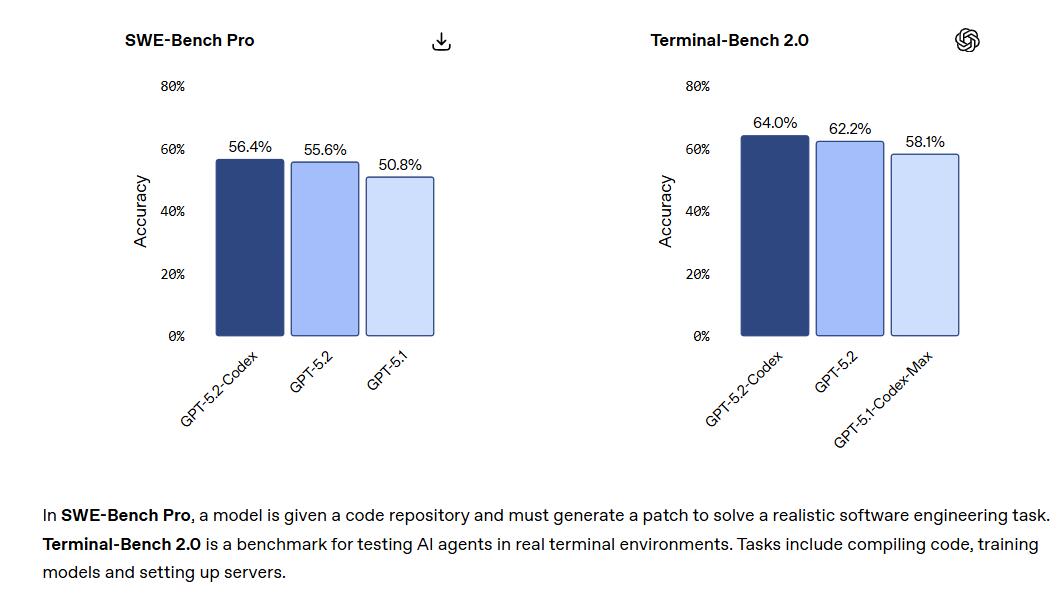
Core Insights - OpenAI has launched the GPT-5.2-Codex model, an advanced coding model focusing on software engineering and cybersecurity, enhancing its competitive edge against Google's Gemini [1][2] - The new model shows significant improvements in coding performance, cybersecurity capabilities, and long-term task handling, achieving record accuracy in benchmark tests [1][3] Group 1: Model Performance - GPT-5.2-Codex achieved an accuracy of 56.4% in the SWE-Bench Pro test, surpassing GPT-5.2's 55.6% and GPT-5.1's 50.8% [3] - In the Terminal-Bench 2.0 test, GPT-5.2-Codex reached an accuracy of 64.0%, compared to GPT-5.2's 62.2% and GPT-5.1's 58.1% [3] - The model has been optimized for long-term coding tasks, improving context retention and reliability in large-scale projects [5][8] Group 2: Cybersecurity Enhancements - GPT-5.2-Codex has made significant strides in cybersecurity, with capabilities observed to have dramatically improved since the previous versions [8] - The model has demonstrated the ability to tackle advanced multi-step challenges requiring professional-level cybersecurity skills [8] - A real-world case highlighted the model's potential in defensive cybersecurity, where vulnerabilities were discovered and responsibly disclosed using the previous Codex model [9] Group 3: Access and Security Measures - OpenAI is implementing additional protective measures for the enhanced cybersecurity capabilities, including specialized training and a trusted access program for security professionals [11] - The trusted access program is initially available to vetted security professionals and organizations with specific cybersecurity use cases, allowing them to utilize OpenAI's models for defensive work [11]
Why 2025 Became the Year Crypto Stopped Chasing Hype
Yahoo Finance· 2025-12-18 21:02
crypto futures trading. Photo by BeInCrypto In 2025, the most influential narratives in crypto shifted away from hype toward utility and systems delivering measurable, real-world impact. The year marked a transition to production-ready systems that enhance the global movement and settlement of value. Experts from SynFutures, Brickken, and Cake Wallet said that stablecoins, privacy, tokenized assets, and applied AI shaped adoption through genuine demand rather than speculation. The Year Crypto Became Infr ...