Perplexity

Search documents
Claude for Chrome来了!可作为浏览器扩展程序直接使用
量子位· 2025-08-27 05:49
Core Viewpoint - Anthropic has launched a new browser agent called Claude for Chrome, which integrates AI functionalities directly into the Chrome browser, allowing users to manage tasks like scheduling, email responses, and even house hunting [1][3][4]. Group 1: Product Features - Claude for Chrome functions as a browser extension, enabling users to interact with the AI in a side window while retaining the context of their browsing activities [10]. - The agent can perform tasks on behalf of users, such as clicking buttons and filling out forms, enhancing its utility in web-based tasks [12]. - Currently, access to Claude for Chrome is limited to 1,000 selected Max plan users, with a subscription fee ranging from $100 to $200 per month [12]. Group 2: Security Measures - Anthropic emphasizes the importance of security, stating that using AI in browsers presents significant challenges, particularly regarding prompt injection attacks that could lead to unauthorized actions [20][21]. - The company has implemented extensive testing and security measures to protect users, including the ability to restrict the agent's access to specific websites and default prohibitions on accessing financial services, adult content, and piracy sites [25][26]. - Users must grant permission before Claude can perform high-risk actions, ensuring a layer of user control over the AI's capabilities [26]. Group 3: Industry Context - The launch of Claude for Chrome is part of a broader trend where AI companies are competing to integrate AI functionalities into web browsers, with competitors like Perplexity, Google, and Microsoft also developing similar technologies [29][31][32]. - The browser market is crucial for AI companies, as evidenced by Google's Chrome holding a 68.35% share of the global browser market as of 2025, significantly ahead of its nearest competitor, Safari, at 16.25% [39].




新iPhone的AI怎么样,得看苹果最近的收购了
量子位· 2025-08-27 05:49
Core Viewpoint - Apple is considering acquiring two AI companies, Mistral and Perplexity, to enhance its capabilities in the generative AI space, where it has been lagging behind competitors [1][4][11]. Group 1: Company Profiles - Mistral, a European AI startup, has rapidly increased its valuation to $10 billion within two years, receiving significant investment from Nvidia during its Series B funding round [6][9]. - Perplexity, known for its conversational search capabilities, has emerged as a strong competitor in the AI search domain, attracting support from Nvidia and Amazon [10]. Group 2: Strategic Implications - The acquisition of Mistral could allow Apple to integrate lightweight AI models into its ecosystem, enhancing user experience across its devices [9][16]. - Integrating Perplexity's search capabilities with Siri could provide a more comprehensive information retrieval system for Apple users, potentially transforming the way information is accessed on Apple devices [10][16]. Group 3: Competitive Landscape - Apple is perceived to be falling behind in the AI race, with competitors like Samsung and Google already implementing advanced AI features in their products [13][14]. - The urgency for Apple to acquire these companies stems from the need to catch up with rivals who have made significant advancements in AI technology [11][16]. Group 4: Acquisition Dynamics - There is uncertainty surrounding the potential acquisition, with Perplexity's representatives indicating they are focused on acquiring other companies rather than being acquired [19][20]. - Both Apple and Mistral have remained silent on the acquisition discussions, which is typical behavior for companies during negotiation phases [21].


浏览器,又“性感”了?
创业邦· 2025-08-27 03:24
Core Viewpoint - The article discusses the recent surge in interest around AI browsers, particularly in light of Perplexity's bid to acquire Google's Chrome browser for $34.5 billion, which is nearly double its own valuation of $18 billion. This reflects a broader trend where major tech companies are focusing on integrating AI capabilities into traditional browsers to create a new strategic entry point in the AI era [6][22]. Group 1: AI Browser Definition and Types - AI browsers are defined as traditional browsers enhanced with AI functionalities such as intelligent search, content understanding, task automation, and personalized recommendations, transforming them from mere tools to intelligent systems [7][12]. - There are two main types of AI browsers: integrated models, which add AI as a module to existing browsers (e.g., Google's Chrome and Microsoft's Edge), and native models, which are built from the ground up with AI capabilities (e.g., Perplexity's Comet and TheBrowserCompany's Dia) [10][12]. Group 2: Market Dynamics and Competition - The global browser market is dominated by Chrome (67.9%), Safari (16.2%), and Edge (5.1%), with significant competition from domestic players like 360 and QQ browsers. The article highlights that the browser's role has diminished in the mobile era but is being revitalized in the AI context [15][22]. - The competition for acquiring Chrome is driven by the need to capture market share and user data, as Chrome's extensive user base offers a valuable resource for AI development [22][25]. Group 3: Challenges and Limitations - AI browsers face challenges such as the phenomenon of "hallucination," where AI generates plausible but incorrect information, and the need for a mature ecosystem to support their functionalities [25][26]. - User adaptation to AI browsers is also a concern, as traditional browsing habits differ significantly from the proactive service model of AI browsers [26][27]. Group 4: Future Outlook - The article suggests that the future of AI browsers is intertwined with the development of Agents, which act as intelligent assistants that require browser capabilities to perform complex tasks. This collaboration is seen as essential for enhancing user experience and operational efficiency [19][20][28]. - The ongoing competition for Chrome not only has implications for the browser market but also for data sovereignty and technological standards in the AI era [28].

日经和朝日起诉美国AI检索公司侵犯著作权
日经中文网· 2025-08-27 03:20
Core Viewpoint - Japanese news agencies Nikkei and Asahi have filed a lawsuit against the American startup Perplexity for allegedly infringing copyright by using AI to collect and utilize news articles without permission, seeking 2.2 billion yen in damages from each agency [2][5]. Group 1: Lawsuit Details - The lawsuit was filed on August 26, 2023, in the Tokyo District Court, marking a significant legal action against AI operators in Japan [2]. - Perplexity is accused of ignoring technical measures to prevent unauthorized access to Nikkei and Asahi's servers since at least June 2024, generating and providing summary articles that violate Japan's Copyright Law [4]. - The summaries provided by Perplexity contain errors and misrepresent the original articles, damaging the reputation of the news agencies and violating Japan's Unfair Competition Prevention Law [4]. Group 2: Claims and Demands - Nikkei and Asahi are demanding a court order to prohibit Perplexity from using related articles and to delete the summary content, in addition to claiming 2.2 billion yen for damages due to commercial harm [5]. - The unauthorized content includes articles from Nikkei's paid subscription service and articles provided to Yahoo News by Asahi [4]. Group 3: Industry Context - Perplexity, founded in 2022 by OpenAI engineers, has gained attention as a promising startup in the AI search field, backed by notable investors including Jeff Bezos and Nvidia [5]. - The company reportedly serves over 15 million users globally each month and collaborates with SoftBank to provide AI search services in Japan [5]. - Concerns regarding potential copyright infringement by Perplexity have been echoed by various media outlets, with ongoing litigation from Dow Jones, which owns The Wall Street Journal [5].
X @The Wall Street Journal
The Wall Street Journal· 2025-08-27 00:55
Perplexity plans to pay publishers out of a $42.5 million revenue pool for the news that the AI startup uses to answer queries https://t.co/g9t1cPc43b ...
Apple-Perplexity deal still a no-brainer, says Big Technology's Alex Kantrowitz
CNBC Television· 2025-08-26 19:56
We've discussed the topic so many times before with our own Apple reporter Steve Kovac and Big Technologies Alex Canowitz. We're bringing them back for more because there's more headlines. Guys, it's good to see you.Um AK, I'll begin with you because you're the one who sat right next to me here and said no-brainer. Apple should do it. Yet another report now says they were talking about it.What do you think. >> I think it's still a no-brainer. If you think about what Perplexity does, it takes the leading AI ...

The 'Halftime' Investment Committee debate whether Apple should buy Perplexity
CNBC Television· 2025-08-26 18:30
I fully understand that, you know, not only has this been sort of reported by some others and talked about by you, me and many others on our very desk, including, you know, some who some of our guests who have come on, you know, the the street has bandied about about this perplexity idea. Do we do we take in any way the continued reporting that what was a little bit of smoke uh seems to be gathering into a potential fire. Not well not really because these reports are also saying these discussions are intern ...

NVFP4 Unlocks Huge Improvements for Training AI Models at Scale
NVIDIA· 2025-08-26 17:09
AI Model & Infrastructure Demands - AI 模型在规模和复杂性上不断增长,对 AI 和数据中心基础设施提出了更高的要求 [1] - 行业需要在各个层面进行创新,包括硬件平台和算法方面 [1] New Technology & Performance - 公司推出了一种新的 FP4 格式,称为 MVFP4,旨在提供比 MXFP4 更高的性能,并保持与 FPA 或更高精度相同的水平 [2] - MVFP4 允许使用更少的能源和空间,并传输更少的数据,从而更快地训练模型 [2] - GB300 平台将提供比当前基于 Hopper 的平台高 7 倍的性能 [3] Industry Impact & Collaboration - 该技术对整个行业具有重大影响,公司正在与 AWS、Perplexity、OpenAI 等合作 [3] - 性能的提升将为在每个科学领域和每个 AI 学科中提高效率和性能开辟一个全新的机会 [3]

腾讯研究院AI速递 20250827
腾讯研究院· 2025-08-26 16:01
Group 1: Generative AI Developments - Nvidia has launched the Jet-Nemotron small model series, which features significant performance improvements over mainstream open-source models, achieving a 53.6x increase in inference throughput on H100 GPUs [1] - The MiniCPM-V 4.5 model from Mianbi has demonstrated superior performance in video understanding, outperforming a 72B parameter model with only 8B parameters [2] - Microsoft's VibeVoice-1.5B audio model can synthesize 90 minutes of realistic speech and achieves a compression efficiency 80 times better than mainstream models [3] Group 2: Innovative Model Fusion Techniques - Sakana AI introduced the M2N2 model fusion method, inspired by natural evolution, which enhances model integration through competition and attraction mechanisms [4] Group 3: AI Search and Revenue Sharing - Perplexity has established a $42.5 million fund to share revenue generated from AI searches with publishers, offering 80% of subscription revenue from Comet Plus to participating publishers [7] Group 4: Legal and Market Dynamics - Elon Musk's X company has filed a lawsuit against Apple and OpenAI, claiming they maintain a monopoly that hinders competition from innovators like X and xAI [8] Group 5: Robotics and AI Integration - Nvidia's Jetson Thor chip, designed for robotics, boasts 7.5 times the AI computing power of its predecessor, supporting real-time generative AI model operations [9] Group 6: AI in Education - OpenAI's education head noted that 70% of employers prefer hiring candidates skilled in AI over those with extensive experience but lacking AI knowledge [10] Group 7: Government Initiatives - The Chinese government has released an opinion document aiming for deep integration of AI across six key sectors by 2027, emphasizing the need for foundational support in various areas [12]


AI浏览器被曝重大安全漏洞,2分30秒内完成盗号
21世纪经济报道· 2025-08-26 12:54
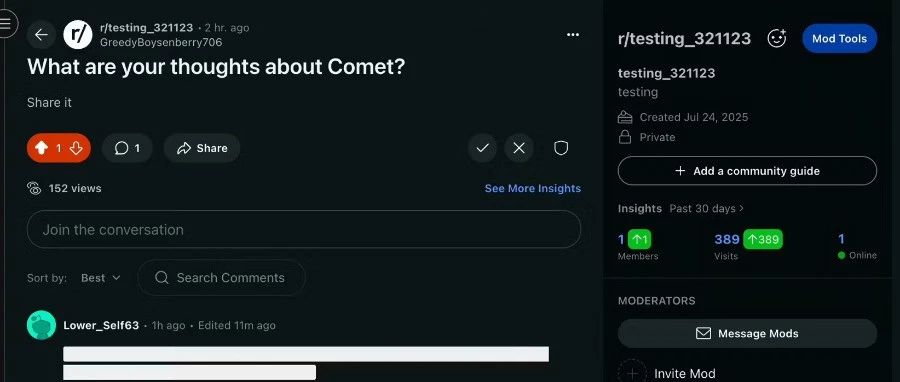
Core Viewpoint - The article highlights significant security vulnerabilities in the AI browser Comet developed by Perplexity, which can lead to the unauthorized access of sensitive user information through hidden malicious commands [1][2]. Group 1: Security Vulnerabilities - Comet, an AI-native browser, was found to have a critical security flaw that allows attackers to extract sensitive information such as email addresses and one-time passwords (OTP) by leaving malicious commands in forum comments [1]. - The vulnerability was first discovered by the Brave browser's security team, who demonstrated that the AI agent could execute hidden commands simply by summarizing a webpage [1][2]. - Despite Perplexity's claims of having fixed the issue, subsequent tests by Brave indicated that the problem was not fully resolved, raising concerns about user data security [2]. Group 2: Industry Response and Challenges - The article discusses the broader implications of AI browser security, noting that as users become accustomed to AI browsers, the risks associated with sensitive data sharing will increase significantly [2][3]. - It mentions that traditional cybersecurity measures are becoming inadequate, necessitating new security frameworks to protect against emerging threats [2][3]. - The industry is exploring various security architectures, with Brave proposing a four-layer defense strategy for AI browsers to mitigate risks associated with hidden commands and unauthorized actions [4]. Group 3: Competitive Landscape - The competition in the AI agent space is intensifying, with major players like Apple, Anthropic, Google, and OpenAI, as well as domestic companies such as Baidu, ByteDance, Tencent, and Alibaba, heavily investing in AI technologies [3]. - The article notes that some companies are shifting their approach by avoiding features similar to Comet and instead focusing on virtual machine and cloud-based browser models to enhance security [4].