苏州银行

Search documents
银行密集发布股东高管增持公告
2 1 Shi Ji Jing Ji Bao Dao· 2025-11-28 06:23
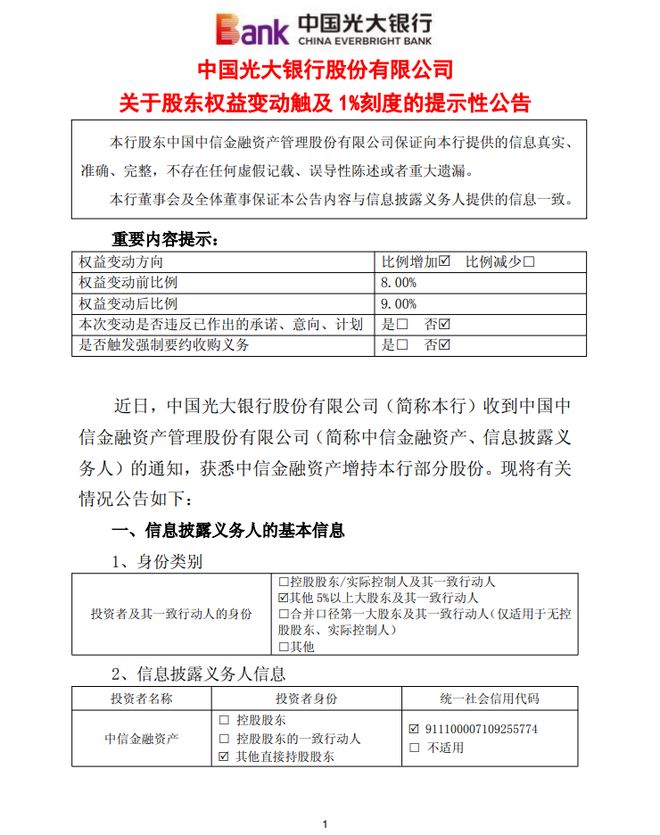
Core Viewpoint - The banking sector is witnessing significant share buybacks from major shareholders and executives, indicating confidence in the banks' future performance and value growth, despite market fluctuations around the 3000-point level [1][10]. Group 1: Shareholder Actions - On November 27, Everbright Bank announced that CITIC Financial Asset Management increased its stake in the bank, marking the seventh bank to report shareholder or executive buybacks in November [1]. - CITIC Financial Asset raised its shareholding in Everbright Bank from 8.00% to 9.00%, acquiring approximately 275 million A-shares and 315 million H-shares, totaling 1.00% of the bank's total equity [6]. - Other banks, such as Nanjing Bank and Chengdu Bank, also reported significant share buybacks by their major shareholders, with Nanjing Bank's major shareholder increasing their stake by 1.04% [6][8]. Group 2: Market Performance - The banking index has seen a nearly 8% increase in the fourth quarter, with major banks like Agricultural Bank of China and Industrial and Commercial Bank of China reaching historical highs [10]. - The continuous buybacks by shareholders and executives are providing support for bank stock prices, reflecting confidence in the long-term investment value of these banks [10][11]. Group 3: Investment Trends - Over half of the listed banks have disclosed buyback plans from major shareholders or executives, with the top five banks by buyback amount being Nanjing Bank (7.38 billion), Suzhou Bank (1.74 billion), Everbright Bank (1.24 billion), Shanghai Pudong Development Bank (890 million), and Chengdu Bank (610 million) [8]. - The banking sector has attracted significant net buybacks amounting to approximately 12.63 billion, ranking second among all sectors, only behind transportation [7][8].



股东高管加速“抢筹” 11月七家银行获增持
2 1 Shi Ji Jing Ji Bao Dao· 2025-11-28 04:52
Core Viewpoint - The continuous share buybacks by major shareholders in various banks indicate strong confidence in the banks' future performance, even as the broader market struggles to maintain stability around the 3000-point mark [1]. Shareholder Actions - China Citic Financial Asset Management Co., Ltd. increased its stake in Everbright Bank from 8.00% to 9.00%, acquiring approximately 275 million A-shares and 315 million H-shares, totaling 1.00% of the bank's total equity [6][7]. - In November, several banks, including Nanjing Bank and Chengdu Bank, reported significant share purchases by their major shareholders, reflecting confidence in their growth potential [7][8]. Market Performance - The banking sector has shown resilience, with the banking index rising nearly 8% in the fourth quarter, driven by shareholder and executive buybacks [10]. - The banking sector has seen a net increase in share purchases amounting to approximately 9.03 billion yuan, ranking first among 31 industries [8]. Investment Sentiment - Analysts suggest that the ongoing buybacks by bank shareholders and executives signal a strong belief in the long-term investment value of these banks, particularly those with stable operations and strong regional economic resilience [10][11]. - The increase in share buybacks is seen as a positive indicator for market valuation, providing a clear valuation anchor for investors [10].


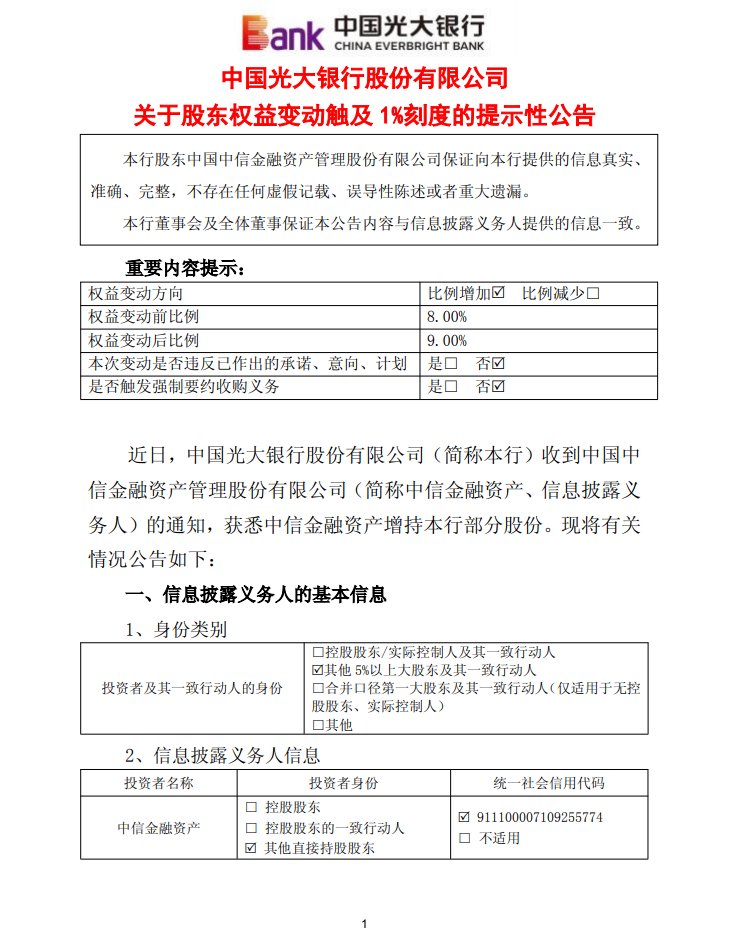
买买买!7万亿股份行股东,出手增持!
证券时报· 2025-11-28 04:27
Core Viewpoint - CITIC Financial Asset has increased its stake in Everbright Bank, reflecting a broader trend of significant share purchases in the banking sector, indicating confidence in the banks' future prospects and value recovery [1][4][9]. Group 1: Shareholding Changes - CITIC Financial Asset increased its holdings in Everbright Bank by 1% from July 24 to November 27, raising its total stake to 9% [1][3]. - The total shares acquired by CITIC Financial Asset during this period include 275 million A-shares and 315 million H-shares [3]. - This is not the first increase in 2025; previously, from January 20 to July 22, CITIC Financial Asset raised its stake from 7.08% to 8% by acquiring 264 million A-shares and 279 million H-shares [4]. Group 2: Financial Performance - As of September 30, 2025, Everbright Bank's total assets reached 7.22 trillion yuan, marking a year-on-year growth of 4.84% [3]. - CITIC Financial Asset's annual report indicated a significant increase in its equity in joint ventures and associates, totaling 216.325 billion yuan, up 191% from the previous year [5]. Group 3: Broader Market Trends - Since October, there has been a wave of share purchases across listed banks, with notable increases from major shareholders and executives [7][8]. - The trend of share buybacks is seen as a shift from a defensive strategy to proactive market value management, driven by expectations of economic recovery and stable interest margins [9].

四季度银行及非银板块投资配置机会
2025-11-28 01:42
Summary of Conference Call Notes Industry Overview - The financial sector, including banking and non-banking institutions, is expected to benefit from supportive policies in Q4 2025, with monetary policy remaining moderately loose and fiscal policy becoming more proactive through special government bonds and targeted debt measures to expand domestic demand and mitigate risks [1][3] Key Points on Banking Sector - The banking industry is projected to perform positively in the first half of 2025, with profit growth turning positive year-on-year, driven by accelerated scale expansion and effective hedging against margin compression [1][4] - Recommendations for investment include: - High-dividend state-owned banks such as Industrial and Commercial Bank of China and China Construction Bank [4] - Quality regional commercial banks with strong performance, such as Chengdu Bank and Suzhou Bank [4] - Shareholding banks with low valuations and improving expectations, such as Industrial Bank and China Minsheng Bank [4] Key Points on Brokerage Sector - The brokerage sector saw significant year-on-year growth in revenue and net profit in the first three quarters, with a steady increase in leverage due to an active capital market [1][5] - The recovery of IPO and refinancing activities is expected to enhance brokerage income, with performance elasticity likely to be fully realized [1][5] - Suggested focus on strong comprehensive capabilities like Guosen Securities and regionally distinctive firms with merger potential such as Dongwu Securities and Changjiang Securities [5] Key Points on Insurance Sector - The insurance sector's liabilities have performed better than expected, with stable growth in life insurance premium income, particularly through the bancassurance channel [1][6] - The decline in fixed deposit rates has boosted the sales of participating insurance, optimizing the income structure [6] - The recovery of the equity market has improved investment returns for insurance companies, suggesting a focus on the sustainability of asset-liability resonance and low-valuation companies with solid fundamentals like China Pacific Insurance and People's Insurance [6] Investment Strategy for Financial Sector - The core strategy for Q4 is to seek stability while aiming for progress, capitalizing on the year-end performance window and pursuing certain elasticities [1][7] - There are opportunities for upward trends from long-term cyclical bottoms, including potential recovery for some shareholding banks [7] - Caution is advised regarding potential risks such as overall market pullbacks, changes in policy implementation expectations, and fluctuations in global macroeconomic data [2][8]
超2600亿“红包”落地!13家银行中期分红,六大行贡献七成
Xin Jing Bao· 2025-11-27 12:05
Core Viewpoint - The mid-term dividends of listed banks have exceeded 260 billion yuan, reflecting a trend towards enhancing shareholder returns and stabilizing market confidence [1][2][5]. Group 1: Dividend Distribution - As of November 26, 2025, 42 A-share listed banks have distributed a total of 263.79 billion yuan in mid-term dividends, with 13 banks having completed their distributions [1][2]. - The six major state-owned banks contributed over 70% of the total mid-term dividends, amounting to 204.66 billion yuan, with Industrial and Commercial Bank of China leading at 50.40 billion yuan [2][3]. - Several banks, including Shanghai Bank and Nanjing Bank, have also participated in mid-term dividends, with total distributions from city commercial banks reaching 3.10 billion yuan [2][4]. Group 2: Market Impact and Investor Confidence - The implementation of mid-term dividends is seen as a signal of stable operations, enhancing market confidence and attracting long-term capital [1][5][9]. - First-time dividend issuers have experienced positive short-term stock performance, indicating that dividends can boost shareholder confidence and improve capital efficiency [5][9]. - The trend of mid-term dividends is aligned with regulatory encouragement for banks to optimize dividend policies and improve shareholder returns [1][6]. Group 3: Future Outlook and Strategic Considerations - The decision to implement mid-term dividends reflects banks' strong financial performance and stable profit models, which provide a solid foundation for such distributions [6][9]. - Analysts suggest that banks should balance short-term dividend payouts with long-term growth strategies, ensuring that capital is adequately retained for future development [9]. - The ongoing trend of mid-term dividends is viewed as a sign of the maturation of China's capital markets and a shift towards greater emphasis on investor returns [9].


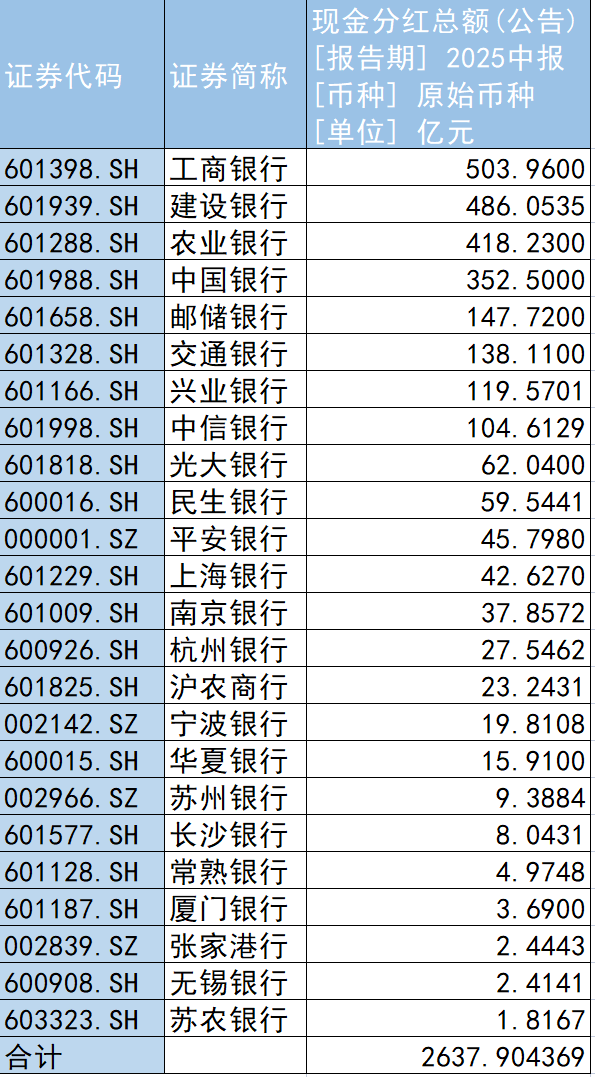
民生银行南京分行以“五服四贷”破解科创企业融资难题
Sou Hu Cai Jing· 2025-11-27 10:51
Core Viewpoint - The article emphasizes the importance of financial institutions in supporting technological innovation and development in Jiangsu province, highlighting the proactive measures taken by banks to provide tailored financial services to tech enterprises [4][6]. Group 1: Financial Support for Tech Innovation - Jiangsu banks are implementing targeted financial strategies to enhance support for "hard technology" sectors, with a focus on providing substantial credit to foster innovation [1][6]. - Minsheng Bank has issued guidelines to strengthen its technology finance business, aiming to create a new development model for tech finance [4][6]. Group 2: Innovative Financial Products and Services - Minsheng Bank's Nanjing branch has developed a comprehensive service mechanism called "Three Special and Four Preferential," which includes specialized branches and expedited loan processes for tech companies [6]. - The bank has introduced a range of tailored financial products, including online credit loans, talent loans, investment-linked loans, and knowledge loans, to meet the diverse needs of tech enterprises [6][7]. Group 3: Technology-Driven Financial Solutions - Minsheng Bank has leveraged big data and cloud computing to create the "Firefly Platform," enabling real-time digital profiling of tech companies and facilitating precise financial assessments [7]. - The bank has established an ecological alliance to integrate resources from various stakeholders, including government agencies and investment institutions, to provide comprehensive financial services to tech firms [7].

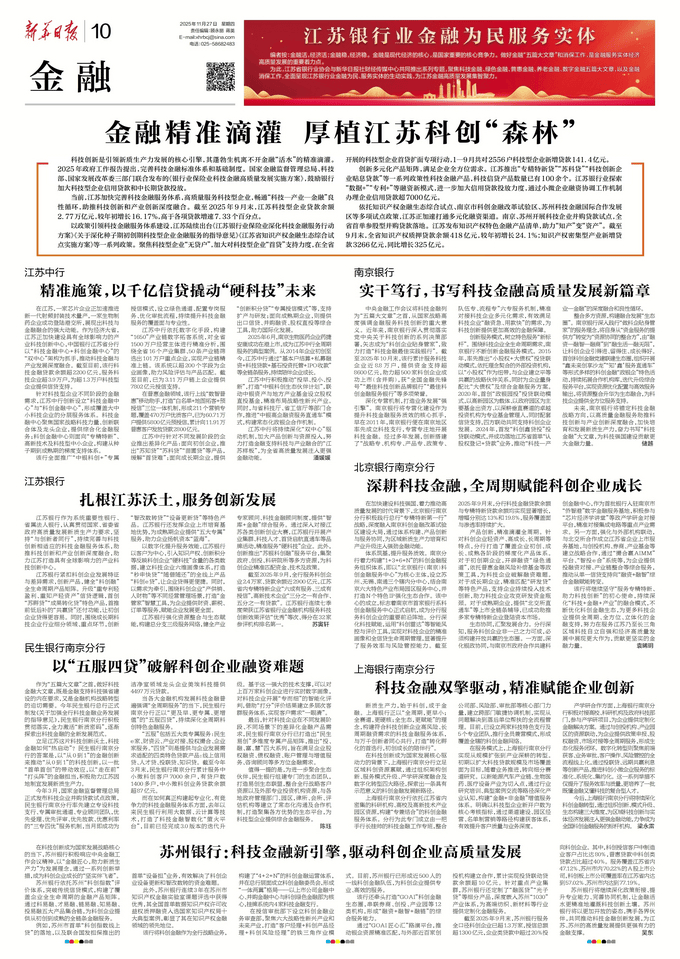
苏州银行:科技金融新引擎,驱动科创企业高质量发展
Xin Hua Ri Bao· 2025-11-26 21:21
Core Insights - Suzhou Bank is actively responding to the national strategy of technological innovation by positioning itself as a "solid partner" for the growth of sci-tech enterprises through innovative financial services [1][3] - The bank has developed a comprehensive financial product matrix that covers the entire lifecycle of enterprises, utilizing the "Sci-tech Innovation Index" evaluation system to break traditional credit models [1][2] Financial Products and Services - Suzhou Bank offers five major financial products: Sci-tech Easy Loan, Talent Easy Loan, Chain Easy Loan, Knowledge Easy Loan, and Investment Easy Loan, providing full-chain financial services from startup to maturity [1] - The bank has successfully launched the first "Sci-tech Index Online Loan" and the first "Equipment Guarantee" business in collaboration with the United Nations, addressing funding challenges for equipment upgrades and digital transformation for sci-tech enterprises [1] Performance and Impact - As of September 2025, Suzhou Bank has served over 13,000 sci-tech enterprises with a total credit amount exceeding 130 billion, with over 20% of corporate loans directed towards sci-tech enterprises [2] - The bank's sci-tech credit clients are predominantly in the manufacturing sector, accounting for 80%, and over 40% of inclusive loans are allocated to sci-tech categories [2] Strategic Initiatives - The bank has established a "GOAI" sci-tech financial ecosystem, connecting various institutions to enhance comprehensive service capabilities, achieving a cumulative loan balance exceeding 1 billion through partnerships with nearly 100 venture capital institutions [2] - Suzhou Bank has set up a dedicated sci-tech financial business review department under the credit approval department, focusing on six strategic emerging industries and future industries [2] Future Outlook - The bank aims to deepen policy alignment, enhance professional capabilities, and improve collaborative mechanisms to provide more precise financial support for technological innovation [3] - Suzhou Bank is committed to fostering technological financial innovation and supporting high-quality development in Jiangsu and Suzhou [3]

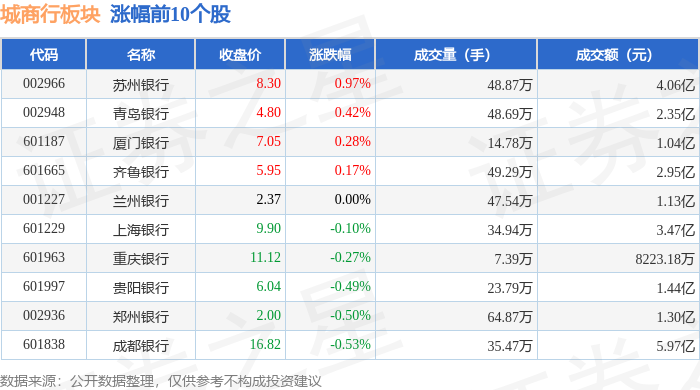
城商行板块11月26日跌0.59%,南京银行领跌,主力资金净流出1.47亿元
Zheng Xing Xing Ye Ri Bao· 2025-11-26 09:05
Market Performance - The city commercial bank sector declined by 0.59% on November 26, with Nanjing Bank leading the drop [1] - The Shanghai Composite Index closed at 3864.18, down 0.15%, while the Shenzhen Component Index rose by 1.02% to 12907.83 [1] Individual Stock Performance - Suzhou Bank closed at 8.30, up 0.97% with a trading volume of 488,700 shares and a transaction value of 406 million yuan [1] - Nanjing Bank closed at 11.49, down 1.29% with a trading volume of 514,300 shares and a transaction value of 592 million yuan [2] - Chengdu Bank closed at 16.82, down 0.53% with a trading volume of 354,700 shares and a transaction value of 597 million yuan [2] Capital Flow Analysis - The city commercial bank sector experienced a net outflow of 147 million yuan from institutional investors, while retail investors saw a net inflow of 152 million yuan [2] - Among individual stocks, Suzhou Bank had a net outflow of 31.27 million yuan from institutional investors, while Nanjing Bank saw a net inflow of 27.56 million yuan [3]


人保上证科创板综合指数增强型证券投资基金基金份额发售公告
Shang Hai Zheng Quan Bao· 2025-11-25 17:55
Core Points - The fund "PICC SSE Sci-Tech Innovation Board Comprehensive Index Enhanced Securities Investment Fund" is approved for fundraising by the China Securities Regulatory Commission (CSRC) [1] - The fund is an open-ended, equity-type securities investment fund managed by PICC Asset Management Co., Ltd. and custodied by Suzhou Bank Co., Ltd. [1][2] - The fundraising period is from December 5, 2025, to March 4, 2026, with specific conditions for the fund to be considered successful [14][30] Fund Details - Fund Name: PICC SSE Sci-Tech Innovation Board Comprehensive Index Enhanced Securities Investment Fund [11] - Fund Code: 024741 for Class A and 024742 for Class C [12] - Initial Fund Share Value: 1.00 RMB [11] - Target Investors: Individual and institutional investors, qualified foreign institutional investors, and other investors permitted by laws and regulations [11] Subscription Process - Investors must open a fund account through the designated registration institution during the fundraising period [2][20] - Minimum initial subscription amount is 1 RMB for online subscriptions and 10,000 RMB for direct sales [2][19] - Investors can make multiple subscriptions during the fundraising period, but once accepted, subscription applications cannot be withdrawn [20][19] Fund Management and Custody - Fund Manager: PICC Asset Management Co., Ltd., established on July 16, 2003, with a registered capital of 1,298 million RMB [32] - Custodian: Suzhou Bank Co., Ltd., established on December 24, 2004, with a registered capital of approximately 3,666.72 million RMB [32] Fund Operation and Regulations - The fund operates under a contract-based open-ended structure with no fixed duration [11] - The fund's total fundraising must reach at least 200 million RMB and involve at least 200 investors to proceed with the establishment [30] - If the fundraising conditions are not met, the fund will be deemed unsuccessful, and investors will be refunded their contributions with interest [30]
城商行板块11月25日涨0.99%,南京银行领涨,主力资金净流入3.66亿元
Zheng Xing Xing Ye Ri Bao· 2025-11-25 09:09
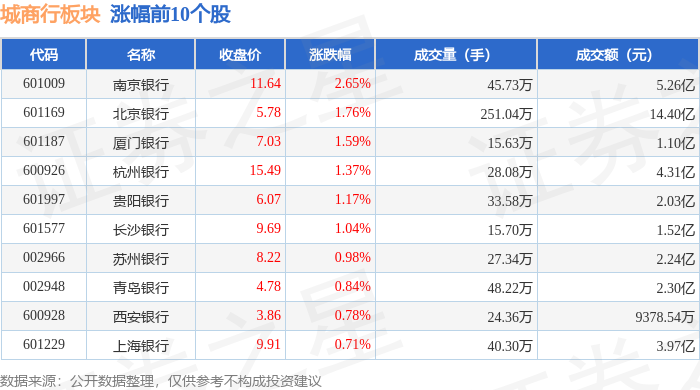
Core Insights - The city commercial bank sector experienced a rise of 0.99% on November 25, with Nanjing Bank leading the gains [1] - The Shanghai Composite Index closed at 3870.02, up 0.87%, while the Shenzhen Component Index closed at 12777.31, up 1.53% [1] Stock Performance - Nanjing Bank (600T009) closed at 11.64, with a gain of 2.65% and a trading volume of 457,300 shares, amounting to a transaction value of 526 million [1] - Beijing Bank (601169) closed at 5.78, up 1.76%, with a trading volume of 2,510,400 shares [1] - Xiamen Bank (601187) closed at 7.03, up 1.59%, with a trading volume of 156,300 shares [1] - Hangzhou Bank (600926) closed at 15.49, up 1.37%, with a trading volume of 128,080 shares [1] - Guiyang Bank (601997) closed at 6.07, up 1.17%, with a trading volume of 335,800 shares [1] - Other notable performances include Changsha Bank (601577) at 69.6 (+1.04%), Suzhou Bank (002966) at 8.22 (+0.98%), and Qingdao Bank (002948) at 4.78 (+0.84%) [1] Capital Flow - The city commercial bank sector saw a net inflow of 366 million in main funds, while retail funds experienced a net outflow of 305 million [2] - The main funds' net inflow for Hangzhou Bank was 97.67 million, while retail funds saw a net outflow of 48.86 million [3] - Qilu Bank (601665) had a main fund net inflow of 67.32 million, with retail funds experiencing a net outflow of 50.62 million [3] - Jiangsu Bank (601009) reported a main fund net inflow of 38.10 million, while retail funds had a net outflow of 45.88 million [3]