渝农商行

Search documents
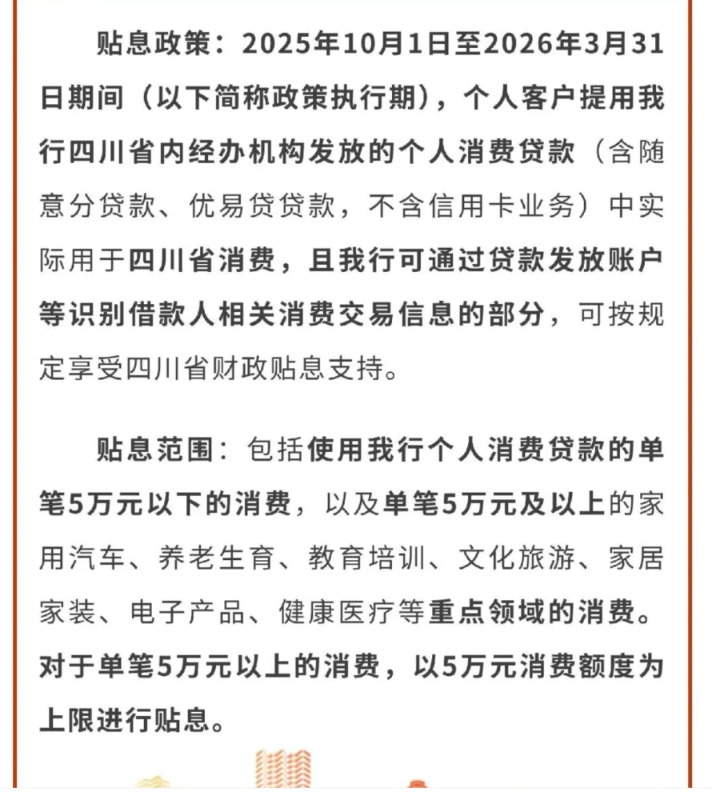
“国补”引路,“地补”接力!个人消费贷财政贴息精准扩围
2 1 Shi Ji Jing Ji Bao Dao· 2025-12-10 08:36
Core Viewpoint - The personal consumption loan interest subsidy policy is accelerating from a national level to local implementation, with regions like Sichuan, Guizhou, and Chongqing actively rolling out their own subsidy measures to stimulate consumption and reduce financing costs for residents [1][2][7]. Group 1: Policy Implementation - The "local subsidy" policies in Sichuan, Guizhou, and Chongqing have been rapidly launched since December, creating a regional synergy effect [2]. - Chongqing's policy emphasizes broad coverage and a long execution period, with a subsidy cap of 3,000 yuan for eligible cumulative consumption of 300,000 yuan [3]. - Sichuan's approach focuses on short-term precision, with a subsidy cap of 1,500 yuan for the same cumulative consumption amount, and funds must be used within the province [4]. - Guizhou's policy offers high subsidies, matching the national standard with a cap of 3,000 yuan, but has a shorter execution period [5]. Group 2: Market Impact - The collaboration between national and local subsidy policies is expected to enhance the competitiveness of regional banks, stimulate local consumption, and lower financing costs for residents [7][9]. - The introduction of local policies is anticipated to create structural changes in the consumer finance market, leading to a reduction in consumer loan interest rates and stimulating demand [10]. - Local banks are expected to leverage the policy to attract price-sensitive customers and expand their coverage in the inclusive finance sector [8]. Group 3: Risk Management - Financial institutions are advised to implement multiple risk control measures to prevent potential arbitrage, including automatic identification of eligible transactions and setting limits on subsidy amounts [5][6]. - The operational guidelines for subsidy agreements emphasize the need for borrowers to provide valid proof of consumption transactions to ensure compliance [6].

行业点评报告:测算:BCBS调整利率冲击幅度对ΔEVE的影响
KAIYUAN SECURITIES· 2025-12-10 05:45
Investment Rating - The industry investment rating is "Positive" (maintained) [1] Core Insights - The report highlights the adjustment of the interest rate shock scenario by the Basel Committee (BCBS), reducing the parallel upward shift from 250 basis points (BP) to 225 BP, which is expected to improve the ΔEVE (Economic Value of Equity) to Tier 1 Capital ratio for major banks [4][5] - It is estimated that this adjustment could release approximately CNY 1 trillion in capacity for 30-year local government bonds and CNY 1.5 trillion for 15-year bonds [6][8] - The report anticipates that the regulatory requirements for interest rate risk indicators may be relaxed in 2026, potentially alleviating the pressure on banks [7] Summary by Sections Interest Rate Shock Adjustment - The BCBS has revised the interest rate shock scenario, reducing the parallel upward shift from 250 BP to 225 BP, which is expected to enhance the ΔEVE/Tier 1 Capital ratio by 0.92% to 1.57% for major banks [4][12] - Major banks such as ICBC, CCB, ABC, and BOC are projected to see improvements in their ΔEVE ratios, with specific improvements of 1.13%, 1.36%, 1.57%, and 0.92% respectively [5][12] Capacity Release for Local Government Bonds - The adjustment in interest rate shock is expected to release approximately CNY 870 billion for 30-year local government bonds and CNY 1.16 trillion for 15-year bonds [5][14] - If the Ministry of Finance injects capital into ICBC and ABC in 2026, it could further improve their ΔEVE ratios and release additional capacity for local government bonds [6][15] Regulatory Environment - The report suggests that regulatory constraints on banks may be relaxed, with a potential reduction in the required shock levels and a possible easing of the upper limit on risk indicators [7] - The report notes that major banks sold approximately CNY 740 billion in 7-10 year bonds and CNY 850 billion in 20-30 year bonds from January to November 2025, indicating a shift in their bond portfolio strategy [16] Investment Recommendations - The report recommends a bottom-up approach focusing on large state-owned banks, with specific beneficiaries identified as Agricultural Bank of China and Industrial and Commercial Bank of China [8] - Core investments are suggested in leading comprehensive banks, with China Merchants Bank and Industrial Bank highlighted as key beneficiaries [8]






银行跌幅居前,大消费、医疗紧随其后,互联网和恒生科技均平盘收官
Ge Long Hui· 2025-12-09 20:49
低开低走后全天震荡下行,截至收盘恒生指数下跌1.23%。银行跌幅居前,大消费、医疗紧随其后,互 联网和恒生科技均平盘收官。 大消费小幅高开后快速回调,随后全天弱势,截至收盘下跌1.18%。其中泡泡玛特大跌8.49%,信达生 物下跌6.96%,巨子生物、思摩尔等多股跌幅在4%上方。 恒生互联网全天围绕中轴弱势盘整,最终平盘收官。其中快手下跌1.37%,阿里巴巴下跌1.03%,腾讯 控股、京东集团、网易等各均小幅收到;百度集团逆势大涨3.45%,商汤上涨1.4%。 内容只是个人观点,仅供参考,不作为投资依据!欢迎关注交流,互相学习、共同探讨! 银行低开低走大跳水,截至收盘大跌2.21%,其中建设银行下跌4.01%,招商银行下跌3.54%,工商银行 下跌3.48%,重庆农村商业银行、中国银行、重庆银行等个跌幅均值2%上方。 ...

消费激励川贵渝领衔,地方贴息扩围
Huan Qiu Wang· 2025-12-09 09:29
尽管西部地区已形成联动,但东部省份对此仍持观望态度。记者联系华东某省城商行人士获悉,该省暂未发布相关 新规,机构正在密切关注。该人士透露,地方银行能否入围,取决于其与监管部门的主动沟通及经营能力考量,政 策或不会强制所有银行参与。 目前,已发布响应公告的均为地方头部城商行,小型农商行、村镇银行等机构尚未有公开动作。市场分析认为,随 着重庆作为直辖市的成功示范,未来或有更多省市,特别是经济活跃地区,跟进推出类似政策,共同推动消费市场 持续回暖。 分析人士认为,川贵渝三地联动,标志着地方财政激励消费的模式正从点状试点走向区域协同,具有强烈的示范效 应。这轮政策精准地选择了消费贷作为切入点,通过财政贴息直接降低居民的消费成本,能有效撬动杠杆,放大政 策效果。更重要的是,将地方城商行纳入贴息体系,既能支持本地金融机构发展,又能利用其地缘优势更好地服务 下沉市场。东部省份的观望,可能源于对财政承受能力和政策效果的审慎评估,但随着西部模式的成效显现,预计 更多地区将打破观望,在示范效应的引领下,共同探索提振内需的有效路径。(文馨) 【环球网财经综合报道】为有效提振内需、激发市场活力,地方政府正积极运用财政工具,为消费市场 ...

直辖市也跟了,重庆两家银行官宣入围个人消费贷地方贴息
Feng Huang Wang· 2025-12-09 07:51
如何让更多消费者愿意消费,敢于消费?来自银行机构的助力必不可少。 昨日晚间,重庆银行、重庆三峡银行相继发布公告称,正在积极制定重庆市内的个人消费贷款财政贴息 工作的细则。 这意味着,重庆成为国内首个启动消费贷地方贴息的直辖市,也是继四川、贵州之后的的第三个省级行 政区。 又有地方政府宣布将辖内银行纳入本地消费贷款财政贴息范围!昨日晚间,重庆银行在官方微信公众号 发布了关于个人消费贷款财政贴息工作的公告。 在公告中,重庆银行表示,该行积极响应并严格执行《重庆市财政局 中国人民银行重庆市分行 国家金 融监督管理总局重庆监管局关于做好个人消费贷款财政贴息工作的通知》(渝财金〔2025〕39号)和 《关于落实巩固拓展经济回升向好势头的财政金融政策有关事项的通知》(川财金〔2025〕76号)精神 及相关要求,正在依法依规、积极有序制定贴息细则,优化办理流程,实施系统改造,推动政策在重庆 市和四川省内和尽快落地。 当日晚间,重庆三峡银行也通过官方微信公众号发布了类似公告。重庆三峡银行表示,具体办理流程等 实施细则后续将通过该行官网、微信公众号等渠道发布,敬请留意。 记者注意到,依据重庆银行的公告,该行在四川省内的经营网点 ...

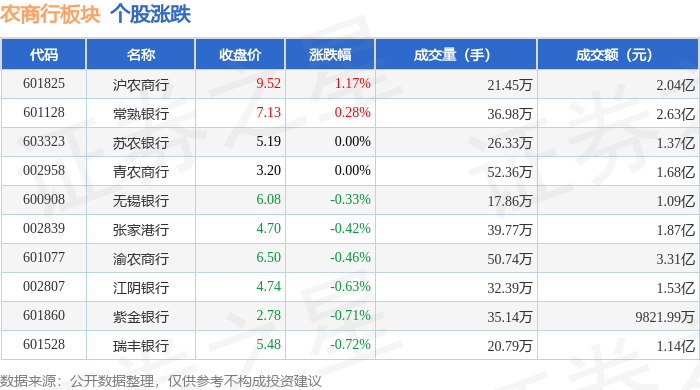
农商行板块12月8日涨0.21%,沪农商行领涨,主力资金净流出504.41万元
Zheng Xing Xing Ye Ri Bao· 2025-12-08 09:09
Core Insights - The agricultural commercial bank sector experienced a slight increase of 0.21% on December 8, with Shanghai Agricultural Commercial Bank leading the gains [1] - The Shanghai Composite Index closed at 3924.08, up by 0.54%, while the Shenzhen Component Index closed at 13329.99, up by 1.39% [1] Stock Performance - Shanghai Agricultural Commercial Bank (601825) closed at 9.52, with a rise of 1.17% and a trading volume of 214,500 shares, amounting to a transaction value of 204 million yuan [1] - Changshu Bank (601128) closed at 7.13, up by 0.28%, with a trading volume of 369,800 shares [1] - Other banks such as Jiangyin Bank (002807) and Zijin Bank (601860) saw declines of 0.63% and 0.71% respectively [1] Capital Flow - The agricultural commercial bank sector saw a net outflow of 5.0441 million yuan from main funds, while retail funds experienced a net outflow of 7.61304 million yuan [1] - Speculative funds, however, recorded a net inflow of 81.1746 million yuan [1] Individual Stock Capital Flow - Wuxi Bank (600908) had a main fund net inflow of 19.0391 million yuan, while retail funds saw a net outflow of 21.8041 million yuan [2] - Qingnong Bank (002958) experienced a main fund net inflow of 15.7202 million yuan, but retail funds had a net outflow of 1.13021 million yuan [2] - Zhangjiagang Bank (002839) had a main fund net inflow of 7.6575 million yuan, with retail funds seeing a net outflow of 1.24512 million yuan [2]


渝农商行股东权益变动事项完成过户
Xi Niu Cai Jing· 2025-12-08 06:32
12月3日,渝农商行发布公告称,农投集团股权无偿划转涉及的市场监督管理局备案手续已办理完成。 公告显示,渝农商行主要股东重庆渝富资本运营集团有限公司(以下简称"渝富资本")的股权变动事项近期取得新进展。2025年6月4日,渝农商行曾披露提 示性公告显示,渝富资本的控股股东重庆渝富控股集团有限公司与中国机械工业集团有限公司(以下简称"国机集团")、国机仪器仪表(重庆)有限公司 (以下简称"国机仪器仪表")签署《表决权委托协议》,同时中国四联仪器仪表集团有限公司与国机集团、国机仪器仪表签署了关于重庆川仪自动化股份有 限公司(以下简称"川仪股份")股份转让的补充协议。上述协议生效后,国机仪器仪表成为川仪股份的控股股东,国机集团成为实际控制人,川仪股份不再 作为渝富资本的一致行动人。近日,渝富资本告知渝农商行,相关协议涉及的川仪股份股票过户登记手续已办理完毕,标志着此次股东权益变动事项正式完 成。 ...



大行ΔEVE指标测算及承接债券能力评估
KAIYUAN SECURITIES· 2025-12-08 05:46
Investment Rating - The industry investment rating is optimistic (maintained) [1] Core Insights - The report indicates that the ΔEVE (Economic Value of Equity) indicator for major banks has decreased compared to 2024, with some banks potentially exceeding the regulatory requirement of -15% [4][15] - The report highlights that for every 20 trillion yuan of local government bonds undertaken by banks, the ΔEVE/ Tier 1 capital ratio deteriorates by 0.65% to 1.73% [24][25] - The current regulatory buffer allows major banks to undertake approximately 666.8 billion yuan of 30-year local government bonds [33][34] - The report suggests a potential relaxation of regulatory requirements for interest rate risk indicators, which could facilitate banks' ability to manage long-term local government bonds [7] Summary by Sections ΔEVE Indicator Assessment - As of H1 2025, the ΔEVE/ Tier 1 capital ratio for major banks is as follows: ICBC at -16.66%, CCB at -17.26%, ABC at -14.89%, BOC at -12.28%, PSBC at -9.02%, and BC at -12.46% [15][16] - The report notes a decline in the ΔEVE indicator for these banks compared to 2024, with specific changes of -1.95pct for ICBC and -2.52pct for CCB [4][15] Local Government Bond Undertaking - The report estimates that major banks added 3.25 trillion yuan in local government bonds in H1 2025, with state-owned banks accounting for 1.86 trillion yuan, representing 57.2% of the total [5][32] - The duration of local government bonds is assumed to be distributed across various terms, with 30% of bonds being 10 years and 23% being 30 years [25][29] Debt Capacity Assessment - The current regulatory buffer allows major banks to support the undertaking of 30-year local government bonds up to 666.8 billion yuan, with potential increases if regulatory requirements are relaxed [33][34] - For every 1% relaxation in the ΔEVE/ Tier 1 capital ratio, banks could undertake an additional 593.4 billion yuan of 30-year local government bonds [34][35] Investment Recommendations - The report recommends a bottom-line allocation to large state-owned banks, with specific beneficiaries being ABC and ICBC [39] - Core allocations should focus on leading comprehensive banks, with recommended stocks including CMB and CCB [39] - For flexible allocations, regional banks with unique characteristics, such as JSB and CQB, are highlighted as potential beneficiaries [39][40]
\双支柱\加强促进银行稳健经营
Xiangcai Securities· 2025-12-07 12:14
Investment Rating - The industry investment rating is maintained at "Overweight" [7][10]. Core Insights - The central bank is promoting the improvement of the dual-pillar system to enhance the stability of bank operations [6][32]. - The banking sector is transitioning from extensive expansion to intensive development, focusing on enhancing the quality of financial services to the real economy [7][33]. - The optimization of credit structure requires banks to improve capital and risk allocation efficiency, emphasizing the importance of precise resource allocation to key policy-supported areas [8][34]. - The macro-prudential management of real estate finance is a clear task, with expectations for real estate risks to converge [8][34]. - The next phase of the dual-pillar system's deepening collaboration will create an environment for banks characterized by strong constraints, optimization, and risk prevention [9][34]. Summary by Sections Market Review - The banking index fell by 1.18%, underperforming the CSI 300 index by 2.46 percentage points during the period from December 1 to December 7, 2025 [12]. - The performance of various bank segments showed that rural commercial banks outperformed others, with notable gains from Zhangjiagang Bank (+3.96%) and Xiamen Bank (+2.92%) [12]. Industry Dynamics - The central bank's article emphasizes the need for a robust monetary policy framework and comprehensive macro-prudential management to adapt to complex economic conditions [32][33]. - Banks are encouraged to enhance their loan pricing capabilities and active liability management to alleviate the downward pressure on net interest margins [7][33]. - The focus is shifting towards differentiated competition based on professional service capabilities and comprehensive financial solutions rather than price wars [7][33]. Investment Recommendations - The report suggests that with a rebalancing of market investment styles, high-dividend bank stocks are attracting allocation funds, indicating a potential for continued valuation recovery [10]. - Specific banks recommended for investment include Industrial and Commercial Bank of China, Bank of China, CITIC Bank, Jiangsu Bank, and others, highlighting their stable high-dividend value [10][35].
银行业周报(20251201-20251207):数字人民币定位有望晋级,支付领域大有可为-20251207
Huachuang Securities· 2025-12-07 11:45
Investment Rating - The report maintains a "Recommended" investment rating for the banking sector, indicating a positive outlook for the industry in the near term [1]. Core Insights - The positioning of the digital RMB is expected to advance, with significant potential in the payment sector. The People's Bank of China (PBOC) is working on optimizing the management system for digital RMB, which may evolve from a cash-like payment instrument (M0) to broader monetary categories (M1, M2) [2][8]. - Infrastructure development for digital RMB is progressing, with the establishment of international and operational centers in Shanghai and Beijing, respectively. As of September 2025, the cumulative transaction amount in pilot areas reached 14.2 trillion yuan, with 2.25 billion personal wallets opened [3][8]. - The banking sector is expected to see a systematic recovery in valuations in 2026, transitioning from a defensive to a growth-oriented investment logic. Key investment themes include high dividend yields and low valuations, particularly as risk-free interest rates decline [9]. Summary by Sections Industry Overview - The banking sector comprises 42 listed companies with a total market capitalization of approximately 1.15 trillion yuan, representing 13.04% of the market [4]. - The average daily trading volume for A-shares was 10,583.60 billion yuan, reflecting a 0.65% increase from the previous week [8]. Performance Metrics - The absolute performance of the banking sector over the past month is 5.0%, with a relative performance of 2.8% compared to the benchmark [5]. - The report highlights that the banking index underperformed the CSI 300 index by 2.46 percentage points during the week [8]. Investment Recommendations - The report suggests focusing on three main investment lines: 1. State-owned banks and major commercial banks like China Merchants Bank. 2. Quality joint-stock banks and city commercial banks with improving net interest margins and credit costs. 3. City commercial banks benefiting from regional policies and showing significant performance potential [9]. - Specific banks recommended for investment include China Merchants Bank, CITIC Bank, and several city commercial banks such as Chengdu Bank and Chongqing Bank [9][10].